Best Portable Dishwashers
Honest take · Fruit and produce cycles

A fruit cycle on a dishwasher? Does it actually work?

Four listings in our database publish a program called Fruit or Fruit Cleaning, and one says outright that it runs without detergent. That's true — but not for the reason the label implies. What the cycle mechanically does, why skipping detergent isn't a produce-safety feature, and when a colander under the tap is still faster.

By Ilane Tall · Updated September 28, 2026 · Research-based.

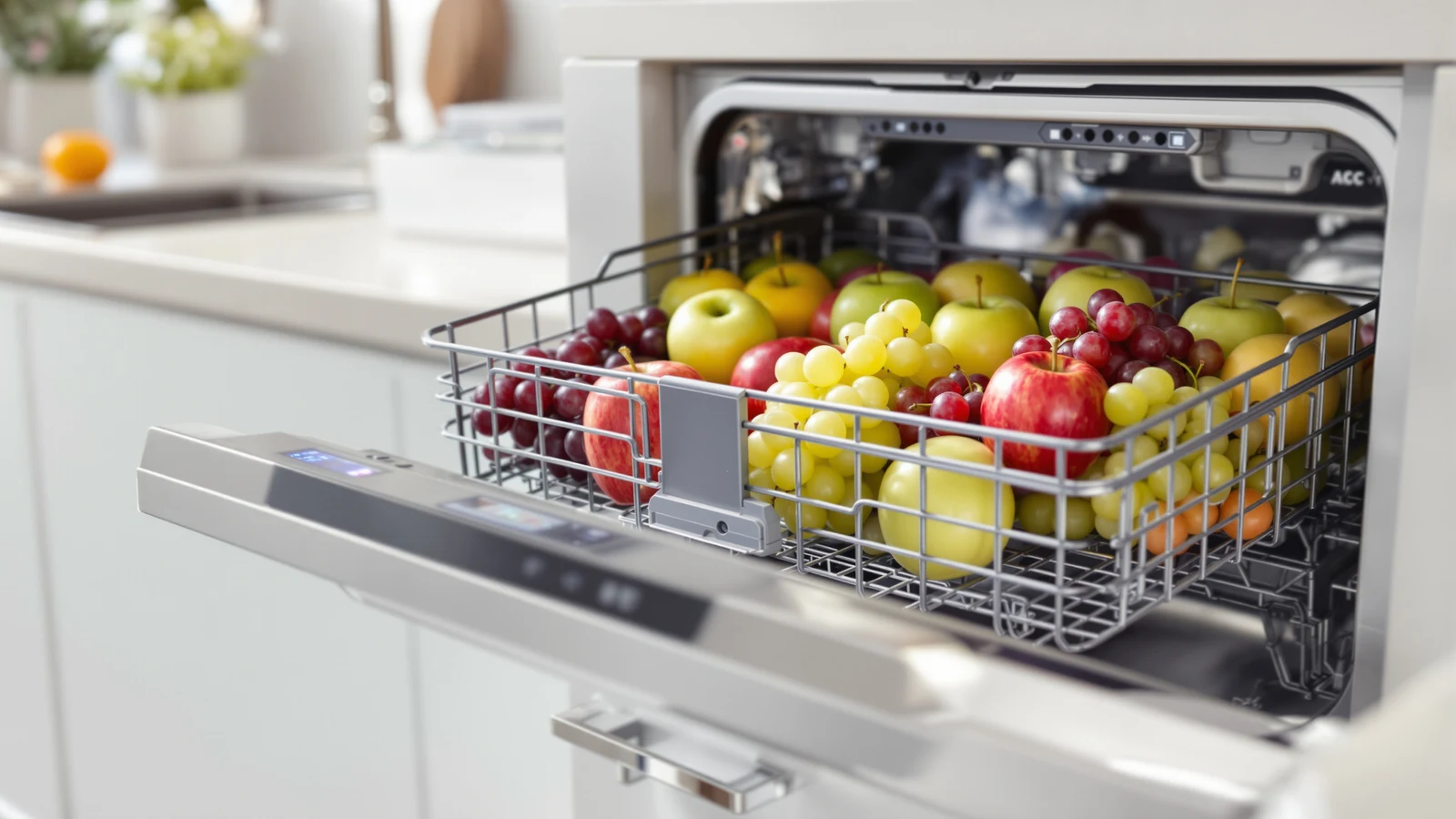
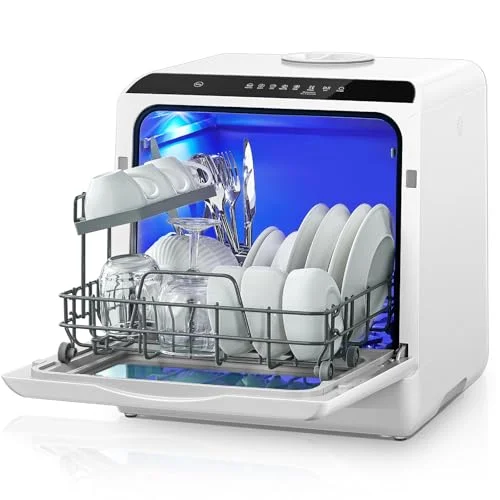
A colander of berries and produce beside the open rack of a countertop portable dishwasher set to its Fruit cycle

Reader-supported: we may earn a commission when you buy through the links on this page, at no additional cost to you. Prices move constantly — confirm the live price before you order.

Quick answer

Mechanically, a Fruit cycle is a rinse, not a wash. Across the four listings we cover here it drops the two things that define a real wash program — a heated water phase and a detergent dose — and runs water over the load with the pump alone. That's a genuinely reasonable way to rinse produce, and the FOHERE 5+1-program model says so directly, describing its Fruit setting as gentle produce rinsing without detergent. The part worth being honest about: no detergent isn't a chemistry decision made for your strawberries. It's what happens by default when a cycle skips the wash step entirely.

Below: what separates this program from Normal or Baby Care on the same control boards, why the no-detergent claim is true for an unflattering reason, the four machines that publish it, what the cycle is actually useful for once you stop expecting it to wash produce like a plate, how its time and water use stack up against a full cycle, and when a colander in the sink still beats loading the machine.

Under the hood

What a Fruit cycle mechanically is

Start with what a real wash cycle on these machines actually does, because it's the baseline everything else gets compared against. A Normal or Standard program fills the tub, heats the water, circulates it under pressure with a dose of detergent long enough for the chemical action to break down grease and starch, drains, refills for a rinse, and finishes with whatever drying method the machine has. The Baby Care cycle on both the Canbo model and the FOHERE model states this plainly: it heats water to 167°F specifically because bottles and heavily soiled dishes need that combination of heat, time and detergent to actually come clean.

Now look at what none of the four listings claim for their Fruit program. Not one states a wash temperature for it, the way two of them do for Baby Care. Not one lists it alongside the cycles described as "deep cleaning" or "heavy." The FOHERE listing is the most direct about why: it describes the Fruit cycle as gentle produce rinsing without detergent, in the same breath it uses "deep cleaning" and 167°F for Baby Care. That's a manufacturer telling you, in its own bullet copy, that this is a different category of program — force without heat, without chemistry, without the dwell time a wash needs.

The AIRMSEN model makes the same point a different way: it lists Fruit and Glass as two separate programs, not one "gentle" catch-all. If Fruit were simply this machine's delicate-items setting, there'd be no reason to also ship a dedicated Glass program alongside it — the two exist separately because Fruit is built around produce specifically, and produce is a rinsing problem, not a delicate-items problem. Strip away the produce framing and what's left across all four listings is the same basic profile every compact dishwasher control board already needs somewhere in its menu: a short, cold-to-lukewarm, detergent-free pass. Call it what it mechanically is — a rinse cycle wearing a produce label.
Read the fine print

The no-detergent claim, and the less flattering reason it's true

Take the claim on its own terms first, because it isn't wrong. The FOHERE listing's language — "the Fruit cycle for gentle produce rinsing without detergent" — describes something genuinely sensible. Dish detergent is formulated to strip grease and protein residue off dishware through surfactant chemistry; no dishwasher pod or gel on the market is marketed, tested or labeled as safe to leave on something you're about to eat unwashed. A program that rinses produce with plain water and skips the soap dispenser entirely is doing the reasonable thing, and general food-safety guidance has always pointed the same direction: rinse produce under running water, don't run it through a wash built for plates and detergent.

Here's the part the marketing copy doesn't say out loud. None of the four listings frames the missing detergent as a formulation choice, a food-safety certification, or an engineering trade-off the way, say, a BPA-free claim would be stated. That's because it isn't one. A dishwasher's detergent dispenser is a mechanical part tied to the wash phase of a cycle — it pops open partway through the heated fill, once there's hot water circulating for the detergent to dissolve into. A cycle with no heated wash phase has nothing for that dispenser to trigger during. The absence of detergent in the Fruit program isn't a decision anyone made about your berries; it's the automatic consequence of a program that was already built to be the shortest, simplest entry on the control board.

Put plainly: if a manufacturer wanted to add a detergent dose to the Fruit cycle, it would cost them a firmware change, not a redesign — the mechanism is already there and already used by Normal and Baby Care. They didn't, because the program's actual job on the control board is to be a fast, low-commitment rinse option, and "safe for produce" is simply the honest, marketable name for what that already was. The claim survives scrutiny. The story behind it is more mundane than the copy suggests, and worth knowing before you credit a machine with a food-safety feature it didn't specifically engineer.

The listings

The four machines that publish it

All four list Fruit (or Fruit Cleaning) among their programs. Prices move constantly — confirm the live price before you order.

MachinePrograms (published)Water sourcePrice
FOHERE 5+1 ProgramsNormal, Speed, ECO, Baby Care, FruitFaucet, 5 L per load$269.99Price
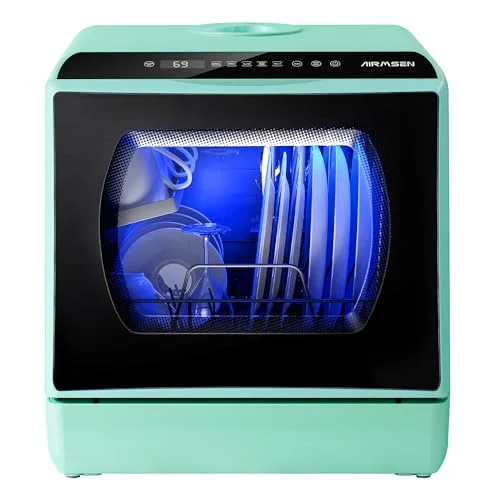
AIRMSEN No Hookup NeededNormal, Speed, Glass, Baby Care, Fruit5 L tank or faucet$339.99Price
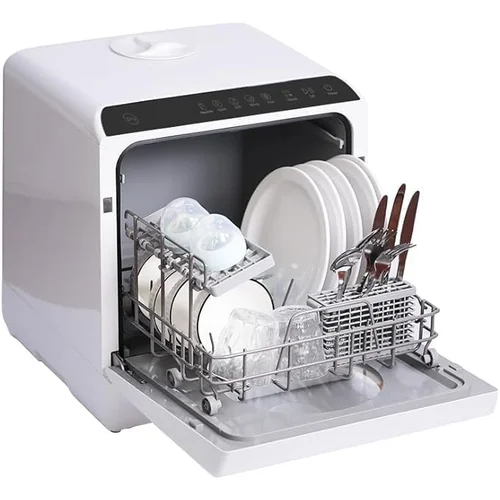
Canbo Countertop TankNormal, Quick, Eco, Baby Care, FruitBuilt-in tank$199.99Price
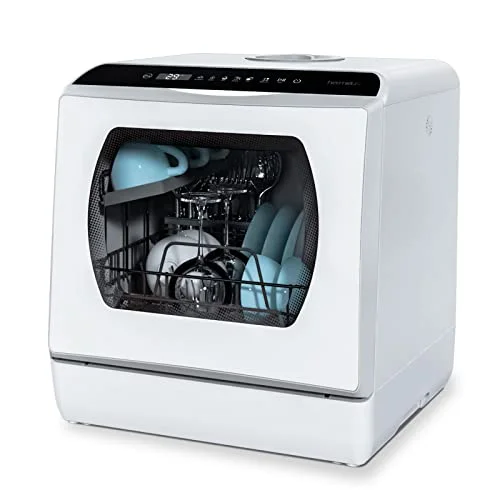
Hermitlux Glass DoorStandard, Fast, ECO, Strong, Fruit5 L tank$284.99Price
01Most explicit claim

FOHERE Countertop Dishwasher with Delay Start, 5+1 Wash Programs

The clearest published statement of what the Fruit cycle is for
Countertop, faucet-fed · 5 L water per load claimed · ETL certified · delay start 1–6 h · 4 place settings

This is the listing that names the tradeoff outright rather than leaving you to infer it: Fruit for gentle produce rinsing without detergent, sitting alongside a Baby Care cycle explicitly described as a 167°F deep clean. Having both spelled out in the same bullet list is what makes this machine the clearest single reference for the mechanical split this whole page is built around. It also carries a delay-start feature worth knowing how to use before you buy on the strength of one cycle alone.

The trade-offFour place settings and 12-inch plates only at an angle — a real machine for two to three people's everyday dishes, not a large household's only dishwasher, with the Fruit program as one feature among several rather than the reason to buy it.

FOHERE countertop dishwasher with delay start
$270
5+1 programsCheck price →
02Widest cycle spread

AIRMSEN Portable Countertop Dishwasher, No Hookup Needed

The only one here that lists Fruit and Glass as separate programs
Countertop · 5 L built-in tank or faucet · 40+ items, 12 in plates at an angle · extra 60-min drying · 72-hour ventilated storage

Keeping Fruit and Glass as two distinct programs is the strongest evidence in this comparison that a produce rinse and a delicate-items wash are not the same thing to the people who design these control boards — see our separate look at dedicated Glass cycles for stemware for what that program does differently. The 72-hour ventilated storage function is also worth knowing about beyond washing: it's built to keep a sealed tub from turning stale, which matters more than usual on a tank-fed machine you might not run daily. Our guide to storing a portable dishwasher between uses covers the same idea from the other direction.

The trade-offThe most expensive of the four at $339.99, and the extra programs and functions are worth it only if you'll actually use more than Normal and Fruit — check the current listing before assuming the premium buys you cleaning power rather than convenience features.

AIRMSEN portable countertop dishwasher, no hookup needed
$340
Tank or faucetCheck price →
03Simplest and cheapest

Canbo Countertop Dishwasher With Built-in Water Tank

The lowest-cost way to find out whether you'll use the Fruit setting at all
Mini countertop, tank-fed · Normal, Quick, Eco, Baby Care, Fruit · Quick mode: 29 min · 1–3 servings, plates to 10.5 in

Five programs, no ambiguity: Normal for everyday dishes, Quick for a 29-minute wash, Eco, Baby Care, and Fruit. It's the plainest five-cycle list of the group and the cheapest machine here at $199.99, which makes it the reasonable pick if you want to try a Fruit-cycle-equipped dishwasher without paying for delay start or a second gentle program you may never touch.

The trade-off1 to 3 servings is a genuinely small capacity — see our capacity-by-household-size guide before assuming it covers more than a couple's daily dishes, produce included.

Canbo countertop dishwasher with built-in water tank
$200
5 programsCheck price →
04Watch it run

Hermitlux Countertop Portable Dishwasher, Glass Door

For anyone who wants to actually see what a Fruit cycle looks like mid-run
Countertop, glass-door variant · 5 L tank · Standard, Fast, ECO, Strong, Fruit Cleaning · 4 place settings, 10.25 in plates at an angle

Same five-program shape as the Canbo machine — a full wash, a fast wash, an eco wash, a strong wash, and Fruit Cleaning as the outlier that isn't described as a wash at all. The glass door is the differentiator: it's the one machine here where you can watch the difference between a Strong cycle's spray pattern and the Fruit program's without opening the lid mid-run. The listing also specifies a 19.88-inch clearance requirement above the counter, worth checking against your own cabinets before ordering.

The trade-offSame 4-place-setting ceiling as the FOHERE model, and the tallest clearance requirement of the group — see our honest take on cookware capacity for how that same height constraint plays out with pots and pans, not just produce.

Hermitlux countertop portable dishwasher with glass door
$285
Glass doorCheck price →
The other uses

What the cycle is actually good for, beyond produce

Once you stop expecting a rinse-only program to wash the way Normal does, it turns out to be a genuinely useful setting for a specific, narrow set of jobs — just not the one on the label. A quick, cold, detergent-free pass is the right tool anywhere the item is already clean and only needs a refresh: glasses and mugs that picked up dust sitting in a cabinet, a stack of plates you rinsed by hand but want run through once more before a dinner party, or produce storage containers and berry baskets that don't need a full wash cycle's worth of heat and chemistry.

It's also a reasonable in-between option for baby bottles on days when the 167°F Baby Care cycle feels like overkill for a bottle that was already rinsed after its last use — though for anything with dried milk residue or genuine buildup, the dedicated Baby Care program exists for a reason and is the one actually engineered to handle it. The same logic applies to any item you'd hesitate to run detergent over: a plastic cutting board you don't want to strip, or delicate glassware you'd rather not expose to a full detergent dose, covered from a different angle in our guide to delicate glassware and fine china.

What it isn't good for is anything the label's marketing photos imply: a greasy cutting board after raw chicken, a colander that held pasta, or produce with actual dirt or wax buildup that needs mechanical scrubbing to shift. Cold water under pressure removes loose surface dirt reasonably well; it doesn't strip the food-grade wax coating some apples and citrus are treated with, and it isn't a substitute for scrubbing firm produce like potatoes under a stiff brush, which remains the standard advice regardless of what machine you own.

Speed and water

Cycle length and water use, compared with Normal

Here's where we have to be honest about a gap in the data rather than paper over it: none of the four listings states an exact run time or water figure for the Fruit program specifically, the way three of them do for their Quick or Speed cycles. The Canbo listing quotes 29 minutes for its Quick mode; the FOHERE listing quotes the same 29 minutes for Speed. Neither publishes a comparable number for Fruit, which is itself a small tell — a manufacturer proud of a specific number puts it in the bullet copy, and none of them did here.

What we can say with reasonable confidence, from the mechanics covered above rather than a published spec: a cycle with no heating phase and no detergent dwell time has no reason to run as long as one that has both. Heating a tub of water to wash temperature is itself one of the slower steps in any dishwasher cycle, compact or full-size; a program that skips it outright should land at or below the 29-minute mark these same machines already quote for their fastest wash cycle, not above it. Treat that as an informed expectation rather than a manufacturer claim, since none of the four will confirm it in writing.

Water use follows a similar logic, with one hard ceiling worth knowing: three of the four machines here run from a 5-liter built-in tank, and the FOHERE listing states 5 liters per load as its overall water-use figure. That's a ceiling on every cycle these tank-fed machines run, Fruit included — roughly 1.3 US gallons at most, regardless of which program is selected, since the tank simply doesn't hold more. A faucet-connected Normal cycle on a machine without a tank isn't bound by that same ceiling, which is one more reason a like-for-like time-and-water comparison across all four listings isn't something we can hand you a clean number for. It's also part of why tank-fed models are a common pick for RV and seasonal use, where a fixed, small water draw matters more than program count.

The honest limit

When a colander in the sink is just faster

Run the numbers on a single bowl of berries or a head of lettuce and the appliance loses outright. Loading a rack, closing the door, selecting Fruit and waiting even a genuinely fast cycle takes several minutes before the first drop of water hits the produce, plus the cycle's own run time, plus unloading. A colander under running tap water, agitated by hand for thirty seconds, finishes the same job before the dishwasher has finished filling. For one-off, small-quantity rinsing, nothing about a Fruit cycle beats the sink, and pretending otherwise is the kind of claim we're specifically not willing to make.

The calculation changes with volume and with what else the machine is doing. A whole basket of loose apples or a large batch of produce ahead of canning or freezing is genuinely tedious to rinse piece by piece under a tap; running it through a machine that agitates and sprays the whole load at once can save real time at that scale, even accounting for load-and-wait overhead. It also makes sense as a secondary use of a machine you're already running for other reasons — a family that owns one of these four for everyday dishes loses nothing by using the same Fruit program for produce instead of dirtying a second bowl or colander.

The honest rule: reach for the colander for anything you can rinse in under a minute by hand, and reach for the machine's Fruit setting for genuine batch jobs or when it's simply already running. Neither choice is wrong, but only one of them is actually faster for the produce most people wash on a given weeknight.

How we picked

Four listings, one shared feature

We searched our product database for every countertop dishwasher that lists a program named Fruit or Fruit Cleaning and kept the four that do: FOHERE, AIRMSEN, Canbo and Hermitlux. We didn't add or exclude any machine based on price or brand — the Fruit cycle itself was the only filter.

How we compared

Listing language, not a lab

We're upfront about this: we don't physically test these machines and we don't run a testing lab. We compare what each listing states — and, just as often, what it doesn't state — about temperature, detergent and cycle time, against general facts about how a dishwasher's wash and rinse mechanics actually work. Where a spec isn't published, we say so rather than filling the gap with a guess. We show no star ratings because we have no verifiable rating data for these products.

FAQ

Common questions about Fruit cycles

Does a Fruit cycle really need no detergent?

Based on the listings that describe it, yes — the FOHERE model states its Fruit cycle runs as a produce rinse without detergent, and none of the four machines here calls for detergent in that program. The reason is mechanical rather than a food-safety innovation: the cycle skips the heated wash phase that would normally trigger the detergent dispenser, so there's no step for detergent to be added to in the first place.

How long does a Fruit cycle take?

None of the four listings states an exact time for Fruit specifically. Two of them quote 29 minutes for their fastest wash cycle (Quick or Speed), and since Fruit skips the heating phase those cycles still include, it's reasonable to expect Fruit to run at or below that mark — but that's an informed expectation based on cycle mechanics, not a published manufacturer figure.

Can I just wash produce on the Normal cycle instead?

Not advisable. A Normal cycle runs hot water with a detergent dose designed to strip grease and food residue off dishware, which is not something meant to sit on produce you're about to eat. If a machine offers a dedicated Fruit or rinse-only setting, that's the appropriate program for produce; otherwise, a rinse under the kitchen tap is the safer default.

Is a Fruit cycle just a rinse cycle with a different name?

Functionally, yes, based on what these four listings do and don't claim for it. None states a wash temperature or a detergent requirement for Fruit, in contrast to their Baby Care or Standard cycles, which do specify both. The produce framing describes a real, sensible use for the program; it doesn't change what the program mechanically is.

Keep reading

Next, from this site