Best Portable Dishwashers
Buying advice · Seasonal storage

Winterizing a portable dishwasher before it sits idle.

A portable dishwasher left full of water over a cold winter doesn't fail quietly. The tank, the pump and the hose all hold standing water by design, and standing water that freezes expands with enough force to split a plastic housing or crack a pump seal you won't notice until spring. The fix is a draining routine, not a special product.

By Ilane Tall · Updated September 19, 2026 · Research-based.

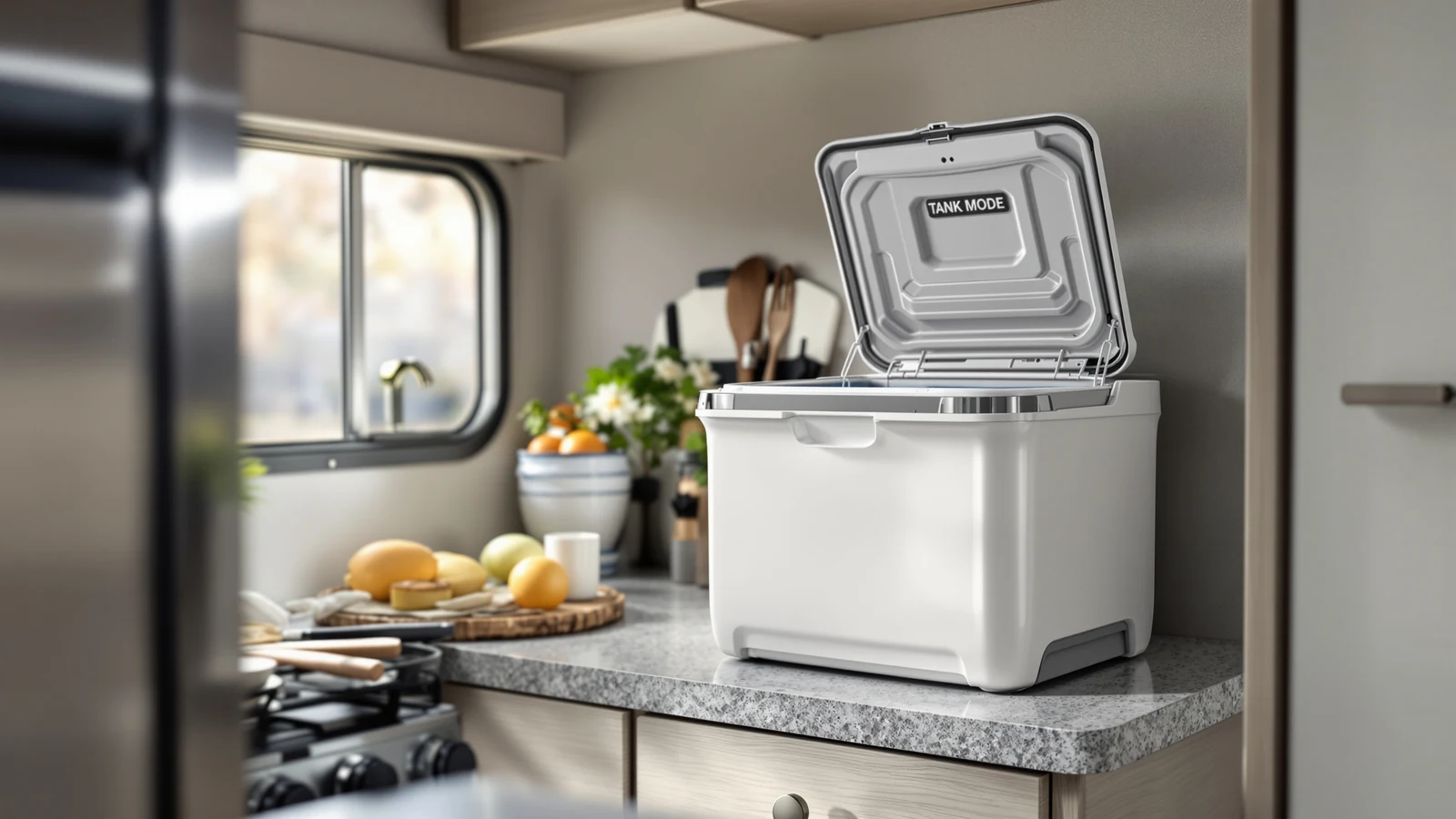
A portable dishwasher's hose and water tank drained and open for winter storage in an RV

Reader-supported: we may earn a commission when you buy through the links on this page, at no additional cost to you. We compare published specifications and prices; we do not physically test these products and we do not run a testing lab.

Every portable dishwasher on the market holds water somewhere even when it isn't running: a built-in tank on the tank-fed models, an inlet or drain hose that never fully empties on its own, a sump under the spray arm, and a rubber door or lid gasket that stays damp between cycles. None of that matters while the machine is in weekly use. It matters enormously the moment a cabin, an RV, a lake house or a seasonal rental goes unheated for weeks or months, because water is one of the few common substances that expands as it freezes rather than contracts. An enclosed space that's completely full when the water is liquid becomes a space under pressure once it's ice, and something has to give — usually a pump housing, a seam in the tank, or a fitting on the hose.

This guide covers the four things worth draining or protecting before a machine goes into storage, how to bring one back into service in spring without assuming it's fine, and which class of machine actually suits on-again, off-again seasonal use in the first place. None of it requires antifreeze, a service call or specialized tools — just doing the draining steps in order, before the temperature drops rather than after.

Why we're not telling you to "test-run" anything first

We compare published specifications, capacity, water source and price across the portable dishwashers in our database. We do not physically test these machines and we do not run a testing lab, so nothing below is a claim that we winterized a specific unit ourselves and watched what happened. It's a synthesis of how these machines are built — where the water sits, what's rubber versus what's rigid plastic, and how manufacturers describe storage and off-season handling in their own documentation — plus the general physics of water and cold that applies to any small appliance with an internal reservoir.

The actual risk

Why standing water is the risk, not the cold air by itself

It's tempting to think of "winterizing" as protecting a machine from cold air, the way you'd cover a grill or bring in a potted plant. That's not quite what's happening here. A portable dishwasher's plastic housing, control panel and exterior tolerate cold temperatures perfectly well while dry — it's an unheated storage unit, an RV bay or a shed, and plastic doesn't crack from cold alone. The actual failure mode is specific: water trapped inside a sealed or semi-sealed cavity, freezing, and expanding by roughly nine percent in volume as it turns to ice.

That expansion has nowhere to go in a closed system. A dishwasher's internal water tank, the length of hose between the tank and the pump, the pump housing itself and the check valves that stop water flowing backward are all rigid or semi-rigid, and none of them are designed to flex the way a car radiator hose or a garden hose might. When ice forms inside one of these components, the pressure is applied directly to a seam, a gasket or a thin plastic wall, and that's what splits — not visibly, most of the time, but as a hairline crack that leaks the first time the machine runs again in spring, often at the worst possible moment mid-cycle.

This is why a machine that "looks fine" in October can fail in April even though nothing touched it in between: the damage happened the first hard freeze of the winter, and it just wasn't running water past the crack until you turned it back on.

Step one

Draining the built-in tank completely

Tank-fed countertop dishwashers hold their reservoir water in a plastic tank of a few liters, filled by hand from a jug and refilled between cycles. It's the feature that lets these machines run with no faucet connection at all — genuinely useful in an RV or off-grid cabin — but it also means there's a dedicated container of standing water sitting inside the appliance any time it isn't actively empty.

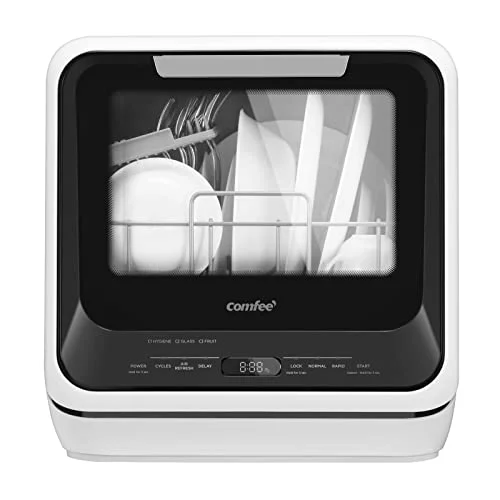
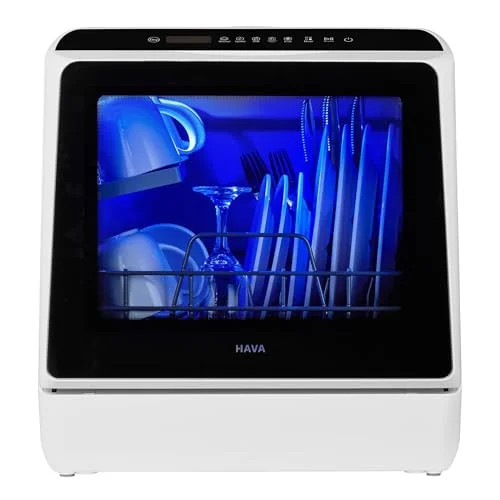
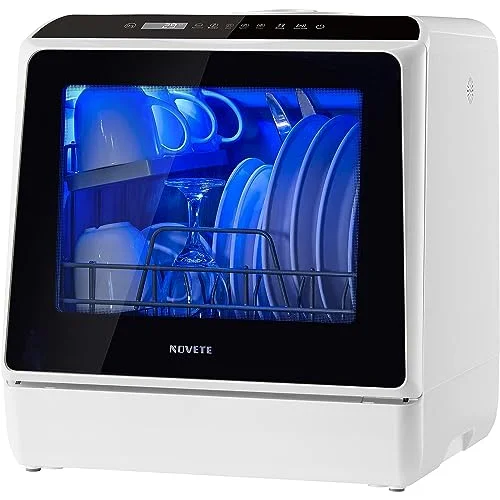
The COMFEE' Portable Mini Dishwasher's listing describes a 1.32-gallon built-in water tank, and the HAVA Countertop Dishwasher and NOVETE Portable Countertop Dishwasher are both built around the same tank-or-faucet approach, the NOVETE with a stated 5-liter built-in tank and an inlet hose as the alternative supply method. On any of these, the tank should be run down to empty — not just "mostly used" — before the machine is put into storage. Run a final short cycle with no dishes to pump out whatever's left in the tank and the internal lines, then, if the machine has a drain plug or a manual drain function described in its manual, use it to get out water the pump cycle alone won't reach. Leave the lid or door open afterward rather than sealing the unit up while any residual moisture is still evaporating.

Don't assume a tank that reads "empty" on an indicator light is actually dry. Most level indicators are calibrated to stop the machine from running with too little water to complete a wash, not to certify that zero water remains — there's commonly a small reserve below the sensor's cutoff. That residual amount is exactly the kind of small pocket of water that's easy to overlook and sits right at a seam.

Step two

Clearing the hose and the faucet adapter

Faucet-connect models — and tank models that also support a faucet hookup, like the NOVETE — route water in through an inlet hose and a threaded adapter that clips onto the kitchen tap's aerator, then pump waste water back out through a second hose hung over the sink's edge. Both of those hoses are flexible, but "flexible" doesn't mean immune to a freeze: a ribbed hose holds a surprising amount of water in its corrugations even after it's been unclipped and appears to have drained, and a length of hose coiled up in a cabinet or a storage bin over winter with even a cupful of standing water in the low points is a length of hose that can split along a rib.

Before storing the machine, disconnect the inlet hose from the faucet adapter, hold it up and let gravity pull whatever water remains toward the open end, then coil it loosely rather than tightly — a loose coil sheds trapped water and dries faster than one wound tight. Do the same with the drain hose. If the machine's connection point uses a quick-connect coupler rather than separate hoses, check the coupler's rubber gasket for any residual moisture before it goes into storage, since a gasket that dries stuck to itself is more likely to leak on reconnection than one that was dried loose.

The faucet adapter itself is usually the smallest and easiest part to overlook. It's a short length of threaded plastic or metal with a rubber O-ring, and it holds only a trace of water — but a trace is still enough to crack a thin plastic thread if it freezes solid inside a fitting. Detach it from both the faucet and the hose, shake it out, and store it somewhere it won't be left connected and full over the season.

Step three

The filter and the door seal before a long storage period

Two more components are worth attending to, and neither is about freeze damage specifically — they're about what happens to a sealed, damp appliance left shut for months.

The filter

Every countertop dishwasher has a removable filter basket or mesh at the bottom of the tub that catches food particles before they reach the pump. Any residue left in that filter over a long storage period has months to dry, harden and, in humid conditions, grow mold — and a moldy filter is a genuinely unpleasant smell to discover when you reopen the machine in spring, not just a hygiene inconvenience. Pull the filter, rinse it clean of any visible debris, let it dry completely outside the machine, and either leave it out or reinstall it dry rather than storing it wet and sealed inside the tub.

The door seal

The rubber gasket around the door or lid keeps water inside the tub during a wash cycle, and rubber that's left compressed and slightly damp for months is more prone to developing a permanent set, a mildew smell, or a soft crack at the fold than rubber that's been left to dry with the door propped open. Wipe the gasket down, and store the machine with the door or lid left slightly ajar rather than latched shut — the same principle as leaving a front-load washing machine's door open between uses, applied to a much smaller sealed tub.

Coming back online

Bringing a machine back into service in spring

Don't load a full rack of dishes and run a normal cycle as the first thing a machine does after months in storage. Run an empty cycle first, with no dishes and no detergent, and watch it — specifically watch the connections you handled in the fall: the faucet adapter, both hose ends, and the tank's drain point if it has one. An empty cycle puts water through every part of the system without risking dishes if something leaks, and a hairline crack that formed over winter will usually show itself as a slow drip rather than a catastrophic failure, which is exactly the kind of problem you want to catch before it's run under a full load.

While the machine is empty, reinstall the filter if you'd removed it, reconnect the hoses and adapter, and check that the door or lid gasket has kept its shape rather than taking a permanent flat set from months in one position — a gasket that's visibly distorted is a reason to inspect the seal for leaks during that first cycle, not necessarily a reason to replace the whole machine. If the empty cycle runs clean with no drips at any connection, it's reasonable to move on to normal loads. If it doesn't, the leak point is usually visible with the machine running, which narrows the fix considerably compared to troubleshooting a mid-cycle leak from scratch.

This same test-cycle habit is worth repeating any time the machine has sat unused for an extended stretch, not just after a winter freeze — the general principles in moving and storing a portable dishwasher between uses cover the shorter-term version of the same idea.

The picks

The machines best suited to on-again, off-again use

Seasonal use rewards a specific set of traits: a tank that lets the machine run without a faucet at all, a manageable amount of water to drain, and a straightforward interior to dry out completely. These four are the ones in our database built around that.

01No hookup needed

EUHOMY Countertop Dishwasher Portable

RVs and cabins with no faucet the machine can connect to
Countertop · 6 programs · 40 dB rated · no hookup needed · Large

A no-hookup design is the single most useful trait for a machine that spends part of the year in an RV or an off-grid cabin, because it removes the faucet-adapter question entirely — there's no inlet fitting sitting connected to a tap for months at a time between visits. It's also rated at 40 dB, which matters less for winterizing than for the RVs and small cabins this machine tends to end up in, where a loud appliance is more noticeable in a small enclosed space.

Winterizing this oneRun the tank down to empty on a final cycle, dry the filter, and prop the door before storage — there's no faucet hose to disconnect, which is one less step than a faucet-connect model needs.

EUHOMY countertop portable dishwasher
$249
No hookupCheck price →
02Built for RVs

COMFEE' Portable Mini Dishwasher Countertop

Small galley kitchens and RVs run for part of the year
Mini countertop · 1.32-gallon built-in tank · no hookup needed · 6 programs · 360° dual spray · Minilite

The listing calls out apartments and RVs specifically, and the small 1.32-gallon tank is genuinely quick to drain and inspect compared with a full-size faucet connection — there's less hose, less standing water, and a smaller cavity to dry completely before the door goes shut for the season. Its 162°F high-temp cycle and air-dry function are unrelated to storage, but worth knowing about if the machine also does regular duty as a baby-bottle washer between trips.

Winterizing this oneThe small tank is an advantage here: drain it fully on an empty final cycle, and there's very little else in the system to worry about besides the filter and the door gasket.

COMFEE' portable mini dishwasher countertop with water tank
$249.98
1.32-gal tankCheck price →
03Tank or faucet

HAVA Countertop Dishwasher

A seasonal home used with plumbing sometimes, without it other times
Countertop · 6 programs · water tank

A dual-supply machine like this one is well suited to a seasonal property that has working plumbing in summer but gets shut off or drained over winter, because the same appliance covers both situations rather than forcing a choice between a faucet-only model and a tank-only one. When the house's water is on, run it off the faucet; when the property is being closed up for the season, that's exactly when the tank and hose both need the full draining routine above.

Winterizing this oneBecause it supports both supply modes, check both: drain the tank on an empty cycle, and separately disconnect and drain the faucet hose and adapter if that's the mode it was last running in.

HAVA countertop dishwasher with water tank
$339
Tank or faucetCheck price →
04Most transparent tank spec

NOVETE Portable Countertop Dishwashers

Small apartments and RVs that want a stated tank size to plan around
Countertop · 5 L built-in tank & inlet hose · 5 washing programs · air-dry function · LED light

A stated 5-liter tank alongside an inlet hose option makes this one straightforward to plan a winterizing routine around: you know exactly how much water the tank itself holds, which makes it easier to confirm a drain cycle actually emptied it rather than guessing. The air-dry function is a genuine plus for the last cycle before storage, since it leaves the interior less damp going into a shutdown than a machine that finishes wet.

Winterizing this oneUse the air-dry function on the final cycle before storage, then still prop the door — air-dry reduces residual moisture, it doesn't replace letting the tub finish drying in open air.

NOVETE portable countertop dishwasher with 5L water tank
$289.99
5 L tankCheck price →
FAQ

Common questions about winterizing a portable dishwasher

Can I just leave the water in the tank if the machine will stay somewhere heated?

If the storage space genuinely never drops near freezing, the freeze-and-crack risk described here doesn't apply in the same way — but standing water left for months in any tank still supports mold and stale odors, and a filter with food residue left to sit is unpleasant regardless of temperature. Draining and drying the machine is the safer routine even in a heated space, and it's the only routine that protects the machine if the heat ever fails or the property is closed up unexpectedly.

Do I need antifreeze, like winterizing an RV's fresh water system?

No. RV winterizing kits use antifreeze because an RV's plumbing has long runs of pipe that are impractical to fully drain by gravity alone. A portable dishwasher's tank, pump and hoses are small and accessible enough to drain completely by running an empty cycle and disconnecting the hoses — there's no equivalent of a long buried pipe run that needs a chemical fill instead.

How do I know if freeze damage happened, since it isn't visible right away?

Run an empty cycle with no dishes before trusting the machine with a full load, and watch the connections while it runs — the faucet adapter, both hose ends, and the tank area. A hairline crack from a winter freeze typically shows up as a slow drip during that first cycle rather than a dramatic failure, which is why an empty test run catches it before it can damage a load of dishes or the surface underneath the machine.

Does a faucet-only machine need less winterizing than a tank model?

Not really — it shifts where the standing water sits rather than eliminating it. A faucet-only machine has no tank to drain, but it has an inlet hose, a drain hose and a faucet adapter that all hold residual water in their own right, particularly in the corrugations of a ribbed hose. Both machine types need the same basic principle applied: drain what you can with an empty cycle, disconnect and shake out what the cycle can't reach, and let everything finish drying in open air before it's sealed up for storage.

Keep reading

Next, from this site