Best Portable Dishwashers
Guide · Portable Dishwasher Capacity

How many place settings do you actually need?

The 4, 6 and 8 place-setting numbers on the box come from a real industry definition, tested against a specific, minimal load. What each size actually holds once it's your dishes, your dinner and your household filling the rack is a different question — and the one that decides whether you buy the right machine the first time.

By Ilane Tall · Updated September 16, 2026 · Research-based.

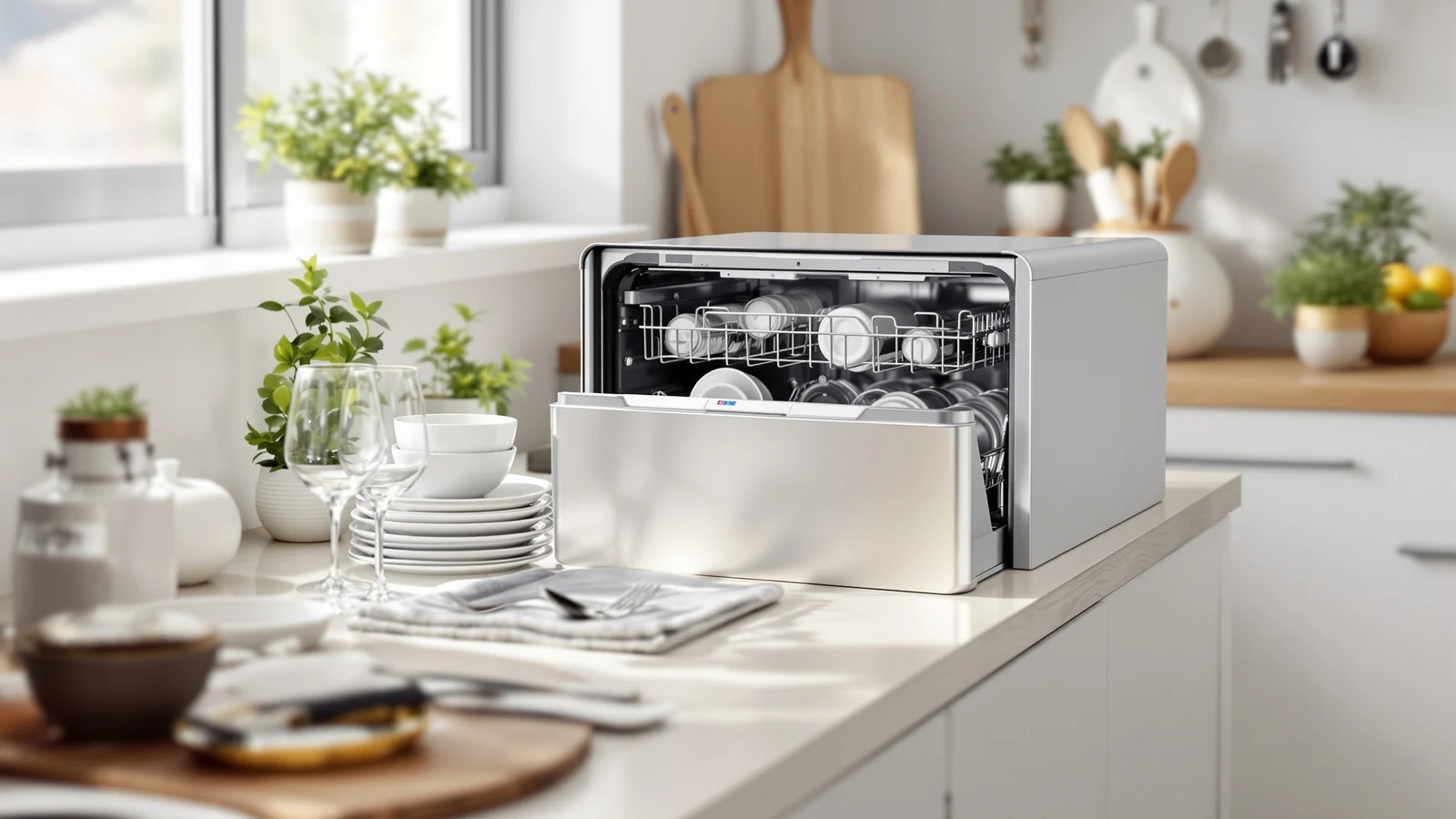
Four full place settings of plates, bowls, glasses and cutlery arranged beside a small portable dishwasher, showing how much one real load actually holds

Reader-supported: we may earn a commission when you buy through the links on this page, at no additional cost to you. Prices move constantly — confirm the live price before you order.

Every portable dishwasher box prints a number — 4 place settings, 6, sometimes 8 — the way a car's window sticker prints a fuel-economy figure: technically accurate, and not quite the number you get to keep. The place-setting count comes from a genuine, standardized definition, and it's tested against a specific, forgiving load. Whether it describes your kitchen depends on how many people eat there and how much they actually dirty.

This guide works through that gap: what a place setting is actually made of, why the manufacturer's number assumes a lighter load than most households produce, what four different capacities look like once one or two people — or a family of four — start filling the rack, and what happens the evening you push more into a small basket than it's rated for. If your household is already outgrowing a small machine, skip ahead to when six settings stops being enough.

How this page is built

We compare published specifications, listing bullets, dimensions and price. We do not physically test these machines, we do not run a testing lab, and we do not publish ratings we cannot verify — Amazon returns no rating or review count for this category, so there are no stars on this site. Where a manufacturer's own capacity figure is generous, we say so; where a spec isn't published for a given model, we don't invent one.

The definition

What a place setting actually contains

A place setting isn't marketing language; it's the industry's standard unit of dishwasher capacity, and every machine — countertop, portable or built-in — is rated against roughly the same count. One setting typically means one dinner plate, one smaller plate or bowl, one drinking glass, one cup and saucer, and one person's flatware: knife, fork and spoon or two. Add it up and a single setting runs to roughly ten pieces. A four-place machine is therefore rated for somewhere around forty items loaded at once; six settings implies something closer to sixty or seventy, which is the exact figure COMFEE' quotes for its six-place countertop model, up to 70 pieces with plates to 10 inches.

The count is useful precisely because it's standardized — a six-place machine from one brand and a six-place machine from another are, on paper, rated against a comparable load, unlike the vaguer "30+ dishes" phrasing some listings substitute instead, which tells you almost nothing about what will actually fit on a given evening.

What the count leaves out matters just as much. It says nothing about pots, pans, cutting boards, mixing bowls or serving dishes — none of that is part of a standard place setting, and none of it is optional in a real kitchen. One listing in this category, BLACK+DECKER's for its 18-inch model, actually folds "dinner plates, bowls, glasses, cups, cutlery and serving platters" into its stated 8-place figure — a more generous inclusion than the standard definition assumes, and a reminder to read what a number is actually counting before you compare it against another brand's.

The fine print

Why the printed number assumes a light load

The place-setting figure comes from a best-case load: flat plates that nest cleanly, standardized dinnerware, nothing large enough to block a spray arm. That's a reasonable way to publish a comparable spec, and it's also a load that doesn't look much like an actual meal. COMFEE' says as much in its own small print for the six-place model — "factory tested before shipped" — which is a lab test, not a promise about your mismatched bowls and travel mugs.

Real dishes vary in ways standardized crockery doesn't. A cereal bowl with a wide lip takes more rack space than a flat side plate; a tall mug crowds the upper rack against the door in a way a teacup never would; a chef's knife needs to sit alone in the cutlery basket rather than nested with three others. None of that shows up in a place-setting count, and all of it eats into the margin between the printed number and what fits on a specific night.

Plate diameter is the other constant surprise, and it's the one spec worth checking before capacity. COMFEE's six-place model is rated to 10-inch plates; plenty of standard American dinner plates run 11 or 12 inches, and a plate that has to lean at an angle to close the door isn't washing at the standard the spec sheet implies — it's just present. Treat every printed capacity figure, and any decibel or cycle-time number that comes with it, as a manufacturer's claim rather than a measurement made in your kitchen. The practical rule of thumb: plan around roughly 70 to 80 percent of the printed number for a real, mixed load — a six-place machine is safer treated as a five, the same way a car's window-sticker mileage assumes flat roads and a light foot.

Who's eating

Capacity by household: one or two people versus a family of four

How far a place-setting number stretches depends on who's eating, not just how many dishes came out of the cupboard. Two people generate less mess per meal but eat more often across a day; a family of four can produce a full rated load from a single dinner. These two profiles decide, more than any spec sheet, whether a given machine fits.

One or two people

A day's dishes, not a sitting

One or two people produce roughly one place setting each per meal — a plate, a bowl, a glass, maybe a mug, and cutlery — plus a saucepan and a cutting board on days that involve real cooking rather than reheating. Run that across breakfast, lunch and dinner for two, and the total lands around four to six settings' worth of dishes for the whole day, which is exactly the band the smallest machines in this category are built for. A tank-fed mini machine like the COMFEE' Minilite doesn't publish a place-setting figure in its own listing at all — typical for the smallest class, which is sized around one person's daily dishes rather than a number meant to be compared against a six-place machine. The trade-off is that it doesn't leave much slack: skip a day, and the next one's dishes won't all fit.

A family of four

One sitting can fill the rack

A family of four can generate a full rated load in a single meal. Four dinner plates, four bowls or side plates, four glasses and four sets of cutlery is sixteen to twenty items before anyone reaches for a serving dish — already most of the way to a four-place machine's capacity, before the saucepan the meal was cooked in. This is why COMFEE' itself markets its six-place model as sized for "2-3 people," not four, despite the "6 Place Settings" name: the maker's own copy agrees that one evening's plates, glasses and cutlery for a family of four leaves little room to spare. Run two meals a day without a wash in between and even a six-place machine gets tight — the point covered next, in when six settings stops being enough.

The ladder

The picks, smallest to largest

Four machines, in order of how much they hold: an unrated tank-fed mini, a six-place countertop model, and two eight-place machines built for a bigger household. None of these listings carry a star rating or review count — Amazon doesn't supply either for this category — so what follows comes from the published specification and price alone.

01Smallest — one person, daily

COMFEE' Portable Dishwasher, Minilite

For one person, or two who don't mind running it most days
Countertop, mini · 5 L built-in water tank, no hookup needed · 6 programs · 360° dual spray · Air-Dry function

The Minilite runs from its own five-litre tank rather than a faucet connection, which is the reason to buy it: no adapter, no aerator threads to check, just water poured in and a power socket. Its listing doesn't quote a place-setting count at all, which is standard for machines this size — it's built around a day's dishes for one person rather than a figure meant to be compared against a six-place machine. The Hygiene cycle heats water to 162°F, and the Air Refresh mode circulates air afterward, which matters more here than in a bigger machine, since a small sealed tub is exactly the kind of space that goes stale between uses if nothing moves air through it.

The trade-offBecause it isn't rated in place settings, there's no clean way to compare it against a six- or eight-setting machine on paper — the honest read is that one real dinner for two, cooked rather than reheated, will fill it.
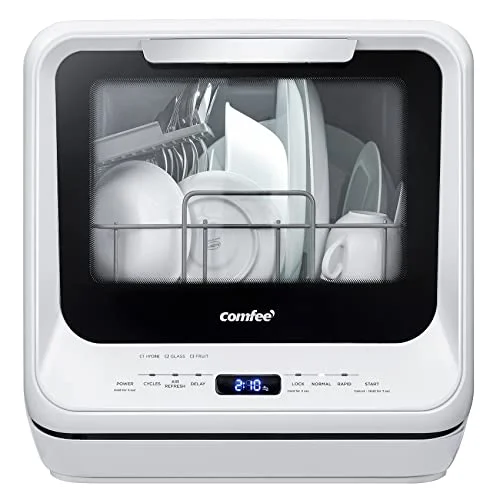
COMFEE' Minilite portable dishwasher with built-in water tank
$289.99
Tank, no hookupCheck price →
02Six settings — one sitting

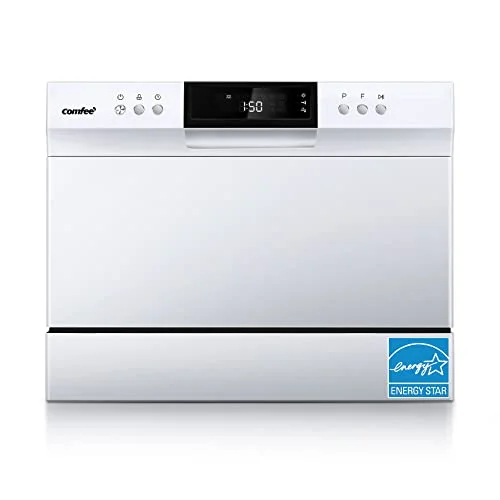
COMFEE' Countertop Dishwasher, 6 Place Settings

For 2–3 people by the maker's own description, and a family's single sitting
Countertop · 6 place settings, up to 70 pieces · plates to 10 in · 19.7"D × 21.6"W × 17.2"H · Energy Star · 8 wash cycles

This is the machine the place-setting math above points to: a listing that states capacity in the same standardized unit the industry uses — six settings, up to 70 pieces — rather than a vaguer "dishes" count. It connects to a standard faucet with an adapter, runs eight cycles (Heavy, Normal, Baby-Care, ECO, Glass, Speed, Mini-party and Rinse) with an extra-drying function, and carries an Energy Star listing in a category where plenty of machines carry none. At 21.6 inches wide it's a genuine chunk of countertop, not a compact appliance.

The trade-offSix place settings covers one sitting for a family, not a full day of breakfast, lunch and dinner — plan on running it daily rather than skipping a day once a family relies on it.

COMFEE' six place setting countertop dishwasher
$309.99
6 place settingsCheck price →
03Eight settings — compact

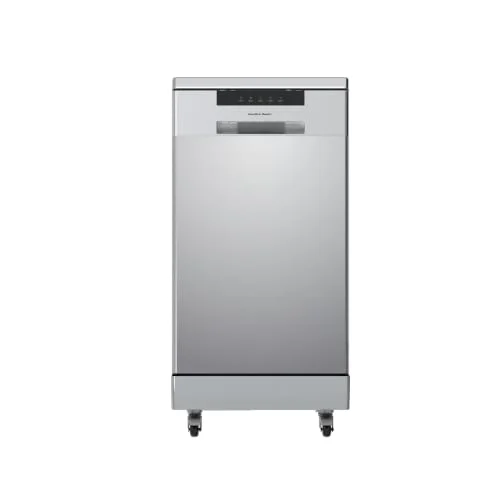
Hamilton Beach Portable Dishwasher

A household that has already outgrown a six-place countertop machine but wants a compact footprint
Portable, compact design · 8 place settings · silverware basket · 52 dB rated · delay start

Hamilton Beach's own listing states 8 place settings and a dedicated silverware basket — a genuine step up from the six-place COMFEE' model, and enough headroom to cover a family of four's evening meal with room to spare for the cooking pot. It's marketed as a compact design for small kitchens and apartments, is rated at a quiet 52 dB, and adds a delay-start option that a six-place machine here doesn't list.

The trade-offThe listing we're working from doesn't specify external dimensions, so measure your available space before ordering rather than assuming "compact" means it will fit where the six-place model did.

Hamilton Beach portable dishwasher, stainless steel and platinum
$599.99
8 place settingsCheck price →
04Eight settings — 18″ platform

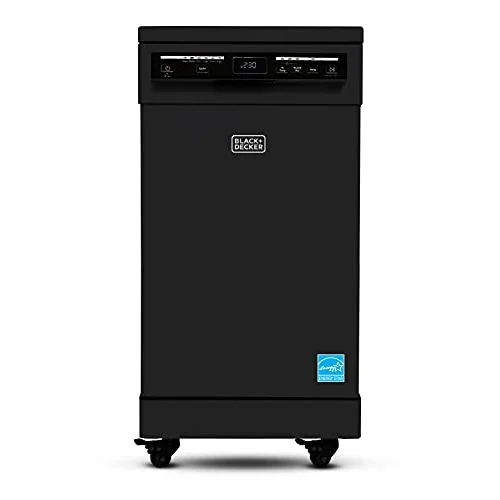
BLACK+DECKER 18-Inch Portable Dishwasher (BPD8B)

A family of four or more that has outgrown every countertop option
Freestanding, 18 in wide · 8 place settings · countertop surface on top · Energy Star · 6 wash cycles

At 18 inches wide this is a genuine full-size dishwasher on wheels rather than a scaled-down countertop tub — roll it to the sink, connect, run, roll it back against the wall when it's done. Its listing states 8 place settings and, unusually, folds in dinner plates, bowls, glasses, cups, cutlery and serving platters under that one figure, which is a more generous accounting than the standard place-setting definition assumes. Six cycles cover Normal, Heavy, Rapid, Glass, Eco and a 90-minute programme, and it carries an Energy Star listing, which matters more at this size since a bigger tub also means more water and power per cycle.

The trade-offIt needs 18 inches of floor space plus room for the door to swing and a clear path to the sink — capacity this size isn't free, and finding the floor space for it is a real planning step, not an afterthought.

BLACK+DECKER 18-inch portable dishwasher on wheels
$609.99
8 place settingsCheck price →
At a glance

How the four compare

All figures are manufacturer specifications or listing claims; prices are approximate and move often on Amazon.

MachineBest forCapacity as listedPrice
COMFEE' MiniliteSolo, daily useNot quoted in place settings$289.99Price
COMFEE' 6 Place Settings2–3 people, one sitting6 place settings, ~70 pieces$309.99Price
Hamilton Beach PortableFamily of four, compact8 place settings$599.99Price
BLACK+DECKER 18″Family of four or more8 place settings$609.99Price
The failure mode

What happens when you overload a small basket

Every rack has a point where adding one more plate stops being "a fuller load" and starts being a wash that fails. The mechanism is simple: a portable or countertop dishwasher cleans by spraying water up and down through a rotating arm, and that arm needs open space above and below every dish to do its job. Push a stack past the rack's rated capacity and plates start shielding the ones behind them, cutlery nests together instead of spreading out, and the water that should hit every surface finds the path of least resistance instead.

The result isn't usually a dramatic failure — it's a scatter of half-clean spots: a bowl that comes out with a dried film on the inside curve, a fork still carrying a smear from where it touched its neighbor, a glass with water spots because the rinse dispenser couldn't reach it through a wall of plates. Loading a machine past its rated place settings gets blamed on the detergent or the machine more often than on the load, when the load was the cause the whole time.

Overloading has a second cost that's easy to miss: it forces a rewash, and a rewash uses the same water and electricity as a full cycle. A six-place machine crammed to hold eight settings' worth of dishes doesn't save a run — it produces one cycle that has to be repeated, which is worse for the water and power figures this site tracks in how much water a portable dishwasher really uses than simply running the machine twice on a lighter load in the first place.

There's a third, quieter cost. Dishes wedged tight against each other or the tub wall dry more slowly than dishes with air moving around them, because these machines dry with residual heat and airflow rather than a heating element. A packed rack is a rack that stays damp longest, and standing water in a sealed tub for hours at a time is the most common cause behind the problems covered in why your portable dishwasher smells. The fix in all three cases is the same: load to the rated count, not past it, and run the machine again rather than once, harder.

The upgrade point

Sizing up: when six settings stops being enough

Six place settings is a comfortable ceiling for two or three people — the range COMFEE' itself markets its six-place model for — and a tight one for four, so the signal that it's time to size up usually shows up as a pattern rather than one bad night. Watch for: running the dishwasher twice most days rather than once; hand-washing the pots and pans every time because there's no room left after the plates and glasses go in; or a growing pile by the sink waiting for "the next load" because the current one is already full.

The household math from earlier in this guide is the useful check. If four people produce sixteen to twenty items a meal before the cooking pot is counted, and that happens twice a day, a six-place machine is being asked to do roughly two full loads' worth of work with capacity for one. At that point the choice is between running the machine more often — a legitimate answer if the water and electricity cost supports it — or moving to a machine built for more, like the two eight-place options in this guide.

The eight-place class exists for exactly this jump, and it comes in two shapes here. Hamilton Beach's compact model adds two more settings and a dedicated silverware basket without asking for the floor space an 18-inch machine needs. The BLACK+DECKER BPD8B is the bigger commitment: a genuine 18-inch platform that needs a clear strip of floor and a path to the sink, but folds serving platters into its 8-place figure and gives back a usable counter on top. Either is a real jump in price and footprint over a six-place countertop model — worth it once the alternative is two cycles a day, every day, indefinitely, rather than a single bad week. For the budget side of that trade-off, see the best portable dishwashers under $400; for certified options at every size, the best Energy Star portable dishwashers covers the water and power side of buying bigger.

There's also a middle answer worth naming: a second wash a day on a six-place machine costs nothing upfront and still gets everything clean, provided the pile by the sink doesn't win. Sizing up is the right call once a household has actually tried that and outgrown it, not before.

FAQ

Common questions about place settings and capacity

What exactly counts as one place setting?

One place setting is a standardized unit: a dinner plate, a smaller plate or bowl, a drinking glass, a cup and saucer, and one person's cutlery — roughly ten pieces in total. A dishwasher rated for four settings is rated for around forty items; six settings implies somewhere near sixty to seventy, which is the figure COMFEE' quotes for its six-place countertop model. The count doesn't include pots, pans or most serving dishes, which is why a rack can look full well before the printed number is reached.

Is a 6-place-setting dishwasher enough for a family of four?

For one meal, generally yes — four dinner plates, four bowls or side plates, four glasses and four sets of cutlery runs to sixteen to twenty items, comfortably inside a six-place machine's roughly 70-piece capacity with room for a cooking pot. COMFEE' itself markets its six-place model as sized for 2 to 3 people rather than four, which lines up with the math: for a full day of breakfast and dinner without an intervening wash, it gets tight, and most families in that position end up running the machine twice a day.

What actually happens if I cram more dishes in than the rack is rated for?

The spray arm loses the open space it needs to reach every surface, so dishes shield each other from the water and detergent instead of getting cleaned individually. The usual result is a partial clean — a bowl or glass that comes out with spots or a film — which forces a rewash that uses as much water and power as running a lighter load the first time would have. Packed racks also dry more slowly, since these machines rely on airflow rather than a heating element.

Do the smallest tank-fed machines list a place-setting number at all?

Not always. Compact, tank-fed models like the COMFEE' Minilite are typically listed by tank size and program count — a 5-liter tank, six wash programs, a high-temperature hygiene cycle — rather than a place-setting figure, because they're built around a single person's daily dishes rather than a count meant to be compared against a six- or eight-setting machine. If a listing doesn't quote a place-setting number, that's usually a sign the machine sits well below that comparison, not a gap in the spec sheet.

Keep reading

Next, from this site