Best Portable Dishwashers
Guide · Cutlery & Loading

A separate cutlery basket. Does it actually matter?

Cutlery is the item small dishwashers clean worst — not because the machines are weak, but because a loose tray in a six-inch rack lets fork nest inside fork, spoon shield spoon, and water never reaches the piece in the middle. Some machines fight that with a dedicated basket built for the job. Here's what actually changes when they do.

By Ilane Tall · Updated September 24, 2026 · Research-based.

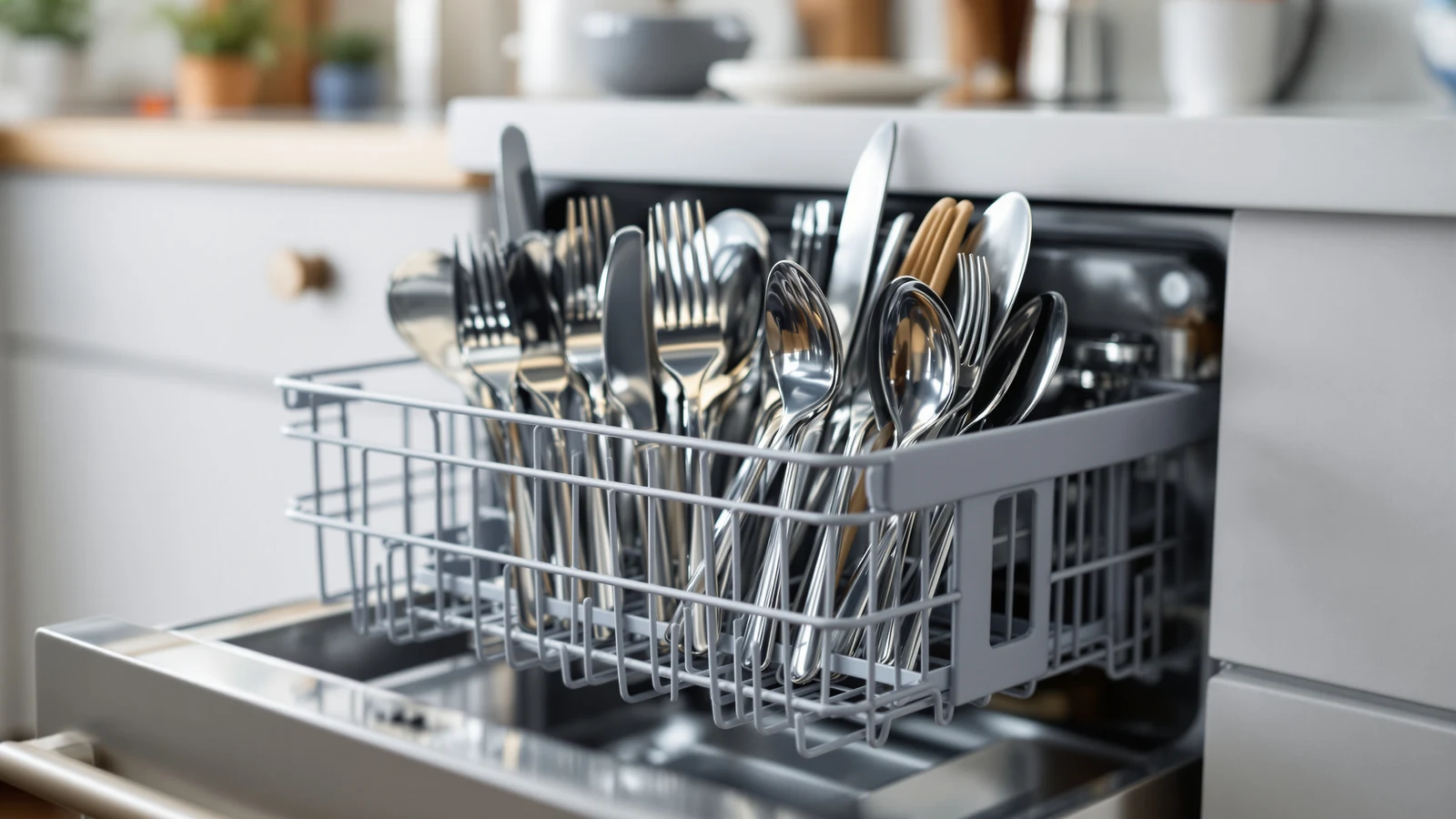
Forks, knives and spoons loaded upright in a dedicated cutlery basket beside the open rack of a portable dishwasher

Reader-supported: we may earn a commission when you buy through the links on this page, at no additional cost to you. Prices move constantly — confirm the live price before you order.

Every full-size dishwasher review eventually says some version of the same thing: dishes come out clean, glasses come out clean, and one fork in the middle of the basket comes out with a smear of egg still on the tines. In a portable or countertop machine the problem is worse, because the whole rack is smaller and the cutlery has less room to avoid touching. Two identical spoons pressed bowl-to-bowl in a cramped tray trap a thin film of water between them that the spray never disturbs, and a fork with three others jammed against its tines simply doesn't get hit from every side.

This guide is about the one part of the rack that decides whether that happens: the cutlery basket itself. We compare how a flat tray built into the rack behaves against a dedicated upright basket, what our three picks actually include, how to load forks, knives and spoons so more of them come out clean, and — the part most buying guides skip — which of these baskets you lift out and carry to the drawer, and which one you sort in place. If you've already decided the basket needs to be removable, skip ahead to the basket that comes out, and the one that doesn't.

How this page is built

We compare published specifications, listing bullets, dimensions and price for the three machines named below. We do not physically test these machines and we do not run a testing lab, and we do not publish star ratings or review counts — Amazon returns neither for this category, so we don't invent either. Where a listing doesn't state a spec, we say so rather than guessing.

The problem

Why cutlery is the item small dishwashers clean worst

A plate has one flat face for the spray to hit and gravity to help rinse. A fork has four narrow tines with gaps between them, a spoon has a concave bowl that can fill with standing water, and a knife has a flat blade that two more knives will happily lie flush against if you let them. None of that is a flaw in the machine — it's geometry, and it's the same geometry a full-size built-in dishwasher deals with by giving cutlery its own dedicated space rather than mixing it into the plate rack.

Portable and countertop machines have less rack to work with in the first place, so the cutlery compartment shrinks along with everything else. Drop a handful of forks and spoons into a tray sized for a handful of dishes and they land the way loose cutlery always lands: stacked, nested, bowls together, tines interlocked. Two pieces touching along their full length block the water and detergent that would otherwise reach both surfaces — which is exactly the mechanism behind the classic complaint of a dishwasher that "leaves half the forks dirty" even though every plate came out spotless.

Overloading compounds it. A cutlery compartment rated for a handful of place settings' worth of forks, knives and spoons is engineered around pieces staying mostly upright and mostly separated; push twice that number in and nesting stops being avoidable no matter how careful the loading. That's one reason how many place settings a household actually needs is worth checking before capacity, not after — a machine that's chronically over its rated load will under-clean cutlery first, before it under-cleans anything else.

The two designs

Tray versus upright basket: how each actually performs

There are two ways a small dishwasher handles cutlery, and they behave differently under the same load.

The integrated tray

A tray is a shallow, mostly horizontal compartment built into the lower rack — a subdivided bin you drop cutlery into rather than a container you lift out. The EUHOMY countertop model below is built this way: its listing describes "a dedicated cutlery holder" alongside the plate and bowl slots, sized for the seven sets of forks, knives and spoons that make up its stated 30-plus-item capacity. A tray loads fast — cutlery goes in loosely, handle-end wherever it lands — but that speed is also the weakness. Because the compartment is shallow and open, nothing stops two spoons from settling bowl-to-bowl or three forks from leaning against each other as the rack fills, and a tray close to a spray arm shields whatever's underneath from whatever's on top of it.

The upright basket

An upright basket is closer to what a full-size built-in dishwasher uses: a caged or slotted container that holds each piece mostly vertical, handle down or handle up, so tines and bowls face outward toward the spray instead of against a neighbor. Both 18-inch machines here use this approach. Honeywell's listing describes a top cutlery rack plus "a large removable cutlery basket," and KoolMore's describes a "removable utensil storage basket" built specifically, in its own words, for "busy homes that go through forks, knives, and spoons quickly." The vertical orientation does the same job a tray can't: it keeps identical pieces from lying flush against each other, so more of each fork's surface stays exposed through the whole cycle.

Neither design is wrong for what it's attached to — a tray fits the compact footprint a tank-fed countertop machine needs, and an upright basket needs the taller interior an 18-inch freestanding machine has to spare. The honest trade-off is capacity versus separation: a tray holds a stated number of place settings in a smaller box, an upright basket separates the pieces better inside a bigger one.
The picks

The picks, and what their basket holds

One tray-style countertop machine and two 18-inch machines with a removable upright basket — the three machines named in this guide, in order of basket design.

01Built-in tray

EUHOMY Countertop Dishwasher, 6 Programs

A dedicated cutlery holder sized into a compact countertop rack
Countertop, Large · 30+ items, plates to 10.25 in · dedicated cutlery holder · 5 L tank or faucet · 16.83 × 16.73 × 18.03 in

EUHOMY's listing spells out the load its rack is built for: 4 plates, 4 small plates, 4 small cups, 4 bowls, 2 glasses, and 7 sets of forks, knives and spoons, with a dedicated cutlery holder alongside a separate fruit basket and kettle space. Six programs cover Normal, Quick, ECO, Baby Care/Heavy, Fruit and Dry, with the Baby Care mode running at 167°F and a 29-minute Quick cycle for a lighter load. It runs from either its own 5 L tank or a faucet inlet hose, which matters for cutlery too — tank mode means shorter, lower-volume cycles, so a tray packed with more than its seven sets is the fastest way to see pieces come out still filmy.

The trade-offThe cutlery holder is built into the rack rather than a separate basket you lift out, and the listing asks for more than 18 inches of vertical clearance above the counter before you buy — measure the cabinet gap first.

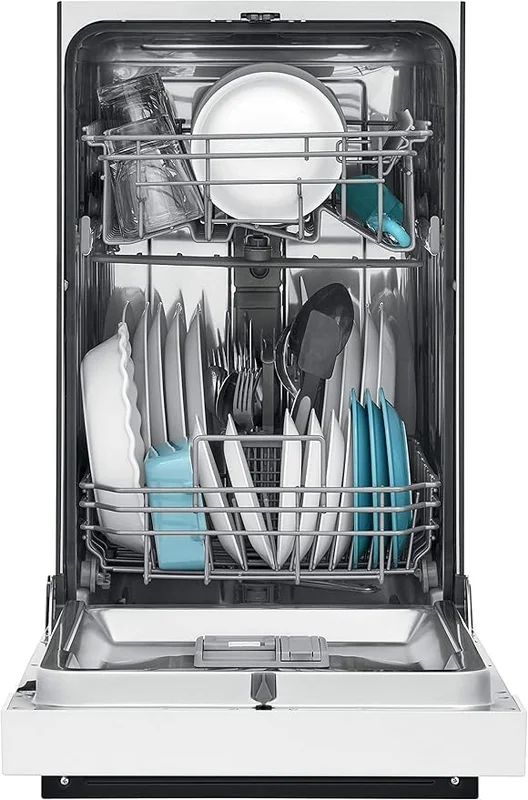
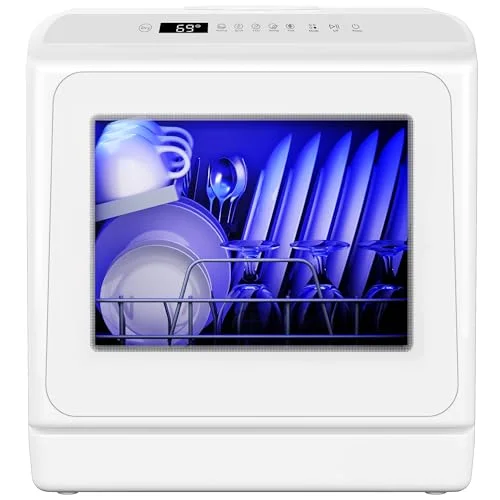
EUHOMY countertop dishwasher with dedicated cutlery holder in the lower rack
$280
Built-in trayCheck price →
02Top rack + removable basket

Honeywell 18 Inch Dishwasher, 8 Place Settings

A full-size layout: a top cutlery rack plus a separate removable basket
18 Inch, built-in style · 8 place settings · top cutlery rack + large removable cutlery basket · stainless steel tub · UL / Energy Star

Honeywell splits cutlery two ways: a top cutlery rack built into the upper level of the machine, plus, in the listing's own words, "a large removable cutlery basket" lower down for the overflow a top rack alone can't hold. That's the layout a full-size 24-inch dishwasher uses, scaled to an 18-inch stainless steel tub. Six washing programs — pots & pans, normal wash, china, quick wash, rinse only and energy saver — plus a delay start of up to 24 hours round out a machine built to run a genuine eight place settings rather than the four to six a compact countertop machine holds.

The trade-offIt's a freestanding 18-inch machine, not a countertop one — it needs floor space and a faucet connection, and at roughly double a compact countertop model's price, the extra cutlery capacity comes bundled with a bigger machine you may not need if you're cooking for one or two.

Honeywell 18-inch dishwasher with removable cutlery basket, white finish
$400
Removable basketCheck price →
03Pull-out basket, ADA panel ready

KoolMore 18 in. ADA Panel Ready Dishwasher (KM-DW1852-PR)

A pull-out utensil basket built for households that go through cutlery fast
18 in., ADA Panel Ready · 8 place settings · 52 dB rated · removable pull-out utensil storage basket · stainless steel, UL & Energy Star

KoolMore's listing pitches its basket directly at this article's problem: a "removable utensil storage basket" the maker describes as "a must for busy homes that go through forks, knives, and spoons quickly," built as a pull-out drawer rather than a fixed compartment, "without lots of bending and reaching." It sits alongside two ergonomic slide-out racks with pop-up-and-down holders for cups, plates, pots and pans, rated at a claimed 52 dB. It's also the only one of the three built to ADA panel-ready specifications, which matters for accessible kitchens more than for cutlery specifically.

The trade-offIt's the most expensive of the three by a wide margin, and 52 dB is a manufacturer figure measured in unstated conditions, not an independently audited one — treat it as a claim, the same as the place-setting count.

KoolMore 18-inch ADA panel-ready dishwasher with pull-out utensil storage basket, stainless steel
$699
Pull-out basketCheck price →
At a glance

How the three compare on cutlery

All figures are manufacturer specifications or listing claims; prices are approximate and move often on Amazon.

MachineCutlery designCapacityBasket removablePrice
EUHOMY CountertopBuilt-in tray7 sets, 30+ itemsNo — sorts in place$279.99Price
Honeywell 18 InchTop rack + removable basket8 place settingsYes — lifts out$399.99Price
KoolMore ADA Panel ReadyPull-out basket8 place settingsYes — pulls out$699.00Price
Technique

Loading forks, knives and spoons so water reaches all of them

The basket design sets the ceiling; how you load it decides whether you get there. The same four habits help whether the compartment is a flat tray or an upright basket, because they all attack the same failure — two identical surfaces lying flush against each other.

  1. Separate by type before anything goes in. Group forks with forks and spoons with spoons rather than dropping a mixed handful in at once, so you can see and break up nesting pairs as you load instead of discovering them after the cycle.
  2. Alternate handle direction. Point some handles up and some down within the same compartment. Two forks with handles pointing the same way tend to slide together as the rack fills; alternating them keeps the tines apart.
  3. Give knives their own space, blade down. A blade lying flat against another blade is the cleanest possible failure to spot after the fact — nothing touched the inside face of either one. Keep knives spread apart from each other and from anything with a flat surface, and point them blade-down for basic kitchen safety when unloading.
  4. Load light, not full. A cutlery compartment with each piece isolated and two-thirds full outperforms the same compartment packed to its rated capacity with pieces touching. If tonight's load doesn't fit without nesting, that's the signal to run a second, smaller cycle rather than force it.

None of this is specific to one basket style. A tray with pieces properly separated by hand will out-clean an upright basket that's been overfilled and left to nest — the geometry that matters is contact between surfaces, not which container holds them.

The limits

What still needs a hand rinse regardless of basket design

No basket design changes what a short, low-volume home cycle is built to do. Dried, baked-on residue — egg yolk left more than an hour or two, hardened oatmeal, a sauce pan scraped straight into the rack — is a job for a pre-rinse or a soak first, in any dishwasher, full-size or portable. A compact machine's cycle is tuned for food that's still soft, not food that's set like glue to the metal, and cutlery is where that shows up fastest because it has the least surface area to hold detergent against a stubborn spot.

Good kitchen knives are worth a hand wash on their own merits, separate from anything to do with basket design: sustained heat and detergent dull an edge and can pit certain steels over repeated cycles, which is standard cutlery-care advice independent of which dishwasher you own. A wooden-handled utensil has the same problem in reverse — heat and prolonged moisture are exactly what wood handles are built to avoid. Neither of our three picks' listings makes a claim either way about knife care, so treat this as general kitchen practice rather than a spec from any one machine.

And any piece too large to sit properly in its compartment — a serving spoon, ladle or carving knife that has to lie across the top rather than down in the basket — will block the spray for everything around it, in a tray or an upright basket alike. If it doesn't fit the compartment it was designed for, wash it by hand rather than wedging it in; that's also the honest answer for most pots and pans, covered in full in can a portable dishwasher actually clean pots and pans.

Unloading

A basket that comes out for easy unloading, and one that doesn't

Loading is only half the chore. The other half is standing at an open dishwasher afterward, sorting a compartment of mixed cutlery back into a drawer one piece at a time — and this is where the three designs here genuinely diverge, not just in how they clean but in how they finish.

Honeywell's "large removable cutlery basket" and KoolMore's "removable utensil storage basket," which KoolMore describes as a pull-out drawer you can access "without lots of bending and reaching," both lift or slide free of the machine entirely. Carry the whole basket to the silverware drawer, tip it in or sort as you go, and set it back empty — no reaching into the machine itself more than once. That's a genuine convenience in a household running the dishwasher daily, and it's the more common approach on full-size and 18-inch machines generally.

EUHOMY's dedicated cutlery holder, by contrast, is described in its listing as a compartment built into the rack alongside the plate and bowl slots — not called out as a separate removable piece the way the other two are. In practice that means unloading happens in place: reach into the machine, pull each fork or spoon out of its slot, and put it away before moving to the next. It's a small extra step, not a real flaw for a compact machine sized around one or two people's daily dishes, but it's the honest difference between the three, and worth knowing before you assume every cutlery compartment works the same way once the cycle ends.

FAQ

Common questions about cutlery baskets

Does a separate cutlery basket really clean better than a tray?

It helps mainly by keeping identical pieces from lying flush against each other, which is the main reason cutlery comes out of a small dishwasher still dirty. An upright basket holds each fork or spoon mostly vertical and separated by design; a flat tray relies more on how carefully you load it. Loaded carefully, a tray can perform just as well — the basket makes good separation easier, it doesn't make bad loading impossible.

What's the actual difference between a cutlery tray and an upright basket?

A tray is a shallow, mostly horizontal compartment built into the lower rack, like the dedicated cutlery holder in the EUHOMY countertop model here. An upright basket is a caged or slotted container, usually removable, that holds pieces vertically — the design both 18-inch machines in this guide use, with Honeywell adding a separate top cutlery rack alongside its removable basket.

Can I put good kitchen knives in a portable dishwasher?

You can, but many cooks choose not to for reasons unrelated to which basket a machine has: sustained heat and detergent can dull an edge and, on some steels, cause pitting over repeated cycles. This is general cutlery-care advice rather than a spec from any specific machine — none of the models in this guide makes a claim either way about knife care.

Why do some forks come out of the dishwasher still dirty?

Almost always because two pieces were touching. When a fork's tines press against another fork, or a spoon's bowl nests against a second spoon, the spray can't reach the touching surfaces and a thin film of water and food residue stays trapped between them. Separating pieces by type, alternating handle direction, and not overfilling the compartment are the fixes that apply regardless of basket design.

Keep reading

Next, from this site