Best Portable Dishwashers
Buying guide · Glass cycles and stemware

A cycle named Glass is a promise. Does it hold?

A handful of portable and 18-inch dishwashers print the word "Glass" on a dial or a settings menu. That single word implies lower pressure, cooler water and a rack built to keep stems apart. Here is what the cycle actually changes, which machines in our database name it, and where real crystal is still safer in the sink.

By Ilane TallUpdated September 23, 2026Research-based — no testing lab, no invented ratings

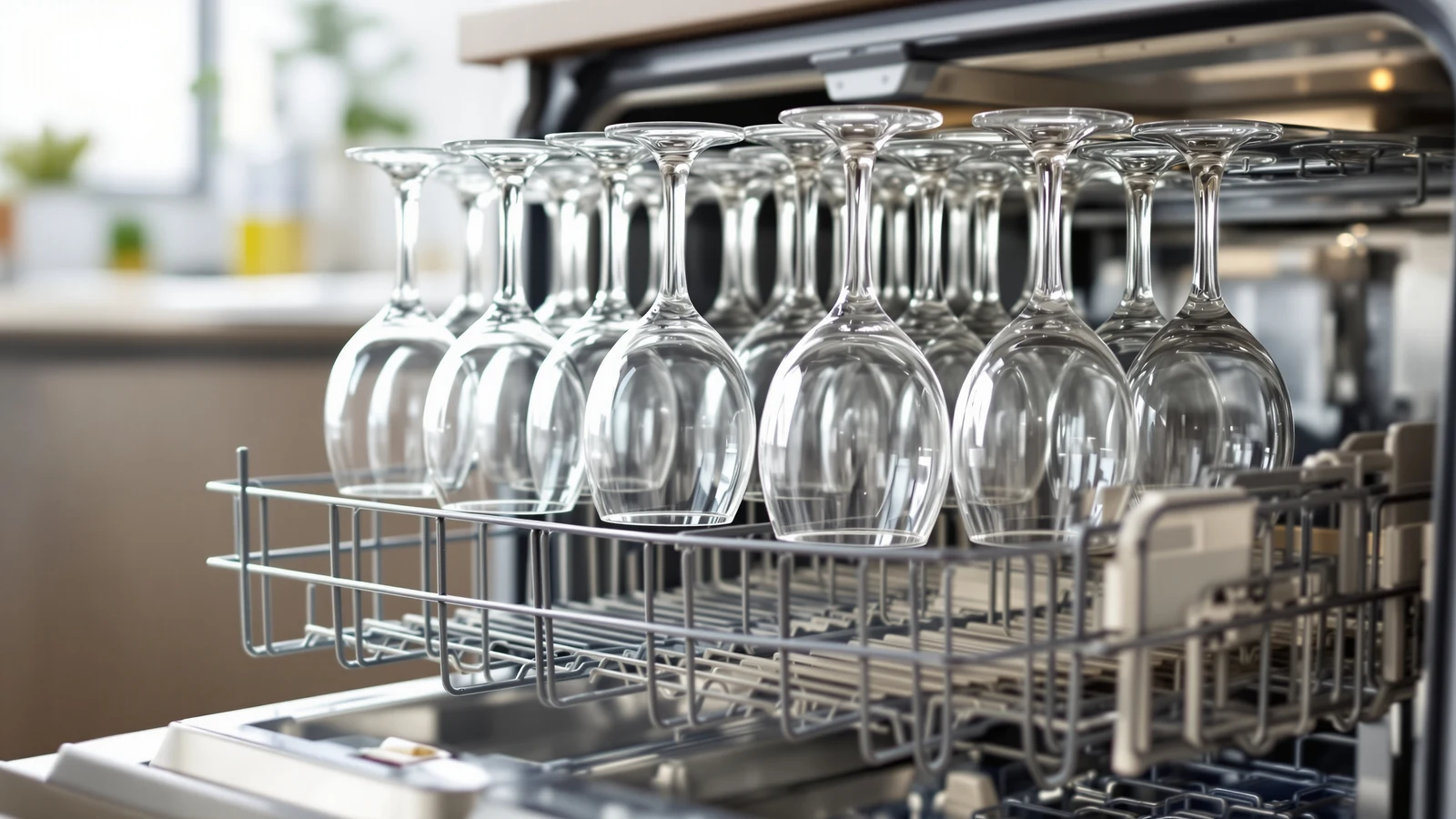
Wine glasses and stemware loaded on the top rack of a portable dishwasher, angled downward and spaced apart

Reader-supported: we may earn a commission when you buy through the links on this page, at no additional cost to you. Prices move constantly — confirm the live price before you order.

A surprising number of countertop and 18-inch portable dishwashers list a cycle simply called Glass among their programs. The name is a specific claim: a wash built around fragile items rather than baked-on grease. Whether that claim survives contact with a $12 wine glass — let alone an heirloom crystal one — is a separate question from whether the cycle exists at all, and answering it honestly means sticking to what these machines' listings actually publish.

This guide covers, in order: what a Glass program mechanically changes about pressure, temperature and rack position; where stemware's real risk differs from an everyday tumbler's; the portable dishwashers in our database that name a Glass cycle, plus one worth checking before you assume it has one; and the loading habits and manufacturer warnings that matter once the door is closed.

How this page is built

We compare published specifications, what ships in the box, and general facts about how dishwashers of this size operate. We do not physically test these machines, we do not run a testing lab, and we do not publish ratings we cannot verify — Amazon returns no rating and no review count for this category, so there are no stars on this site. Where a listing doesn't spell out a program's exact pressure or temperature, we say so rather than guess.

The mechanism

What a Glass cycle actually changes

None of the listings in our database publishes the exact pressure or temperature figures behind their Glass programs — only that the cycle exists by name. What follows is the general mechanism a Glass cycle uses across the dishwasher category, not a spec claim about any single unit here.

Lower water pressure

A Normal or Heavy cycle relies on spray arms pushing water hard enough to knock dried food off a plate. That same force, aimed at a thin-walled glass, is what chips a rim or knocks a glass against a rack tine or its neighbor hard enough to crack it. A Glass program throttles that pressure down: a gentler spray pattern moves water across the surface instead of blasting it — less mechanical force, at the cost of being a poor choice for anything with dried-on food.

Lower temperature

Heat is the part people underestimate. Glass is a poor conductor, so a sudden jump from a cold rinse to a near-boiling wash — or the reverse — creates uneven expansion across the piece. That thermal shock, not a physical knock, is a common way a wine glass stem fails inside a dishwasher. A Glass program generally runs cooler than Normal and often shortens the temperature swing between wash and rinse for that reason.

Rack position

This one isn't specific to any cycle — it's true in every dishwasher. The top rack sits farther from the heating element and receives a gentler, more indirect spray angle than the bottom rack. Stemware belongs on the top rack regardless of program, and that matters more in a portable machine, where the smaller tub puts every rack mechanically closer to the spray arm than a full-size built-in would.

Where it actually breaks

Stemware versus everyday glassware: where the risk actually is

An everyday tumbler is short, wide-based, and its weight is spread evenly across the bottom third of the glass, usually in soda-lime or tempered glass built to survive a kitchen. Run a set through Normal in a portable dishwasher and the main risk is cosmetic — cloudiness from hard water, not breakage.

Stemware is built the opposite way: weight sits in the bowl at the top, balanced on a stem sometimes a few millimeters wide, over a base often smaller than the bowl above it. That geometry creates risk points a tumbler doesn't have:

  • The stem snapping. Vibration from the spray arm, transmitted through a top-heavy glass on a narrow stem, concentrates stress exactly where it's thinnest — the same place thermal shock does its damage.
  • The rim or bowl chipping. Two glasses touching during the wash, or a bowl brushing a rack tine, chips the rim more easily than it would a tumbler's thicker wall.
  • Clouding and etching. Genuine lead crystal is softer than ordinary glass and more reactive to alkaline detergent and hard-water minerals, so it clouds and etches faster than everyday glassware under identical conditions.
  • Tipping and pooling. A tall, unsecured glass can tip mid-cycle; water pools in the bowl instead of draining, and a glass full of water through a heated dry is more likely to crack than one that drained properly.

None of this means stemware can't go in a dishwasher — it means the margin for error is thinner, which is what a Glass program is designed to widen back out.

The picks

The machines that publish a named Glass program

Three machines in our database share one 18-inch platform and its published six-cycle list, which names Glass explicitly. A fourth is worth a closer look before you assume the same.

01Full-size, White

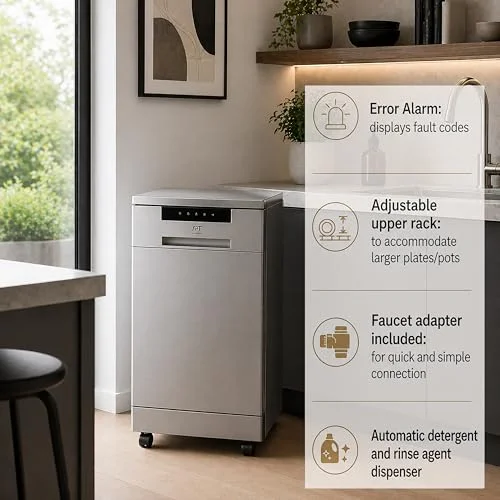
SPT SD-9263WB 18″ Portable Dishwasher (White)

Eight place settings and a spec sheet that names its cycles instead of hiding behind "6 Programs"
Freestanding on castors · 8 place settings · 6 wash programs · stainless steel tub · ENERGY STAR

This is the white-finish version of SPT's SD-9263 platform, the same 18-inch chassis SPT has sold under several exterior finishes for years. The published cycle list names Heavy, Normal, Eco, Glass, 90 Min and Rapid — six programs, one explicitly a Glass setting rather than a generic "delicate" mode. A stainless steel interior tub resists the etching a plastic tub picks up over years of hard-water washing. It stands on the floor, so it needs an 18-inch strip and a clear path to the sink; our guide to placing a portable dishwasher in a small kitchen covers finding that space before you order.

The trade-offFaucet-only — there's no water tank on this platform, so a kitchen tap with a removable aerator is required. And a named Glass cycle is not a guarantee against breakage on its own; loading still does most of the work, which the next two sections cover.
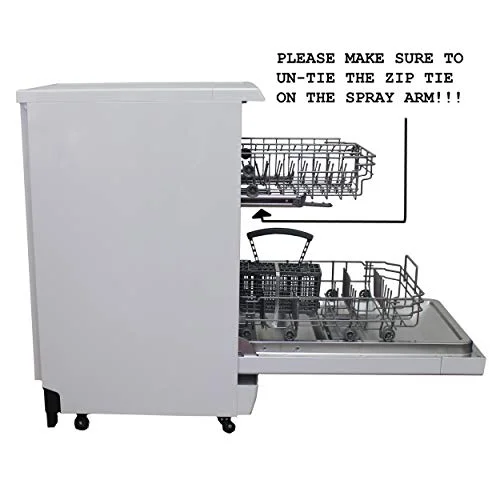
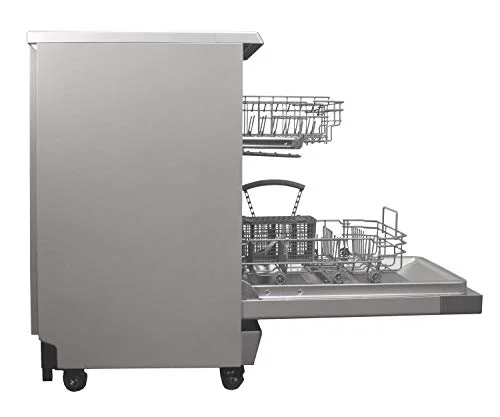
SPT SD-9263WB 18-inch portable dishwasher in white
$614
Glass cycle namedCheck price →
02Full-size, Stainless

SPT SD-9263SSB 18″ Portable Dishwasher (Stainless Steel)

The same platform as above in a stainless exterior, for kitchens where white doesn't match
Freestanding on castors · 8 place settings · 6 wash programs · stainless steel tub · ENERGY STAR

Same SD-9263 chassis, same eight place settings, same published six-program cycle list including Glass — this SKU simply swaps the white exterior for stainless steel. Nothing about the wash mechanics changes with the finish; the Glass program runs the same way it does on the white model, because it's the same interior.

The trade-offIt costs a little more than the white version for a cosmetic difference, and carries the same faucet-only requirement and 18-inch footprint. Check your place-setting math before assuming eight settings covers a glass-only load plus everything else — our breakdown of place settings by household size walks through what that number holds in practice.

SPT SD-9263SSB 18-inch portable dishwasher in stainless steel
$623
Glass cycle namedCheck price →
03Full-size, Stainless

SPT SD-9263SSA 18″ Portable Dishwasher (Stainless Steel)

A third SD-9263 variant, listed separately, running the same six named programs
Freestanding on castors · 8 place settings · 6 wash programs · stainless steel tub · ENERGY STAR

This third listing is close enough to the SSB above that the difference is almost certainly a packaging or minor-revision distinction rather than a different machine — same eight place settings, same six-program spread including Glass, same stainless tub and ENERGY STAR certification. Compare both stainless SKUs' live price before ordering rather than assuming the first one you find is the better deal.

The trade-offBecause SPT lists near-identical hardware under multiple ASINs, check the current listing photos for anything that looks like a stemware rack insert — our database confirms the six named programs, not the exact shape of the rack tines.

SPT SD-9263SSA 18-inch portable dishwasher in stainless steel
$624
Glass cycle namedCheck price →
04Worth checking first

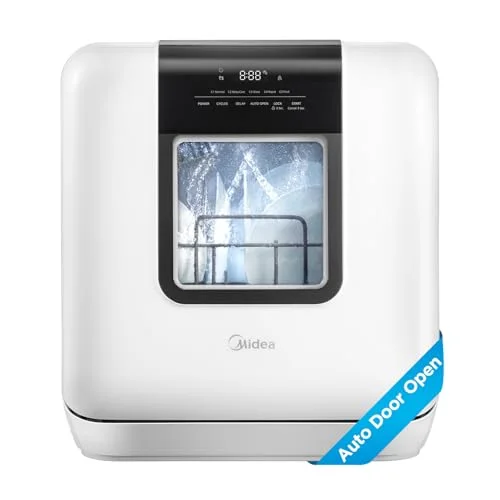
Midea Countertop Dishwasher with 1.59Gal Built-in Water Tank

A tank-fed budget machine where the program names aren't published — verify before assuming
Countertop, tank-fed · 1.59-gallon built-in tank · 5+2 programs · Auto Door Open

This is the honest inclusion. Midea's listing advertises "5+2 Programs" and an Auto Door Open finish — the door pops open automatically at the end of a cycle to vent steam, a real drying aid on a machine with no heating element — but the listing bullets we have don't name the five wash programs individually. That means we can't confirm this specific unit has a program actually labeled Glass, only that it's a tank-fed countertop machine in the same price band as several models in our roundup of portable dishwashers under $400. If a Glass cycle by name is the deciding feature for you, check the current Amazon listing's program list before ordering rather than assuming "5+2" includes one.

The trade-offAt roughly half the price of the SPT platform above, it's the cheaper way into a tank-fed machine that needs no faucet — but treat the Glass-cycle question as unresolved for this unit until you've read the listing yourself.

Midea countertop dishwasher with built-in water tank, Auto Door Open
$288
Verify program listCheck price →
At a glance

How the four compare

All figures are manufacturer specifications; prices are approximate and move constantly on Amazon.

DishwasherClassProgramsGlass cycle named?Price
SPT SD-9263WB (White)18″ freestanding6 programsYes$613.92Price
SPT SD-9263SSB (Stainless)18″ freestanding6 programsYes$622.85Price
SPT SD-9263SSA (Stainless)18″ freestanding6 programsYes$623.75Price
Midea Tank CountertopCountertop, tank-fed5+2 programsNot confirmed$287.98Price
Technique

Loading stems so they don't touch or tip

The cycle name matters less than how the rack is loaded, whether the machine is a full-size built-in or an 18-inch portable. A handful of habits do most of the work of keeping stemware intact:

  • Use the top rack, always. It sits farther from the heating element and gets a gentler spray angle in every dishwasher. Use a stemware section or clip-in tines if the rack has them; if not, angle the glass so the stem is held between two adjacent tines rather than resting loose.
  • Angle the bowl downward. Loaded upright, the bowl fills with water that has to drain past the rim; angled slightly down, water runs out during the cycle instead of pooling through the dry.
  • Leave a gap between glasses. Vibration during the wash is constant, and two bowls touching for the length of a cycle is how a chip starts. A finger's width of clearance is enough.
  • Keep the spray arm's path clear. In a portable machine's smaller tub it's easy for a tall stem to block the arm's rotation. Load stemware toward the outer edge of the rack, away from the center post.
  • Don't mix heights in one row. A short tumbler and a tall wine glass wedged together means neither is properly secured.
  • Run stemware as its own load when you can. Crowding a Glass cycle with plates and pans defeats the point of the gentler pressure. If an off-peak Glass-only run suits your schedule better, several portable dishwashers support delay start for exactly this — see how delay start works and when to use it.
Read the fine print

What manufacturers warn against putting in that cycle

Across the dishwasher category generally — not specific to the four units above, whose individual manuals we haven't reviewed line by line — a Glass cycle is built for everyday stemware, and manufacturers commonly draw a line well short of "anything glass-shaped is safe":

  • Hand-painted or gilded rims. Gold and silver decoration is applied to the surface rather than fired into the glass on most pieces, and repeated exposure to hot water and detergent — even on a gentler cycle — dulls or flakes it over time.
  • Decals and adhesive labels. Printed designs and stick-on decoration are not the same as glass fired with color, and dishwasher heat and detergent are what most manufacturers cite when they exclude decorated pieces.
  • Hand-blown glass with uneven walls. Artisan pieces with visible air bubbles or a wall thickness that varies across the piece are more prone to the thermal-shock failure described earlier, because heat doesn't move evenly through uneven glass.
  • Lead crystal specifically. Many crystal manufacturers advise hand-washing regardless of what cycle a dishwasher offers, because lead crystal is softer than ordinary glass and reacts more readily with dishwasher detergent's alkalinity — the etching risk isn't solved by lower pressure alone.
  • Anything already chipped or cracked. A small existing flaw is where stress concentrates during a wash cycle; a piece that's survived hand-washing with a hairline crack often doesn't survive a dishwasher cycle, gentle or not.

None of this is unique to Glass programs — it's the same list that applies to a full-size built-in's delicate cycle. A portable machine's smaller tub just means the margin for getting the loading wrong is thinner; see our look at what a small tub can and can't handle for the same trade-off applied to cookware instead of glassware.

The honest limit

When hand washing is still the safer call for crystal

A named Glass program narrows the gap between a dishwasher and hand-washing for stemware you can afford to replace. It does not close that gap for pieces you can't. Genuine lead crystal — hand-cut, heavier than ordinary glass, often with a faint gray or bluish tint — is where the honest answer stays "wash it in the sink":

  • Lead crystal is inherently softer than soda-lime glass, so the etching and clouding risk from detergent and hard water is higher no matter how gentle the spray.
  • Cut and faceted patterns trap water and detergent residue in the grooves, which plain hand-washing and a soft cloth remove far more reliably than a rinse cycle.
  • Heirloom and gifted pieces are, by definition, not replaceable at any price a dishwasher's convenience is worth risking.
  • Manufacturer care instructions for genuine crystal frequently say "hand wash only" — when a piece came with that instruction, no machine's Glass cycle overrides it.

The practical dividing line: everyday stemware bought in sets is a reasonable candidate for a dishwasher with a named Glass program, loaded the way this guide describes. Crystal that came in a box lined with tissue paper, or belonged to someone before it belonged to you, goes in the sink.

How we picked

Started from what the spec sheet names

We searched our product database for portable dishwashers whose published cycle list names a Glass program explicitly, rather than machines that merely mention "gentle" cleaning in marketing copy. That surfaced the SD-9263 platform's three listed variants. We included one additional tank-fed machine at a very different price point specifically because its listing does not spell out its program names — an honest example of the exact ambiguity this guide is written to help readers spot.

How we compared

Research, not a lab

We're upfront about this: we don't physically test these machines and we don't run a testing lab. We compare published specifications, program names, capacity and price, and we explain the general mechanics of how a Glass cycle works across the dishwasher category using widely known facts about water pressure, thermal shock and rack position — not claims about a specific unit's internal pressure or temperature, which none of these listings publishes. We show no star ratings because we have no rating data we can verify.

Go deeper

Keep reading

More on getting a portable dishwasher set up right. View all guides →

FAQ

Common questions

What does a dishwasher's Glass cycle actually do differently?

It generally runs at lower water pressure and a cooler, gentler temperature curve than a Normal or Heavy cycle, which reduces the mechanical force and the thermal shock that most often damage thin-walled glass. None of the machines in our database publish the exact pressure or temperature figures for their Glass programs, so treat this as the general mechanism the category uses rather than a spec claim about any one unit.

Can I put real crystal wine glasses in a portable dishwasher?

Everyday stemware is a reasonable candidate for a machine with a named Glass program, loaded on the top rack with space between pieces. Genuine lead crystal is a different case: it's softer than ordinary glass and reacts more readily to dishwasher detergent, so many crystal manufacturers recommend hand-washing regardless of the cycle. Heirloom or irreplaceable pieces belong in the sink, not the machine.

Why do wine glasses sometimes crack even on a Glass cycle?

The two most common causes are thermal shock — a sudden temperature swing between the wash and rinse water — and physical contact with another glass or a rack tine during the cycle's vibration. A gentler cycle reduces both risks but doesn't eliminate them; loading stems with a gap between them and keeping the wash and rinse temperature swing moderate matters as much as which program you select.

Do I need a special rack for stemware in a portable dishwasher?

It helps but isn't strictly required. If a machine's listing or photos show dedicated stemware clips or tines on the top rack, use them. If not, angle each glass so the stem sits held between two adjacent rack tines and the bowl points slightly downward so water drains rather than pools — the same loading principle applies whether or not the rack has dedicated stemware hardware.