Best Portable Dishwashers
Comparison · Delay start

Delay start. Worth having, or just a clock?

A handful of portable dishwashers let you queue a wash for off-peak electricity hours or a quieter time of day. The feature sounds like a small luxury on a spec sheet. What it actually changes — and what a five-dollar timer plug already does for less — is a shorter list than the marketing copy suggests.

By Ilane Tall · Updated September 20, 2026 · Research-based.

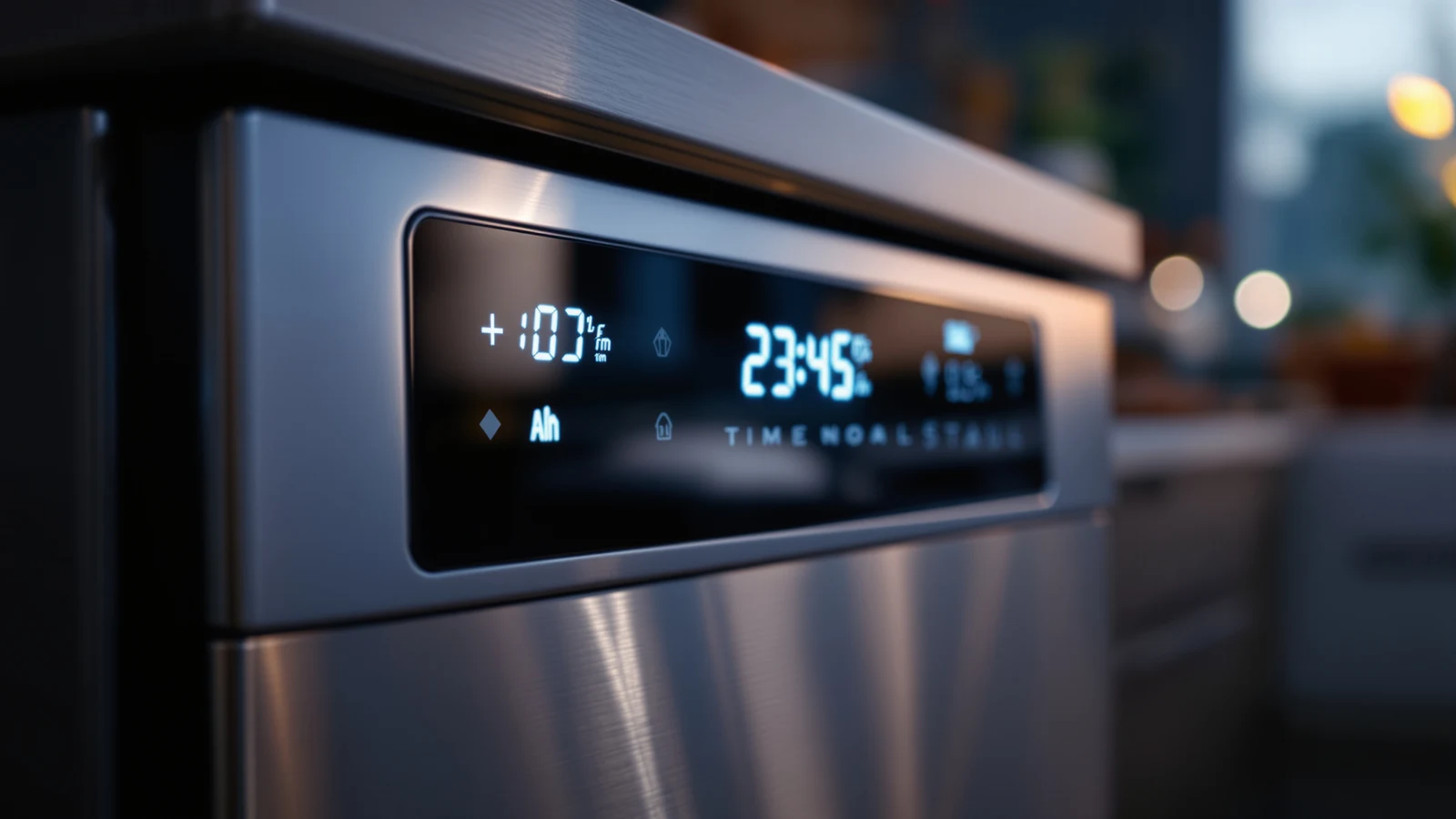
A portable dishwasher control panel showing a delay-start timer set for an overnight cycle

Reader-supported: we may earn a commission when you buy through the links on this page, at no additional cost to you. Prices move constantly — confirm the live price before you order.

Delay start is a small line item on a countertop dishwasher's spec sheet, usually buried after the cycle count and the tank size, and it gets treated by a lot of listings as an automatic selling point. Press a button, tell the machine how many hours to wait, walk away, and the wash begins on its own later — after you've gone to bed, after you've left for work, or after the utility's cheaper electricity hours have started. That's the whole mechanism. It is a countdown timer wired to the start relay, nothing more.

What it's worth depends entirely on what you're hoping it will do. As a way to shift a wash into a quieter part of the night, it does exactly what it says. As a way to cut your electricity bill, the math below shows why the saving on a machine this small is close to invisible. And on three of the four machines in our current lineup, the published spec sheet doesn't mention delay start at all — so before anything else, this page tells you which one actually has it, and what a plain outlet timer does instead for machines that don't.

How this page is built

We compare published specifications, listing titles and prices — we do not physically test these machines and we do not run a testing lab. Amazon's product data returns no rating or review count for this category, so there are no star ratings on this site and no paraphrased review sentiment. Where a listing states a spec, we quote it; where it doesn't, we say so rather than guess.

How it works

What delay start actually does, mechanically

A countertop dishwasher's control board is a small computer sitting between the buttons on the front panel and the parts that do the work — the fill valve or pump, the heating element, the wash pump and the drain pump. Pressing Start normally closes that loop immediately: the board begins running its stored sequence of fill, heat, wash, drain and dry right away.

Delay start inserts a countdown ahead of that sequence. You select a number of hours on the panel — the increments are usually whole hours, not minutes — and the control board simply waits, doing nothing, until the countdown reaches zero. Then it runs the exact cycle you selected, at the exact settings you chose, as if you had pressed Start at that later moment yourself. It is not a smarter cycle and it doesn't run any differently once it begins; it is a wait state bolted onto the front of an ordinary wash.

Two practical consequences follow from that simple description. First, you load the machine, add detergent and select the wash programme before you leave — the delay only postpones the start, so the detergent compartment sits closed and dry for the whole waiting period, which is normal and by design. Second, once the countdown finishes, the machine is unattended for the full length of the cycle, which is the point of the feature and also the thing to plan around; see the section below on running a cycle overnight versus running it while you're out.

The lineup

Which of these four actually offer it, and for how long

Of the four portable dishwashers we currently track, exactly one lists delay start on its own spec sheet. The SUNVIVIPRO 18" Portable Countertop Dishwasher states a 12-hour delay start window in its own listing title, alongside a 152-ounce built-in water tank, six preset wash modes, ENERGY STAR certification and plates up to 12 inches. Twelve hours is enough to load it after breakfast and have it finish by early evening, or load it at bedtime and wake up to clean dishes — either direction fits inside the window without the countdown running out mid-plan.

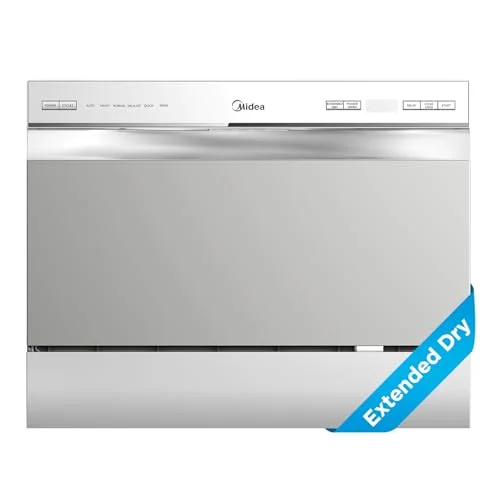
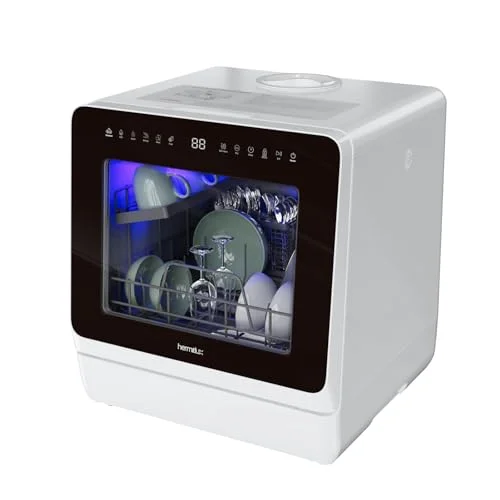
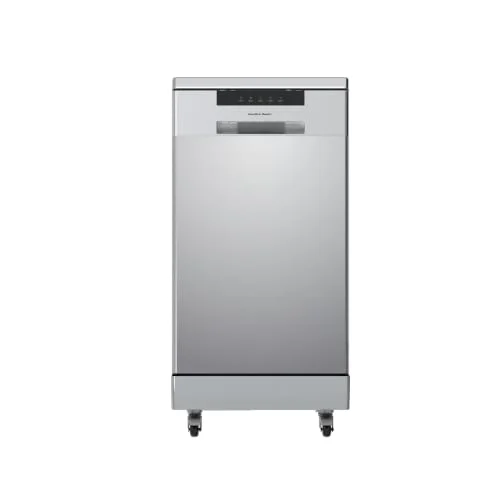
The other three do not mention delay start anywhere in their published listing. The Midea Countertop Dishwasher, a 6-place-setting, ENERGY STAR model, lists its cycle count and capacity but no delay function. The Hermitlux Countertop Dishwasher — the black-glass-door, 10-function variant we track — lists seven washing programmes but nothing about a countdown timer. And the Hamilton Beach Portable Dishwasher, the most expensive of the four at $599.99, doesn't list one either in the information we have on file.

That's not the same as saying those three definitely lack the feature — listing bullet points are written by marketing teams, not engineers, and a real control-panel function occasionally goes unmentioned. But we don't assert a spec we can't see: treat delay start as confirmed only for the model whose own listing states it, and check the current listing yourself for the other three before assuming they have it.

The money question

Off-peak electricity, and why the saving is usually small

The pitch behind delay start's off-peak angle is straightforward: some utilities charge less for electricity used late at night or in the early morning, under a time-of-use rate plan, so shifting a wash into that window should shave something off the bill. It does — the question is how much, and a countertop dishwasher is a small enough appliance that the honest answer is "not much."

Work through the arithmetic with round, stated assumptions rather than a number we can't verify for any specific machine: assume a wash cycle draws on the order of 1 kWh, a reasonable ballpark for a compact, cold-fill countertop machine — actual draw varies by model and cycle, and none of the four listings above states a per-cycle kWh figure, so treat this as illustrative, not a spec. Assume a time-of-use utility charges $0.30/kWh at peak and $0.20/kWh off-peak, a $0.10 spread on the generous end of what residential plans typically publish. One cycle shifted off-peak then saves roughly ten cents; run the dishwasher daily for a month and the saving totals around three dollars.

Three dollars a month is real money over a year, but it's a rounding error against the price difference between models, and it assumes your utility offers time-of-use billing at all — most U.S. residential customers are still on a flat rate, where shifting the wash time changes nothing. If cutting electricity cost is the actual goal, the bigger levers are elsewhere: a full load instead of a half-empty one, air-drying instead of a heated dry cycle, and buying an ENERGY STAR-certified model — a spec both the SUNVIVIPRO and the Midea here carry. Delay start's off-peak case is real but small; its better case, covered next, is about noise and timing rather than money.

Overnight vs. out

A quiet cycle overnight versus running it while you're out

The stronger, more defensible use of delay start has nothing to do with electricity rates — it's about when the noise and the wait happen relative to your life. A countertop dishwasher's wash-and-dry cycle commonly runs upward of an hour, sometimes closer to two on a heavy or sanitizing programme, and for that whole time it is running a pump, cycling a heating element and occasionally sounding a drain cycle loud enough to notice in an open-plan apartment or a studio. Delay start lets you push that noise into a stretch of time when nobody's listening, rather than sitting through it or working around it.

Two versions of "nobody's listening" are not equivalent. Running the delayed cycle overnight while you're asleep in the same home means the machine is unattended but the space is occupied — if a hose slips or the machine trips a breaker, you're present to notice, even half-awake. Running it while you're out for hours is unattended in a different sense: nobody notices anything until you return. That's a meaningfully longer unattended window, and it applies to any water-using appliance, which is why manufacturer guidance for washing machines and dishwashers alike generally leans toward attended use — worth reading your specific model's manual on the point.

For countertop tank-fed machines, the plumbing involved is closer to a kettle with a drain hose than to a fixed appliance — no permanent supply-line connection, which removes one failure mode but not others (a drain hose knocked loose, a tank overflowed, an uneven counter). None of that argues against delay start; it argues for thinking about where the machine sits and how the drain hose is secured, regardless of whether the cycle runs at 2pm or 2am. If placement is the open question, our guide to where to put a portable dishwasher when there is no room covers the counter, drain-reach and stability questions in more depth.

The pick

The one with the most useful delay window

01Confirmed delay start

SUNVIVIPRO 18" Portable Countertop Dishwasher

The only one of our four with a stated delay-start spec
Countertop · 152 oz built-in tank · 6 preset modes · 12-hour delay start · plates to 12 in · ENERGY STAR

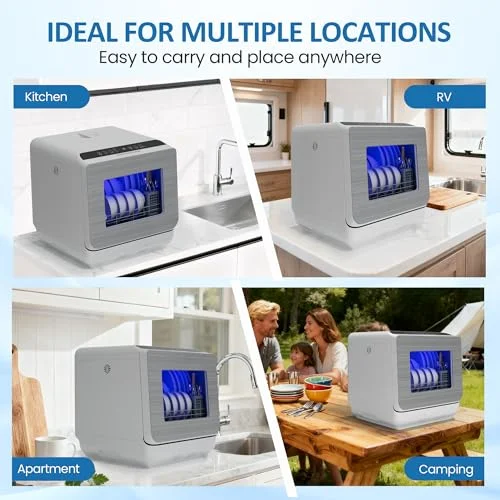
A 12-hour window is the practical sweet spot for this feature: long enough to load the machine before you leave for a full workday and have it finish not long after you're back, or to load it at night and wake up to a finished cycle, without a countdown so long it feels arbitrary. Pair that with the 152-ounce tank and this is also one of the few models here that can run a delayed cycle with no faucet connection at all — load the tank, set the timer, and the machine needs nothing else until it's done. It's marketed toward dorms, RVs and apartments, which lines up with the no-hookup, set-and-forget use case delay start suits best.

The trade-offTwelve hours is a fixed maximum, not adjustable in finer increments than the listing states, and this is a tank-fed machine capped at 12-inch plates — check the current listing for the full dimension and place-setting figures before you buy.

SUNVIVIPRO 18-inch portable countertop dishwasher with built-in water tank
$300
12h delay startCheck price →

The other three in our lineup are worth knowing about for other reasons even though none confirms a delay-start spec. The Midea 6-place-setting model is the largest-capacity countertop machine of the four and also ENERGY STAR certified, which matters more for a household running it daily than a delay timer does. The Hermitlux, in its black-glass-door, 10-function configuration, leads on cycle variety with seven washing programmes. The Hamilton Beach, at roughly double the price of the other three, is the premium pick of this group on cost alone — check its current listing directly for capacity and installation details, since we don't have those specifics on file for this ASIN.

The cheaper alternative

When a manual timer plug does the same job for less

Here's the honest limit of delay start as a selling point: for three of our four machines, and for most countertop dishwashers on the market generally, a mechanical or smart outlet timer plugged in line with the power cord gets you most of the same outcome for a few dollars, and it works on a machine that has no delay function of its own.

The idea is simple. Load the dishwasher, add detergent, select your wash programme — but don't press Start. Instead, plug the machine's power cord into an outlet timer set to cut power now and restore it at whatever hour you want the wash to begin. When power returns, some control panels resume the exact state they were in and will start automatically once power is live; others require a physical button press to actually begin the cycle even after power returns, which a timer alone can't do. That's the one thing to check on your specific model before you rely on a timer to finish the job unattended — read your dishwasher's manual for how it behaves after a power interruption, rather than assuming it works like a lamp.

Where a timer plug wins: it costs a fraction of the price gap between a dishwasher with delay start and one without, it works on every machine in our lineup that lacks the built-in feature, and a smart-plug version adds scheduling flexibility a fixed 12-hour countdown doesn't offer — a different start time each night, controlled from your phone. Where the built-in feature still wins: it's simpler, has no separate part to lose, and is validated by the manufacturer to behave predictably with that exact control board, which a generic timer from an unrelated brand is not.

The honest framing: buy a machine with delay start if that spec happens to come with a model you'd choose anyway for its capacity, tank or price — as it does with the SUNVIVIPRO here. Don't pay a premium for the feature alone, and don't rule out the other three on the assumption a pricier model needs a delay timer to be worth owning; a cheap outlet timer closes that gap.
At a glance

The four machines in this comparison

Delay start is stated only where the manufacturer's own listing states it. Prices move constantly — confirm the live price on Amazon.

DishwasherClassDelay startWater sourcePrice
SUNVIVIPRO 18" CountertopCountertop12 hours152 oz tank$299.99Price
Midea 6-Place CountertopCountertopNot statedFaucet$299.98Price
Hermitlux CountertopCountertopNot statedCheck listing$299.99Price
Hamilton Beach PortablePortableNot statedCheck listing$599.99Price
The decision

Where delay start actually belongs on your checklist

Delay start earns its keep if

Any one of these is true

You want the wash to finish before you wake up or before you get home, without doing any extra math. You run the machine from its own tank and want to set it and walk away with no faucet or outlet plumbing to think about beyond power. Or a home with time-of-use electricity rates makes the small off-peak saving worth having as a bonus, not the main reason to buy.

A timer plug is the better answer if

Any one of these is true

The machine you actually want for its capacity, price or tank doesn't have delay start — as is the case for three of the four models here. You want scheduling flexibility a fixed countdown doesn't offer, like a different start time each night. Or the electricity saving is the whole reason you're considering the feature — a $6 timer captures that saving on any machine, with money left over.

FAQ

Common questions about delay start

What does delay start actually do on a portable dishwasher?

It inserts a countdown timer ahead of the wash cycle you've already selected. You load the machine, add detergent and choose your programme, then set the number of hours to wait; the control board holds the machine in a paused state until the countdown reaches zero, then runs the exact cycle you picked. It doesn't change how the cycle itself washes or dries.

Which of these four portable dishwashers has delay start?

Only the SUNVIVIPRO 18" Portable Countertop Dishwasher states a delay-start spec in its own listing — a 12-hour window. The Midea, the Hermitlux and the Hamilton Beach models we track do not mention the feature in their published specifications, so we don't assert they have it; check each listing directly if it's a deciding factor.

Does running a dishwasher on off-peak electricity actually save money?

A little, and only if your utility bills on a time-of-use plan. Assuming a cycle draws roughly 1 kWh and a $0.10 spread between peak and off-peak rates — both estimates, since none of these listings states a per-cycle kWh figure — one shifted cycle saves around ten cents, or roughly three dollars a month run daily. Full-size appliances and time-of-use plans with a wider rate spread produce a bigger saving than a small countertop dishwasher does.

Can I use a smart plug or timer instead of buying a dishwasher with delay start?

Often, yes. Load the machine and select the programme without pressing Start, then let an outlet timer cut and later restore power at the time you want the wash to begin. The catch is that some control panels require a manual button press to begin the cycle even after power returns, rather than resuming automatically — check your specific model's manual or listing Q&A before relying on a timer to finish the job while you're away.

Keep reading

Next, from this site