Best Portable Dishwashers
Guide · Power & Electrical

What a portable dishwasher needs from your outlet.

These machines heat their own water from cold, on top of running a pump and a heating element at the same time. That is a bigger electrical draw than the appliance's size suggests, and it is why the manual bans extension cords and why some kitchens trip a breaker on the first run.

By Ilane Tall · Updated September 13, 2026 · Research-based.

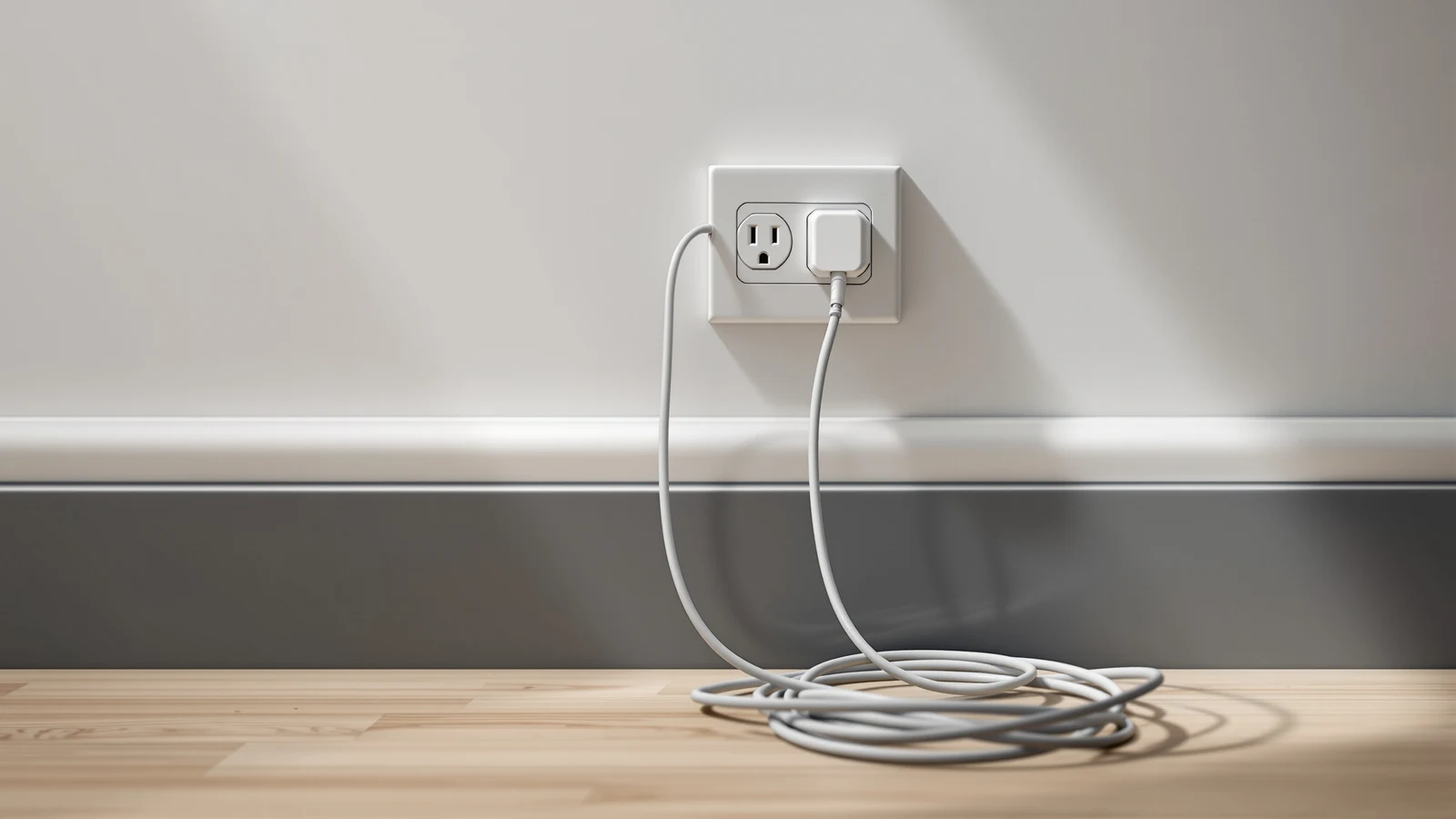
A portable dishwasher plugged directly into a kitchen wall outlet, no extension cord in sight

Reader-supported: we may earn a commission when you buy through the links on this page, at no additional cost to you. This is general information based on published specifications and standard electrical code — not a licensed electrician's inspection of your kitchen.

A portable dishwasher looks like a small, low-power appliance. It is roughly the size of a microwave, it runs quietly, and the box it came in was not heavy. None of that tells you what it draws from the wall, because unlike a microwave it is not just moving current through a magnetron for two minutes — it is heating several litres of water from tap temperature to somewhere between 120°F and 165°F, every cycle, using a resistive heating element that behaves electrically like a space heater. That single fact is behind almost every power complaint this category gets: the tripped breaker, the "do not use an extension cord" warning stamped on page one of the manual, and the outlet that gets warm to the touch after a long Heavy cycle.

This guide covers what a portable dishwasher actually draws, why the number is higher than the appliance's size implies, what else is typically wired to the same kitchen circuit, why the manual is specific about extension cords, what changes in an older building, and what a breaker that trips more than once is actually telling you. It ends with the three machines in our database sorted by what we know about their power draw.

How this page is built

We compare published specifications — wattage, amperage and voltage where the manufacturer states them, or the certification standard they carry — against general facts about US residential electrical code (NEMA plug types, NEC circuit rules, standard breaker sizes). We are not licensed electricians and this is not a substitute for one; anything involving your home's wiring, breaker panel or outlet count should be confirmed by a qualified electrician or your building's maintenance staff. We do not physically test these machines and we do not publish ratings we cannot verify — Amazon returns no rating or review count for this category.

Why the draw is bigger than it looks

Why a dishwasher draws more than it looks

Most small kitchen appliances draw current for a short burst or a low, steady trickle. A dishwasher — portable or built-in — does neither. Its single biggest load is the water heater, a resistive element that runs at or near full power for a meaningful chunk of the cycle, because heating water is one of the most electrically expensive things a household appliance can do. Water has a high specific heat: it takes real, sustained energy to raise several litres of it by 60 or 80 degrees, and that energy comes from the wall, not from the tap.

Layer onto that a circulation pump running the whole time water is being sprayed, a drain pump at the end of the cycle, and on some models a heated-air drying element — and you get an appliance whose peak draw, during the heating phase, is meaningfully higher than its average draw across the full two-hour cycle. A "quiet, compact machine" framing misses this because size and sound don't track electrical load the way they do with, say, a fan. A countertop dishwasher and a countertop microwave can be the same footprint and pull very different currents.

This is also why manufacturers specify a dedicated plug type and a minimum circuit rating for these machines, in the same section of the manual that covers detergent and rinse aid — it isn't boilerplate, it's load-bearing information. Standard household outlets in the US are rated 15 or 20 amps at 120 volts; a dishwasher's startup surge and steady-state heating draw are sized against that number, which is why the type of outlet in your kitchen — not just whether there's a free socket — decides whether the machine belongs there.

Amps and circuits

Amps, circuits, and what else is on that wall

A circuit is not the same thing as an outlet. One breaker in your panel commonly feeds several outlets around a kitchen — sometimes the whole counter run — and the breaker trips based on the total current drawn by everything plugged into that circuit at once, not just the dishwasher. This is the detail that catches people out: a portable dishwasher can be well within its own rated draw and still trip a breaker, because a coffee maker, a toaster and a microwave are also live on the same 15-amp loop.

Standard US kitchen circuits are rated 15 or 20 amps at 120 volts, which under NEC guidance works out to a continuous safe load of about 12 or 16 amps respectively — codes generally recommend not loading a circuit past 80 percent of its rating for anything running a sustained draw, which a water heater qualifies as. A dishwasher's heating phase, run at the same time as a kettle or a space heater on the same loop, can push the combined draw over that line even though neither appliance is individually "too much" for the circuit.

The practical version of this rule: before you run a portable dishwasher, know which outlets in your kitchen share a breaker. Older homes, apartments split into smaller units, and kitchens with a lot of outlets on one run are the most common places this bites. If in doubt, run the dishwasher on its own — nothing else drawing power from that circuit for the length of the cycle — before you assume a repeated trip means a faulty machine.

Extension cords

Extension cords: why the manual forbids them

Every portable dishwasher manual we've read carries some version of the same instruction: plug directly into a wall outlet, never into an extension cord or a power strip. It is worth taking literally rather than treating as generic small-print caution, for two specific reasons tied to what this appliance is electrically.

  • Sustained high current, not a brief spike. A standard household extension cord is built for lighter, shorter-duration loads. A dishwasher's heating element draws close to its rated current for a sustained stretch of the cycle, and a thin or long extension cord run at that load for that long generates heat in the cord itself — the resistance in the wire converts some of that current into heat rather than delivering it to the appliance, and a long or coiled cord makes this worse.
  • Voltage drop. The longer and thinner the cord, the more the voltage sags under sustained load. A water heater running on a lower-than-rated voltage draws more current to do the same work, compounding the first problem instead of relieving it.

Put together, that's the mechanism behind the fire-risk warnings that show up in the fine print: an undersized cord carrying a sustained near-maximum-rated load for an extended period is exactly the failure case extension cords are worst at. A power strip built for electronics — phone chargers, a lamp, a laptop brick — is not rated for it at all. If the outlet you want to use is too far from where the machine needs to sit, the fix is a longer-reaching supply hose or moving the machine closer to the outlet, not a longer power cord.

Older buildings

Older buildings and shared kitchen circuits

This is where the theory in the two sections above turns into an actual buying decision for a lot of renters. Buildings wired before modern kitchen-circuit code requirements often have fewer dedicated circuits serving the kitchen than a newer build, meaning more outlets — sometimes the whole room — sharing one breaker rated 15 amps rather than 20. Two-prong outlets without a ground, common in pre-1960s buildings that haven't been rewired, are a separate issue again: most dishwasher plugs are three-prong and grounded, and an adapter that defeats the ground pin is not a fix, it's a removed safety feature.

None of this means a portable dishwasher can't work in an older kitchen. It means the outlet needs to be checked, not assumed. A grounded three-prong outlet, on a circuit not already carrying a fridge, microwave or space heater, is the baseline. If your building's outlets are original two-prong, or you're not sure how the kitchen circuits are split, that's a question for the building's maintenance staff or a licensed electrician before the machine ships, not after the first tripped breaker.

This is also a reason a tank-fed countertop model can be the more forgiving choice in an older apartment: it still needs a proper grounded outlet, but it doesn't add a second constraint about which faucet it can reach, the way a faucet-only machine does. Our comparison of the two portable classes covers the faucet side of that trade-off in full.

Repeated trips

What tripping repeatedly is telling you

A breaker that trips is doing its job — it's a safety device, not a malfunction, and it means the circuit drew more current than it's rated to carry safely. What matters is the pattern, because different patterns point to different causes.

Trips once, on a long or hot cycle

Most likely something else on the same circuit was drawing power at the same time — a kettle, a toaster, a second appliance mid-heat. Unplug everything else on that circuit, run the dishwasher alone, and see if it repeats. This is the single most common cause and the easiest to rule out.

Trips every time, dishwasher alone on the circuit

This points to the circuit itself being undersized for the appliance — a 15-amp circuit trying to carry a machine specified for 20, for example — or a wiring or breaker problem unrelated to the dishwasher at all: a weak breaker, a loose connection, deteriorating insulation. This is not a case for trial and error. It's the point to stop and call an electrician, because the fix is either a different circuit or a repair, not a different dishwasher habit.

Trips on a specific cycle, not others

Cycles that run hottest — Heavy, Sanitize, Baby-Care — draw the most sustained current during the heating phase, so a circuit near its limit will show the problem there first and stay fine on a quick rinse or glass cycle. That's a symptom of the same margin issue as above, just easier to miss because the machine "mostly works."

What repeated tripping is never telling you is that you should switch to an extension cord to "spread the load," or wedge a two-prong adapter over a three-prong plug to make it fit an older outlet. Both remove a safety mechanism instead of addressing the actual mismatch between the appliance's draw and the circuit supplying it.

The picks

The picks by power draw

Manufacturer-stated figures where available. Confirm the rating plate on your unit and your outlet type before installing — these are general figures, not a wiring inspection.

01Countertop, faucet-fed

COMFEE' Countertop Dishwasher, 6 Place Settings

For a standard grounded kitchen outlet, no extension cord
Countertop · 6 place settings, 8 programmes · faucet-connect · ENERGY STAR

This is the largest countertop machine in our database and the one we lead our main roundup with, and it plugs into a standard 120-volt grounded household outlet like the rest of the machines here — it is not a special-circuit appliance. What it does need is that outlet to itself for the length of a cycle, and specifically not an extension cord, per the standard portable-dishwasher instruction covered above. Its ENERGY STAR certification, unusually for this category, means a third party has independently verified its energy consumption figures — a small proof point in a category where most power claims are unverified.

The trade-offBeing the biggest countertop machine here means the heating element has more water to bring up to temperature per cycle than a smaller tank model, which is a longer sustained draw, not a higher rated one.
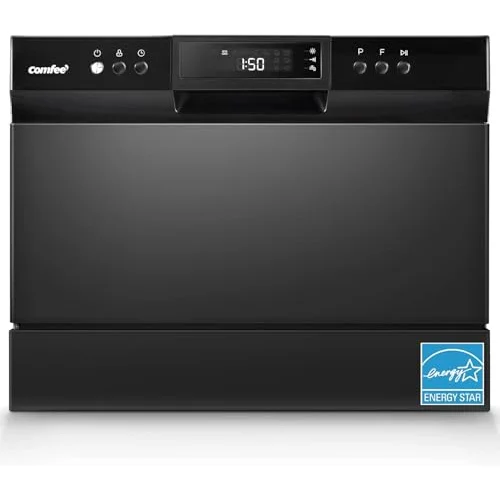
COMFEE' countertop dishwasher in black
$279
6 place settingsCheck price →
02Freestanding, full-size

HAMILTON BEACH Portable Dishwasher, SS/Platinum

A near-full-size machine, still on a standard household plug
Freestanding on castors · faucet-connect

Being closer in size to a built-in dishwasher than to a microwave, this is the machine most likely to prompt the question "does this need special wiring?" It doesn't — like the countertop machines here, it's designed to run from an ordinary grounded 120-volt outlet, the same class of circuit as a full-size built-in dishwasher would use if it were plumbed in instead of rolled to the sink. The rating plate on the back or underside of the unit is the authoritative source for its exact wattage and amperage; check it against your specific outlet and circuit before the first run, particularly in an older kitchen.

The trade-offIts size means it's the machine most likely to be run alongside other kitchen appliances during meal prep — exactly the shared-circuit scenario in the "amps and circuits" section above — so give it a circuit with headroom rather than the same outlet strip as the toaster and the coffee maker.

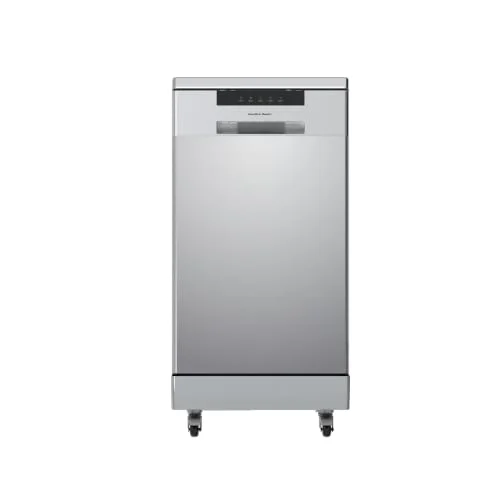
Hamilton Beach portable dishwasher in stainless steel and platinum
$600
FreestandingCheck price →
0318-inch, freestanding

BLACK+DECKER 18-Inch Portable Dishwasher, BPD8B

A real dishwasher on castors, same plug rules apply
Freestanding on castors, 18 in wide · faucet-connect · ENERGY STAR

The BPD8B is built on the same electrical premise as the other two picks here: a standard household plug, no special circuit, and the same manual instruction against extension cords that applies across this category. Its ENERGY STAR certification is a useful, independently verified data point on energy consumption, though certification covers total energy use across a standard cycle rather than instantaneous amperage — the two are related but not the same number, and the rating plate is still the source for the latter.

The trade-offRolling on castors means it can be moved to whichever outlet is best positioned, which is genuinely useful — but the temptation that comes with that mobility is reaching further than the cord allows and reaching for an extension cord instead. Move the machine, not the plug.

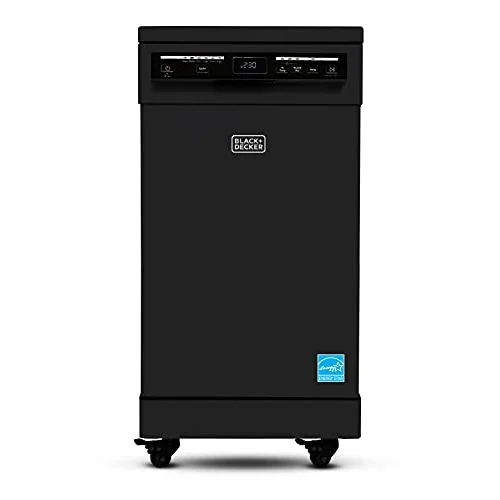
BLACK+DECKER 18-inch portable dishwasher on wheels
$610
18 in wideCheck price →
Our top picks

Our Top Picks

Editor's Pick

COMFEE' 6-Place Countertop

$278.97

Standard grounded outlet, ENERGY STAR verified, our overall top pick for capacity per dollar.

Check price →
Premium Choice

Hamilton Beach SS/Platinum

$599.99

Full-size freestanding capacity on the same ordinary household circuit as the smaller machines.

Check price →
Best Value on Wheels

BLACK+DECKER BPD8B

$609.99

18-inch freestanding on castors, ENERGY STAR certified, no special wiring required.

Check price →
How we picked

Three machines, sorted by electrical footprint

We drew on the three portable dishwashers in our database and sorted them by physical class — countertop faucet-fed, freestanding full-size, and 18-inch freestanding on castors — since size and installation type correlate with how a machine gets discussed in the power-and-outlet conversation, even though the underlying plug requirement (a standard grounded 120-volt household outlet) is consistent across all three.

How we compared

Research, not a lab

We're honest about this: we don't physically test these machines and we don't run a testing lab. We compare published specifications, certification status and general US residential electrical code, and we read manufacturer claims sceptically. We show no star ratings because we have no rating data we can verify, and we never invent scores or paraphrase review sentiment we don't have.

FAQ

Common questions about power and outlets

Can I plug a portable dishwasher into a regular outlet?

Yes — portable dishwashers are designed to run from a standard grounded 120-volt household outlet, the same type most kitchen appliances use. What matters is that it's a dedicated connection: plugged directly into the wall, not through an extension cord or power strip, and ideally not sharing that circuit with other high-draw appliances during the cycle.

Why does my portable dishwasher's manual say not to use an extension cord?

Because the machine's water heater draws a sustained, near-maximum current for a meaningful part of the cycle, and a standard extension cord is built for lighter or shorter-duration loads. A cord carrying that draw for that long heats up in the wire itself and can drop the voltage reaching the appliance, both of which compound rather than relieve the load — the mechanism behind most appliance-cord fire warnings.

Why does my breaker trip when I run the dishwasher?

Most often it's the total load on that circuit, not the dishwasher alone — a shared kitchen circuit carrying a kettle, toaster or microwave at the same time as the dishwasher's heating phase. Unplug everything else on the circuit and run the dishwasher by itself first. If it still trips alone, that points to an undersized or faulty circuit, which is a question for a licensed electrician rather than something to work around.

Do older apartments need special wiring for a portable dishwasher?

Not special wiring, but a working grounded three-prong outlet not already loaded with other appliances is the baseline, and older buildings are more likely to fall short of it — fewer dedicated kitchen circuits, or original two-prong outlets that predate modern grounding requirements. Check with a licensed electrician or your building's maintenance staff before assuming an older kitchen's outlets can take the load.

Keep reading

Next, from this site