Best Portable Dishwashers
Guide · Placement & Clearance

Where to put it when there's no room to put it.

A portable dishwasher doesn't need a hole cut in your cabinetry, and that's the whole sales pitch — but it still needs an exact amount of counter, cupboard, tap and floor, and the tape measure decides whether the machine gets used past the first week or ends up folded away in a closet.

By Ilane Tall · Updated September 14, 2026 · Research-based.

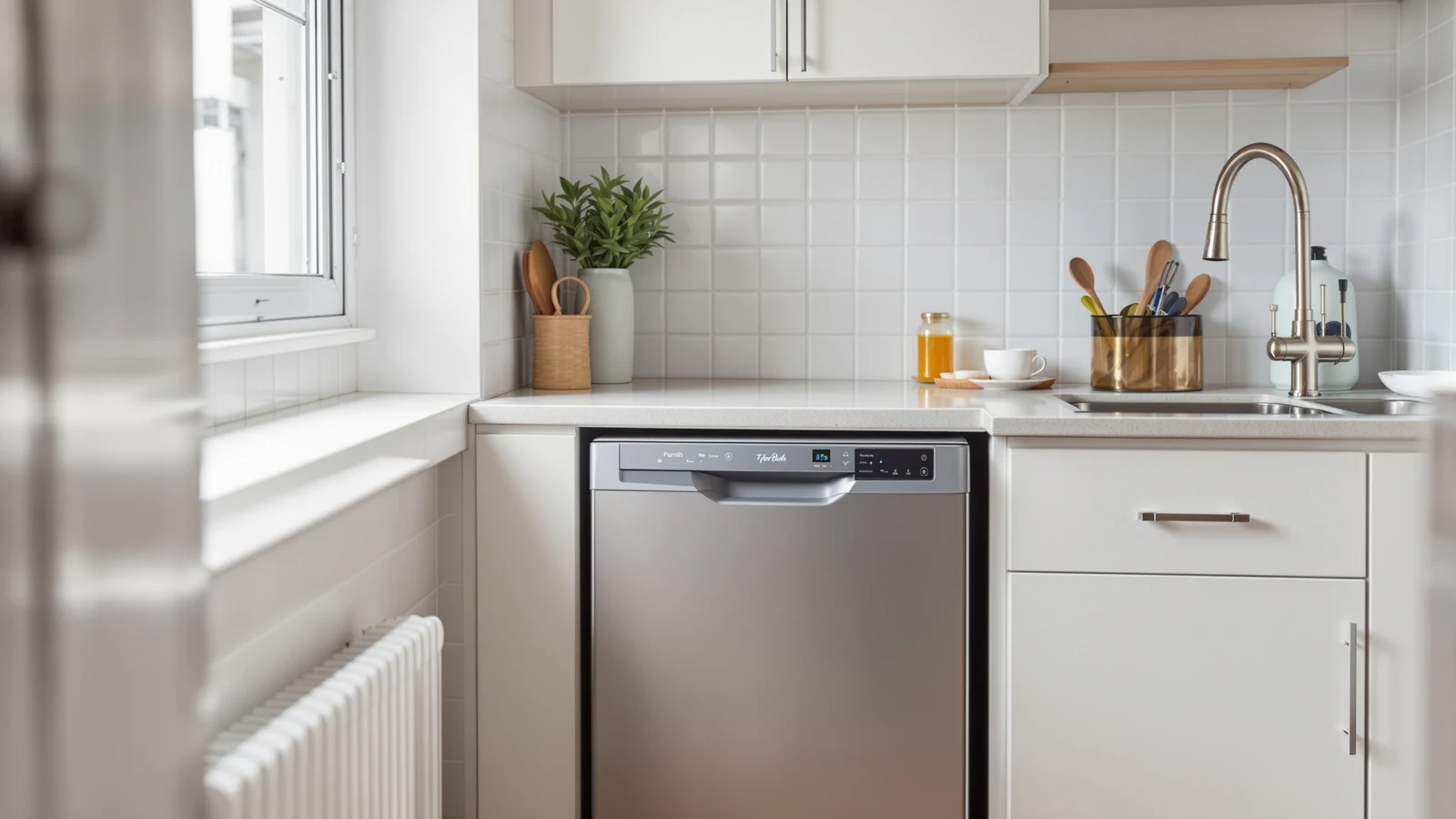
A stainless-finish portable dishwasher fitted into a narrow strip of counter next to the kitchen sink, tucked under a white wall cabinet

Reader-supported: we may earn a commission when you buy through the links on this page, at no additional cost to you. Prices move constantly — confirm the live price before you order.

Most buying guides for this category talk about place settings, cycles and price, and leave the physical siting of the machine for you to work out after the box arrives. That's backwards. A portable dishwasher needs to sit somewhere with a specific amount of headroom, a specific relationship to your sink, and in some layouts a specific weight limit under it. Get the placement wrong and the "portable" part stops helping: the machine ends up living on a dining table, blocking the one sink in a studio, or back in its box within a month.

This guide works through the five things that actually decide where a countertop dishwasher can live in a small kitchen — door swing beyond the box dimensions, the cupboard clearance almost nobody checks, what happens to your sink while it runs, whether a rolling cart is really the fix it looks like, and what steam does to the wood above it — then closes with picks sorted by footprint rather than capacity.

How this page is built

We compare published specifications, what ships in the box, dimensions where the listing states them, water source and price. We do not physically test these machines, we do not run a testing lab, and we do not publish ratings we cannot verify — Amazon returns no rating and no review count for this category, so there are no stars on this site. Where a specification isn't published for a given model, we say so and point you to the listing instead of guessing.

Rule one

Measuring for the door, not just the box

The number printed on the listing — height by width by depth — describes a closed box sitting still. It says nothing about the shape the machine takes up once you open it, and that second shape is what has to fit your kitchen. Most countertop dishwashers open one of two ways: a front-hinged door that drops down and swings forward, or a lid that lifts straight up off the top. Either way the appliance needs more space than its resting footprint the moment you're loading it — which is twice a day.

A door that drops forward needs clear air in front equal to roughly its own height, plus room to reach into the tub without your knuckles hitting the counter edge — awkward under an overhanging cabinet. A lid that lifts up needs headroom for the full lid travel, on top of whatever the cupboard already demands, the subject of the next section. Before you order, stand at the intended spot and hold your arms out where the open door or raised lid would be — a cabinet handle, a spice rack or a low light fixture is the kind of obstruction a floor-plan measurement misses and a physical check catches instantly.

The same walk-through should include where the machine plugs in — its power cord is short by design, and per manufacturer instructions it needs a dedicated wall outlet directly, not an extension cord. Our guide to outlet and power requirements covers why that rule exists and where the outlet needs to sit relative to the spot you've picked.

Rule two

Clearance above: the cupboard nobody measures

This is the single most common reason a countertop dishwasher gets returned. Standard American kitchens hang wall cabinets about 18 inches above the countertop, a number set to clear a standing person's sightline, not to accommodate a new category of appliance. Compact countertop dishwashers are commonly 17 to 18 inches tall in their own right, before you account for opening anything, which puts the two numbers on a collision course from the start.

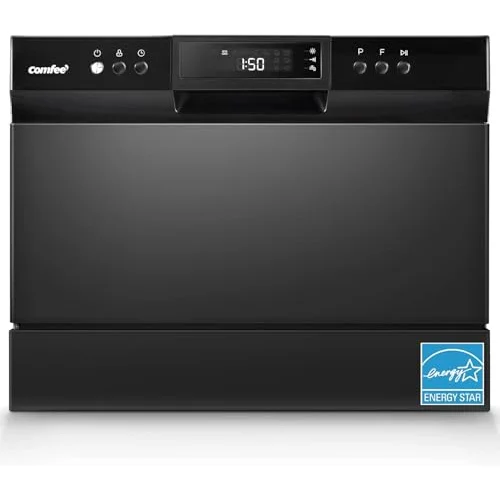
The COMFEE' 6-Place Countertop Dishwasher shows how tight that math actually is. It's a larger machine within its class, and manufacturer instructions for machines in this size band commonly ask for well over 19 inches of clear vertical space to actually operate — more than the standard 18-inch cabinet gap gives you, before the lid or door has opened at all. That isn't a defect in the appliance; it's a mismatch between two things designed independently. The only way to catch it before the machine arrives is to measure from your countertop straight up to the underside of the cabinet above, at the exact spot you intend to use, and compare that against the clearance figure printed in the listing — not the ceiling height, not a guess.

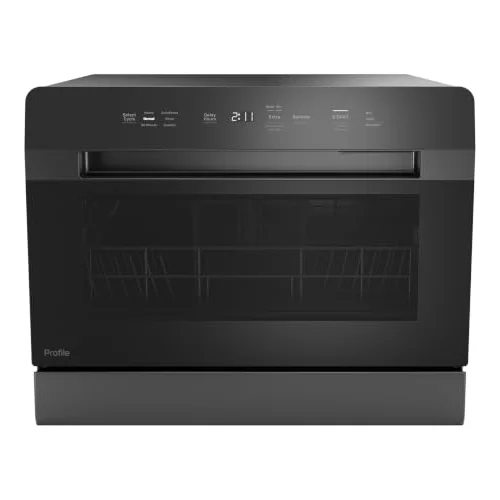
If your counter run has no gap that clears, the fix isn't a smaller dishwasher, it's a different kind of spot: an island, an open shelf, or a stretch of counter with no upper cabinet at all. The GE Profile sidesteps the collision differently — built for three installation types, sitting on the counter, built into a cabinet opening, or fitted under the sink — so a kitchen where clearance genuinely doesn't work can still house it under the sink, provided that space and its plumbing are free. The AIRMSEN listing doesn't publish a clearance figure in the specifics we have, so treat that number as unknown until you check the listing rather than assuming it matches a similarly sized machine.
Rule three

Keeping the sink usable while it runs

A studio or one-galley kitchen usually has exactly one sink, and a faucet-fed dishwasher wants that sink's tap for the length of an entire cycle — commonly close to two hours, which our guide to cycle times breaks down programme by programme. The COMFEE' 6-Place model connects via a faucet adapter, and the GE Profile connects the same way through its included unicouple fitting. With either running, the tap is occupied: no rinsing a pan at that sink until the cycle finishes or you disconnect it early, which defeats the point of running it.

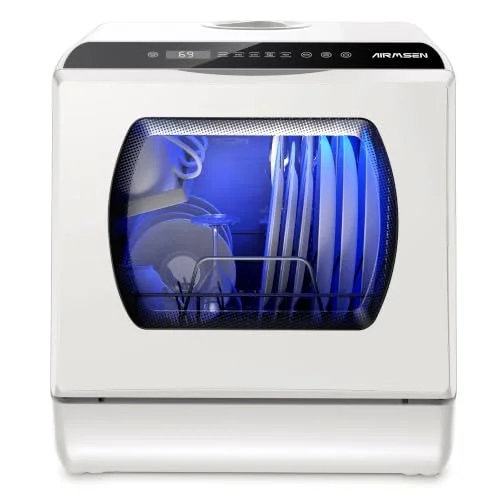
This is where a tank-fed machine changes the calculation. The AIRMSEN is built around not needing a faucet hookup at all — fill it and it runs independent of the tap, so the sink stays completely free for the whole cycle. In a one-sink kitchen that single fact can matter more than any spec on the comparison table: it's the difference between doing dishes and dinner at the same time, or picking one.

Tank or faucet, the drain side doesn't change: dirty water pumps out through a hose hooked over the edge of the sink, so whichever spot you pick needs to be within hose reach of a drain, roughly level with or above it. A tank also has to be filled by hand before each run, so "no faucet needed" doesn't mean "no trip to the sink," just a shorter, more flexible one. Our guide to how much water these machines actually use has the fill-and-run numbers.

Rule four

Rolling carts and the weight problem

When neither the counter nor the under-sink cabinet has a clear spot, a rolling kitchen cart looks like the obvious workaround: park the dishwasher on it, wheel it to the sink to run, wheel it back against a wall when it's done. It can work, but it swaps one measuring problem for another, and the weight side is the one people skip.

Countertop dishwashers in this size class commonly weigh somewhere in the 30-to-50-pound range empty — a real load for a utility cart, and one that grows once the tub fills with several litres of water plus a full rack of dishes. Most carts publish a maximum load rating, usually printed on the listing or stamped on the underside of the shelf; that number needs to clear the dishwasher's own weight plus a full water load with margin to spare. Loading a cart to its limit and adding the sideways force of a spinning drain pump is a stability problem as much as a weight one — unlocked or undersized casters can walk or tip under that motion.

A cart doesn't cancel out the two rules above, either — it relocates them. Whatever cabinet is above wherever you roll it to run the machine is still subject to the same clearance math, and the drain hose still has to reach a sink from wherever it's parked. The COMFEE' 6-Place model, being the widest and deepest of these three, is also the one most likely to overhang a cart sized for a smaller appliance — check the cart's shelf dimensions against the full footprint, not just its weight rating.

Rule five

Steam, and what it does to a wall cabinet

None of these machines has a heating element built purely for drying — like most of the category, they rely on residual heat from the wash water, a fan, or a door and lid that opens at the end of the cycle to let trapped steam escape. The GE Profile's Auto Open Dry feature is a direct example: the door pops open once the cycle finishes specifically to vent that heat and moisture out into the room rather than let it condense back onto the dishes. That's good for the dishes. It's a separate question what it's good for above the machine.

The heat inside the tub isn't really the concern — dishwasher tubs, plastic or stainless, are built to handle repeated hot-water exposure, which is one reason buyers focused on durability compare tub material at all (our guide to stainless-tub models covers that trade-off). The real risk sits outside the machine: steam venting upward, repeatedly, against the underside of a cabinet with nowhere to go is a known way particleboard swells and laminate edge-banding lifts over time — the same mechanism behind an under-cabinet coffee maker vent or a built-in run with its door cracked to dry. Trapped moisture in an enclosed cabinet cavity is also a common cause of a musty smell unrelated to the dishwasher's own tub, which our guide to dishwasher odour covers from the appliance side.

None of this matters if the machine sits on an open counter or an island with nothing but air above it — the same gap that lets the lid or door open freely is also the gap that gives steam somewhere to go besides straight into painted MDF. If the only available spot is under a cabinet, cracking a nearby window or running the exhaust fan during and just after the cycle is a low-effort way to move that moisture out of the room instead.

The picks

The picks by footprint

Sorted by how much of your kitchen each one actually needs, not by capacity.

01Smallest commitment

AIRMSEN Portable Countertop Dishwasher

Kitchens with no faucet to spare and no fixed spot to give up
Countertop · No hookup needed · runs from power only

This is the pick for the placement problem the other two can't solve: a kitchen where the faucet can't take an adapter, or where you don't want the tap tied up for two hours. Because it needs no plumbing connection, it isn't restricted to a spot within hose-and-adapter reach of the sink the way a faucet-fed machine is — it needs a stretch of counter and a power outlet, and the sink is free the moment you close the door and start it.

The trade-offThe listing doesn't publish exterior dimensions or a clearance figure in the specifics we have, so measure your intended spot against the listing's own numbers before ordering.

AIRMSEN portable countertop dishwasher, no hookup needed
$340
No hookup neededCheck price →
02Most flexible footprint

GE Profile Countertop Dishwasher

Kitchens that might get a real dishwasher cabinet later, or need the under-sink option now
Countertop, built-in or under-sink · 6 place settings · 6 wash cycles · WiFi Connected · ENERGY STAR

The only machine here designed to be sited three different ways changes the placement question entirely: if the counter clearance doesn't work, the same appliance can go under the sink or into a cabinet opening instead of being ruled out. Auto Open Dry pops the door at the end of the cycle to vent steam rather than let it sit trapped against the dishes, which matters more once you've read the steam section above. It connects to the faucet through an included unicouple fitting.

The trade-offIt's the most expensive of the three, and installing it under the sink or building it in is a bigger project than setting a countertop model on the worktop — plan the plumbing access before you commit.

GE Profile countertop dishwasher, WiFi connected
$533
3 install optionsCheck price →
03Biggest footprint, worth the counter

COMFEE' Countertop Dishwasher, 6 Place Settings

Kitchens with two feet of counter to dedicate and a family's worth of dishes
Countertop · 6 place settings, 8 washing programs · faucet-connect · ENERGY STAR

Of the three, this is the machine that asks the most of your counter and ceiling clearance in exchange for the most capacity — six place settings and eight programmes, including Speed, Baby-Care, ECO and a glass cycle. If the vertical gap above your intended spot genuinely clears, dedicating a fixed run of counter to it rather than rotating it in and out of a cupboard is what makes six place settings worth having: a machine you have to unpack before every use quietly turns back into hand-washing.

The trade-offIt's the widest and deepest of the three, and needs the most rigorously checked cupboard clearance of the picks in this guide — see the clearance section above first.

COMFEE' countertop dishwasher, 6 place settings, in black
$279
6 place settingsCheck price →
Our top picks

Our Top Picks

Editor's Pick

COMFEE' 6-Place Countertop

$278.97

The most capacity per dollar here, if your cupboard clearance genuinely allows it.

Check price →
Best Value

AIRMSEN No Hookup Needed

$339.99

No faucet, no lost sink time, no plumbing project — the simplest placement of the three.

Check price →
Premium Choice

GE Profile, WiFi Connected

$533.00

Counter, built-in or under-sink — the only pick that adapts to a kitchen that changes its mind.

Check price →
How we picked

Sorted by footprint, not capacity

We drew on the machines in our database and sorted them by what decides whether they fit a small kitchen — water source, install flexibility and known clearance behaviour — rather than by place settings or price, since a roomier machine that can't clear your cupboard or reach your sink isn't the better buy for this question.

How we compared

Research, not a lab

We're honest about this: we don't physically test these machines and we don't run a testing lab. We compare published specifications, water source and price, and read manufacturer claims sceptically. We show no star ratings because we have no rating data we can verify, and where a listing doesn't publish a dimension, we say so instead of estimating one.

FAQ

Common questions about placement

Does a countertop dishwasher have to sit right next to the sink?

Only if it connects through the faucet. A faucet-fed machine needs to be within reach of the adapter hose and close enough for the drain hose to reach the sink, roughly level with or above the drain point. A tank-fed machine only needs the drain hose within reach — it can sit further from the tap since you fill it by hand.

How much clearance do I need above a countertop dishwasher?

Measure from your countertop surface straight up to the underside of the cabinet above, at the exact spot you intend to use, and compare it against the clearance figure in the listing rather than the machine's stated height alone. Standard US wall cabinets hang about 18 inches above the counter, and larger countertop dishwashers can ask for more than 19 once you include room for the door or lid to open.

Will a portable dishwasher damage a wood cabinet above it?

The risk isn't heat inside the machine — dishwasher tubs are built for repeated hot-water cycles. The risk is steam venting upward, cycle after cycle, against the underside of a cabinet with nowhere to go, which over time is a known way particleboard swells and laminate edging lifts. A clear gap above the machine, or running an exhaust fan during and after the cycle, moves that moisture into the room instead.

Can I put a portable dishwasher on a rolling cart?

Yes, if the cart's rated load clears the machine's own weight plus a full load of water and dishes with margin to spare, and its casters lock during the wash cycle's vibration. A cart also relocates rather than removes the cupboard-clearance and sink-reach questions — wherever you roll it to run, those two rules still apply.

Keep reading

Next, from this site