Every roundup on this site assumes you've already decided to buy one. This one doesn't. We priced out the actual weekly time, the water and power a cycle uses against a sink, the counter space a machine takes and never gives back, and which hygiene claims are real versus just confident marketing — so you can tell whether the machine genuinely beats hand washing in your kitchen, or whether the dish rack you already own is doing the job fine.
Reader-supported: we may earn a commission when you buy through the links on this page, at no additional cost to you. We compare published specifications and live prices — we do not physically test these machines, we do not run a testing lab, and we do not publish ratings we cannot verify.
"Saves up to 80% of the water of hand washing" is on nearly every listing in this category, and it's a real number measured against a specific, wasteful hand-washing habit — a tap left running. It's also not the only honest comparison worth making. Hand washing costs time, not money, for most people; a portable dishwasher costs money and counter space in exchange for some of that time back. Whether that trade is worth it depends on how many people are in your kitchen, how you currently wash, and how much counter you actually have to give up permanently. This piece works through all four: time, water and energy with the assumptions shown, counter space, and the hygiene claims — plus a plain verdict by household size at the end. If you just want the answer for your household, skip to the verdict by household size. For the deeper cent-by-cent breakdown of running a machine, see what a portable dishwasher really costs to run.
These are illustrative US figures for 2026, not measurements taken in a specific kitchen. Numbers pulled from a product listing are labelled as claims; numbers we supplied ourselves are labelled as assumptions where they first appear. We anchor every product claim below to what the four listings in this comparison actually state — where a spec isn't published, we say so rather than guess.
Manufacturer copy likes to imply a cycle's full run time is time you get back — "washes in 39 minutes" reads like 39 minutes saved. It isn't, because you weren't standing at the machine for those 39 minutes; you were doing something else while it ran. The honest measurement isn't cycle length. It's active time — the minutes you're actually occupied, either scrubbing at the sink or loading and unloading a machine.
Fifty minutes a week is real, but it's roughly seven minutes a day — it's also the ceiling, not the floor. None of the four machines here states a place-setting count on its listing, so we won't guess how many dinners' worth of dishes any of them holds. A machine sized for one evening's dishes saves the time above; a machine you have to run twice because the rack is smaller than your daily load erases most of it. Loading it correctly the first time helps; our guide to loading a portable dishwasher covers the layout that keeps a second run from being necessary.
One more honest point: the 50-minute figure assumes you'd otherwise be hand-washing every single day. If you eat out some nights or run a lighter kitchen than that, the real weekly saving is smaller.
Three of the four machines in this comparison state a 5-liter built-in tank directly on their listings: the EUHOMY 8-program model, the NOVETE, and the COMFEE' Minilite. The fourth — the EUHOMY 6-program, 40 dB model — states "No Hookup" rather than a tank capacity, which tells us it's likewise tank-fed, so we'll treat 5 liters as a reasonable planning figure for it too, not a confirmed spec. A tank-fed machine physically cannot use more water than the tank holds, which makes this one of the few numbers in the category that isn't a stretched marketing claim.
Set that beside hand washing under the same rate assumptions, and the honest answer splits in two directions depending on habit.
| Method | Water per wash | Utilities (water + power) | Consumables | All-in, 260 washes/year |
|---|---|---|---|---|
| Hand, running tap | 16.2 gal | $0.39 | Dish soap ~$0.05 | ~$115 |
| Portable dishwasher | 1.32 gal | $0.105 | Powder + rinse aid ~$0.15 | ~$66 |
| Hand, filled basin, tap off | 5 gal | $0.12 | Dish soap ~$0.05 | ~$44 |
Assumptions: running tap at 1.8 gal/min for 9 minutes; filled basin at 5 gallons; electric water heating with a 45°F rise; $0.17/kWh; $0.015/gallon water and sewer combined. The machine's 5 L figure comes from three of the four listings in this comparison.
On water alone, the machine wins against both hand-washing methods. On total cost, once detergent is priced in, the picture inverts against the careful basin washer: the machine runs about $22 a year more than someone who fills a basin and shuts the tap off, and about $49 a year less than someone who washes under a running tap. The "80% less water" claims are true, and measured against the wasteful method, not the careful one — the same pattern in the full running-cost breakdown for this category.
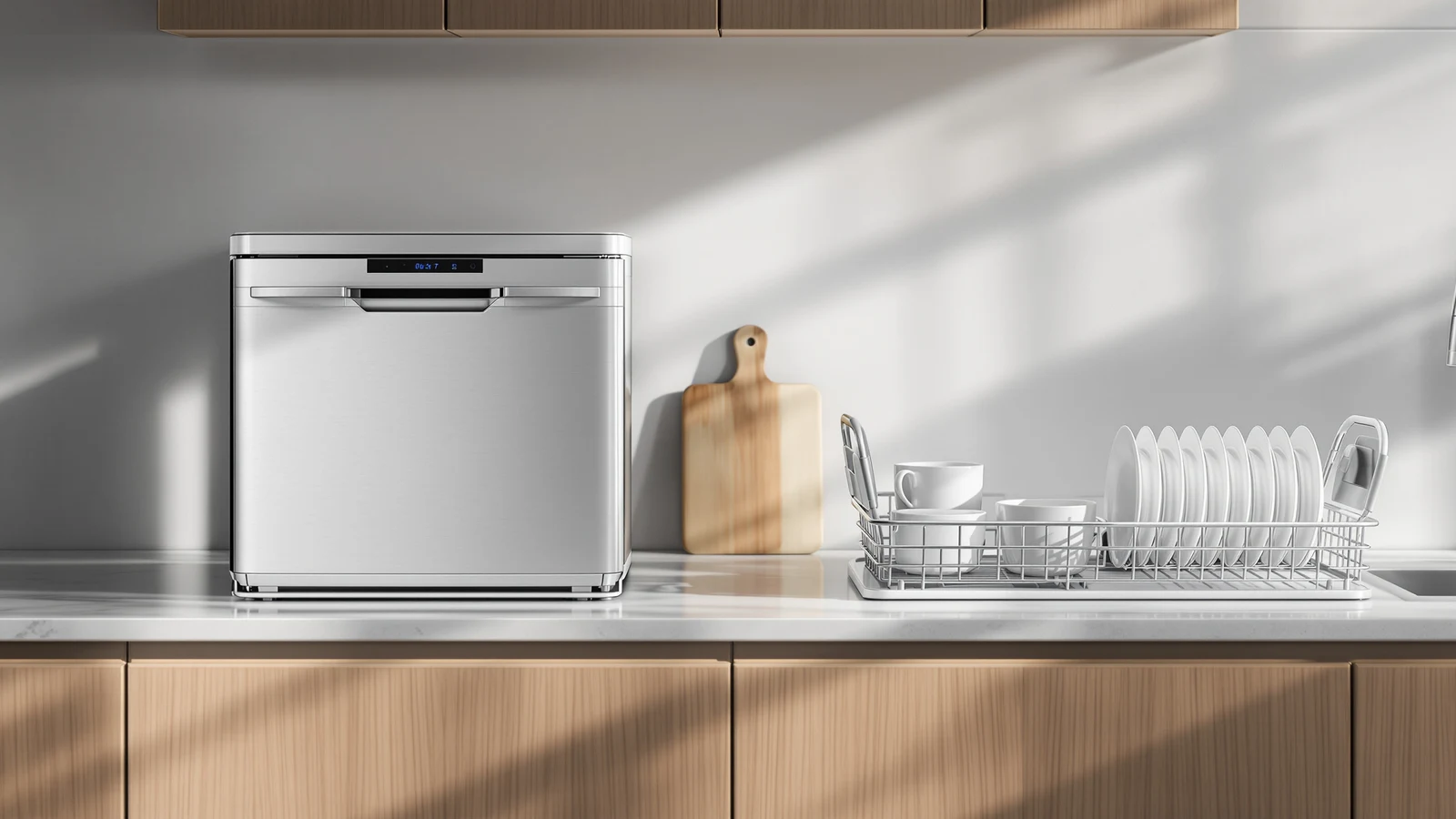
All four machines in this comparison are countertop models — nothing here is an 18-inch machine on castors that lives on the floor. That matters more for this comparison than for anything else on this page, because a dish rack is temporary furniture and a countertop dishwasher isn't. Empty the rack and you get the counter back; unplug a countertop dishwasher and you still have a roughly 16-to-22-inch, 17-to-18-inch-tall appliance that needs somewhere to live, permanently, whether it's running or not.
None of the four listings here publishes external dimensions to us, so we won't invent numbers for any one of them — check the current listing before you buy. What we can say from the naming alone: the EUHOMY 6-program model ships in a "Large" size variant, and the COMFEE' is explicitly the "Minilite" — the compact end of that platform, built for RVs and small kitchens. Expect the Large to occupy noticeably more counter than the Minilite, and confirm both against your own measured space rather than the product name.
Two general facts worth checking first. Standard American wall cabinets hang about 18 inches above the counter, and compact countertop dishwashers commonly run close to that height once the lid or door needs room to open — a mismatch here is the most common reason a countertop machine ends up on a dining table instead of next to the sink, which raises the drain-hose-reach problem covered in our faucet-versus-tank hookup guide. A dish rack asks nothing of your cabinets — it only needs space while dishes are actually wet. If your kitchen has no spare counter, that alone can decide the comparison before price or time enters into it; our guide to portable dishwashers for small apartments goes deeper on working around a tight counter.
Stated plainly: a rack costs counter space only while dishes are wet and gives it back once they're dry. A countertop dishwasher costs that same strip of counter every day, mid-cycle or empty, in exchange for the active time it saves. For a kitchen with counter to spare, that's a trivial trade. For a galley kitchen with eighteen inches of usable surface total, it's the whole decision.
Four situations come up repeatedly, and in each of them the honest answer is that a rack and a sink already do the job as well as, or better than, a machine would.
If your evening's dishes are a plate, a pan and a couple of glasses, the 4 minutes of active machine time from the section above is close to the 10 minutes of hand-washing it's meant to replace — the gap that makes a machine worth it shrinks fast at low dish volume.
The table above isn't hypothetical: on our own numbers, a careful basin wash with the tap off costs about $22 a year less than a portable dishwasher once detergent is counted, because detergent is the single largest line item in a cycle's cost. If that's already your habit, the machine is a convenience purchase, not a savings one.
Every machine here needs a place to sit permanently, and three of the four also need either a compatible faucet or a tank refilled by hand each cycle. A pull-down or pull-out sprayer faucet generally won't accept a dishwasher adapter — see the hookup guide for which taps work with which machines. If your kitchen fails on both counter space and faucet compatibility, hand washing is the only option that doesn't require a kitchen renovation.
A machine run five times a week is a different appliance from one that sits for two weeks between uses — the tank and drain line can hold standing water, and a sealed tub needs its own upkeep to avoid smells and limescale, covered in our cleaning and descaling guide. Anyone who washes dishes irregularly gets less of the time benefit and more of the maintenance burden than the weekly-use math above assumes.
This is the argument that survives every version of the money math, because it isn't about money — it's a physical limit. Comfortable hot tap water sits around 105 to 110°F, and above roughly 120°F you're into scald territory within minutes. That ceiling is set by your skin, not by technique or effort, and no amount of careful hand washing changes it.
One machine here states a wash temperature well past that ceiling: the COMFEE' Minilite advertises a 192°F high-temp function. Take that as a manufacturer claim rather than an independently measured figure, but the direction isn't in dispute — 192°F is roughly 70 to 80°F hotter than water hands can tolerate, with detergent, under pressure. The NOVETE names a "Baby Care" program, signalling intended use, but doesn't state a wash temperature for it, so we won't attach a number that isn't published. Neither EUHOMY listing names a baby-care or hygiene-specific program; both are general wash cycles with a stated 40 dB rating and nothing more to evaluate on hygiene specifically.
A hot wash cycle is a real, physical advantage over hands, and it's the strongest honest argument for owning one of these machines. It is not the same claim as a certified sanitizing cycle: none of the four listings here carries an independent sanitization or NSF certification, so "hotter than your hands" is as far as the evidence goes. And heat doesn't fix what wasn't scraped off first — baked-on food needs a soak either way, one of the few places hand and machine washing are exactly equivalent.
All figures are from the current product listings; prices move on Amazon — confirm live before you buy.
| Machine | Water source | Programs | Notable spec | Price | |
|---|---|---|---|---|---|
| No hookup (tank) | 6 | 40 dB rated | $249.00 | Price | |
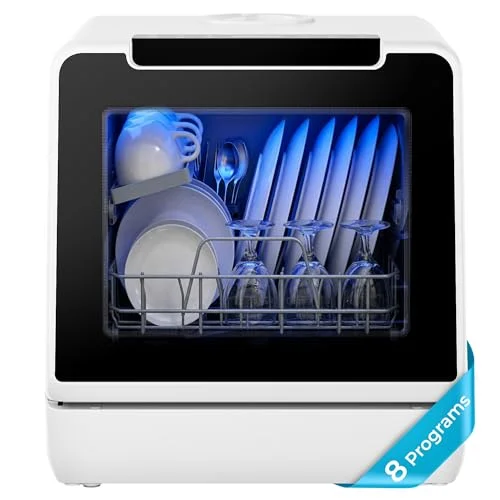
| 5 L tank | 8 | 40 dB rated | $261.35 | Price | |
| 5 L tank or faucet | 5 | Baby Care program | $289.99 | Price | |
| 5 L tank, no hookup | 6 | 192°F high-temp function | $289.99 | Price |
Solo, light cooking. Hand washing wins on both time and money — a plate and a pan don't generate enough active minutes for the machine's load-and-unload overhead to pay off, and none of these listings states a capacity small enough to justify running for one person's daily dishes. If you dislike washing up regardless of volume, the COMFEE' Minilite is built for a small footprint and no hookup, but go in knowing you're buying convenience, not time or money.
Two people, cooking most nights. The closest call, and the household the numbers above are built around: about 50 minutes a week of active time back, money roughly a wash against a careful basin routine, and a real saving against a running tap. Either EUHOMY — the 6-program "Large" for the lower price, the 8-program for more cycle choice — is a reasonable place to start.
Three or four people, or a household with a baby. Daily dish volume compounds fast enough that active time saved is usually larger, but none of these listings states a place-setting count, so don't assume any clears a full family evening in one cycle without checking. The NOVETE's Baby Care program and tank-or-faucet flexibility make it worth a closer look here; our guide to choosing a machine for an apartment, dorm or RV covers the same clearance and hookup checks for a bigger kitchen.
Five or more people. Hand washing likely stays the primary method regardless of which countertop machine you buy, since unstated, likely-modest tank capacity means multiple runs a day — which erases the time saving entirely. If capacity is the real constraint, see the best 18-inch portable dishwashers on wheels rather than solving a large household's dish volume with a countertop tank model.

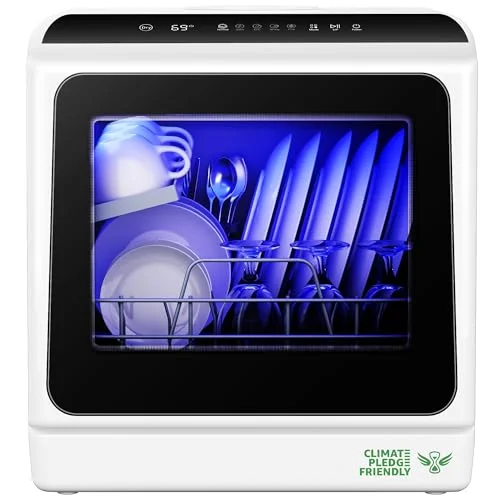
No hookup needed, 40 dB rated, six programs. The lowest-priced entry into the tank-fed math worked out above.

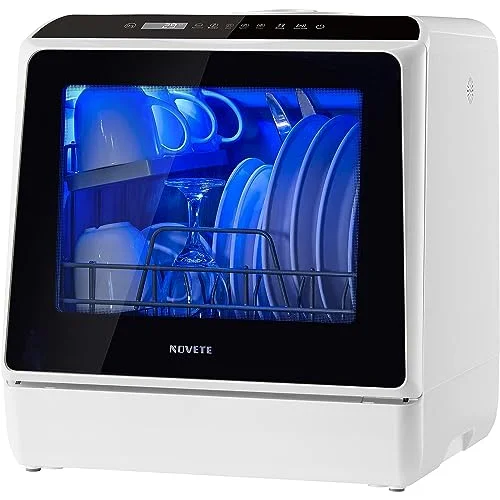
Tank or faucet, a named Baby Care program, air-dry function and LED light. Built for small apartments per its own listing.

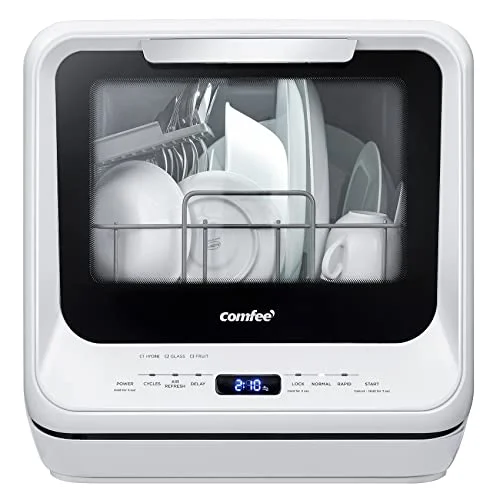
No hookup needed, 360° dual spray, a 192°F high-temp function and air-dry. Sold as a mini dishwasher for RVs.
One more from the table: the EUHOMY 8-program model shares its tank and dB rating with the 6-program version above but adds two more programs for about $12 more — worth it mainly if you want a dedicated fast or glass cycle rather than cycling through the same six settings for every load.
Only counting active time, and only for households that wash daily. On our assumptions, hand-washing for two people takes about 10 minutes of active time a day versus about 4 minutes to load and unload a machine — roughly 50 minutes a week saved, not the hours a cycle-length figure might imply, since most of a cycle's runtime is unattended, not time you were otherwise spending at the sink. For light cooks or irregular users, the saving shrinks well below that.
It depends entirely on how you currently hand-wash. A tank-fed cycle uses about 1.32 gallons, well under both a running tap (about 16.2 gallons for a comparable load) and a filled, tap-off basin (about 5 gallons). But once dishwasher detergent is priced in alongside water and electricity, the total cost comparison flips against a careful basin washer — the machine ends up costing slightly more per year than a disciplined tap-off routine, even though it uses less water.
The hot-water argument is real: comfortable hand-washing water tops out around 105 to 110°F, and one machine in this comparison, the COMFEE' Minilite, states a 192°F high-temp function — well past what hands can tolerate. Treat that as a manufacturer claim rather than an independently verified figure. None of the four listings here carries a certified sanitization rating, so "hotter than your hands" is a supported claim; "sanitizes" or "kills germs" would not be, and none of these listings makes that stronger claim.
All four machines in this comparison are countertop models, and none of their listings states external dimensions to us, so check the current listing before buying. As a general reference point, countertop dishwashers in this category commonly run in the range of 16 to 22 inches wide and deep and about 17 to 18 inches tall — occupied every day, whether the machine is running or empty, unlike a dish rack that only holds counter space while dishes are actually wet.