Choosing a Portable Dishwasher for an Apartment, Dorm or RV
This is the rare appliance where the spec sheet is the second thing you read. The first is a tape measure. Cabinet height, counter depth, drain reach, the shape of your faucet and the circuit behind the outlet cut a shortlist of twenty-five machines down to three before capacity or cycle count gets a vote.
We're reader-supported: if you buy through a link on this page we may earn a commission, at no extra cost to you. It doesn't change what we recommend — we compare published specifications and live prices, we don't run a testing lab, and we don't publish ratings we can't verify.
- The short version
- The gap above your counter
- Counter depth, and keeping a work surface
- Drain-hose reach
- Your faucet decides tank or tap
- The outlet and the circuit behind it
- Noise when the kitchen is the living room
- What a lease actually cares about
- RVs, vans and boats
- Dorm rooms
- Three rooms, three machines
- Common questions
The short version
Most guides to this category sort machines by price or by place settings, which is close to useless in a rental: what disqualifies a portable dishwasher is almost never its cycle list. It is 18 inches of air.
Standard American kitchens hang the wall cabinets about 18 inches above the countertop, and countertop dishwashers stand between roughly 17 and 18.2 inches tall. Much of this category physically will not slide into the space it was designed for — and the manufacturers know it, which is why several listings quietly ask for 19.6 or even 20.08 inches of vertical clearance.
So work in this order: the gap above the counter, the depth and length of counter you can lose, the run from the machine's future home to the edge of the sink, whether an adapter can grip your faucet, and what else sits on the circuit behind the outlet. Only then open a product page. The full comparison of the category lives on the portable dishwasher home page.
Where the numbers here come from
Every dimension, decibel figure and capacity claim below is quoted from the manufacturer's listing and treated as a claim, not a measurement. Points about kitchen dimensions, circuits and freezing water are general information, and manufacturer guidance where we say so — anything beyond plugging an appliance into an existing outlet is work for a licensed trade.
The gap above your counter is the first filter
Measure from the worktop to the underside of the wall cabinet, at the exact stretch of counter where the machine would live rather than at the tidiest spot: under-cabinet lighting, a moulding, a backsplash lip or an outlet cover can each eat an inch the room's nominal dimension doesn't know about. Then compare against the class, because the spec sheets show how tight this is:
- Canbo tabletop — 18.03 in high × 16.54 × 16.54
- EUHOMY 6-program countertop — 16.83 × 16.73 × 18.03 in
- NOVETE countertop — 16.9 × 16.8 × 18.1 in
- Hermitlux countertop — 16.85 × 16.73 × 18.23 in
- COMFEE' 6-place countertop — 17.2 in high × 21.7 wide × 19.7 deep
Four of those five stand taller than the 18 inches a builder typically leaves. Only the COMFEE' six-place model, at 17.2 inches, has genuine room to spare, and it buys that height back in width and depth.
Fitting by a hair isn't fitting, either. Manufacturers ask for clearance beyond the machine's own height because something has to open and the machine has to vent: the COMFEE' Minilite listing states the distance between countertop and wall cupboard should be more than 19.6 inches, and Hermitlux asks for at least 20.08. EUHOMY's listings tell you to leave "more than" a certain clearance and then omit the number itself — a reminder that these are marketing documents, not engineering drawings. Assume 20 inches unless a manual says otherwise.
The vent matters for a second reason: these machines finish hot and push warm, moist air out, and aiming that at the underside of a particleboard cabinet for years is the sort of slow water damage a landlord notices at move-out. Check which way the machine opens, too: a door hinged at the bottom needs clearance in front and above its arc; a lid that loads from the top makes a tight gap above fatal rather than awkward.
If your gap is under about 20 inches you have three honest options: a rolling cart or low table beside the sink; a stretch of counter with nothing above it, such as a peninsula or an island end; or an 18-inch machine on wheels, which lives on the floor and gives you a work surface on top. We cover that fork in countertop versus 18-inch on wheels.
Counter depth, and whether you still have a work surface
American base cabinets are usually about 24 inches deep, with the worktop overhanging to roughly 25. Subtract a backsplash and whatever lives permanently at the back and you have maybe 22 usable inches. The compact machines fit that easily — Canbo at 16.54 inches deep, EUHOMY at 16.73, NOVETE at 16.8 — and leave a few inches behind for the hoses, which is not optional space: a hose crushed against a wall kinks.
Frontage is the dimension people regret. A compact machine consumes about 17 inches of counter length; the COMFEE' six-place model takes 21.7 inches of length and 19.7 of depth, plus the arc of the door as it drops. In a galley with one usable four-foot run, that is half your working surface gone permanently, because a dishwasher is not something you put away between meals.
Before you order, set a cardboard box of the machine's footprint on the counter and cook one dinner around it: a machine that has to be moved to chop an onion stops being used. The COMFEE' six-place listing notes it can also be fitted into a cupboard, so an empty base cabinet near the sink can absorb it.
Drain-hose reach to the sink
Dirty water leaves through a hose hooked over the rim of the sink, pumped out at the end of the cycle. Reach is the second most common reason a machine doesn't work in a kitchen, after cabinet height.
Measure the route, not the straight line: from the back of the machine's future position, around the counter, to a point where the hose end hangs securely inside the bowl, plus slack for it to arc rather than stretch. Expect the supplied hose to be short.
Three rules come from the manuals rather than from us. The hose end shouldn't sit submerged in standing water, which invites siphoning back into the machine. The pump has a maximum lift, so a machine parked well below the drain point may not empty properly. And manufacturers generally tell you not to splice on an extension, because a longer hose changes the load on a small pump. If the geometry doesn't work, move the machine; don't modify the plumbing. Our step-by-step hookup guide goes through the fittings.
Your faucet decides tank or tap
Faucet-fed machines work by unscrewing the aerator from the end of your spout, threading on an adapter and clipping the inlet hose to it. On an ordinary straight tap with standard threads this takes a minute. EUHOMY's 8-program model specifies a G3/4-inch faucet and says to buy a separate adapter if yours differs, which describes the category well: standardised enough to usually work, unstandardised enough to sometimes not.
Then there is the faucet that ends the conversation. A pull-down or pull-out sprayer has no fixed spout to thread onto — the business end detaches into a hose, and an adapter has nothing to grip. Touchless faucets and many gooseneck designer taps have the same problem, because the aerator hides inside a decorative housing or the thread is proprietary. In a rental you can't simply swap the faucet.
That is exactly why tank models exist. A tank machine carries its own reservoir — 5 litres, about 1.32 gallons, on most of them — filled from a jug; it needs power and somewhere to drain, nothing else. The NOVETE, the EUHOMY countertop models, the COMFEE' Minilite and the Canbo tabletop all work this way, and most accept a faucet hose too, so you can start on the tank and switch later.
The trade-off is that you are carrying water, and that five litres is the whole cycle's supply, which caps how much rinsing the machine can do — one reason this class does better with lightly soiled plates than with a roasting pan.
The outlet, and the circuit behind it
A countertop dishwasher heats its own water, which is where nearly all its electricity goes — the same class of load as a kettle rather than a blender. Several of these advertise wash temperatures of 162 to 167°F, generated from an ordinary household outlet.
A 120-volt, 15-amp branch circuit is nominally 1,800 watts, and it is rarely serving one thing. In a small apartment kitchen it may already carry the microwave, the kettle and the toaster; in a residence hall it can be shared with the room next door. Adding a water-heating appliance to a circuit that already trips when two people make coffee is predictable rather than mysterious. The figure that applies to your machine is on its rating plate and in the manual — check that, not any number we could generalise.
On extension cords the manufacturers are consistent: manuals here routinely instruct you to plug the machine directly into a properly grounded outlet, not into an extension cord or a multi-outlet adapter. The reason is sensible — a long thin cord under a sustained heating load runs warm — but the practical point is simpler. If the only outlet is across the room, that is a conversation with the building, not a problem to solve with hardware from a drugstore.
Noise, when the kitchen is the living room
In a studio the dishwasher runs six feet from where you sleep and take calls, so noise becomes the specification you live with. The published figures are worth knowing and worth discounting. EUHOMY advertises 40 dB for its countertop machines and frames it exactly this way — a machine you can run during a call or a nap. The GE Profile countertop model is listed at 52 dBA and the Hamilton Beach portable at 52 dB. Since perceived loudness roughly doubles every 10 dB, the gap between a claimed 40 and a claimed 52 is not cosmetic. But these are manufacturer figures produced under the manufacturer's own conditions, so treat them as a ranking signal rather than a promise.
What a decibel number doesn't capture is where the noise comes from. The drain is the loudest moment of the cycle — a short hard surge that wakes people even on a machine that hums quietly otherwise — and a hard countertop transmits vibration, so a thin rubber mat underneath does more for perceived noise than a decibel point on a listing. Duration counts too: the 29-minute quick cycle the Canbo, EUHOMY and SUNVIVI machines advertise is 29 minutes of noise, while an eco cycle runs for hours.
Check the drying behaviour, because that is the part that runs while you sleep: one EUHOMY model advertises 60 minutes of hot-air drying then up to 73 hours of automatic ventilation, and an AIRMSEN model quotes 72 hours of ventilated storage. If a fan would bother you, look for drying that can be switched off — COMFEE's Air Refresh is described as optional. Midea's countertop model offers a 1 to 24-hour delay start, which solves the problem from the other end.
What a lease actually cares about
The entire appeal of this category is that nothing is permanently modified: no cabinet cut, no supply line tapped, no valve added, no circuit run. The machine plugs into an outlet that already exists, clips to a tap that already exists, and when the lease ends it goes in the car with everything else. For a renter that isn't a compromise — it is the product.
Most standard US leases restrict alterations, plumbing and electrical work. A countertop dishwasher sits in the same bracket as a microwave: something you own, plugged into an existing outlet. Where it stops being that is installation — the GE Profile model advertises countertop, built-in and under-sink options, and the last two are modifications to someone else's property. If that's the plan, ask first, in writing.
The risk a landlord genuinely cares about is water, and how renters' policies treat escaping water varies. That isn't a reason to avoid a portable dishwasher; it's a reason to be unglamorous about it. Check the connections the first few times you run it, don't leave early cycles going while you're out, and put a shallow drip tray underneath.
Two habits pay off at move-out: photograph the aerator before you unscrew it, bag it, and screw it back on when you leave; and keep the machine descaled, since limescale is what shortens these machines' lives. The schedule is in cleaning and descaling a portable dishwasher.
RVs, vans and boats
Half the listings here name RVs, campers and boats, and the fit is genuine — a tank-fed machine is built for a kitchen with unreliable plumbing. But a vehicle adds four constraints a kitchen doesn't have.
Power: 120 volts, not 12
These are 120-volt AC appliances — Hermitlux states 120 V outright, and the rest are ordinary household plugs. Nothing here runs from a 12-volt system directly. That leaves shore power, a generator, or an inverter, and the inverter is where the arithmetic gets serious: a water-heating appliance draws hard, for a long time. Check the machine's rating plate against your inverter's continuous rating and your battery capacity before assuming it will work off-grid, and treat that as a question for whoever specified your electrical system.
Water: tank mode is the whole point
An RV fresh-water system is not a house supply. Pump pressure varies and sits low; COMFEE' publishes a working range of 0.04 to 1.0 MPa for one of its machines, and an RV pump can live near the bottom of that. Tank mode sidesteps pressure entirely: pour in about 1.32 gallons of potable water and the machine does the rest.
It matters more when the rig is winterised. With antifreeze in the fresh-water lines you don't want to draw from the taps at all, and a machine that fills from a jug is the only version of this appliance that still works — the argument for a dual-mode machine over a faucet-only one.
Grey water and detergent
Everything the machine drains goes into the galley grey tank. Assume the 5-litre cycle Hermitlux publishes, one cycle a day: about 1.32 gallons daily, roughly 9.2 gallons a week. Against a 30-gallon grey tank shared with a shower, that is a real share of your dump interval — better planned than discovered. Hermitlux claims the machine uses up to 83% less water than washing by hand; if that claim holds, the dishwasher helps your tank rather than hurting it.
Use dishwasher powder or gel, never ordinary liquid dish soap — COMFEE' spells out in its listing that liquid dish soap causes problems, and in a small tub it means foam everywhere. Follow the local rules for grey discharge wherever you're parked or moored; on a boat they are stricter.
Transit and freezing
A dishwasher is a heavy box with a hinged door, which in a moving vehicle makes it a projectile. Secure it as you would anything else in the galley: strapped into a cabinet or at floor level, on a non-slip mat, door latched, not left standing on a countertop while you drive. Empty the tank and let the sump drain before you move — residual water sloshes, finds the vent, and leaves a puddle you'll blame on something else.
Freezing weather is the failure mode that ends these machines. Water stays behind in the sump, the pump housing and the hoses after every cycle, and freezing water expands; that is the entire reason RV plumbing gets winterised each autumn. As general guidance, and as manufacturer guidance in most manuals: drain the machine completely before it sits in sub-freezing conditions, then leave the door ajar so the tub dries. Some machines include a forced-drain command for exactly this — EUHOMY's listing describes a long press of Dry plus Power. Let a cold-stored machine return to room temperature before running it, and keep it indoors over winter if you can.
Dorm rooms
A dishwasher in a residence hall is a good idea with three obstacles in front of it, and the order matters.
Policy first. Most universities publish an appliance policy: what's permitted, what's banned, often a cap on refrigerator size or total wattage. Those lists were written with kettles and space heaters in mind, and a countertop dishwasher usually isn't named at all — which makes it a question for the housing office rather than an assumption. Ask by email so the answer exists in writing, and ask about a water-heating appliance rather than about "a dishwasher", because that is the property the rules care about.
Power second. Halls that cap per-room draw do it because their circuits are old and shared, and the same policies typically ban extension cords and multi-plug adapters outright. The manufacturers agree, for their own reasons. If your room has one outlet behind the bed, that is a real constraint, not a puzzle to solve with a cord.
Water third. With an in-room sink, a tank machine and a short drain run is genuinely workable — the best case for a student. Without one, you can fill from a jug and drain into a bucket: about 1.32 gallons in and the same back out, carried to the bathroom. People do this and it works, but count the trips honestly first. The alternative is the shared kitchen, which brings us to etiquette.
A personal appliance left on a communal counter will be moved, borrowed, unplugged mid-cycle or thrown out. Take the machine there for the cycle and bring it back — which argues for the smallest machine you can find and a quick cycle rather than a three-hour eco run. The Canbo tabletop's 16.54 by 16.54-inch base is about the footprint of a large microwave, and its listing describes one to three servings with plates up to 10.5 inches, which is right for one person. If budget binds, our guide to the best countertop dishwashers under $300 covers the false economies, and the cost and water math asks whether the idea earns its place at all. One last detail: move-out often means a car parked outside in December, so drain the machine first.
Three rooms, three machines
Three living situations, three machines from our database extract, chosen on published specifications and current pricing. Prices move constantly, so confirm before you buy.
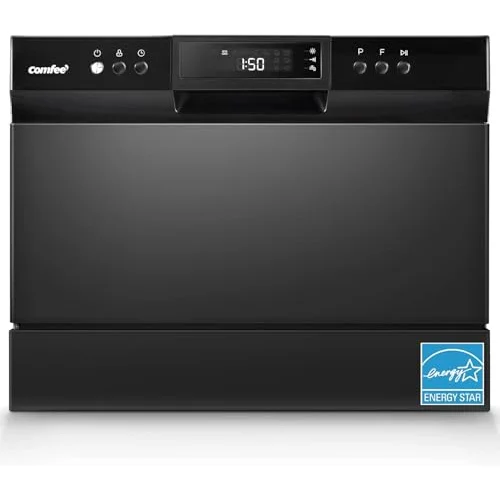
COMFEE' 6-Place Countertop Dishwasher
17.2 inches tall — one of the few countertop machines with real clearance under a standard 18-inch cabinet gap. Six place settings, up to 70 pieces, eight cycles, ENERGY STAR. Faucet-connect only, and it takes 21.7 by 19.7 inches of counter, so measure the frontage before the height.
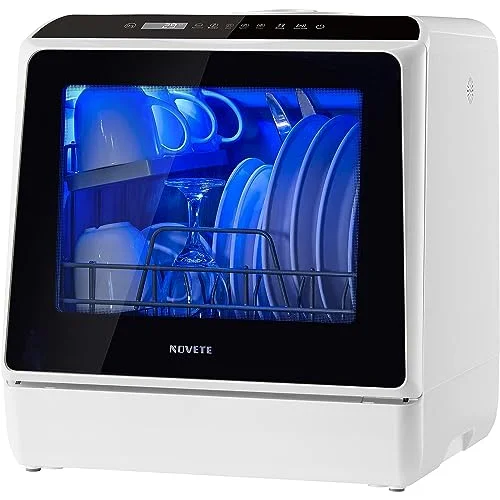
NOVETE Countertop Dishwasher
A 5-litre tank and an inlet hose, so it works with no usable tap and keeps running when the rig is winterised. Four place settings, 12-inch plates at an angle, a 167°F heavy cycle. At 16.9 × 16.8 × 18.1 inches it is taller than a standard cabinet gap — this one wants open counter above it.
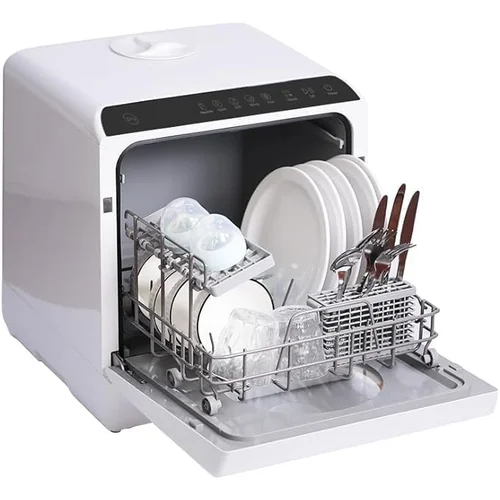
Canbo Tabletop Dishwasher
The cheapest machine here worth buying, and the smallest base: 16.54 inches square, 18.03 tall. Tank-fed, five programs, a 29-minute quick cycle, upper and lower spray arms. One to three servings with plates to 10.5 inches, which is the right size for one person.
If a 40 dB claim matters more than any of the above, the EUHOMY 6-program countertop model at 16.83 × 16.73 × 18.03 inches publishes the lowest figure in this group at around $250, with the usual caveat that decibel numbers are manufacturer claims.
Common questions
How much clearance do I need above the counter?
Plan on about 20 inches from the countertop to the underside of the wall cabinet. Countertop dishwashers stand roughly 17 to 18.2 inches tall and standard US wall cabinets are hung about 18 inches above the worktop, so the fit is tighter than most listings suggest. Manufacturers ask for more than the machine's own height because the door has to open and the machine vents steam: the COMFEE' Minilite listing asks for more than 19.6 inches, the Hermitlux listing for at least 20.08. Measure at the exact spot, allowing for backsplash lips and under-cabinet lighting.
Can I run a portable dishwasher in an RV, and does it work from 12 volts?
It works well in an RV, but not from 12 volts. These are 120-volt appliances that heat their own water, so they need shore power, a generator, or an inverter and battery bank sized for a sustained heating load — check the machine's rating plate against your inverter's continuous rating first. Choose a model with a built-in tank: it copes with low or variable pump pressure and still works when the fresh-water system is winterised. Every cycle drains into the galley grey tank, roughly 1.32 gallons at a time.
Can I plug a countertop dishwasher into an extension cord in a dorm?
Manufacturer manuals in this category routinely say no: plug the machine directly into a properly grounded outlet, without an extension cord or a multi-outlet adapter. Most residence halls have the same rule, since a dishwasher heats its own water and behaves like a kettle rather than a laptop charger. Check your housing office's appliance policy first, and ask about a water-heating appliance rather than about a dishwasher, because that is the property the rules are written around.
Do I need my landlord's permission for a portable dishwasher?
For a countertop or wheeled machine, usually not: nothing is permanently modified, it plugs into an existing outlet, clips to an existing faucet and leaves with you. It sits in the same category as a microwave. Permission becomes a real question if you plan to install it under a sink or inside a cabinet, as some models allow, because that is an alteration to someone else's property. Either way, protect against the risk a landlord actually cares about: check the connections on the first few runs and keep a drip tray under the machine.