Best Portable Dishwashers
Maintenance

How to Clean and Descale a Portable Dishwasher (So It Lasts)

Small dishwashers rarely die of overwork. They die of a clogged mesh filter, a crust of limescale on the heater, and water left standing in a sealed plastic tub for a week.

Some links on this page are affiliate links: if you buy through them we may earn a commission, at no extra cost to you. Everything below is general information and manufacturer guidance — your model's manual always outranks this page.


A compact countertop dishwasher with its door open on a kitchen counter, filter and spray arm removed and laid out for cleaning
The whole maintenance kit is a soft brush, a toothpick, a cloth and a jar of citric acid.

A built-in dishwasher hides neglect better: more water, a bigger sump, fixed plumbing, and a cabinet with air around it. A countertop machine has none of that — about five liters of water through a plastic tub the size of a microwave, a drain hose hooked over the sink, and then an airtight box with warm damp plastic inside.

So almost nobody wears one of these out. Instead the filter fills, the spray holes narrow, grit appears on the plates, the tub starts to smell, and a year later an element wrapped in limescale stops getting the water hot. Three things do that damage — the filter, scale and standing water — and none of them takes long to prevent.

One honest note that shapes everything below: we compare published specifications and prices; we don't run a testing lab; and we don't publish ratings we can't verify, because Amazon returns no rating data for these machines. What follows is mechanism plus manufacturer guidance, with features quoted from the spec sheets of the machines in our main portable dishwasher guide. Where your manual disagrees, follow your manual.

On this pageThe filter · Spray arms · Door gasket · The smell · Tank models · Descaling · Detergent & rinse aid · Storage & winterizing · By machine · What not to do · The routine · FAQ

Weekly, and after anything rice-based

The mesh filter: where it is, how to lift it, what happens when it clogs

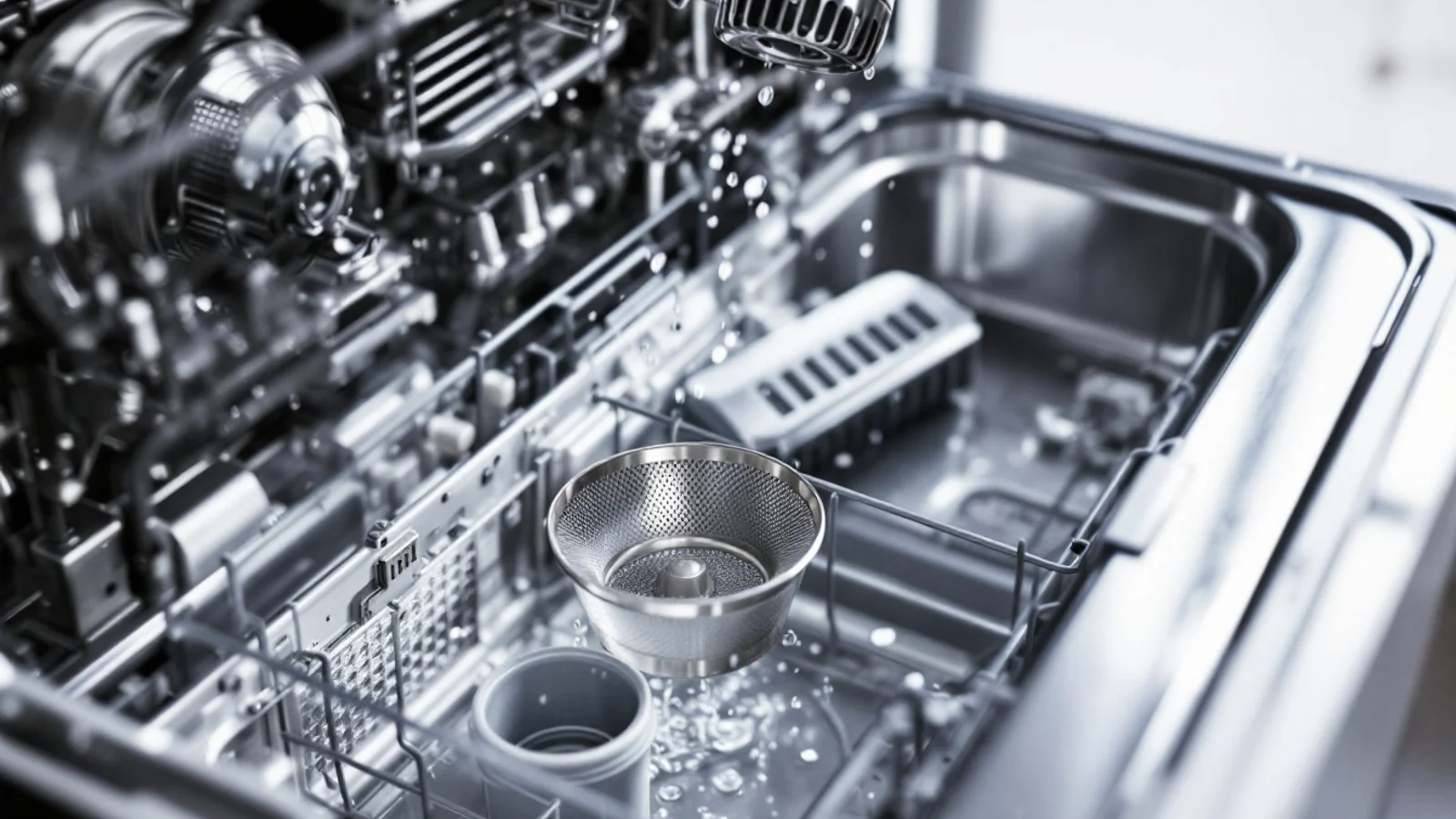
Open the door and look at the floor of the tub. Under the lower spray arm sits a flat plastic or stainless mesh insert, often a round cup dropped into a coarser screen. On most models it lifts straight out, or turns a quarter-turn counter-clockwise first — there is normally an arrow or grip ridges molded in. No tools. If nothing comes out, check the manual before forcing it; a few designs fix the coarse screen and only the center cup lifts.

How to clean it

Rinse it with the mesh facing the tap, so debris is pushed back out the way it came in rather than deeper into the weave. Use a soft brush — an old toothbrush is the standard tool — with a drop of dish liquid if it feels greasy, then hold it to a light: you should see through the whole mesh. While it is out, feel around the sump for what never reaches the filter at all, and wipe it with a paper towel.

What happens when you don't

A clogged filter is a hydraulic problem, not just a hygienic one. These machines recirculate: the pump draws from the sump, pushes water up through the arms, and it falls back through the filter to be used again. Block the return and the pump moves less water than it was designed to. Pressure drops, the wash pattern collapses, and dishes come out with a fine grit — the same debris sprayed back on. Keep going and you get standing water, then a pump laboring against a blockage.

Check it weekly if you run the machine most days, and immediately after rice, oatmeal or coffee grounds. Scraping beats rinsing, too: a five-liter cycle has no capacity for half a plate of food, which is why the EUHOMY 8-program tank model says to scrape heavy grease before loading and keep bulky pots out.

Monthly

Spray-arm holes: ten minutes that restore cleaning power

Nearly every machine in this class uses two arms, above and below, because a small tub needs coverage from both directions. HAVA quotes 14 water ports across its arms; the Canbo tabletop machine describes upper and lower arms for 360-degree coverage. Fourteen holes is not many — block three and you have lost a fifth of the wash. Scale narrows them from inside; debris parks in one and stays. The symptom is distinctive: dishes clean in one part of the rack and dirty in the same spot.

  • Spin each arm by hand. Dragging means something is jammed under it or the bearing needs cleaning.
  • Remove the arm if the manual allows — most lift off or unscrew from a central nut.
  • Clear each hole with a toothpick, never a needle: metal burrs the molded edge and changes the spray angle permanently.
  • Flush the arm by running water into the center hub until it exits the jets, carrying grit with it.
  • Reseat it fully and spin it again to confirm it clears the rack.

If the holes are scaled rather than blocked — a chalky ring you can scratch with a fingernail — soak the arm in citric-acid solution for twenty minutes instead of picking at it.

Weekly

The door gasket, and the seam where food actually hides

The gasket is the flexible strip around the door opening, and it is the dirtiest part of a small dishwasher: water carrying food particles is thrown at it all cycle, then drains away and leaves the particles in the fold. Wipe it weekly, then run a fingertip along the underside of the lip. That fold, and the seam where the gasket meets plastic at the bottom corners of the door, is where the grey-brown film lives; a cotton swab reaches it.

This matters beyond appearance. A gasket held slightly open by trapped debris is the most common cause of a small leak, and a countertop machine leaks onto your counter rather than into a cabinet. Rubber left coated in grease also hardens and stops sealing. Check the hinge too: on machines whose door pops open at the end — the GE Profile countertop model calls it Auto Open Dry — that latch does extra work. Never put oil or grease on a gasket.

The problem specific to this category

Why a small dishwasher smells, and the two habits that stop it

Here is the situation a countertop machine creates that a built-in mostly doesn't. The cycle ends. There is no heated drying element in most of these machines, so the tub is warm and wet rather than baked dry, and some water sits in the sump by design. Then the door closes on a sealed plastic box that will not be opened for a day or three, because two people do not fill a small dishwasher daily. Warm, damp, dark and still is an ideal culture condition, and what grows is biofilm — in the sump, on the filter, in the gasket fold. That is the stale, sulfurous smell, and it is biology rather than a defect.

Habit one: leave the door ajar

When the load is out, leave the door open a couple of inches — enough to break the seal and let air exchange. A tub that dries overnight cannot support biofilm, and this one habit prevents most odor problems. If the machine will sit unused for a week, leave it ajar the whole time; a closed empty dishwasher is a humidity trap.

Habit two: use the air or drying mode

Several manufacturers designed for this specifically. The COMFEE' Minilite lists an Air Refresh mode that circulates air to remove moisture and odors, and its spec sheet is explicit that the point is keeping the machine dry, not only the dishes. The EUHOMY 6-program model quotes 60 minutes of hot-air drying then up to 73 hours of automatic ventilation, and says drying can run on its own; AIRMSEN describes 72 hours of ventilated storage. On the SPT 18-inch portable the equivalent is cracking the door. Treat those ventilation hours as claims rather than measurements — but the mechanism is sound, and a dry-only cycle gives you something to run when the tub smells and you have no full load.

If it already smells, work in order: scrub the filter, wipe the gasket fold, run an empty hot cycle with a descaler or cleaner (or the self-clean program, as the Hermitlux model offers), then leave the door open overnight. If the smell survives, check the drain hose — one looped so water sits in a low point develops its own smell.
Tank models only

Emptying the tank and the pump: the step tank owners skip

A built-in tank is what makes these machines work with no usable faucet — five liters on the NOVETE countertop model, six on the COMFEE' Miniplus, 152 ounces on the SUNVIVI machines. It also adds a step faucet-fed machines don't have: the tank holds water between loads, and water sitting in warm plastic for a week is the tub problem again — this time water you are about to spray on your plates. If the next load isn't coming soon, run the tank down or empty it.

  • If the tank lifts out — as on the SUNVIVI models — pour it away, rinse it and let it drain upside down before refitting.
  • If it doesn't, run a rinse-only or fruit cycle to consume the water. Some machines have a forced-drainage command: EUHOMY documents a long-press of Dry plus Power on the models that offer it.
  • Wipe the fill opening — it is a funnel into the machine — and fill it only with water you would drink.

The pump matters too. A little water left in the sump is normal; a lot is not. Persistent standing water is a drain problem: usually a clogged filter, a kinked hose, or a hose hooked too high or low enough to siphon back. Our hookup guide covers hose height and routing.

Every 1 to 6 months, by hardness

Descaling: the long-term threat that decides whether you reach year five

Everything above is housekeeping. Descaling determines the machine's lifespan. Tap water carries dissolved calcium and magnesium, and heating it drops those minerals out as limescale — a hard, thermally insulating layer. It lands in three places that matter: the heating element, which then has to run longer and hotter for the same temperature; the inside of the spray arms, where it narrows the holes; and your glassware, as the film that never rinses off. On the cheaper machines the heater is not a serviceable part, so a scaled element is effectively the end of the machine.

First, find out what your water actually is

Two easy routes: your utility's annual water-quality report, which states hardness in milligrams per liter as calcium carbonate or in grains per gallon, or a hardness test strip — a few dollars and thirty seconds. The conventional US classification runs soft under about 60 mg/L (roughly 3.5 grains per gallon), moderately hard 60 to 120, hard 120 to 180, and very hard above 180; one grain per gallon is about 17.1 mg/L. Read your manual first, but the intervals commonly specified here look like this, assuming a few loads a week.

Your waterTypical hardnessDescale everyWhat you see if you don't
SoftUnder 60 mg/L · under 3.5 gpg4–6 monthsLittle scale; detergent dose is the likelier problem
Moderately hard60–120 mg/L · 3.5–7 gpg2–3 monthsSlow filming, faint white specks
Hard120–180 mg/L · 7–10.5 gpg6–8 weeksCloudy glassware, chalk in the sump
Very hardAbove 180 mg/L · over 10.5 gpgMonthlyCrust on the element, spray holes narrowing

What to use

A proprietary dishwasher descaler is the safe default: the manufacturer matched it to the seals and metals inside. Food-grade citric acid is the common alternative — widely specified for kettles and small appliances, cheap by the jar, and it rinses away without a smell. Vinegar is where we would be cautious: acetic acid varies in strength, is harsher on some seals, lingers in a sealed tub, and several manufacturers advise against it.

The routine, step by step

  1. Empty the machine completely. The acid needs to reach the tub walls, arms and element.
  2. Clean the filter first, or the solution won't circulate and the cycle is wasted.
  3. Check the manual for the approved product and dose. Where citric acid is permitted without a quantity, a few tablespoons in warm water is the usual starting point for a five-liter machine.
  4. Add it to the empty tub, not the detergent dispenser — that flap opens partway through the cycle.
  5. Run the longest, hottest cycle — Heavy, Intensive or Hygiene, not the 29-minute quick program.
  6. Run a full plain-water cycle to flush the acid out, and a second if there was visible buildup.
  7. Wipe the tub and gasket fold, and clear the spray-arm holes while softened scale comes out easily.
  8. Leave the door ajar until dry, and write the date on tape on the back of the machine.

The machine that changes the schedule

One model attacks the problem at the source. The HAVA countertop dishwasher with water softener includes a softener you set to your local hardness — the arrangement used in full-size European machines, where a resin bed swaps calcium and magnesium for sodium before the water is heated. That stretches the interval rather than removing it: a hard-water household descaling monthly might move to quarterly. Two caveats — the setting has to match your actual water, and a softener is worth nothing if your water is already soft. At about $329 it runs roughly $40 above comparable machines, a trade-off we weigh in the sub-$300 guide.

Every load

Detergent dosing, why pods fail here, and why rinse aid matters more

This is the most common self-inflicted problem in the category. A pod is engineered for a full-size cycle: a given volume of water, temperature and duration. These machines run short, low-volume programs — many advertise a 29-minute quick cycle — on roughly five liters, so a pod can still be sitting half-dissolved in the tub when the cycle ends. The result is a film of detergent on the dishes and a wash that had almost none in it when it mattered.

That is why manufacturers here tend to specify powder or gel. COMFEE's own listing is unusually direct: use standard dishwasher powder or detergent, because regular liquid dish soap causes problems — and it adds that RAPID needs half the standard quantity and FRUIT none. In a small tub a full-size dose is too much, and the excess doesn't rinse away in five liters; it lands on your glasses as haze. Hand dish soap is a separate rule: it foams, the suds escape the door seal, and no dose is small enough to be safe.

Rinse aid is not optional here

In a full-size machine rinse aid is a nice-to-have. Here it does real work, because of what these machines lack — a heated drying element. It lowers the surface tension of the final rinse so water sheets off instead of beading, leaving less to evaporate and fewer spots where it dries in place; on hard water it is what stands between you and permanently cloudy glasses. Not every machine has a dispenser, so check first: the SPT SD-9263SSC 18-inch portable lists a rinse-aid warning indicator, which tells you the dispenser exists and is meant to be kept full. Adding it loose to the tub is not a substitute. If glasses come out with a rainbow sheen, the setting is too high, not too low.

Seasonal

Storing a machine, and winterizing one in an RV

A large share of these dishwashers live in RVs, boats, cabins and dorm rooms, and those uses come with an annual stretch where the machine sits unused. That is where a lot of them quietly die.

  • Run one empty hot cycle with a descaler or cleaner, so nothing organic is left to ferment.
  • Clean and dry the filter, and empty the tank.
  • Drain the sump and hoses — use the forced-drain function if you have one, then let both hoses hang down to empty.
  • Wipe the tub and gasket dry, unplug, and store with the door open.

Freezing is the specific RV risk. Water expands as it freezes, and any left in a pump housing, valve or hose in a vehicle stored below freezing can crack the part it sits in — which you discover in spring, as a leak from somewhere you can't reach. The pump holds water you can't see, so the drain-down matters most there. As for pink RV antifreeze: do not put it into a dishwasher unless the manufacturer explicitly instructs it, because these machines have seals, sensors and a dispenser never specified for it. If the space will be below freezing, the safer move is to carry the machine indoors. Our guide to apartments, dorms and RVs covers those constraints. Back in service, run one empty hot cycle before washing anything.

Model by model

What maintenance looks like on specific machines

Features quoted from the manufacturers' published specifications. Prices move constantly — confirm the current one before buying.

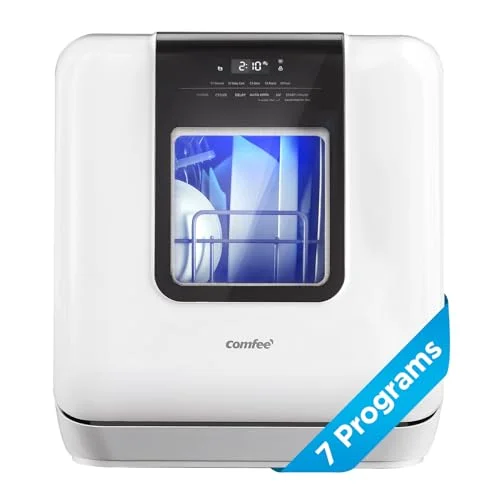
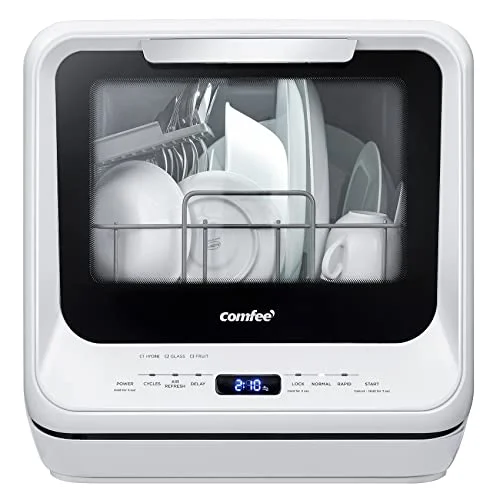
COMFEE' Minilite countertop dishwasher in white

COMFEE' Minilite

Countertop · 5 L tank · about $250

Air Refresh is the answer to the sealed-tub smell: it circulates air to keep machine and dishes dry. The Hygiene cycle heats to a stated 162°F — use it for the monthly empty run.

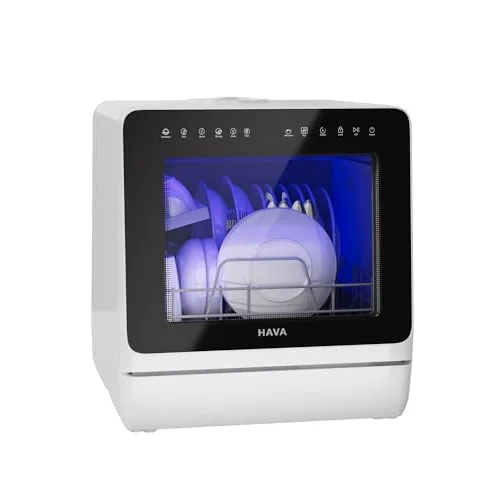
HAVA countertop dishwasher with water softener in black

HAVA with Water Softener

Countertop · softener by hardness level · about $329

The only machine here that treats water before it is heated. Set the softener to your local hardness and scale forms far more slowly — descaling still happens, just less often.

COMFEE' Miniplus countertop dishwasher with auto door open

COMFEE' Miniplus

Countertop · 6 L tank · auto-open · about $290

AUTO-OPEN cracks the door at the end of the cycle — the mechanical version of the habit we recommend. The 6 L tank is more water to empty when it sits unused.

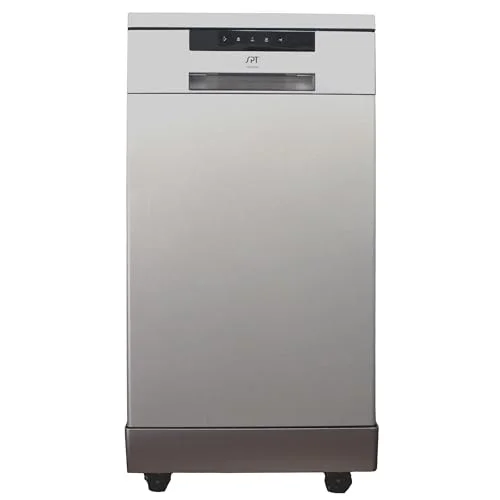
SPT SD-9263SSC 18-inch portable dishwasher in stainless steel

SPT SD-9263SSC 18-Inch

Freestanding · 8 place settings · about $600

A full-size-style tub with a rinse-aid warning indicator, so the machine tells you when to refill. Bigger filter, plus one extra item: the faucet coupling, connected and disconnected every load.

Countertop machines put more of the burden on you; 18-inch freestanding ones mostly need their filter and coupling looked after. Which class suits you is worked through in the countertop versus 18-inch comparison.

Don't

Five things not to do to a portable dishwasher

Don't use bleach. Chlorine attacks stainless steel, degrades rubber seals, and produces hazardous gas if it meets an acidic descaler or an ammonia cleaner — a real risk in a machine you may descale a week later. A hot empty cycle with a dishwasher cleaner does everything bleach would.

Don't use abrasive pads or scouring powder on the tub. Many of these tubs are plastic, and abrasives leave fine scratches that hold grease and can never be cleaned out.

Don't run a descaling cycle with dishes inside. They block the spray and can be etched by a strong solution — aluminum and some glazes especially.

Don't ignore a machine that stops draining. Standing water means the return path is blocked, and running it again loads the pump against that blockage. Unplug it, pull the filter, check the hose for kinks and low loops, and confirm the hose height matches the manual. Anything past that — a pump humming without moving water, a burning smell, a tripped breaker — is the manufacturer's service line, not a screwdriver. These are 120 V appliances full of water, and that is where general information stops.

Don't put it away wet. The single habit worth taking from this page: unload it, and leave the door ajar.

Copy this

The whole routine, on one page

Tape the descale date to the back of the machine — it is the only task with an interval long enough to forget.

WhenTimeWhat you do
After each load30 secUnload, glance at the filter, leave the door ajar. Empty or run down the tank if the next load isn't coming soon.
Weekly5 minPull the filter, rinse it against the flow, brush it, check it against a light. Wipe the gasket fold, the tub floor and the tank opening.
Monthly15 minClear the spray-arm holes and spin both arms. Run an empty hot or self-clean cycle. Check the drain hose for kinks and low loops. Top up rinse aid.
Every 1–6 months (set by hardness)30–45 minDescale with the manufacturer's product or food-grade citric acid: machine empty, longest hottest cycle, then a full plain-water rinse.
Before storage or winter30 minEmpty hot cycle, clean and dry the filter, empty the tank, drain sump and hoses, dry tub and gasket, unplug, store door open. Move it indoors if the space will freeze.

Under an hour a month, for an appliance costing between $170 and $700. The machines that fail at eighteen months are almost never the ones that got that hour. Whether one is worth buying at all is a separate calculation, run in the cost and water math.

FAQ

Common questions

How often should I clean the filter in a portable dishwasher?

Weekly if you run the machine most days, and straight after rice, oatmeal, coffee grounds or breadcrumbs. The filter sits in the floor of the tub under the lower spray arm and usually lifts out or turns a quarter-turn counter-clockwise. Rinse it against the direction the water flowed, brush it, and hold it to a light to check you can see through the whole mesh. A blocked filter starves the pump, weakens the spray and leaves grit on the dishes.

Can I use vinegar to descale a countertop dishwasher?

Only if your manual names it. Acetic acid varies in strength, is harsher on some rubber seals, and its smell lingers in a small sealed plastic tub. The safer options are a proprietary dishwasher descaler or food-grade citric acid dissolved in warm water and poured into the empty tub. Either way, run the longest hottest cycle empty, then a full plain-water cycle to rinse the acid out.

Why does my portable dishwasher smell even when it's clean?

Because it is a sealed plastic box that stays warm and damp between loads. These machines mostly have no heated drying element, some water remains in the sump by design, and a small household does not run one daily — so biofilm establishes itself in the sump, the filter and the door gasket. Two habits fix it: leave the door open a couple of inches after every load, and use an air or drying mode if the machine has one, such as Air Refresh on the COMFEE' Minilite.

Can I use dishwasher pods in a small countertop dishwasher?

Often not well. Pods are formulated for a full-size cycle, and these machines run short, low-volume programs — some as quick as 29 minutes on roughly five liters — so a pod can still be partly undissolved when the cycle ends. Most manufacturers here specify powder or gel at a reduced dose; COMFEE' states its rapid program needs half the standard quantity and its fruit program none. Never use hand dish soap: it foams, and the suds escape the door seal.

Keep reading

Next, from the same shelf