Best Portable Dishwashers
Comparison · Faucet Adapter vs Built-In Tank

Hook it to the tap, or fill the tank? One choice decides the rest.

Every portable dishwasher gets its water one of two ways: piped in through an adapter clipped to your kitchen faucet, or hand-filled from a built-in tank a jug at a time. It looks like a minor spec buried under place settings and price. It isn't. It decides whether the machine can even run in your kitchen, how much it will annoy you on a Tuesday night, and whether your landlord has an opinion about it at all.

By Ilane Tall · Updated August 17, 2026 · Research-based.

A compact countertop dishwasher next to a kitchen faucet, illustrating the choice between a faucet adapter connection and a hand-filled water tank

Reader-supported: we may earn a commission when you buy through the links on this page, at no additional cost to you. Prices move constantly — confirm the live price before you order.

Shoppers researching this category almost always start with place settings and price, and end up back here anyway, because water source is the specification that actually gates the purchase. A faucet-connect machine needs a specific kind of tap and never needs refilling. A tank machine needs no tap at all, but you become the water main, filling it by hand before every cycle. Several listings advertise both, and that flexibility has its own cost, measured in litres of tub space you don't get to wash dishes with.

This page works through both systems on their mechanics, not their marketing: how a faucet adapter actually attaches and which taps refuse it, what a built-in tank really holds and how often you're back at the sink with a jug, what a landlord actually objects to, and where the dirty water is supposed to go once the cycle ends. It closes with a straight answer — which mode suits which kitchen — and a short list of tank-fed and faucet-fed machines worth knowing by name.

How this page is built

We compare published specifications, what ships in the box, water source, capacity and price. We do not physically test these machines and we do not run a testing lab, and we do not publish star ratings or review counts — Amazon's listing data returns none for this category, so there are no invented scores here. Where a conclusion is a judgement rather than a spec, we say so.

The two systems

Two ways to get water into a machine that isn't plumbed in

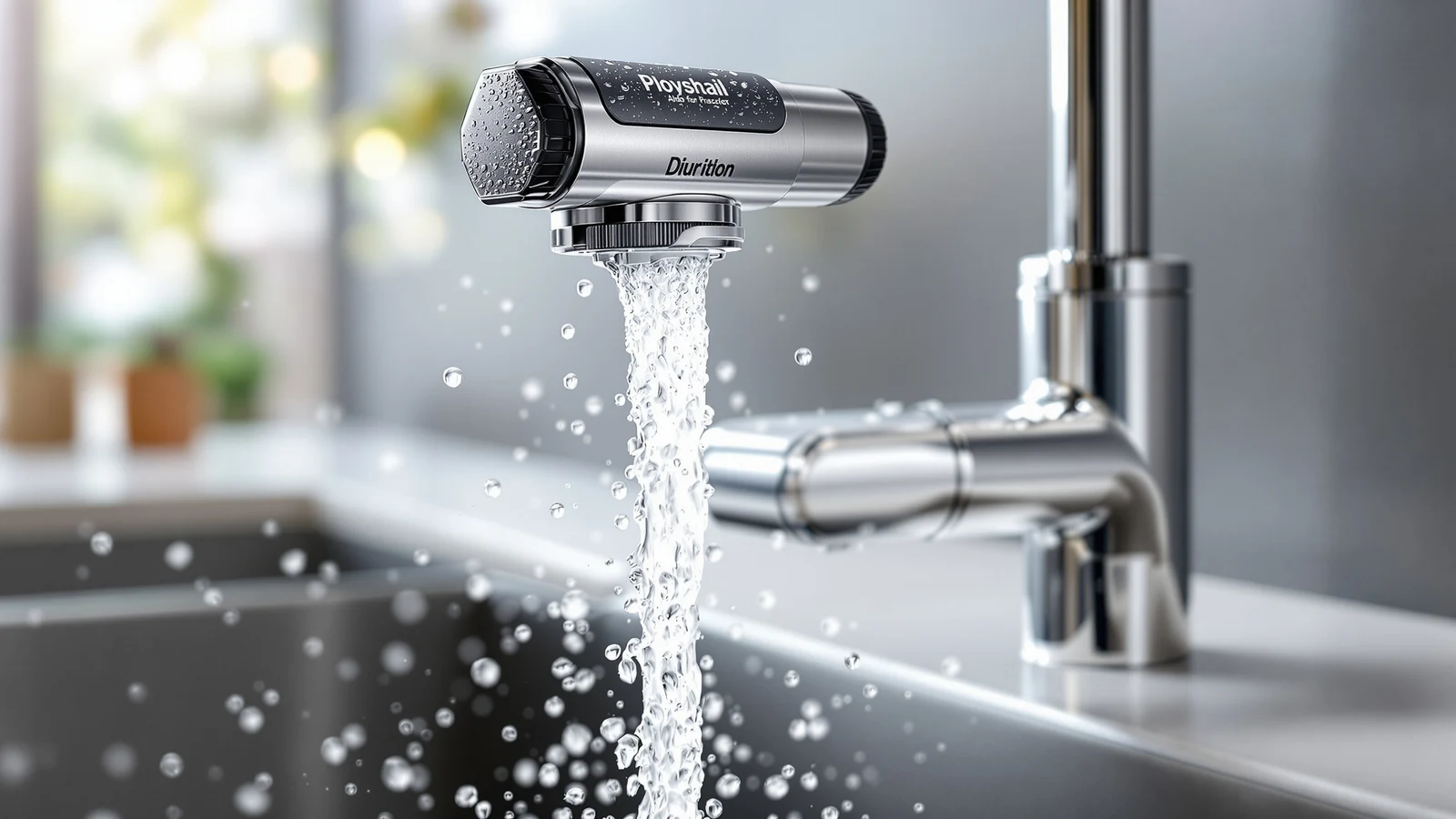
A portable or countertop dishwasher isn't connected to your home's water lines the way a built-in is, so every model solves the same problem — get several litres of hot water in, and dirty water back out — with one of two mechanisms. The faucet adapter system runs a supply hose from an adapter fitted where your tap's aerator used to be, so the machine draws directly from your existing hot and cold lines for as long as the cycle runs, and refills itself automatically between the wash and rinse stages. The built-in tank system skips the tap entirely: you pour water into a reservoir inside the unit — most of the machines in this category use a tank in the 5-litre region — and the machine draws only from that reservoir for the whole cycle. Some models, described further down, offer both connections and let the owner choose per session.

Neither system is more "portable" than the other in the sense the category name implies; both machines sit on a counter or floor and need to be near a sink for drainage regardless of how they take in water. The real difference is what each one asks of your kitchen before it will run at all — a faucet it can grip, or a person willing to refill it.

Faucet adapter

How the faucet adapter works, and which taps it won't fit

The adapter itself is a small plastic or metal fitting that threads onto the end of your faucet spout in place of the aerator — the small mesh screen that softens the water flow, screwed into most kitchen taps by hand or with a wrench. Once it's on, a supply hose runs from the adapter to the back of the dishwasher, and a lever or dial on the adapter lets you switch the tap between normal use and feeding the machine. Installing it is meant to be a five-minute, tool-optional job, which is the whole appeal of the category: no plumber, no permanent change to the tap itself once the adapter is removed.

The catch is thread compatibility, and it rules out more kitchens than any other single spec in this guide. The adapter is built for a straight faucet spout with a standard, removable aerator — the kind found on most fixed kitchen taps. It generally will not fit:

  • Pull-down and pull-out sprayer faucets, now common in American kitchens and close to standard in newer rentals, because the spray head detaches from a hose rather than unscrewing a fixed aerator.
  • Faucets with a non-standard or European thread, or a concealed, non-removable aerator built into the spout casting.
  • Touchless and sensor faucets, where the internal solenoid valve isn't designed to stay open for the length of a wash cycle.
  • Single-lever mixer taps with an integrated filter or purifier head, which often have no exposed aerator thread at all.

If any of those describes your kitchen, the entire faucet-fed class of machine is unavailable to you regardless of price — the fix isn't a better adapter, it's a different water source. That's the situation a tank-fed machine is built for, and it's worth checking your own faucet before you shortlist anything. Our step-by-step hookup guide covers how to test your aerator threads and install the adapter correctly once you've confirmed it fits.

Built-in tanks

What a tank actually holds, and the refill you sign up for

A tank-fed machine sidesteps the whole faucet question by treating water as something you carry to it, not something it draws on its own. Most tank capacities in this category sit around five litres, and the design premise is the same across brands: one full tank supplies one wash cycle, start to finish, because the machine has nowhere else to draw extra water from mid-programme. There's no partial refill option — you fill it before you start, or the cycle doesn't run.

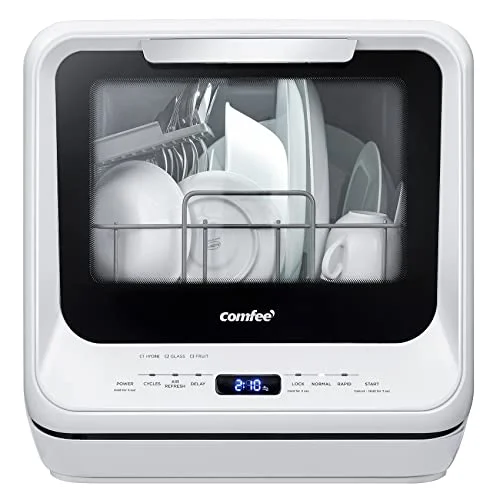
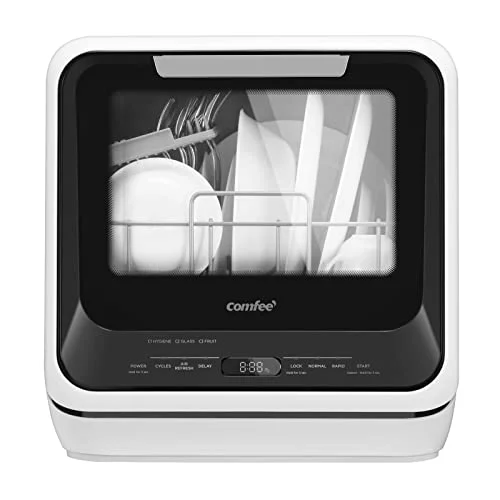
The COMFEE' Portable Mini Dishwasher is built around a 1.32-gallon tank — about five litres — and its listing states plainly that no hookup is needed: fill it, plug it in, and it runs six programmes with 360° dual spray and a 162°F high-temperature wash, finishing with an air-dry function. The COMFEE' 5L Countertop Dishwasher follows the identical no-hookup design with the same 5-litre tank and six programmes, but runs its high-temperature wash hotter, at 192°F, which matters if you're washing baby bottles or greasy cookware and want the extra margin on sanitizing heat. Both are the same idea at two price points and two temperatures.

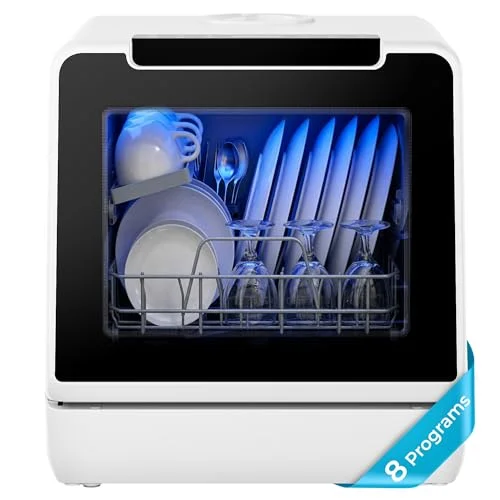
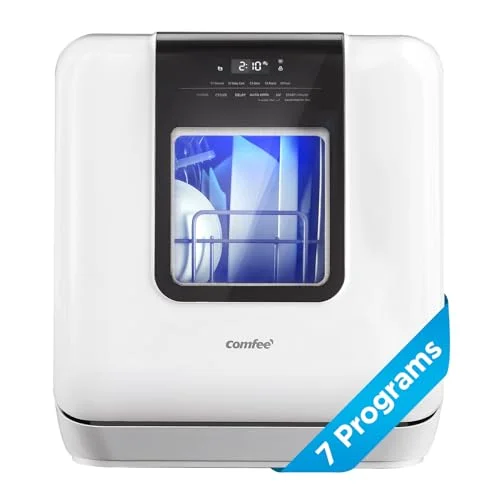
The EUHOMY Countertop Dishwasher also runs from a 5-litre tank, with eight programmes to choose from and a 40 dB noise rating — worth knowing if the machine will run within earshot of a living room, since manufacturer decibel figures are self-reported and best read as a class indicator rather than a lab measurement. And the COMFEE' 6L Countertop Dishwasher — the Miniplus Auto Door Open variant — steps the tank up to six litres, the largest reservoir of the four, and pairs it with seven programmes, a UV hygiene function and a door that pops open automatically at the end of the cycle to vent steam and help drying finish.

The refill annoyance, stated plainly

A five- or six-litre jug is not a small thing to fill and carry more than once. In practice, tank ownership means a trip to the tap before every load — not a weekly errand, a per-cycle one — and if you run the machine daily, that's roughly 365 refills a year of walking a jug from the sink to the counter and back. It's a genuinely small chore each time and a real one in aggregate, and it's the honest trade for never needing a faucet that fits.
Dual-mode machines

The machines that do both — and what that flexibility costs

A third category exists across this market: countertop dishwashers built with both a faucet inlet and an internal tank, switchable per cycle. The appeal is obvious — connect to the tap at home for unlimited water and zero refilling, then disconnect and run the same machine from its tank in an RV, a dorm with no kitchen faucet, or a rental where the tap simply won't take the adapter. One machine, two water strategies, chosen on the day.

The cost of that flexibility isn't in the price tag, it's in the tub. Building space inside a small countertop shell for both a tank reservoir and a faucet-inlet valve assembly leaves less interior volume for dishes than a machine engineered around one system only — which is a real part of why several dual-mode machines in this category top out at four place settings rather than six. It's a legitimate trade if you genuinely need both water sources at different times; it's dead weight, and lost capacity, if you'll only ever use one. We've documented a dual-mode machine's real-world capacity trade-off — tank or faucet, four place settings either way — in our comparison of countertop and 18-inch portable dishwashers, alongside the class of machine that skips the choice entirely by never having a tank at all.

None of the five machines singled out on this page are dual-mode: each is built and marketed around a single water strategy, which is exactly why they're useful as clean examples of what each system costs and delivers on its own.

Renters

Renters: what your landlord actually cares about

Neither faucet-adapter nor tank-fed machines require permission from a landlord in the way a built-in dishwasher installation would, because neither cuts into a cabinet, taps a supply line permanently, or needs a drain plumbed through the wall. That's the whole premise of the category. But "doesn't need permission" isn't the same as "can't cause a problem," and the two systems create different small risks a landlord would care about if they thought about it.

A faucet adapter is removed the same way it's installed — unscrew it, screw the original aerator back on — and leaves no trace once it's off, which is the strongest argument for it in a rental. The risk sits in the connection itself: a supply hose that isn't fully seated on the adapter, or an adapter left loosely threaded, can leak at the tap during a cycle, and a slow leak under a cabinet is exactly the kind of damage a security deposit exists to cover. Checking the connection is snug before every run, and not leaving the machine running unattended overnight, is the practical answer.

A tank-fed machine removes that risk at the tap entirely — there's nothing clipped to the faucet to work loose — but it introduces a different one: the machine itself holds several litres of water, and any leak from the tank, the door seal or the drain hose is a leak inside the unit sitting on a rented countertop or floor. Either system is safer than the alternative on a different axis, which is why the honest advice for renters is less about which system and more about supervision: run it on a hard floor if possible, keep it off the edge of counters, and don't run a cycle and leave the apartment. General guidance on setup and cabinet clearance for rented and shared kitchens is in our guide to choosing a machine for an apartment, dorm or RV.

Drainage

Drain options: sink, bucket, and what not to do

Water source and drainage are separate questions, but they get confused because both hoses run to roughly the same place: whether the machine fills from a tap or a tank, waste water leaves through a drain hose at the end of the cycle, and that hose has to go somewhere.

Into the sink

The standard method is hooking the drain hose over the edge of the sink, usually with a clip or bracket supplied in the box, so the pump can push the waste water out and gravity carries it down the drain. This only works reliably if the hose end sits roughly level with or above the machine's own drain outlet — a small internal pump is not built to push water uphill over any real distance, so a machine placed far from or below the sink can leave water pooling inside the tub instead of draining fully.

Into a bucket

Where a machine can't reach a sink — set up on a dining table, an island with no adjacent basin, or a spot chosen for the wall-cabinet clearance rather than proximity to plumbing — draining into a bucket set on the floor below the hose end is a workable substitute. It works because it only asks the pump to push water downhill, which it's built to do easily. The obvious catch is capacity: a bucket that isn't emptied before the next cycle overflows, and checking it before every run becomes one more manual step layered on top of a tank refill if you're running a tank-fed machine to begin with.

What not to do

Don't run the drain hose into a sink with the garbage disposal switched on, or leave it draining into a basin full of standing dishwater — either can push waste back up the hose. Don't let the hose kink or loop above the height of the machine's outlet, which traps water and forces the pump to work harder than it's designed to, shortening its life. And don't leave a full drain bucket unattended near foot traffic; a spill on a kitchen floor is the more common failure mode than anything mechanical in this category. The filter and hose are also where smells originate between cycles — covered in full in how to clean and descale a portable dishwasher.

At a glance

The five machines in this comparison

All figures are manufacturer specifications; prices are approximate and move on Amazon.

MachineWater sourceCapacity / tankNotable specPrice
COMFEE' Mini (Minilite)Tank only, no hookup1.32 gal (~5 L)162°F wash, 6 programmes$249.99Price
EUHOMY CountertopTank only5 L8 programmes, 40 dB rated$260.99Price
COMFEE' 5L (Minilite)Tank only, no hookup5 L192°F high-temp wash$289.99Price
COMFEE' 6-Place CountertopFaucet-connect6 place settingsENERGY STAR, 19.7×21.6×17.2 in$309.99Price
COMFEE' 6L (Miniplus)Tank only6 LUV Hygiene, Auto Door Open, 7 programmes$337.88Price
The shortlist

Five machines that define both systems

01Faucet-connect

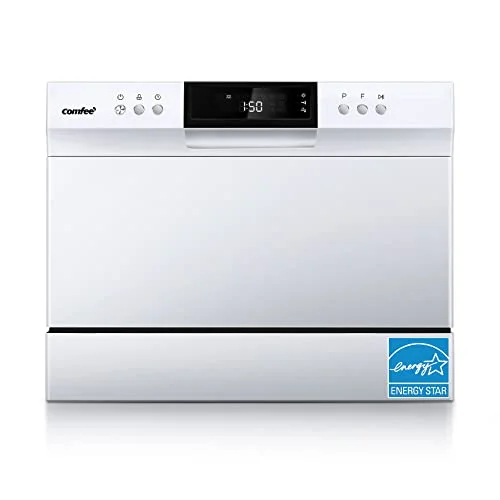
COMFEE' 6-Place Countertop Dishwasher

Straight faucet, standard aerator, no interest in refilling anything
Faucet-connect · 6 place settings · 19.7 in D × 21.6 in W × 17.2 in H · ENERGY STAR

This listing doesn't advertise a built-in tank, which in this category is the tell that a machine is built around the faucet connection instead — unlimited water for the whole cycle, no jug, no per-load chore. Six place settings is also the largest capacity of the five machines here, the direct benefit of not spending interior volume on a tank reservoir.

The trade-offIt only works at all if your faucet has a straight spout and a removable aerator. A pull-down sprayer or a tap with no exposed thread takes this machine off the table regardless of price.

COMFEE' six-place countertop dishwasher
$310
6 place settingsCheck price →
02Tank, lowest price

COMFEE' Portable Mini Dishwasher

The cheapest way into a no-hookup machine that just works
Tank only · 1.32 gal (~5 L) · no hookup needed · 6 programmes · 162°F high-temp wash · air-dry

The Minilite is what to buy when the honest answer is "no faucet will ever work here" and the budget is tight. Fill the tank, plug it into a socket, done — 360° dual spray arms and a 162°F wash on the Hygiene cycle cover most everyday loads, and the air-dry function finishes the job without a heating element.

The trade-offIt's the entry-level tank in this lineup, and a jug of water before every cycle is the price of never needing a faucet. It's also the coolest of the two 5-litre COMFEE' washes at 162°F, ten degrees short of the pricier model's 192°F.

COMFEE' Mini Dishwasher with built-in water tank
$250
Tank, no hookupCheck price →
03Tank, hottest wash

COMFEE' Countertop Dishwasher with 5L Tank

Baby bottles, greasy pans, and anyone who wants the hotter of the two tank washes
Tank only · 5 L built-in tank · no hookup needed · 6 programmes · 192°F high-temp wash · 360° dual spray

Same no-hookup premise as the Mini, with the tank spec'd at a flat 5 litres and the high-temperature wash raised to 192°F, the hottest cycle among the tank-only machines on this page. Higher wash temperature matters most for baby gear and cookware carrying baked-on grease, where hotter water does more of the work than extra spray pressure.

The trade-offIt costs about $40 more than the Mini for the same tank size and the same refill routine — you're paying for the extra 30°F of wash heat, not for less manual filling.

COMFEE' countertop dishwasher with 5L water tank
$290
192°F washCheck price →
04Tank, quietest

EUHOMY Countertop Dishwasher

Studios and open-plan kitchens where the machine runs while you're in the room
Tank only · 5 L tank · 8 programmes · 40 dB rated · black finish

Eight programmes is the most cycle choice of any tank-fed machine on this page, and the 40 dB rating puts it at the quiet end of the category — worth weighing if the machine will sit within earshot of a living space, since a countertop dishwasher runs at ear height and out in the open, unlike a floor-standing unit partly shielded by cabinetry.

The trade-offManufacturer decibel figures are self-reported and measured in undisclosed conditions, so treat 40 dB as a strong indication of class rather than a guaranteed number. It's still a 5-litre tank — the same per-cycle refill as every other tank machine here.

EUHOMY countertop dishwasher in black
$261
40 dB ratedCheck price →
05Tank, biggest reservoir

COMFEE' Countertop Dishwasher with 6L Tank

Anyone who wants to refill as rarely as a tank machine allows
Tank only · 6 L built-in tank · 7 programmes · UV Hygiene function · Auto Door Open · white finish

This is the Miniplus Auto Door Open variant, and the 6-litre tank is the largest reservoir of the four tank-fed machines on this page — one litre more water per fill than the 5-litre models, which stretches the wash a little further before the tub is drawing on fumes. Auto Door Open pops the door at the end of the cycle to vent steam, the most effective drying method available to a machine with no heating element, and UV Hygiene is an added sanitizing pass.

The trade-offIt's the most expensive machine on this page, and a bigger tank is still a tank: you fill it by hand before every load, the same routine as the cheaper models, just with slightly more water to carry each time.

COMFEE' countertop dishwasher with 6L water tank and auto door open
$338
6L tank, largestCheck price →
The decision

Which mode suits which kitchen

Choose the faucet adapter if

All of these are true

Your kitchen tap is a straight spout with a standard, removable aerator — not a pull-down or pull-out sprayer, not a touchless faucet. You wash daily or near-daily and refilling a jug every time would genuinely wear on you. You want the largest capacity the category offers without paying for an 18-inch machine on wheels. Miss the faucet requirement and nothing else on this list matters.

Choose a built-in tank if

Any one of these is true

Your faucet is a sprayer, touchless, or has no removable aerator. You're in an RV, dorm or anywhere without a reliable kitchen tap. You wash for one or two people, where a five- or six-litre fill comfortably covers a load. Or you'd simply rather carry a jug than risk a leak at the tap in a rented kitchen. Any one of these settles it on its own.

The middle case: check before you assume

Some kitchens qualify for both — a straight faucet and a willingness to refill either way. There, the deciding question is simpler than the spec sheet: how often will you actually run the machine? Daily use tips toward the faucet adapter, because the refill chore compounds fast at that frequency. Occasional use — every few days, or a machine kept mainly for RV trips — tips toward a tank, because the convenience of never touching the tap outweighs a refill you're doing a handful of times a week rather than every single day. What the machine costs to run either way, water and electricity included, is worked through in our honest cost and water math.

FAQ

Common questions about water hookup

Can I switch a faucet-only dishwasher to run from a tank later?

No. A faucet-only machine has no internal reservoir built in, and a tank-only machine has no faucet-inlet valve — the water system is part of the machine's internal design, not an add-on you can retrofit. If there's any chance your faucet situation will change, or you'll need both at different times, that decision has to be made before you buy, by choosing a dual-mode machine rather than trying to convert one after the fact.

How do I know if my faucet will accept an adapter?

Check for a removable aerator — the small mesh disc screwed into the tip of a straight faucet spout — and standard threads underneath it. If your tap has a pull-down or pull-out sprayer head, a touchless sensor, or a built-in filter with no exposed aerator, the adapter supplied with most portable dishwashers will not fit, and a tank-fed machine is the only version of this appliance that will work in that kitchen.

How many dishes can I wash on one tank fill?

One tank fill supplies one full wash cycle, not multiple loads — a five- or six-litre tank is sized to cover the wash and rinse water for a single programme from start to finish. That's the entire point of a tank system: refill before every cycle, rather than trying to stretch one fill across several loads.

Where does the water go when I use a bucket instead of the sink?

The drain hose empties into the bucket the same way it would empty into a sink, using the machine's own pump — the bucket just needs to sit lower than the hose outlet so the pump is pushing water downhill. Check and empty the bucket before starting another cycle, since it isn't connected to a drain and will overflow if it fills during a run.

Keep reading

Next, from this site