Best Portable Dishwashers
How-to · Loading a compact dishwasher

Load it right, or it won't clean.

A four-to-six-place-setting tub has no margin for a careless load. One blocked spray arm, one nested bowl, one plate leaning the wrong way, and the "it doesn't clean well" review writes itself. Here's how to load a compact machine so every item actually gets hit by water.

By Ilane TallUpdated August 21, 2026Research-based — no testing lab, no invented ratings

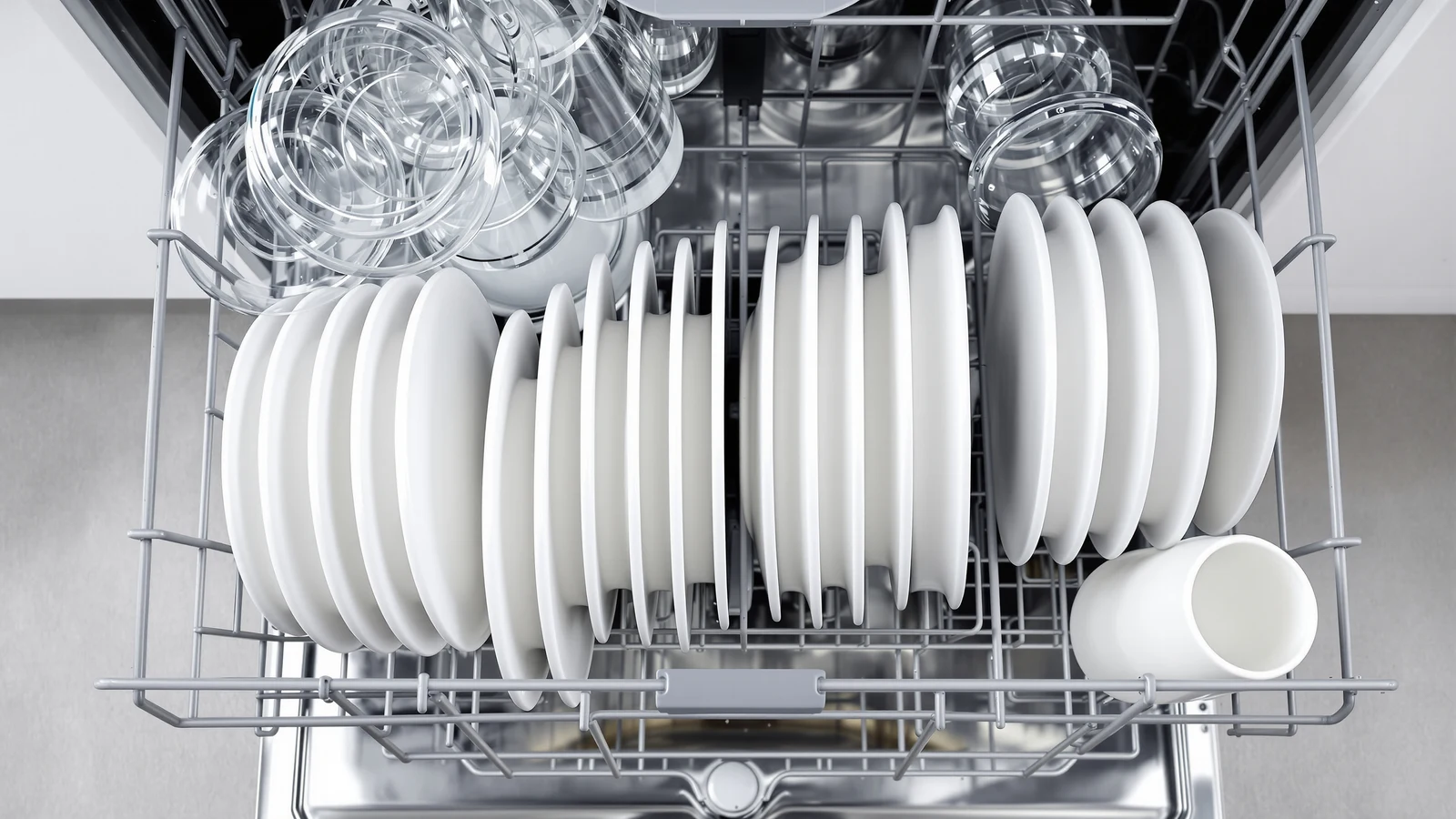
Overhead view of a compact countertop dishwasher's lower rack, plates angled toward the center and bowls turned downward around the spray arm

Reader-supported: we may earn a commission when you buy through the links on this page, at no additional cost to you. Prices move constantly — confirm the live price on Amazon before you order.

Most complaints about a portable dishwasher aren't really about the machine. They're about the load. A compact tub washes with one spray arm, or two on machines built with a spray path above and below the rack, spinning inside a space roughly the size of a microwave. That arm needs a clear, unbroken column of air above it to complete its rotation and to actually throw water where it's aimed. Fill that column with plastic lids stacked flat, a mixing bowl sitting right-side up, or a dinner plate wedged in backwards, and the same detergent, the same water temperature and the same cycle that cleans everything else in the basket will leave two or three items untouched.

That's the single most common cause behind the "doesn't clean well" complaints that show up in reviews of almost every compact dishwasher on Amazon, and it has very little to do with which specific model got ordered. If dishes are coming out with a chalky film, standing water in the bottom of a bowl, or visible food after a full cycle, loading is worth ruling out before assuming the machine itself is at fault — our troubleshooting guide covers the mechanical causes once loading is confirmed correct. What follows here is the loading logic itself: where clearance matters most, how to angle plates, bowls and mugs so they don't collect standing water, what physically doesn't belong in a tub this size, the honest answer on pre-rinsing, where detergent goes in a dispenser built for a fraction of a full-size machine's dose, and a worked example using a real six-place-setting machine, item by item.

How this page is built

We compare published specifications — place settings, spray arm design, cycle counts, dimensions — against general, well-established facts about how compact dishwashers are engineered and how detergent chemistry behaves in a short, low-volume cycle. We do not physically test these machines and we do not run a testing lab. We also don't publish star ratings: Amazon's product API returns no rating or review count for this category, so there are none on this site, and we never invent or paraphrase review sentiment we don't have.
Mechanics

Why spray arm clearance beats cramming more in

A countertop dishwasher pressurizes water through a rotating arm mounted under the lower rack, and on some machines a second arm above or below the upper one as well — the design behind claims like the COMFEE' Minilite's 360° dual spray. The arm spins because water jetting sideways out of its nozzles pushes it around, the same principle as a lawn sprinkler. That only works if there's open space above the arm for it to complete a full rotation, and open space beyond that for the thrown water to actually travel outward and hit every surface in the tub rather than being stopped an inch above the nozzle by the underside of a mixing bowl.

Manufacturers market this directly. EUHOMY's countertop dishwasher is sold on "360° coverage," language meant to reassure buyers the spray reaches every angle of the tub. Treat that kind of claim as a design intention, not a guarantee: it describes how the arm is engineered to move, not how a specific load will interact with it once it's packed. A 360° spray path aimed into an overloaded top rack still can't reach dishes it has no straight line to.

This is also the specific way a compact countertop machine differs from a full-size 18-inch portable on wheels. A larger tub has enough interior volume that a slightly tight load still leaves working clearance around the arm; a tub built for four to six place settings does not have that margin to spare. Anyone loading for more than two or three people every night and fighting this compromise on a regular basis may find it's cheaper, in wasted rewashes and hand-finishing, to size up — see the best 18-inch portable dishwashers on wheels for the full-size alternative — than to keep working around a countertop tub's limits.

The practical rule that follows from all of this: load the rack from the outside in, and stop before the last item forces anything into the vertical column directly above the spray arm. If you have to press down or angle a plate to make it fit, the machine has already told you the load is one item too many.

Loading

Plates, bowls and mugs: the angle rules

Plates belong in the bottom rack, facing the center of the tub, tilted slightly forward rather than standing bolt upright. A plate leaning dead vertical presents its flat face edge-on to the spray, which sounds efficient but means loosened food debris runs straight down the surface and can re-deposit on whatever sits below it; a gentle forward lean lets water sheet off and carry debris down and out toward the base of the tub instead.

Bowls are the item people get wrong most often. A bowl set right-side up, even angled, forms a pocket that traps water for the entire cycle — the spray fills it faster than the shallow tilt can drain it, and it comes out with a puddle of gray water sitting in the base. That water either has to be tipped out by hand or, worse, sits on a surface that's about to hold food. Bowls belong upside down, or angled steeply enough against the rack tines that nothing can pool, never sitting flat the way a plate does.

Mugs and glasses go on the top rack, upside down, spaced so the rim of one doesn't nest against another. Nested glassware blocks water from reaching the inside of at least one of the pair, and it's a common reason a single mug comes out still cloudy from the last coffee poured into it. Machines built with spray above and below the rack — the COMFEE' Minilite's 360° dual spray arms are the example here — are somewhat more forgiving of a mug that isn't perfectly inverted than a machine with a single lower arm. "More forgiving" is not the same as "doesn't matter": invert it anyway.

The quick version

  • Plates: bottom rack, facing center, tilted forward — not vertical, not flat.
  • Bowls: upside down or steeply angled — never sitting flat like a plate.
  • Mugs and glasses: top rack, upside down, with a gap between each one.
  • Cutlery: mixed handle-up and handle-down in the basket so pieces don't nest together and shield each other from spray.
Limits

What never goes in a compact machine

A compact machine's rack footprint is dictated by its exterior dimensions, and even the largest countertop model in this guide, the COMFEE' 6-place-setting dishwasher at 19.7 inches deep by 21.6 inches wide, is still a fraction of a full-size built-in. Sheet pans, large stockpots, roasting trays and oversized platters simply don't fit the rack geometry, and forcing one in blocks the spray arm for everything around it rather than getting itself clean. Cast iron, anything with a wood component, and pieces explicitly marked hand-wash-only shouldn't go in any dishwasher, compact or full-size — heat and detergent strip seasoning and finish faster than they clean.

Two more categories are specific to small, sealed tubs. Anything with a battery, a cork, or an electronic component obviously stays out. And delicate glassware — thin stemware, crystal, anything that chips easily — is a worse fit in a compact machine than a full-size one, because the tighter rack spacing means more contact points with neighboring items during the wash and dry cycle.

On maximum plate size specifically, we're being careful here rather than guessing: none of the four machines referenced in this guide has a published plate-diameter figure in the data we're working from, except by way of the COMFEE' 6-place model's overall rack footprint. The AIRMSEN countertop dishwasher, sold simply as a no-hookup unit, doesn't list a plate-diameter or place-setting number at all — its own listing is the only accurate source for what its rack will actually take, and that's the right instinct for any compact machine: check the number before you buy the platter to match it, not after.

Prep

Pre-rinse or not, honestly

The honest answer sits between the two extremes people argue about. Modern dishwasher detergent, including the smaller powder and gel doses these compact machines use, contains enzymes that need some soil to work against — rinsing a plate spotless before it goes in doesn't help the detergent and can leave it with nothing to break down, which is mostly wasted effort, not actively harmful. But that's a full-size-machine argument, and it only holds up when the machine has enough water volume and cycle time to carry loosened debris all the way to the filter and out through the drain.

Compact machines run shorter cycles with a fraction of the water volume of a full-size dishwasher, which changes the calculation. Heavy debris — dried sauce, rice, egg — is more likely to redeposit onto a neighboring item or clog the small filter and pump than it is in a machine with more water to carry it away. Scrape solids into the trash and rinse anything with dried-on or starchy residue before loading; you don't need dishes to be spotless going in, just free of the debris a small pump wasn't built to chew through. A filter that keeps catching heavy debris is also the most common reason a compact machine starts to smell or drain slowly over time — see how to clean and descale a portable dishwasher for the maintenance side of that problem.

Detergent

Detergent placement in small dispensers

A compact machine's detergent dispenser is sized for its tub, which means a fraction of the dose a full-size dishwasher pod is built to deliver. Pods are formulated to dissolve across a longer, higher-volume cycle, and in the short, low-volume cycles these machines run they often fail to fully dissolve — the film left on plates and glasses that people blame on the machine is frequently undissolved pod residue. Powder or gel detergent, measured to the dispenser's own fill line rather than eyeballed from a pod's assumed dose, dissolves more reliably in this category and is what most compact-machine manuals actually specify.

Temperature helps detergent do its job, which is where a spec like the COMFEE' Minilite's 192℉ high-temp function matters beyond just sanitizing: hotter water dissolves powder and gel faster and helps break down grease that a cooler, shorter cycle would leave behind. It's also worth being deliberate about rinse aid in this category. Compact dishwashers overwhelmingly dry with residual heat and air circulation — an air-dry function, in the Minilite's case — rather than a heating element built for drying specifically, so rinse aid is doing more work here than in a full-size machine that can finish with a dedicated heat-dry cycle. Underdosing it is why plastic containers in particular come out with visible water spots even after a cycle that otherwise ran clean.

Worked example

A 6-setting load that actually works, item by item

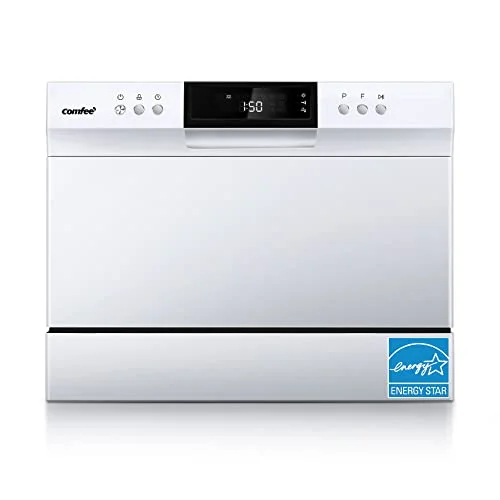
Six place settings, on paper, means roughly enough dishes for two or three people for a full day, and it's the largest capacity claimed by any machine in this guide — the COMFEE' 6-place-setting, ENERGY STAR-certified dishwasher, at 19.7 inches deep by 21.6 inches wide by 17.2 inches tall, is built around exactly that number. Here's how that load actually breaks down inside the rack rather than as an abstract count on a spec sheet.

  1. Bottom rack, back row: the two largest dinner plates, angled forward, spaced with a visible gap between them — not touching edge to edge.
  2. Bottom rack, front and sides: the remaining plates and any side plates or saucers, same forward angle, arranged so none blocks the space directly above the spray arm's center.
  3. Bottom rack, corners: bowls, upside down or steeply angled against the rack tines, never sitting flat.
  4. Top rack: mugs, glasses and cups, upside down, each with clear space around it so nothing nests inside its neighbor.
  5. Cutlery basket: forks and spoons mixed handle-up and handle-down rather than sorted into one orientation per compartment, which keeps utensils from nesting together and shielding each other from spray. Knives point down for safety, not up.
  6. What stays out: the roasting pan or stockpot from that day's cooking. Even a six-setting rack this size doesn't have room for full-size cookware without blocking the arm for everything else — wash those separately.
  7. Detergent: fill the dispenser to its marked line with powder or gel, not a full-size pod, and add rinse aid if the machine has a reservoir for it.
  8. Cycle: a Normal or equivalent mid-length program for a full six-setting load; save the fastest cycle for a lightly loaded rack of mostly glassware, since a short cycle on a full load is the most common reason people end up rewashing one item by hand.

The same logic scales down. A four-setting machine follows the identical order — plates low and angled, bowls inverted, glassware up top with space around each piece — it just has less room to be forgiving about it, which is exactly why the clearance and angle rules earlier in this guide matter more, not less, on the smallest machines.

Referenced in this guide

The machines mentioned above

Specs and prices as published by the manufacturer and Amazon; prices move constantly — confirm the live price before you order.

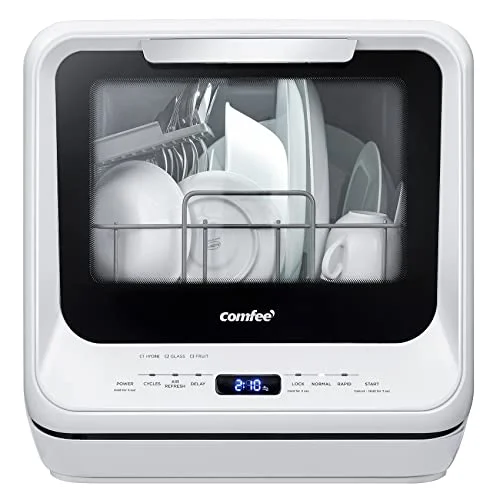
COMFEE' countertop dishwasher, 6 place settings

COMFEE' Countertop Dishwasher, 6 Place Settings, ENERGY STAR

19.7"D × 21.6"W × 17.2"H

$309.99Price
COMFEE' Minilite portable dishwasher with 5L built-in water tank

COMFEE' Minilite, 5L Tank, 6 Programs, 360° Dual Spray

192℉ high-temp · air-dry · no hookup needed

$289.99Price
EUHOMY countertop dishwasher, 40 dB, 360 degree coverage

EUHOMY Countertop Dishwasher, 6 Programs, 40 dB, 360° Coverage

Size/variant: Large

$269.99Price
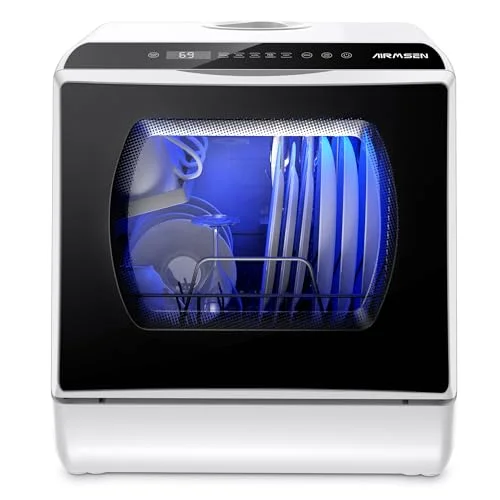
AIRMSEN portable countertop dishwasher

AIRMSEN Portable Countertop Dishwasher, No Hookup Needed

Check the listing for exact rack dimensions

$309.99Price
FAQ

Common loading questions

Why do my glasses come out with water pooled in the bottom?

The glass or mug was loaded right-side up, or close enough to it, so it formed a pocket that filled with spray faster than a shallow tilt could drain it. Mugs, glasses and any bowl-shaped item need to sit fully upside down on the rack, with space around each one so it isn't nested against its neighbor — nesting blocks the spray from reaching the inside surface at all.

Do I need to rinse dishes before loading a portable dishwasher?

Not to the point of spotless — detergent enzymes need some soil to work against. But scrape off solids and rinse anything with dried-on or starchy residue first. Compact machines run shorter, lower-volume cycles than full-size dishwashers, so heavy debris is more likely to redeposit on another dish or clog the small filter than it is to simply wash away.

Can I put a pot or pan in a compact dishwasher?

Only if it physically fits without touching the space directly above the spray arm, and even then it usually shouldn't share a load with a full set of plates and bowls — a large pan blocks water from reaching everything around it. In a six-setting rack that's about 20 inches wide, a full-size stockpot or roasting pan is usually better washed separately.

Where does detergent go in a small dishwasher, and can I use pods?

Into the built-in dispenser, filled to its marked line with powder or gel rather than a full-size pod — pods are formulated for longer, higher-volume cycles and often don't fully dissolve in a compact machine's shorter run, leaving a film on plates and glasses. Rinse aid matters more here too, since most compact machines dry with residual heat and air rather than a dedicated heating element.

Keep reading

Next, from this site