Best Portable Dishwashers
How-to · Maintenance

The monthly routine that prevents repairs.

A portable dishwasher fails for a small, repeatable set of reasons: a clogged filter, blocked spray-arm holes, a perished adapter washer, scale on the heating element, a hardened door seal. None of them require a technician. All of them take about twenty minutes a month to head off, and skipping that twenty minutes is the single biggest reason a $250 countertop machine dies at two years instead of five.

By Ilane TallUpdated August 25, 2026Research-based — no testing lab, no invented ratings

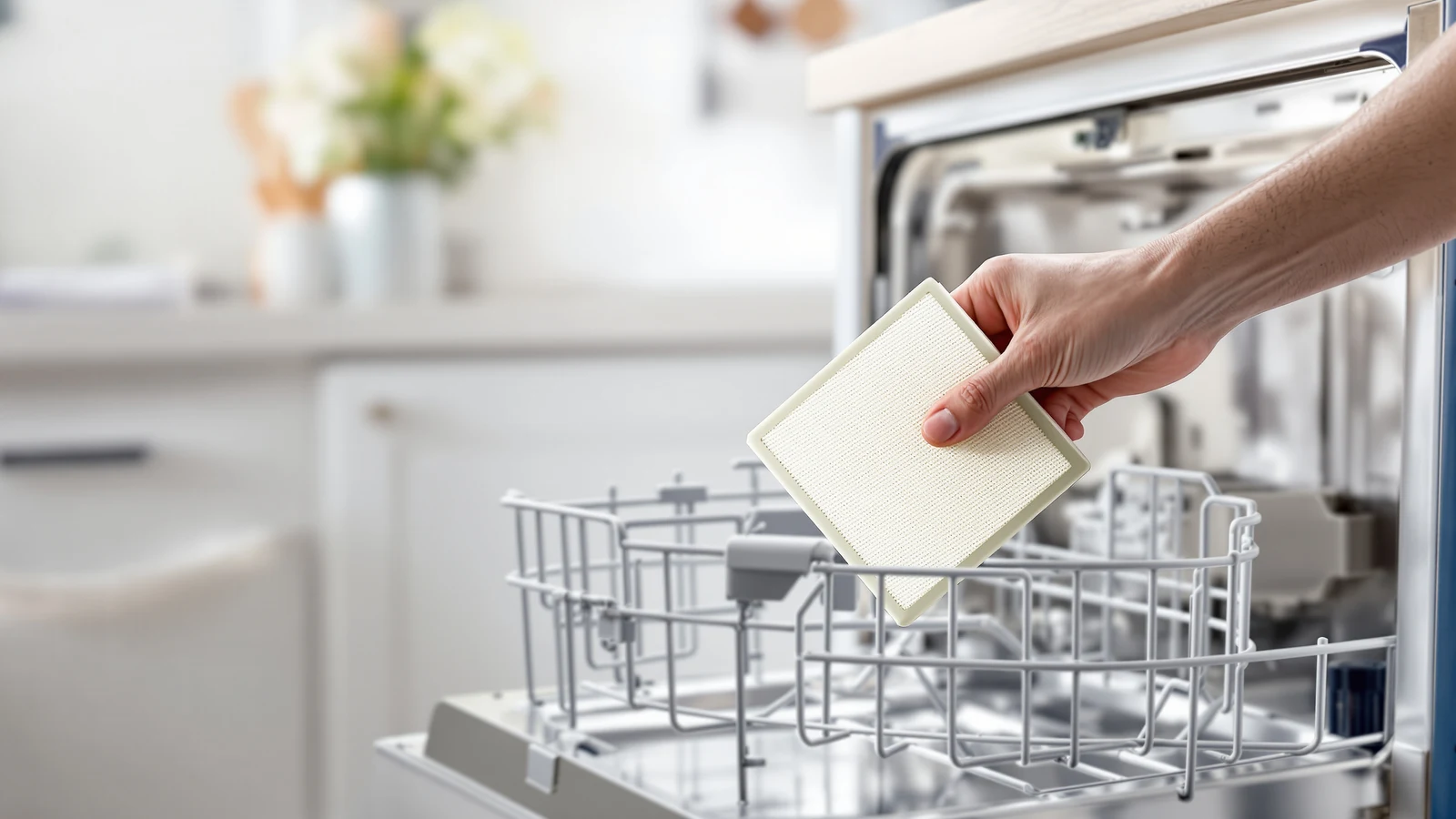
Close-up of a hand cleaning the filter basket of a portable dishwasher at the kitchen sink

Reader-supported: we may earn a commission when you buy through the links on this page, at no additional cost to you. As an Amazon Associate, we earn from qualifying purchases.

Portable and countertop dishwashers are mechanically simpler than a full-size built-in — smaller pump, shorter hose runs, one or two spray arms instead of three — and that simplicity cuts both ways. There's less to go wrong, but also less margin: a countertop machine's filter basket clogs faster per load than a built-in's, and its smaller heating element leaves a thicker layer of hard-water scale in less time. Neglect compounds quickly in a small appliance.

None of the six things below are specialist work. They're the same category of task as changing a furnace filter — mildly unpleasant, over in a few minutes, and the reason the appliance that gets them lasts years longer than the one that doesn't. We've laid them out in the order we'd actually do them on a Sunday morning: filter, spray arms, hoses, descaling, door seal, then a note on storing a machine you don't run every week.

How this page is built

This is general maintenance guidance based on how these machines are engineered as a class — a sealed tub, a recirculating pump, one or two spray arms, a filter basket, and either a built-in water tank or a faucet-connected inlet hose — plus manufacturer care instructions that are broadly consistent across brands. We are not a repair service and this isn't a substitute for your specific model's manual, which should always take precedence on anything involving the drain pump, heating element or electrical components. Where we mention specific machines, we cite only their published specifications and price — we do not physically test appliances, we do not run a testing lab, and we do not publish star ratings or review counts we cannot verify.
Step one

The filter: the single most neglected part

Almost every countertop and portable dishwasher uses the same basic filtration setup: a cylindrical or disc-shaped mesh filter that sits in the base of the tub, directly under the lower spray arm, catching food particles before the pump recirculates the wash water through the spray arms again. Full-size built-ins work the same way, just at a larger scale — which is exactly the problem. A compact tub recirculates the same few litres of water through a filter a fraction of the size, so it fills with debris faster per cycle than a built-in's ever does.

Most filters twist or lift out without tools — a quarter-turn counter-clockwise on the cylindrical type, or a simple lift on the tray type. Rinse it under the tap, working loose any trapped food with a soft brush or an old toothbrush, and check the fine mesh layer for a film that won't rinse off; that's usually grease, and it needs a drop of dish soap and warm water to break down. Put it back seated fully, because a filter that's sitting proud of its housing lets unfiltered water bypass it entirely.

Skip this for a few months and the symptoms show up in order: a faint odor when the door opens, then a fine grit left on glasses, then visibly cloudy water because the pump is redistributing debris instead of removing it. Left long enough, trapped food restricts flow and the pump works harder every cycle — sustained strain that shortens a small motor's life. A quick rinse after any greasy load and a proper scrub once a month is enough to stay ahead of it.

Step two

Spray arm holes and how to clear them

The spray arm is the plastic bar (or pair of bars, on machines with dual-level spraying) that spins under water pressure and throws jets of hot water at the dishes above and below it. Each jet comes from a small drilled hole, narrow enough — usually a millimeter or two — that a stray grain of rice, a coffee ground or mineral scale can block one completely. One blocked hole doesn't stop the machine; it just quietly stops cleaning one section of the rack, which is why "the top rack never gets fully clean" is so often a spray-arm problem rather than a cycle-length one.

Most spray arms lift off with a firm upward pull or release with a central clip or retaining nut — check whether yours is a snap-fit or threaded before forcing it, since older or brittle plastic can crack under the wrong kind of pressure. With the arm off, hold it up to a light and look through each hole; a toothpick, a straightened paperclip or a dedicated spray-arm cleaning tool will punch out debris without enlarging the hole the way a metal skewer can. Rinse the whole arm under running water afterward, since dislodged debris that isn't rinsed out just relocates to the next hole down.

Two things make this job come up more often than it should. The first is loading: dishes that lean into the arm's spin path, or lightweight items that flip and land underneath it, are the leading physical cause of a jammed or cracked arm, and our guide to loading a portable dishwasher covers the rack layout that avoids it. The second is hard water — mineral deposits narrow the holes gradually rather than blocking one outright, which is a scale problem and is covered in the descaling section below rather than something a toothpick fixes for good.

Step three

Hoses and the adapter washer

A faucet-connected portable dishwasher relies on a small rubber or silicone washer inside the tap adapter to form a watertight seal against your kitchen faucet's spout. That washer is the single most failure-prone part of the entire hookup, because it's under constant thermal cycling — cold at rest, hot during the fill, cold again — while also being compressed and rotated slightly every time the adapter goes on and off the tap. Rubber takes a permanent set under that kind of repeated stress faster than almost any other part of the machine.

A worn washer shows up as a slow drip at the adapter connection during the fill, sometimes only under pressure and invisible once the tap is off — easy to mistake for a loose connection. The fix is a two-dollar part sold at any hardware store; inspect the one on your machine every few months for cracking or flattening, and replace it at the first sign rather than waiting for a leak onto the counter or floor. The full range of adapter types, and which faucets won't accept one at all, is in our guide to portable dishwasher water hookup options.

The drain hose deserves separate attention because its job — carrying wastewater out — makes it the part most likely to hold standing water and grow odor-causing residue between cycles. Ribbed interiors are worse for this than smooth ones, since the ridges trap water a straight length would drain by gravity. Let the hose drain fully before coiling it away, and periodically flush it with a cup of soapy water. A hose kinked behind the machine also restricts drainage, so check the run to the sink edge isn't folded back on itself.

Step four

Hard water: descaling interval by hardness

Hard water is dissolved calcium and magnesium, measured in grains per gallon (GPG) or as a water-hardness classification your utility publishes and that home test strips will confirm cheaply. Every time a dishwasher heats water, some of those minerals come out of solution and deposit as scale — a chalky film on the interior walls, a crust on the heating element that makes it work harder to reach temperature, and a narrowing of the same spray-arm holes covered above. A compact dishwasher's smaller heating element and tighter internal tolerances mean the same water hardness does more visible damage, faster, than it would in a full-size built-in.

How often to run a descaling cycle depends almost entirely on how hard your water is:

Water hardnessApprox. grains per gallonDescale every
SoftUnder 1 GPG6 months
Moderately hard3.5–7 GPG3 months
Hard7–10.5 GPG4–6 weeks
Very hardOver 10.5 GPG2–3 weeks

To descale, run an empty hot cycle with a citric-acid-based dishwasher descaler rather than a rinse-and-detergent load — citric acid dissolves mineral scale without attacking rubber seals the way repeated vinegar use can over time, which is why most manufacturer care guides specify a citric-acid product by name. Your local water utility's annual water-quality report lists your hardness if you're not sure; a descale cycle on soft water is harmless but unnecessary, while under-descaling hard water is how a heating element fails years early. Scale buildup also raises the running cost of every cycle, broken down in what a portable dishwasher really costs to run.

Step five

Door seal care and why it leaks

The rubber gasket around the door or lid keeps a pressurized spray of hot water inside the tub instead of on your countertop, and it fails in one of two quiet ways. The first is a buildup of dried detergent, grease film and mineral residue along the gasket's face, which stops it seating flush even though the rubber itself is fine. The second is the rubber losing its elasticity — compression set — after months of being squeezed shut and released, so it no longer springs back and can't form a complete seal however clean it is.

Wipe the gasket with a damp cloth after full or greasy loads, and once a month go over it properly with warm water and mild dish soap, working into the fold where residue and mildew collect. Avoid bleach, ammonia and other harsh solvents on the gasket specifically — they accelerate the hardening and cracking that ages it out early.

A leak that pools under the door after a cycle, rather than a slow drip during the fill like a worn adapter washer produces, points to the seal. Press a finger along the gasket while the door is closed and feel for any section that doesn't spring back — that's compression-set failure, and cleaning won't fix it. Replacement gaskets are sold for most models and aren't hard to fit, but a leak that continues after a new one is properly seated points to the door latch or hinge alignment instead, worth checking against our troubleshooting guide.

Step six

Storing a machine you only use occasionally

A portable dishwasher that runs every day rarely has time to develop the problems that come from sitting idle — it's the machine used once a week, kept for guests, or packed away between RV trips that suffers most, because standing water and a sealed, humid tub are a better environment for mold and odor than regular use ever creates. If you're weighing whether occasional use even justifies keeping one, our honest comparison of a portable dishwasher against hand washing is worth a look before you invest more time in upkeep than the appliance earns back.

Before any stretch of storage longer than a couple of weeks, run one final empty hot cycle to flush the system, then leave the door propped open overnight so residual moisture evaporates rather than sitting sealed in the dark. Remove the filter, rinse and dry it separately, and store it outside the machine — a wet filter left inside a closed unit is close to the single most common cause of the sour smell that greets people when they pull a dishwasher out of storage. Disconnect and drain the inlet adapter and drain hose fully, and coil them loosely rather than kinked or sealed in a bag that traps residual moisture against the rubber.

If the machine will sit anywhere unheated — a garage, a shed, an uninsulated RV bay — residual water left in the pump or hose lines can freeze and crack a fitting, so a full drain-and-dry before cold weather matters more than for a machine kept indoors. When you bring it back into service, run one empty cycle before loading real dishes to flush out dust and confirm the seals and pump are still doing their job.

Put it together

The 20-minute monthly routine

None of the six tasks above takes long on its own, and done together in one sitting they add up to roughly twenty minutes a month for most countertop and portable machines — closer to thirty if it's the month you're also descaling. In order:

  1. Pull and rinse the filter — twist or lift it free, rinse under the tap, clear any film with soap and a soft brush, reseat fully.
  2. Remove the spray arm and check every hole — clear blockages with a toothpick or spray-arm tool, rinse, and refit before the next cycle.
  3. Inspect the adapter washer and drain hose — look for cracking or flattening on the washer, drain and check the hose isn't kinked.
  4. Run a descaling cycle, on the interval your water hardness sets — monthly for hard water, longer for soft.
  5. Wipe and inspect the door seal — clean the gasket face and press along its length to check it still springs back.
  6. If it's going into storage, flush, dry and disconnect — the extra ten minutes that prevents the smell and the frozen fitting.

Set a reminder for the same day each month — the first Sunday, the day rent is due, whatever sticks — because the routine works by staying ahead of buildup, not by catching up on it. A machine that gets this every month rarely needs anything beyond it; one that gets it twice a year is usually already repairing rather than preventing.

When to stop

When maintenance isn't enough

Maintenance extends a machine's life; it doesn't reverse damage already set in. A few signs mean it's time to price a replacement rather than another repair: a heating element that won't reach temperature even after a thorough descale, a door seal that won't hold watertight even when new, visible rust through the tub's interior coating, or a pump that's started grinding rather than humming. None of those are filter or gasket problems, and more cleaning past that point is time spent for no result.

If a replacement is where you land, the water-source decision is worth revisiting, since it's also a maintenance decision: a tank-fed machine has no adapter washer to fail, in exchange for filling it by hand before every cycle, while a faucet-fed machine never needs refilling but adds the washer and hose inspection above. Our 2026 buying guide walks through that trade-off, and if floor space allows it, an 18-inch machine on wheels — covered in our roundup of the best 18-inch portable dishwashers — trades counter space for close to full-size capacity.

DishwasherTypePrice
EUHOMY 6-Program Countertop, 40 dBCountertop, no hookup required$249.00Price
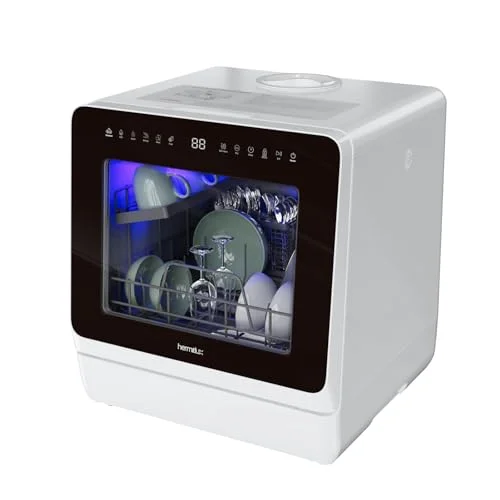
Hermitlux Countertop, 7 ProgramsCountertop, black glass door$299.99Price
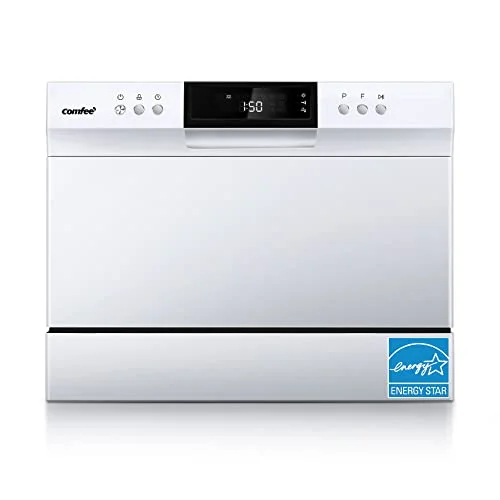
COMFEE' 6-Place Countertop, Energy StarCountertop, 19.7"D x 21.6"W x 17.2"H$309.99Price
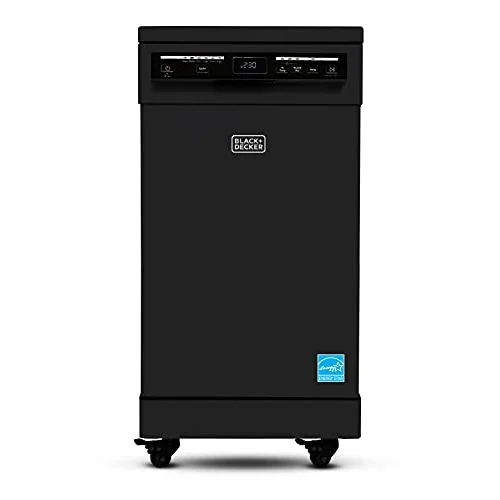
BLACK+DECKER BPD8B 18-Inch, Energy StarFreestanding on wheels, 18 in wide$609.99Price

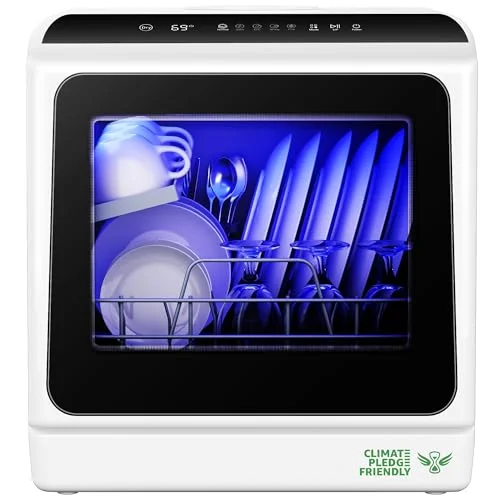
The EUHOMY is worth a look specifically for anyone who found the adapter washer the most annoying part of the routine above — it needs no faucet hookup at all, so that entire failure point disappears. The Hermitlux and the COMFEE' are both faucet-connected countertop machines in the same general size and price band, and the BLACK+DECKER is the only one here from the 18-inch freestanding class, which behaves and maintains more like a full-size dishwasher on wheels than a countertop appliance. None of these prices are guaranteed to hold — confirm the live price on Amazon before ordering.

FAQ

Common questions

How often should I clean my portable dishwasher's filter?

Rinse it after any load with heavy food debris, and give it a proper scrub with soap and a soft brush once a month regardless. A compact dishwasher's filter is smaller than a full-size built-in's and clogs faster per cycle, so monthly is the minimum for machines used several times a week rather than the maximum.

Can I use vinegar to descale a portable dishwasher?

Occasionally, yes, but a citric-acid-based dishwasher descaler is the better routine choice. Vinegar's acetic acid dissolves mineral scale effectively, but repeated use can soften and degrade rubber door seals and hose fittings over time, which is why most manufacturer care guides for these machines specify citric acid by name rather than a pantry substitute.

Why does my portable dishwasher smell bad?

Almost always one of three causes: a filter that hasn't been rinsed and is holding trapped food, a drain hose with ribbed sections holding standing water between cycles, or a door seal with dried residue in its fold. Work through the filter and seal cleaning steps above first, since they resolve the majority of odor complaints without needing to open up the machine.

Do I need to winterize a portable dishwasher?

If it will sit unheated — a garage, shed or uninsulated RV bay — for any length of time in freezing temperatures, yes. Run a final empty cycle, drain the inlet and drain hoses fully, remove and dry the filter, and leave the door propped open until the interior is completely dry before storing, since residual water left in the pump or hose lines can freeze and crack a fitting.

Keep reading

Next, from this site