Best Portable Dishwashers
Buying Guide · Noise & Decibel Ratings

Quiet enough to run while you're in the room.

In a studio, decibels matter more than programs. A machine three feet from your desk or your couch is a different purchase from one tucked behind a kitchen door, and most listings bury the one number that actually predicts how much you'll notice it. We compared five portable dishwashers on published noise ratings, water source and capacity, and worked out what 40, 45 and 55 dB actually sound like next to each other.

By Ilane Tall · Updated August 24, 2026 · Research-based.

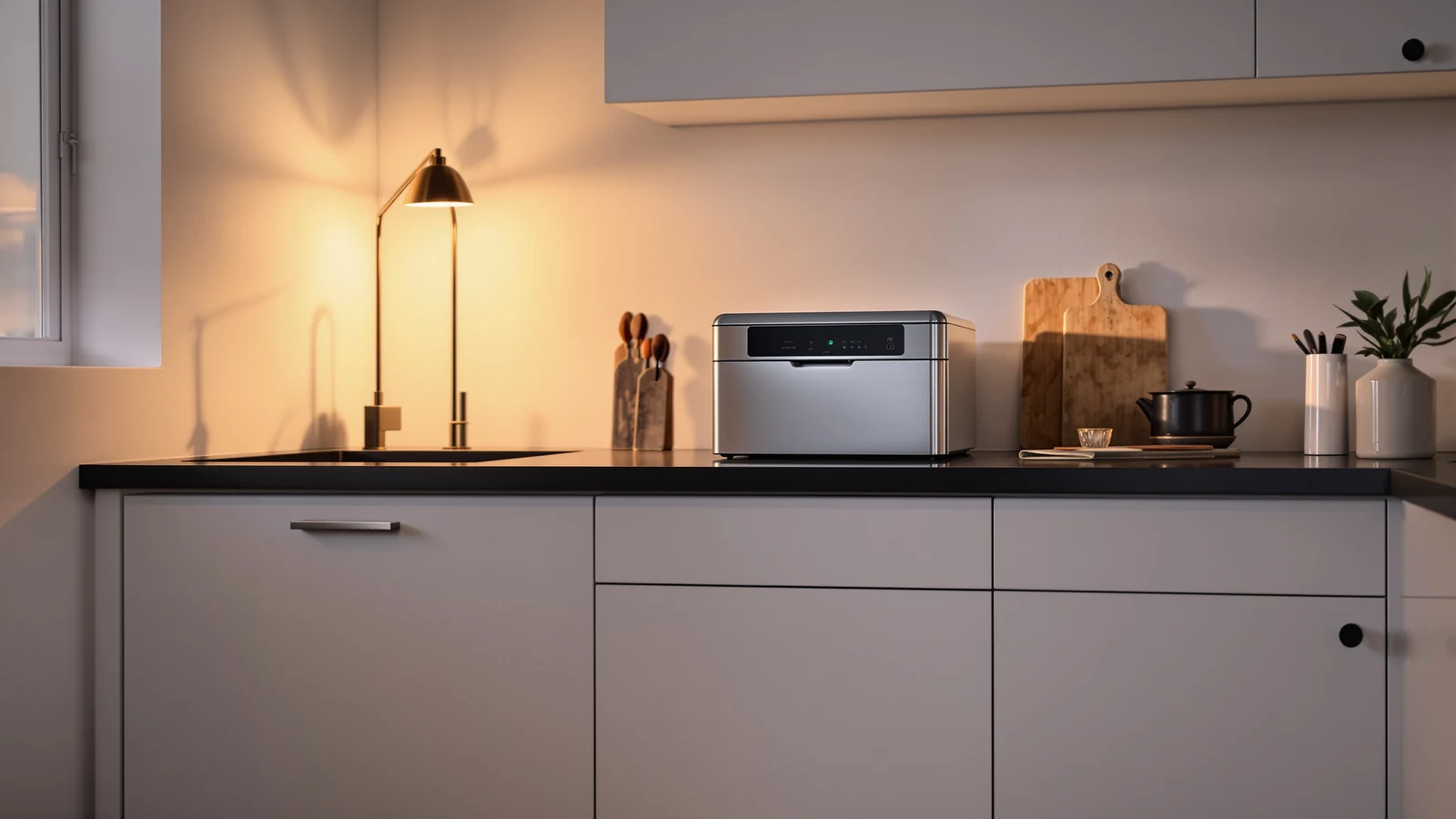
A compact countertop dishwasher running on a kitchen counter in a small open-plan studio apartment

Reader-supported: we may earn a commission when you buy through the links on this page, at no additional cost to you. Prices move constantly — confirm the live price before you order.

Most portable-dishwasher listings lead with programs, place settings and price, and bury the decibel figure two bullets down — if they publish one at all. That ordering makes sense for a machine hidden behind a cabinet door in a normal kitchen. It makes no sense for a studio, a one-room apartment, or an open-plan kitchen with no wall between the sink and the sofa, where the dishwasher runs in the same acoustic space as everything else you're doing that evening. In those layouts, a 12 dB gap between two machines matters more than an extra wash cycle ever will.

This guide starts with what the numbers actually mean, works through why a countertop machine can be louder than the built-in it's replacing, ranks the five machines below from quietest published rating to loudest, and ends with placement tricks and delay-start scheduling that can make a merely average machine livable in a small space.

How this page is built

We compare published specifications, what ships in the box, water source, capacity and live pricing. We do not physically test these machines, we do not run a testing lab, and we do not publish ratings we cannot verify — Amazon's product data returns no rating and no review count for this category, so there are no stars on this site. Manufacturer decibel figures are treated as claims, not measurements: they're produced in undisclosed test conditions and aren't independently audited. Where a listing publishes no decibel figure at all, we say so rather than guessing.

The scale

What 40, 45 and 55 dB actually sound like

01

~40 dB

Roughly a quiet library, or the hum of a refrigerator from across the kitchen. The quietest published rating in this category, and the figure the two EUHOMY machines below carry.

02

~45–50 dB

A quiet home office, light rainfall on a window, or a hushed conversation from the next room. Most countertop dishwashers that decline to publish a number likely sit somewhere in this band.

03

~52–55 dB

Normal conversation at a few feet, or a window air conditioner on a low setting. The Hamilton Beach machine below is rated here — audible across a studio, not disruptive across a house.

04

Every +10 dB ≈ 2×

The decibel scale is logarithmic: each 10 dB increase is roughly a doubling of perceived loudness. The gap between a 40 dB and a 52 dB machine isn't a rounding error — it reads as noticeably more than half again as loud.

These reference points are common acoustic benchmarks, not measurements of any specific dishwasher — they exist to give the manufacturer's number somewhere to land. A rated 40 dB dishwasher won't sound silent; it will sound like a refrigerator with a fan and a faint splash of water, audible if the room is otherwise quiet and easy to talk over. A rated 52 dB machine sounds more like a low conversation happening in the kitchen — fine if you're in another room, present if you're at the desk six feet away.

Why the gap exists

Why compact machines are often louder than built-ins

A full-size built-in dishwasher is recessed into a cabinet run, sandwiched between two panels of particleboard, sitting on a floor rather than a hollow countertop, and usually wrapped in its own sound-insulation blanket around the tub — several layers of material between the pump and your ears before the sound ever reaches open air. A portable or countertop machine has almost none of that. It's a thin-walled plastic or steel shell standing directly on the worktop, in the open room, with the hard countertop surface underneath it free to act as a soundboard for any vibration the pump and motor produce.

The motor itself works harder, too. A compact machine has to move water and pressure through a much smaller pump than a built-in's, running closer to its mechanical limit for a given wash intensity, and that pump usually sits inches from the base rather than isolated in a dedicated compartment. None of this means portable machines are badly engineered — it's a direct consequence of being small, freestanding and unenclosed rather than built into cabinetry. If your kitchen can support a genuine built-in installation instead, our guide to full-size 18-inch portables on wheels covers the closest thing to that experience without plumbing work.

What follows from this: a manufacturer's decibel rating on a countertop machine is measured under conditions the brand controls and rarely discloses, so treat the number as a claim and the relative ranking between machines that publish one as the more useful signal. A listing with no decibel figure at all isn't necessarily loud — but brands that have a genuinely quiet number tend to lead with it, so its absence is worth noting rather than ignoring.

The picks

Five machines, quietest first

01Quietest, no hookup needed

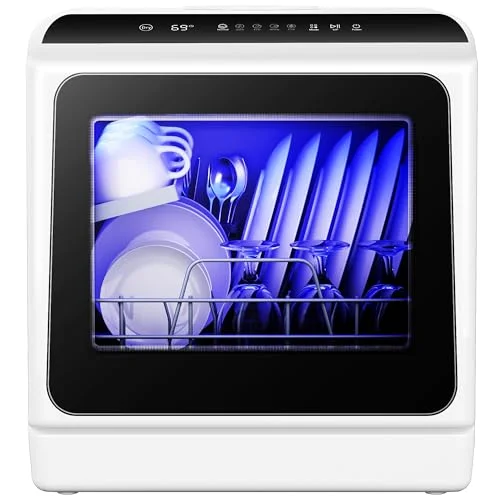
EUHOMY Countertop Dishwasher Portable, 6 Programs

A studio where the machine sits within earshot of your desk or your bed
Countertop · 40 dB rated · 5 L tank or faucet · 6 programs · no hookup needed

This is one of two machines here rated at 40 dB, the quietest published figure in this comparison. It runs from a 5 L built-in tank you fill by hand, or from the included hose connected to a faucet for continuous supply — a water-level indicator tells you when the tank is topped up, and there's no drilling or fixed installation either way. The listing frames the 40 dB rating specifically around apartment living: running it during a work call or after the rest of the household is asleep. Drying leans on 60 minutes of hot-air drying followed by up to 73 hours of automatic ventilation rather than a heating element.

The trade-offThe listing doesn't publish a place-setting count, so there's no clean capacity comparison against the larger COMFEE' machines below — check the current listing for load-size photos before assuming it matches a 6-setting machine. Like every figure on this page, 40 dB is a manufacturer claim, not an independently audited measurement.
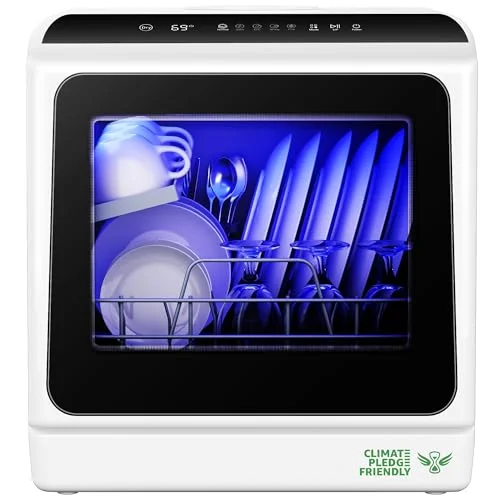
EUHOMY countertop dishwasher with 40 dB rating and no hookup needed
$249
40 dB ratedCheck price →
02Quietest, fullest spec sheet

EUHOMY 6 Programs Countertop Dishwasher, 40dB, 360° Coverage

Buyers who want the same 40 dB rating with more of the spec sheet spelled out
Countertop · 40 dB rated · 5 L tank or faucet · 30+ dishes, plates to 10.25 in · 16.83 × 16.73 × 18.03 in

The sibling model to the pick above, also rated at 40 dB, but with a fuller published spec sheet: exact external dimensions, a stated plate diameter of 10.25 inches, and five named cycles — Normal, Fast, Glass, Baby Care/Heavy Duty and Fruit. The Fast cycle finishes in 29 minutes, useful if you want the machine done and silent before a call rather than running through it. The Baby Care/Heavy Duty mode boils water to 167°F for greasy pans and baby bottles, and dual 360° spray arms are the reason a five-litre tank still gets full coverage of the rack.

The trade-offCapacity is quoted as "30+ dishes" rather than a place-setting count, which on this site's reading usually lands closer to four settings in practice than six. Treat the 40 dB figure the same way as its sibling's: a manufacturer claim, not an audited measurement.

EUHOMY countertop dishwasher rated 40dB with 360-degree spray coverage
$270
40 dB ratedCheck price →
03Biggest capacity, no published dB

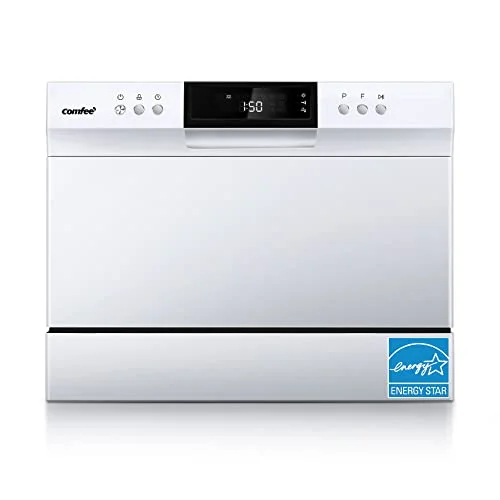
COMFEE' Countertop Dishwasher, 6 Place Settings & 8 Washing Programs

Households of two or three who need real capacity and can place the machine away from a desk
Countertop · 6 place settings, up to 70 pieces · plates to 10 in · faucet only · ENERGY STAR

The largest capacity of the five machines here — six place settings, up to 70 pieces by the brand's own count, with eight cycles including Heavy, Normal, Baby-Care, ECO, Glass and Speed plus an extra-drying function. It's ENERGY STAR certified, a credential the two 40 dB EUHOMY machines above don't carry. It connects to a standard faucet with an adapter rather than a tank, so it needs a compatible tap.

The trade-offThe listing publishes no decibel figure at all. Following this site's rule of thumb, that absence is worth weighing against the two machines that do lead with a quiet number — assume it lands closer to the noisier end of the category rather than matching the 40 dB pair, and confirm on the current listing before buying for a noise-sensitive room.

COMFEE' countertop dishwasher with 6 place settings and 8 washing programs
$279
6 place settingsCheck price →
04Same platform, different footprint

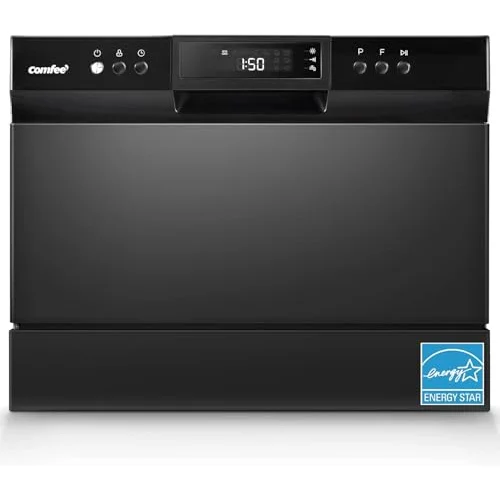
COMFEE' Countertop Dishwasher Portable, 6 Place Settings, Energy Star

Buyers comparing two very similar COMFEE' listings before choosing one
Countertop · 6 place settings, up to 70 pieces · faucet only · ENERGY STAR · 19.7 D × 21.6 W × 17.2 H in

Effectively the same six-place, faucet-only, ENERGY STAR platform as the pick above, listed separately with a near-identical footprint. It connects to a faucet with an adapter and can sit on the counter or be built into a cupboard. If your decision is coming down to price rather than features, compare the live price on both listings before ordering — they describe the same machine.

The trade-offSame caveat as its sibling: no published decibel figure, so don't assume it matches the 40 dB EUHOMY pair without checking the current listing. At the prices in this guide it also runs about $31 more than the near-identical model above, which is worth confirming before you order either one.

COMFEE' countertop dishwasher, 6 place settings, ENERGY STAR certified
$310
6 place settingsCheck price →
05Loudest confirmed figure, most capacity

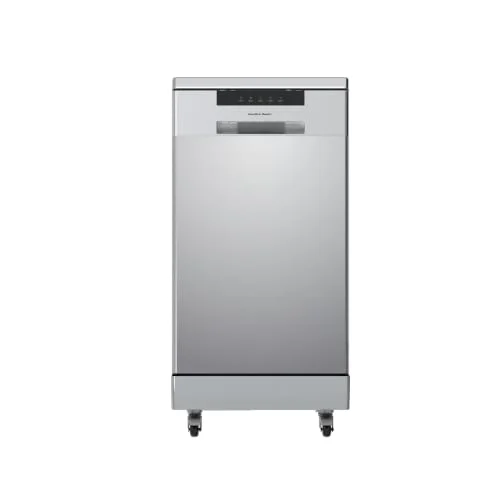
HAMILTON BEACH Portable Dishwasher

A family that needs 8 place settings and can place the machine away from the main living space
Countertop · 52 dB rated · 8 place settings · silverware basket · delay start

The only machine in this comparison with a published decibel figure above the 40 dB pair — rated at 52 dB by the listing's own "Whisper-Quiet Performance" claim, which by the reference points above lands closer to a low conversation than a library. It's also the largest here by a wide margin, at 8 place settings with a dedicated silverware basket, and it's the only one of the five with a published delay-start function, letting you schedule the wash instead of starting it on the spot.

The trade-offApplying the roughly-doubling rule from the decibel section above, 52 dB is a real step up from the 40 dB machines — noticeable in a studio, less relevant in a separate kitchen. The listing gives no external dimensions, so confirm the footprint on the current page rather than assuming it matches the COMFEE' machines' published sizes.

Hamilton Beach portable dishwasher in stainless steel and platinum
$600
8 place settingsCheck price →
At a glance

The five machines, ranked by noise rating

All figures are manufacturer specifications; prices are approximate and move on Amazon.

DishwasherNoise (mfr)Water sourceCapacityPrice
EUHOMY 6 Programs, No Hookup40 dB5 L tank or faucetNot quoted in settings$249.00Price
EUHOMY 360° Coverage40 dB5 L tank or faucet30+ dishes$269.99Price
COMFEE' 6 Place SettingsNot publishedFaucet only6 settings, ~70 pieces$278.97Price
COMFEE' 6 Place, Energy StarNot publishedFaucet only6 settings, ~70 pieces$309.99Price
HAMILTON BEACH Portable52 dBSee listing8 settings$599.99Price
Beyond the spec sheet

Placement tricks that cut perceived noise

The decibel rating on the box is a starting point, not the final word — where and how the machine sits changes what you actually hear, sometimes by more than the gap between a 40 dB and a 52 dB rating.

  • Put something soft underneath it. A hard countertop or a hollow cabinet top acts as a soundboard, carrying vibration from the pump into the surface and amplifying it. A dense silicone mat or a folded towel under the machine's feet absorbs a meaningful share of that transmitted vibration before it ever reaches the counter.
  • Keep it off a shared wall. In a studio or open-plan layout, a few feet of distance from a bed, desk or sofa reduces both direct sound and the vibration path into furniture touching the same wall or floor.
  • Check the drain hose for kinks. A pinched or kinked drain hose makes the pump work harder at the end of the cycle, which is usually the loudest few minutes of any wash — a straight, unobstructed hose run reduces that spike. Our guide to faucet adapters versus built-in tanks covers hose routing for both connection types.
  • Never run it half-empty on purpose. Water striking bare metal or an empty rack section is noticeably louder than water striking a full load of dishes, which absorbs and dampens the spray. Waiting for a fuller load is quieter, not just more efficient.
  • Leave clearance behind the unit. A few inches of open air behind the machine, rather than pushing it flush against a wall or backsplash, gives the pump and drain line room to vent sound instead of reflecting it straight back into the room.

None of these tricks close a genuinely wide gap — a 52 dB machine on a padded mat is still louder than a 40 dB machine on bare countertop — but they can be the difference between a quiet machine you never notice and a quiet machine that occasionally interrupts a phone call.

Scheduling around noise

Night cycles and delay start

The simplest fix for a noisy dishwasher in a small space isn't a quieter machine — it's not being in the room while it runs. A delay-start function lets you load the machine after dinner and schedule the wash for a time you won't be sitting six feet away, whether that's while you're out, or overnight if the machine is far enough from where you sleep.

Of the five machines in this comparison, the HAMILTON BEACH Portable Dishwasher is the only one whose listing publishes a delay-start feature, letting you set the wash to begin later rather than running it the moment the door closes. None of the EUHOMY or COMFEE' listings referenced in this guide mention a delay-start option, so if scheduling matters as much as noise itself, that's a real point in the Hamilton Beach machine's favor even though its 52 dB rating is the loudest published figure here.

A night cycle also interacts with your electricity bill, not just your neighbors — many utilities charge less per kilowatt-hour during off-peak overnight hours, and a delayed cycle is one of the few genuinely free ways to shave a little off a dishwasher's running cost. We work through the actual math, with local-rate assumptions stated inline, in what a portable dishwasher really costs to run.

The decision

Verdict for studios and open-plan kitchens

If noise is the deciding factor

Start with the 40 dB EUHOMY machines

Both EUHOMY models here carry the quietest published rating in this comparison and need no faucet hookup, which also means no adapter noise and total freedom over where in the room you place them. Pick the 360° Coverage model if you want the fuller published spec sheet — exact dimensions, named cycles, a stated plate diameter — and the plainer model if the lowest price matters more than the extra detail.

If capacity matters more than the last few decibels

The COMFEE' or Hamilton Beach machines still work

Neither COMFEE' listing publishes a decibel figure, so budget for something in the middle of the category rather than assuming it matches the EUHOMY pair. The Hamilton Beach machine's confirmed 52 dB is the loudest number here, but its 8 place settings and delay-start function are real advantages for a household that needs more capacity than a studio-focused buyer does.

Our honest read: in a true studio or a kitchen with no wall between the sink and the seating area, the noise rating should outrank capacity, cycle count and even price, because you're the one who has to sit next to the result every time you run it. In a separate kitchen behind a door, the gap between 40 dB and 52 dB matters far less, and it's reasonable to buy for capacity instead. If you haven't settled on a class of machine at all yet, our full buying guide walks through hookup type and place settings before noise ever enters the decision, and our guide to portable dishwashers for small apartments covers the footprint side of the same studio problem.

How we picked

Five machines that span the published range

We selected the machines in our database with the clearest published noise position: the two EUHOMY models that lead with a 40 dB rating, the two COMFEE' countertop models that publish no decibel figure at all but the largest capacity in this comparison, and the Hamilton Beach model as the only machine here with both a confirmed decibel figure above 40 dB and a delay-start function. We excluded near-identical listings that would repeat a position already covered.

How we compared

Research, not a lab

We're honest about this: we don't physically test these machines and we don't run a testing lab. We compare published specifications, water source, capacity claims and live pricing, and we read manufacturer decibel figures skeptically — they're measured in undisclosed conditions and aren't independently audited. We show no star ratings because we have no rating data we can verify, and we never invent review sentiment or scores.

FAQ

Common questions about dishwasher noise

Are decibel ratings on portable dishwashers accurate?

Treat them as manufacturer claims rather than independently measured facts. Brands test in their own conditions, which they generally don't disclose, and there's no third-party audit requirement for a dishwasher's decibel rating the way there is for ENERGY STAR certification. The relative ranking between machines that do publish a figure — a 40 dB unit versus a 52 dB unit, for example — is still a useful signal, even if the exact number in your kitchen may differ.

What's a genuinely quiet decibel rating for a countertop dishwasher?

Around 40 dB is the quietest published figure common in this category, comparable to a quiet library or a refrigerator's hum from across the room. Most machines that publish a number at all sit somewhere between 40 and 55 dB, and the decibel scale is logarithmic, so a 10 dB gap reads as roughly double the perceived loudness rather than a small difference.

Does running a dishwasher at night disturb neighbors in an apartment?

It can, depending on your building's construction and how the machine is placed — sound and vibration travel differently through shared walls and floors than through open air. A delay-start function, where the machine supports one, lets you schedule the wash for a time when running noise matters less, and placing the machine away from a shared wall with a vibration-dampening mat underneath reduces what transmits through the structure.

Can I make a loud portable dishwasher quieter without buying a new one?

Placement changes what you actually hear more than most people expect. A dense mat or folded towel under the machine reduces vibration transmitted into the countertop, a straight and unkinked drain hose avoids the loudest part of the cycle — the end-of-wash pump — running harder than it needs to, and running only full loads means water strikes dishes instead of bare metal, which is quieter. None of these close a wide gap between a 40 dB and a 55 dB machine, but they narrow it.

Keep reading

Next, from this site