Best Portable Dishwashers
Buying Guide · Energy Star Portable Dishwashers

The best ENERGY STAR portable dishwashers

The certification means a measured water and power figure from an independent lab test, not a marketing claim on the box. Here's what it actually measures, what it's worth in a real year of use, and five certified machines worth buying.

By Ilane TallUpdated September 4, 2026Research-based — no testing lab, no invented ratings

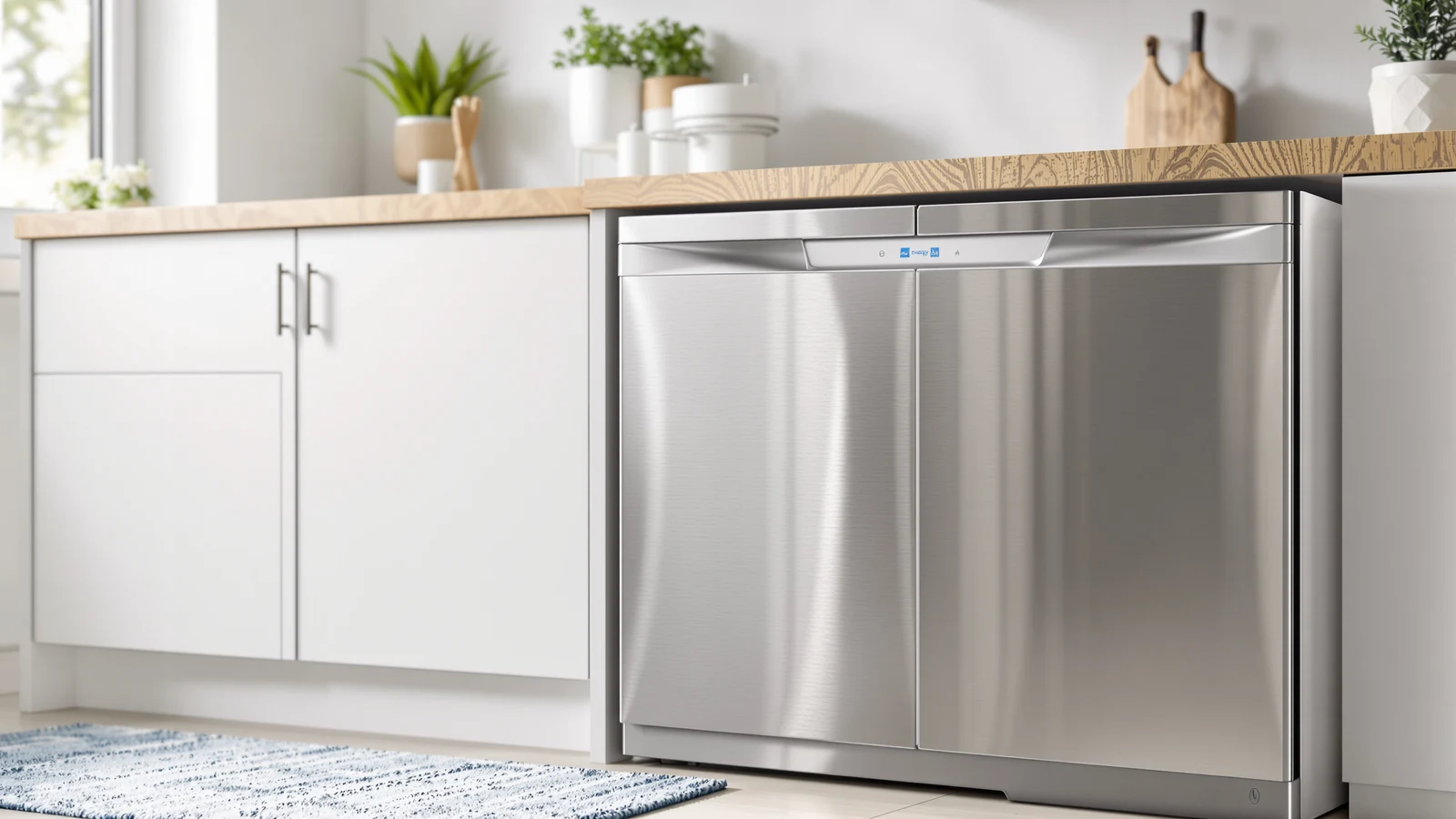
Stainless steel portable dishwasher with an ENERGY STAR label on the control panel, in a bright kitchen

Reader-supported: we may earn a commission when you buy through the links on this page, at no additional cost to you. Prices move constantly — confirm the live price before you order.

Open a page of portable dishwashers on Amazon and about half the listings mention ENERGY STAR somewhere in the bullets, usually next to "eco-friendly" and a leaf icon nobody officially issued. The other half say nothing about it, which is the more honest position if the machine simply wasn't submitted for certification. The label itself isn't decoration: it's a pass or fail result from an independent lab test against a federal ceiling on water and electricity use, administered by the EPA's ENERGY STAR program, not written by the brand's own marketing team.

This guide covers five portable and countertop dishwashers that carry the certification, pulled from our product database — COMFEE', Midea and GE Profile's countertop machines, and SPT's and BLACK+DECKER's full-size 18-inch units on wheels. Before the picks, we work through what the test actually measures, how much water a certified cycle uses against a hand-washed sink, where the electricity goes, and what that adds up to in a year of ordinary use, with every assumption shown so you can rerun the math on your own utility bill. We close with the honest case for skipping certification altogether, because for some households it genuinely doesn't pay for itself. Our portable dishwasher buying guide covers everything else that decides a purchase — capacity, water source, cabinet height — if certification turns out not to be your deciding factor.

How this page is built

We compare published specifications, what ships in the box, water source, capacity, dimensions and live price. We do not physically test these machines, we do not run a testing lab, and we do not publish ratings we cannot verify — Amazon returns no rating and no review count for this category, so there are no stars on this page. Any cost, water or energy figure below states its own assumptions, because rates vary enormously by state and we're not going to dress up a national placeholder as your bill.

The mechanism

What ENERGY STAR actually measures

ENERGY STAR is a joint program of the EPA and the Department of Energy, not a manufacturer-run scheme, and a dishwasher doesn't earn the mark by printing it on the box. The manufacturer submits the model to an EPA-recognized lab, which runs it through a standardized test cycle under fixed conditions — a defined water hardness, a defined incoming water temperature, a defined soil load — and records exactly two outputs: how much energy the cycle consumed and how much water it used. Certification is a pass or fail against a ceiling set below the federal minimum efficiency standard for that class of machine. Miss the ceiling and the badge doesn't appear, no matter what the listing copy claims elsewhere.

Two things about that process are easy to miss. First, the ceiling is set separately for different classes of dishwasher — a full-size 24-inch built-in isn't held to the same numeric limit as a compact countertop model washing four to six place settings, because the smaller machine's baseline water and energy use is different to begin with. A portable or countertop machine carrying the mark has cleared the ceiling built for its own size class, not the one built for the dishwasher under your neighbor's counter. Second, the test measures water and energy consumption only. It says nothing about how well the machine gets dried egg off a plate, how loud it runs, or how long it lasts — noise in particular is a separate question we cover on its own terms in the quietest portable dishwashers.

We don't have the current numeric thresholds this narrower countertop and portable class is tested against, and printing a number we can't verify would be worse than not printing one — the criteria are revised periodically and a stale figure reads as current when it isn't. What's reliable, and unlikely to change, is the shape of the test: a fixed lab cycle, an independent lab, a published ceiling, and a badge that appears only if the machine comes in under it.

The water number

Water per cycle, against a hand-washed sink

The EPA's own published comparison for the ENERGY STAR dishwasher program puts hand-washing a full sink of dishes at up to 27 gallons of water — the tap running while you scrub, rinse and set pieces aside, which is closer to how most people actually wash than a careful measured trickle. A certified dishwasher cycle, by contrast, is capped under 4 gallons. That's roughly an 85 percent cut in water per load, and it's the number the certification is built to guarantee, not a figure any single manufacturer invented for its own listing.

Of the five machines in this guide, only the GE Profile countertop model states its own figure directly in the listing: it says the machine "reduces water use by over 75% when compared to handwashing," which lines up with the EPA's range and is the kind of claim we're comfortable repeating because it's attributed to the manufacturer's own published bullet, not our estimate dressed up as theirs. COMFEE', Midea, SPT and BLACK+DECKER don't quote a specific gallons-per-cycle or percentage figure for the models here. All five carry the ENERGY STAR mark, so all five have cleared the same water-use ceiling in testing — but we're not going to invent a matching percentage for machines whose listings don't state one. Treat "roughly 75 to 85 percent less water than washing by hand" as the honest range for the category, not an exact figure for every unit on this page.

One caveat worth stating plainly: none of this accounts for how carefully you hand-wash. Someone who fills a basin and shuts off the tap between rinses uses far less than 27 gallons; someone who lets the hot water run continuously while scrubbing can easily use more. The dishwasher's number is fixed by the test cycle. The hand-washing number is not fixed by anything, which is exactly why the comparison favors a machine — it turns a variable habit into a repeatable one.

The energy number

Power draw, and where it goes

None of the five machines in this guide connects to your home's hot-water line — they take in water from the faucet and heat it internally with their own element. That single design fact decides where the electricity goes: the heater that raises incoming water to wash and rinse temperature is by far the largest load in the cycle, not the pump that drives the spray arms or the control board that runs the timer. A motor moving water around a small tub for the length of a cycle draws comparatively little; an element bringing several liters of water up to a target temperature is where most of the kilowatt-hours go.

This is also why cycle selection changes the electricity bill more than it changes the water bill. A Heavy or Baby-Care program that targets a higher temperature and holds it longer runs the heating element for more of the cycle than a Rapid or Glass program does, even though the pump behaves almost identically either way. We go through why these cycles run as long as they do — and which ones are safe to skip on a lightly soiled load — in why a portable dishwasher cycle takes two hours. The short version for this guide: shorter, cooler cycles use less electricity, not just less time.

The incoming water temperature matters too, and it's one variable the ENERGY STAR test standardizes that your kitchen doesn't. A machine hooked to a cold-water-only line has to do more heating work, cycle after cycle, than the same machine on a line that runs warm. That's outside anything a spec sheet or a certification can capture, and it's a real reason two households running the identical model can see different electricity draws from it.

The math

The yearly saving, in real dollars

Here's a worked estimate, with every assumption stated so you can swap in your own numbers — water and sewer rates vary by a factor of five or more between cities, and this math is only as good as the rate you plug into it.

Assume a two-to-three-person household that runs the dishwasher five times a week: 260 cycles a year. Using the EPA's hand-wash figure of up to 27 gallons a load against a certified cycle capped under 4 gallons, that's roughly 23 gallons saved per cycle, or about 5,980 gallons over the year. Combined water-and-sewer rates run anywhere from around $4 to $20 per 1,000 gallons depending on the utility and the state — we'll use $8 per 1,000 gallons as a deliberately middle-of-the-road figure, which puts the water saving at roughly $48 a year against washing the same load by hand. Check your own bill for the actual combined rate; ours is a placeholder, not a national average we're claiming to know precisely.

The electricity side is harder to put an honest number on, and we're not going to fake one. None of the five listings here publishes a kWh-per-cycle or kWh-per-year figure, which is the number you'd need to calculate an electricity cost with any confidence — draw varies by cycle, incoming water temperature and how full the tub is, and a plug-in watt meter on your own machine will tell you more than a spec sheet ever could. What we can say honestly: the ENERGY STAR ceiling exists specifically to keep that number below what an equivalent uncertified machine in the same size class would draw, so there is a second saving here on top of the water figure above — we just can't attach a verified dollar amount to it without a meter reading, and won't pretend otherwise.

So the defensible number from this page is water alone: on the assumptions above, roughly $48 in the first year, growing slightly as utility rates rise, plus an unquantified electricity saving on top of it. Against a $310 to $610 purchase price, that's not a fast payback if you're comparing to hand-washing outright — it's a modest, compounding saving on a machine you were likely buying anyway for the convenience, with certification tipping the water math in your favor rather than justifying the purchase by itself.

At a glance

How the five compare

All five carry ENERGY STAR certification. Prices move constantly on Amazon — confirm the live price before you buy.

DishwasherClassCapacityPrice
COMFEE' 6-Place CountertopCountertop6 settings, ~70 pieces$278.97Price
Midea 6-Place CountertopCountertop6 settings, ~70 pieces$299.98Price
GE Profile CountertopCountertop, built-in or under-sink6 settings$533.00Price
SPT SD-9263W 18″Freestanding, castorsNot stated in listing$597.89Price
BLACK+DECKER BPD8B 18″Freestanding, castors8 settings$609.99Price
The picks

Five ENERGY STAR machines worth buying

01Best overall

COMFEE' 6-Place Countertop Dishwasher

The biggest countertop capacity at the lowest price of the five
Countertop · 6 place settings, up to 70 pieces · plates to 10 in · 17.2 × 21.7 × 19.7 in · 8 cycles · ENERGY STAR

This is the machine most kitchens should start with. Six place settings — up to 70 pieces — means one evening's dishes fit in one cycle for two or three people, and it still connects to a standard faucet with an adapter rather than demanding floor space. Eight cycles cover Heavy, Normal, Baby-Care, ECO, Glass, Speed, Mini-party and Rinse, most paired with an extra-dry function, and it's certified at the same ENERGY STAR ceiling as the pricier machines in this guide.

The trade-offIt's faucet-only — no tank option — so a kitchen with a pull-out sprayer tap can't use it, and at nearly 22 inches wide it's the biggest machine here that still calls itself a countertop model.

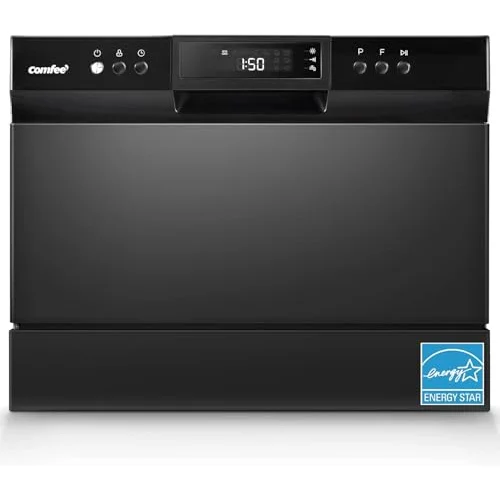
COMFEE' six-place countertop dishwasher in black
$279
6 place settingsCheck price →
02Close alternative

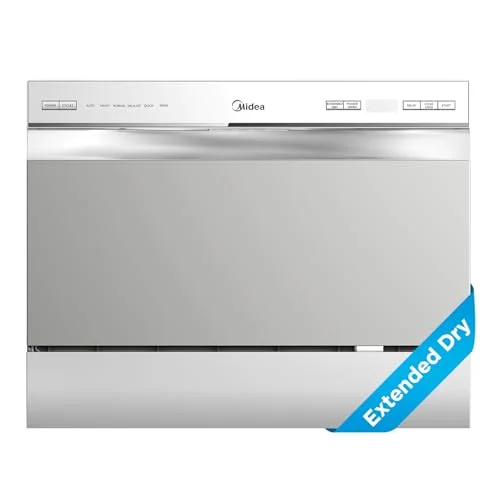
Midea 6-Place Countertop Dishwasher

The same capacity class with a different cycle mix
Countertop · 6 place settings, up to 70 pieces · plates to 10 in · 17.25 × 22 × 20 in · 6+2 cycles · delay start 1–24h · ENERGY STAR

Midea's entry sits in the same size and capacity class as the COMFEE' above — six place settings, up to 70 pieces, plates to 10 inches — with a different cycle set: Auto, Heavy, Normal, Quick, Rinse and Delicate, plus Extended Dry and Power Wash functions. The delay-start timer, up to 24 hours ahead, is the feature the other countertop machines here don't list, useful for running the wash on off-peak electricity.

The trade-offMidea doesn't publish its own water-reduction percentage the way GE Profile does, and at $30 more than the COMFEE' for a near-identical spec sheet, the delay-start function and Auto and Delicate cycles are mainly what the difference buys.

Midea six-place countertop dishwasher in silver
$300
6 place settingsCheck price →
03Most flexible

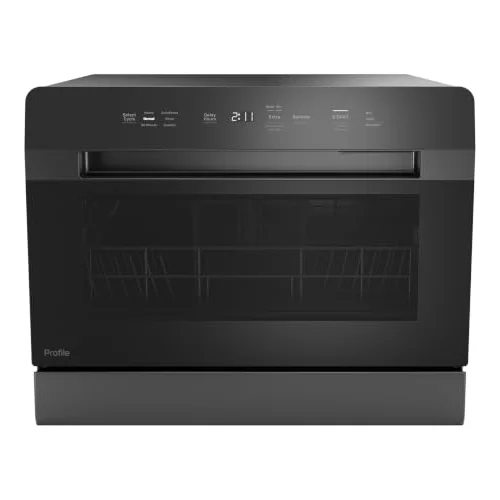
GE Profile Countertop Dishwasher

The only pick with its own published water-reduction figure
Countertop, built-in or under-sink · 6 place settings · 6 cycles · 52 dBA · WiFi via SmartHQ · Auto Open Dry · ENERGY STAR

The only pick here from a major American appliance brand, and the only one designed to be installed three different ways: sitting on the counter, built into a cabinet, or tucked under a sink — useful if you're renting now but expect to keep the machine through a move. It's the one machine in this guide whose own listing states a water-reduction figure — "reduces water use by over 75% when compared to handwashing" — which is why it anchors the water-savings math earlier on this page. It's certified at 52 dBA and finishes with Auto Open Dry, the door popping open to let steam escape.

The trade-offIt costs roughly $150 to $180 more than the two countertop machines above for the same six place settings — you're paying for install flexibility, WiFi and the stated water-reduction figure, not for extra capacity.

GE Profile countertop dishwasher in black
$533
3 install optionsCheck price →
04Full-size, budget

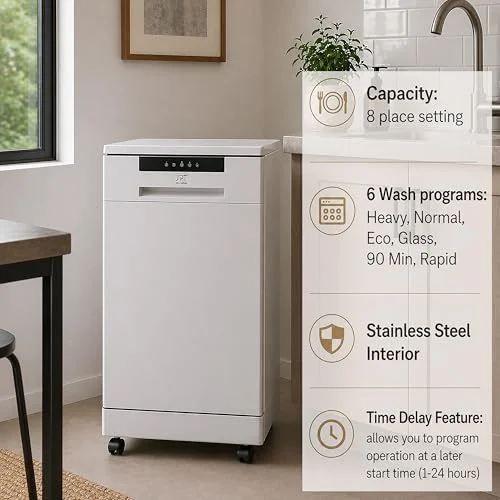
SPT SD-9263W 18-Inch Portable Dishwasher

The cheaper way into the certified 18-inch class
Freestanding on castors · 18 in · white finish · faucet-fed · ENERGY STAR

SPT has built this 18-inch platform for years, and this white version is the lower-priced entry into a certified full-size portable. Like every 18-inch freestanding machine, it rolls to the sink, connects to the faucet, and rolls back against the wall when it's done — the closest thing to a real dishwasher in a kitchen with no cabinet cut for one.

The trade-offThe listing doesn't break out a place-setting count or cycle list, so confirm current specs on the listing before ordering, and it needs 18 inches of floor plus door swing plus a clear path to the sink.

SPT 18-inch portable dishwasher in white
$598
18-inch, whiteCheck price →
05Full-size, counter back

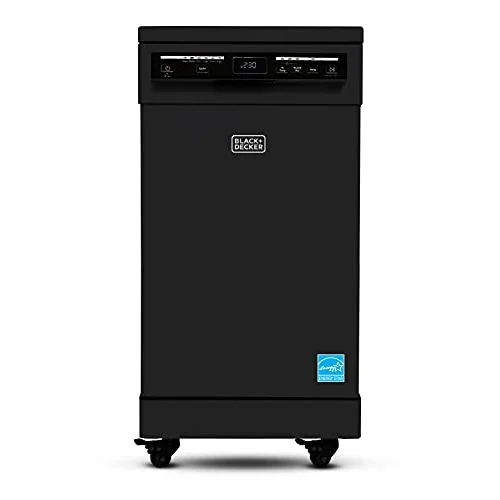
BLACK+DECKER BPD8B 18-Inch Portable Dishwasher

For a genuine 8-place-setting machine that also gives back a work surface
Freestanding on castors · 18 in wide · 8 place settings · 6 cycles · usable countertop on top · ENERGY STAR

The largest capacity in this guide: eight place settings, close to what a standard 24-inch built-in holds, across six cycles — Normal, Heavy, Rapid, Glass, Eco and a 90-minute program. It's built with a finished top surface, so the machine adds counter space back rather than only occupying floor, which matters in a small kitchen that's already short on worktop.

The trade-offAt $609.99 it's the most expensive machine in this guide, and like every 18-inch portable it's faucet-only with no tank option — the payoff is the finished countertop surface and two extra place settings over the countertop machines above.

BLACK+DECKER 18-inch portable dishwasher on wheels
$610
8 place settingsCheck price →
The other side

When a cheaper uncertified unit still wins

Certification is a real, verified saving on the numbers above — but it's a small one relative to the price of the appliance, and there are ordinary situations where chasing the badge is the wrong priority.

You run the machine rarely. The yearly saving above assumes five cycles a week. A single person running the dishwasher twice a week is looking at closer to $19 a year in water savings on the same assumptions — a real number, but not one that should outrank capacity, price or whether the machine fits your kitchen at all.

Your local water and power rates are low. Swap our $8-per-1,000-gallon placeholder for a cheaper utility's actual $4 rate and the water saving above is cut in half. In some regions the arithmetic in this guide simply produces a smaller number than it does elsewhere, and no certification changes that.

Fit beats certification. A certified machine that's too tall for your wall cabinets, or faucet-only when your kitchen has a pull-out sprayer tap with no removable aerator, is worse than an uncertified one that actually works. Measure the clearance and check your faucet before you filter by badge — the tank-fed models we cover separately sidestep the faucet question entirely for kitchens where it's the dealbreaker.

You're really comparing it to a built-in, not to hand-washing. If you have a dishwasher cabinet, plumbing and permission to use them, a portable machine — certified or not — usually loses to a proper built-in on capacity and water use per place setting. What you give up moving from a built-in to a portable is a separate trade-off from certification, and we cover it directly in portable vs. built-in: what you give up.

None of that is an argument against the five machines above — all are competitive on their own specs, certification aside, which is why they're in this guide. It's an argument for putting certification third or fourth on your list of filters, after capacity, water source and physical fit, rather than first.
FAQ

Common questions

What does ENERGY STAR certification actually test on a dishwasher?

An independent, EPA-recognized lab runs the machine through a standardized cycle under fixed conditions and measures two things: energy consumed and water used. The model passes only if both come in under a ceiling set for its size class, below the federal minimum efficiency standard. It doesn't test cleaning performance, noise or durability.

How much water does hand-washing use compared to a certified dishwasher?

The EPA's published comparison puts hand-washing a full sink at up to 27 gallons of water, against a certified dishwasher cycle capped under 4 gallons — roughly an 85 percent reduction. How carefully you hand-wash changes the real-world gap; the dishwasher's number is fixed by the test, yours isn't.

Do all five machines in this guide save the same amount of water and energy?

All five have cleared the same ENERGY STAR ceiling for their size class, but only the GE Profile states its own water-reduction figure in the listing, over 75% versus handwashing. We haven't repeated that percentage for the other four, since their listings don't publish one — treat 75 to 85 percent as the honest range for the category rather than an exact figure for every unit.

Is it worth paying more for an ENERGY STAR portable dishwasher?

On the water savings alone, the payback is modest — around $48 a year on our stated assumptions for a household running five cycles a week, less for lighter use or cheaper local utility rates. It's a real, compounding saving rather than a fast one, and it shouldn't outrank capacity, water source or whether the machine physically fits your kitchen.

Keep reading

Next, from this site