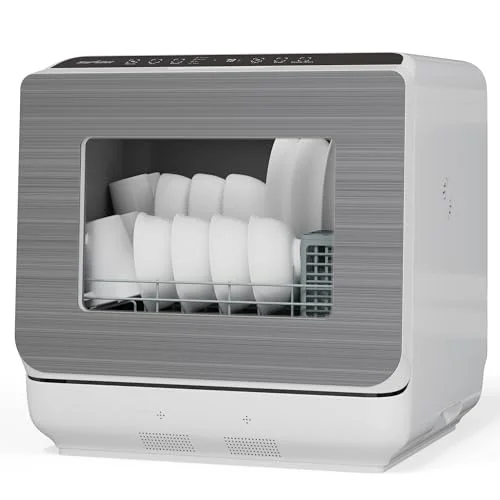
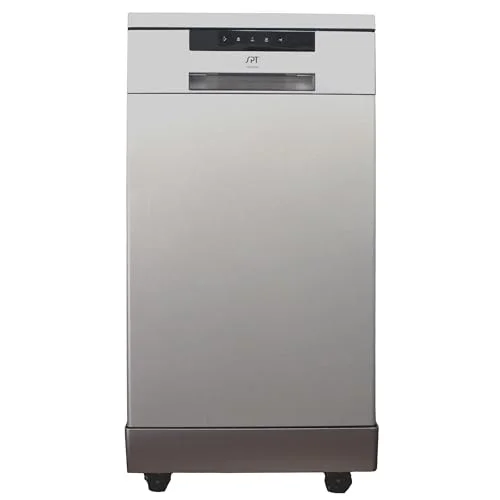
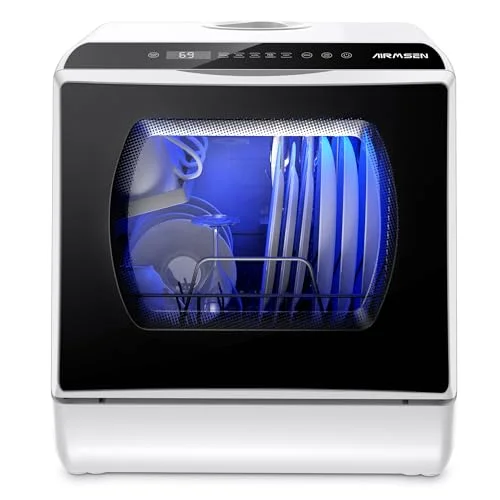
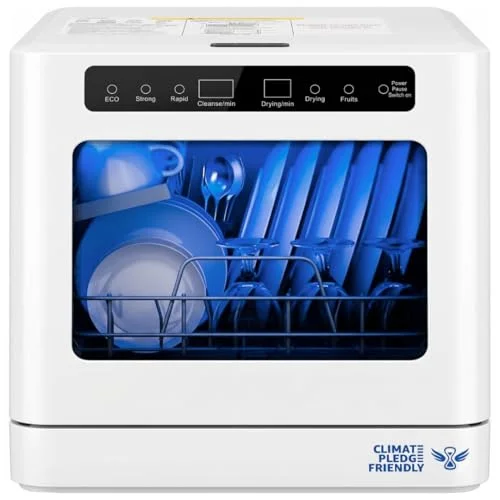
Strip away the programme names and every wash on a compact dishwasher — countertop or 18-inch — moves through the same six stages. The order rarely varies; what varies is how many times the machine repeats stage two.
1. Fill
The tub takes on water — either pumped in from the faucet through the inlet hose, or drawn from a built-in tank you filled by hand beforehand. Tank fills are effectively instant once you've poured the water in; faucet fills take a minute or two while the inlet valve opens and the pump primes.
2. Heat
The heating element raises that water to wash temperature. This is the step that decides the whole cycle length, and it happens more than once per wash — see the next section.
3. Wash
A single recirculating pump pushes the now-hot water through the spray arm (or arms) for a set number of minutes, then the water is reused and reheated rather than replaced, because a five-litre tank or a small faucet fill doesn't leave room to run fresh water continuously the way a full-size machine with a permanent supply line can.
4. Drain
The pump reverses and pushes the wash water out through the drain hose. This is the fastest stage in the cycle — usually a minute or two — and the one most people notice least.
5. Rinse
Fresh water fills again and gets heated a second time, usually to a higher temperature than the wash, to flush detergent residue and sanitize. This is the second full pass through the heating step, and on some programmes there's a third rinse for good measure.
6. Dry
Most compact dishwashers have no dedicated heating element for drying. They rely on the residual heat left in the dishes and tub from that hot final rinse, sometimes helped by a fan or a door that pops open automatically. A hotter final rinse dries better, which is exactly why some manufacturers push their last rinse to a higher temperature specifically for this stage — more on that in the eco and heavy section below, and in detail in why your portable dishwasher leaves dishes wet.
Add it up and a Normal cycle is really: fill, heat, wash, drain, fill, heat, rinse, drain, dry. Two full heating passes bookending one wash pass is the structural reason these machines run long, regardless of brand.