Best Portable Dishwashers
Comparison · Portable vs built-in

Portable vs built-in dishwasher: what you give up.

No plumbing, no cabinet cut, no landlord conversation. That's the pitch for a portable dishwasher, and it's true. What the pitch leaves out is three trade-offs nobody mentions until they're standing in their own kitchen with the thing running: how it hooks up, how much it actually holds, and how long you'll be listening to it.

By Ilane Tall · Updated August 30, 2026 · Research-based.

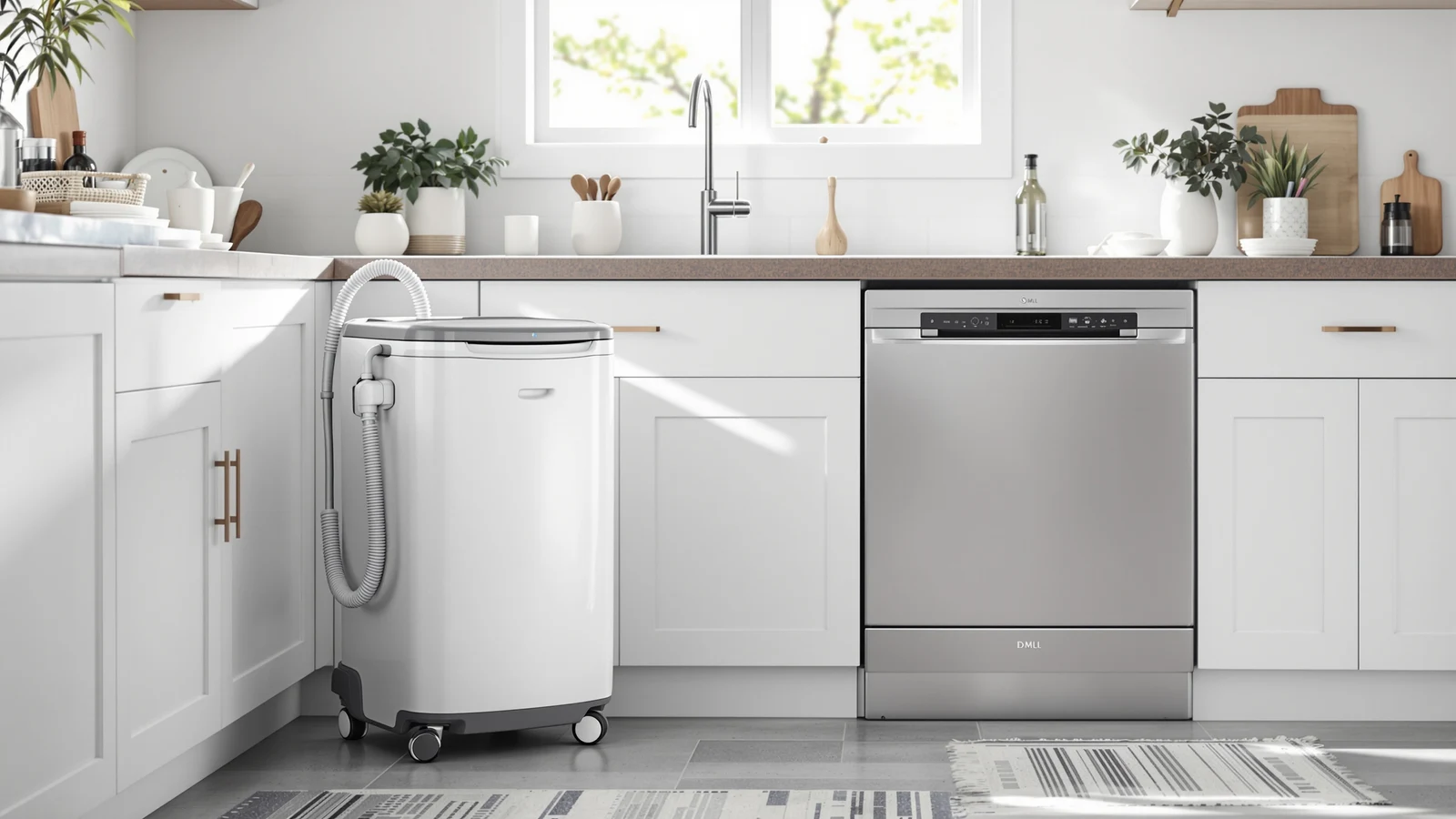
A countertop portable dishwasher on a kitchen counter beside a built-in dishwasher installed under the counter

Reader-supported: we may earn a commission when you buy through the links on this page, at no additional cost to you. Prices move constantly — confirm the live price before you order.

Every "portable vs built-in" comparison online starts with the same three bullet points: no installation, no plumber, works in a rental. All true, and all beside the point for the person actually deciding. The real question isn't whether a portable dishwasher can wash dishes without a permit — it's what you're trading away to get that freedom, and whether the trade is one you can live with for the next three to five years.

This isn't a "portable dishwashers are secretly bad" argument. A faucet-fed countertop machine or an 18-inch unit on wheels genuinely replaces hand-washing for most households, and we compare the specific machines worth buying in each class below. It's a plain accounting of where a portable dishwasher costs you something a built-in doesn't: at the faucet, in the rack, in the clock, and in the room. Read it before you buy, not after the box is open.

How this page is built

We compare published specifications, what ships in the box, dimensions, water source, capacity and price. We do not physically test these machines, we do not run a testing lab, and we do not publish ratings we cannot verify — Amazon returns no rating and no review count for this category, so there are no stars on this site. Where a judgement is ours rather than a specification, we say so, and we treat manufacturer capacity and decibel figures as claims, not measurements.

Trade-off one

A faucet adapter against a plumber

A built-in dishwasher is plumbed in once: a water supply line, a drain line routed to the sink's drain or garbage disposal, and a dedicated electrical connection, all sealed behind a cabinet panel. It's real installation work — most people pay a plumber or an appliance installer to do it — but once it's done, it's done. You open the door, load it, close the door. The machine has no relationship with your faucet at all.

A portable dishwasher's relationship with your faucet is the whole design. A faucet-fed model — which describes every 18-inch machine on wheels and most full-size countertop units, including the EUHOMY Countertop Dishwasher and the HAMILTON BEACH Portable Dishwasher with Wheels — connects with a quick-release adapter that clamps onto your kitchen tap in place of the aerator. That adapter is doing the plumber's job every single time you run a load: supplying water in, and on the 18-inch wheeled machines, carrying waste water back out through the same coupler.

The catch is the adapter needs a specific kind of faucet to grip: a straight spout with a removable aerator and standard threads. Pull-down or pull-out sprayer faucets — now common in American kitchens and close to standard in recent rentals — generally won't take it, because the spray head detaches from a hose rather than unscrewing from a fixed spout. Some designer taps with concealed or non-standard aerators have the same problem. If that's your kitchen, no adapter fixes it, and the entire faucet-fed class — countertop or 18-inch — is off the table regardless of budget.

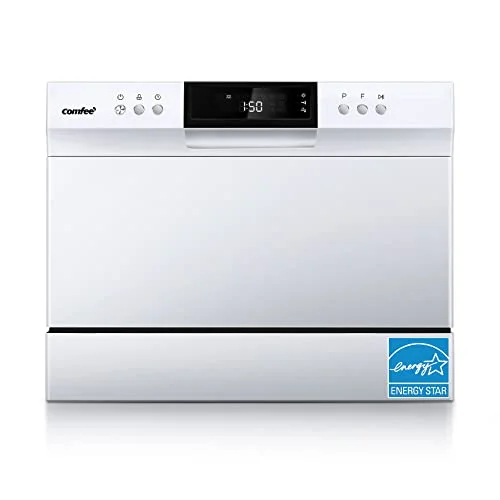
This is exactly what makes a machine with a built-in water tank different in kind, not just in convenience. The COMFEE' Countertop Dishwasher is built around a tank you fill by hand — no faucet connection required at all, which means no aerator threads to check, no adapter to lose, and no argument with a sprayer faucet you can't win. The trade there is capacity, not plumbing: a five-to-six-litre tank is one cycle's worth of water, so you're refilling by hand before every run rather than connecting once and forgetting about it.

The other side of the install question is what happens when you move. A faucet adapter unclips in seconds and travels with you to the next kitchen — assuming that kitchen's faucet also has standard threads, which is worth checking before you sign a lease if a portable dishwasher is part of the plan. A built-in dishwasher, by contrast, usually stays behind; it's wired and plumbed into the cabinetry it was installed in, and ripping it out to take with you is a bigger job than installing a new one would have been. For a full walkthrough of adapter types, threads and which faucets actually cooperate, see how to hook up a portable dishwasher.

Trade-off two

Place settings versus what a real dinner produces

A place setting is a defined unit — one dinner plate, one side plate or bowl, one glass, one cup and saucer, one person's cutlery, roughly ten items — and it's how dishwasher capacity has been quoted for decades, which is why the number on a countertop machine's box is genuinely comparable to the number on a full-size built-in's spec sheet. It is not, however, comparable to what a family dinner actually generates once you count the serving bowls, the pot, the cutting board and the pan nobody remembers to leave room for.

Built-in dishwashers, standard 24-inch width, typically hold 12 to 16 place settings. That's the number a portable machine is measured against, and it loses badly on paper. The COMFEE' Countertop Dishwasher is rated for six place settings — around 70 pieces by the manufacturer's count — which is roughly half a full-size load and, in practice, close to a full day's dishes for two or three people rather than one dinner for a crowd. The HAMILTON BEACH Portable Dishwasher with Wheels and the BLACK+DECKER 18-Inch Portable Dishwasher both claim eight place settings, which narrows the gap considerably — eight is close to what a compact built-in holds — but neither reaches the top of the built-in range.

Two caveats worth taking seriously before you compare numbers on a box. First, these are manufacturer figures, produced with standardized crockery under ideal stacking, not your mismatched bowls and the one oversized mug everyone reaches for — real-world capacity tends to land under the stated number, sometimes well under it. Second, place-setting count says nothing about plate diameter, and that's usually the harder constraint. A portable machine rated for 10-inch plates will not seat an 11- or 12-inch dinner plate flat, however many settings the box claims, and a plate that doesn't sit flat doesn't get properly washed. Where we have a confirmed plate size for a product, we say so in the picks below; where we don't, check the listing before you assume your dinnerware fits.

What this means in practice: a portable dishwasher changes your dishwashing rhythm, it doesn't eliminate it the way a full-size built-in can. Expect to run it more often, load it with intent rather than tossing dishes in as you go, and still hand-wash the stockpot. If capacity is the deciding factor for your household, an eight-setting 18-inch machine on wheels closes most of the gap to a built-in; a six-setting countertop model doesn't, and shouldn't be bought expecting it to.
Trade-off three

Cycle time, and why portable cycles run longer

A full-size built-in dishwasher on a Normal cycle typically runs two to three hours, and that number surprises people who assume "quick" means quick — modern built-ins actually run long, hot cycles for water efficiency, and shorter Express cycles exist specifically to work around it. Portable and countertop dishwashers are frequently marketed the opposite way, on speed: quick cycles, small loads, short waits. That's often true for the cheapest, smallest tank-fed cycle on the smallest tub. It is not the whole story once you look at the standard cycle rather than the fastest one.

Two mechanical reasons push portable cycle times up rather than down. The first is water volume and pressure: a tank-fed machine is working from five or six liters at whatever pressure its own small pump can generate, not municipal line pressure, so getting water hot enough and moving it with enough force to clean effectively takes longer per liter than a built-in fed straight from the hot water line. The second is the drying step. Full-size built-ins increasingly use a heating element or a zeolite drying system to force dry in the final phase; most portable and countertop machines dry with residual heat, a fan, or simply popping the door open at the end, none of which is fast, and manufacturers compensate by extending the wash-and-rest phase rather than promising a heated finish they can't deliver in a small sealed tub.

The result is a machine advertised on "six programs" or "eight cycles" whose everyday cycle — not the fastest one, the one you'll actually run for a normal load — frequently lands in the same two-to-three-hour range as a built-in, sometimes longer for a Heavy or sanitizing program. The EUHOMY and COMFEE' countertop machines both include multiple cycle options; the manufacturer literature for machines like these typically lists a fast cycle under 40 minutes alongside a standard cycle well over 90. Read the cycle list on any listing carefully — the headline number is usually the fastest one, not the one you'll use most.

What this costs you in practice isn't the electricity or the water, which is usually a wash between the two classes — it's the faucet. A tank-fed countertop machine doesn't occupy your sink at all once it's filled and running. A faucet-connected machine, whether countertop or an 18-inch unit on wheels, ties up that faucet for the length of the cycle, which in a one-sink kitchen running a two-and-a-half-hour Normal program means no washing hands, rinsing a knife, or filling a kettle at that sink until it finishes. That's a real cost a built-in, tucked into its own cabinet with its own water lines, simply doesn't impose.

Trade-off four

Noise where you actually stand in an open kitchen

Built-in dishwashers are installed inside cabinetry that does real acoustic work: a wood or composite panel door, insulation in some models, and a cabinet box on three sides that absorbs and redirects sound before it reaches the room. Modern full-size built-ins are commonly rated in the 44-to-50 decibel range, and the cabinet installation genuinely helps that figure hold up in practice.

A portable dishwasher has none of that shielding. A countertop machine sits in open air on the worktop, typically three feet from your ears at standing height, with nothing but its own plastic housing between the motor and the room. The EUHOMY Countertop Dishwasher is rated at 40 decibels by the manufacturer, which — if accurate — undercuts a typical built-in's rating. But rated decibels and perceived loudness in an open kitchen are different things: a machine at eye level with no cabinet to muffle it can feel louder in the room than a quieter-on-paper built-in sealed behind a door, and every 10 decibels is roughly a doubling of perceived volume, so small differences in the published number matter less than where the sound is coming from.

An 18-inch machine on wheels, like the HAMILTON BEACH Portable Dishwasher with Wheels or the BLACK+DECKER 18-Inch Portable Dishwasher, sits at floor level rather than counter height, partially shielded by the counter overhang and adjacent cabinets even without being built in — which can make a nominally louder floor-standing machine feel less intrusive than a countertop unit in the same open-plan room. Neither class publishes an independently audited decibel figure; treat manufacturer noise ratings as an indication of class, not a guarantee, and remember that two things spike noise regardless of the base rating: the drain pump cycling at the end of a run, and water striking a half-empty tub.

In a studio apartment, a small open-plan kitchen, or anywhere the dishwasher runs while you're in the room and not in a separate space behind a door, this is the trade-off that shows up every single day, not just on move-in day. A closer look at which machines hold up best on this specific spec is in the quietest portable dishwashers.

The picks

The picks in each class

01Best countertop, no faucet

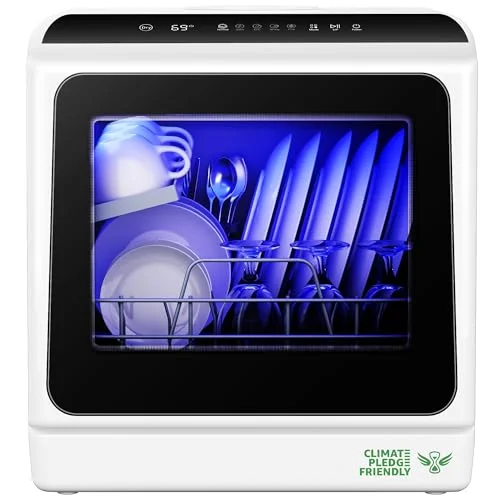
COMFEE' Countertop Dishwasher

Kitchens where the faucet can't take an adapter, or a household of two to three
Countertop · 6 place settings · 19.7"D × 21.6"W × 17.2"H · ENERGY STAR

This is the countertop machine to buy if the built-in's plumbing is the whole point of avoiding a built-in — it needs no faucet connection at all beyond what its own tank supplies. Six place settings is enough to clear one evening's dishes for two or three people in a single run, and the ENERGY STAR certification is worth noting in a category where most listings carry none. It gives back none of your counter's worktop, though — at 21.6 inches wide, plan for a semi-permanent spot beside the sink.

The trade-offSix settings is roughly half of what a standard built-in holds, and this machine's own tank means refilling by hand rather than a set-and-forget connection.

COMFEE' countertop dishwasher
$310
6 place settingsCheck price →
02Quietest countertop

EUHOMY Countertop Dishwasher Portable

Studios and open-plan kitchens where the machine runs while you're in the room
Countertop · 6 programs · 40 dB rated · no hookup required

Noise is the specification that matters most once a dishwasher sits in the open rather than behind a cabinet door, and at a manufacturer-rated 40 decibels this is the quietest machine in this comparison. Six programs give some flexibility on cycle length, and it's built to run without a mandatory faucet hookup, which sidesteps the adapter-and-aerator problem entirely for anyone whose kitchen tap won't cooperate.

The trade-offManufacturer decibel figures are measured in undisclosed, ideal conditions and aren't independently audited — treat 40 dB as a strong indication of class, not a guarantee of what you'll hear standing next to it.

EUHOMY countertop dishwasher
$249
40 dB ratedCheck price →
03Closest to a built-in

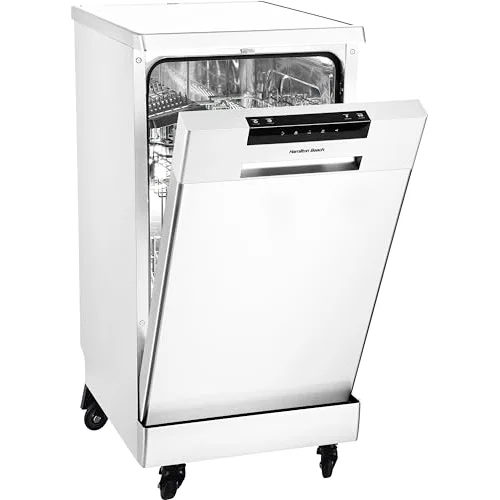
HAMILTON BEACH Portable Dishwasher with Wheels

Renters who want the capacity of a real dishwasher without the install
Freestanding on wheels · 19 in wide · 8 place settings

At eight place settings and 19 inches wide, this is the machine that narrows the capacity gap to a built-in the most out of anything in this comparison — close to what a compact 24-inch built-in holds. It rolls to the sink, connects via faucet adapter, and rolls back when it's done, giving back most of the floor space a permanent installation would consume without giving back any countertop.

The trade-offIt's faucet-only, so the same aerator-and-threads check applies before you buy, and at 19 inches wide it needs a clear strip of floor plus door swing plus a path to the sink — floor space a small kitchen may not have to spare.

HAMILTON BEACH portable dishwasher on wheels
$600
8 place settingsCheck price →
0418-inch, certified efficient

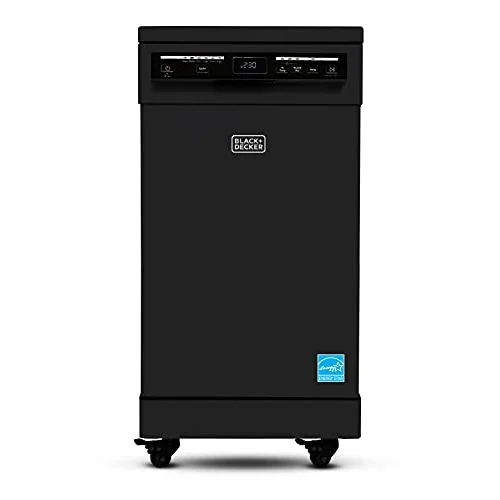
BLACK+DECKER 18-Inch Portable Dishwasher

A genuine full-size-adjacent portable for a household of three or four
Freestanding, 18 in wide · ENERGY STAR · BPD8B

The other 18-inch machine in this comparison, and the one to weigh directly against the Hamilton Beach on price and width — one inch narrower, and ENERGY STAR certified where plenty of portables carry no certification at all. Like every faucet-fed portable, it ties up the kitchen faucet for the length of its cycle, which for a standard-length wash typically runs well past an hour.

The trade-offIt costs roughly double the countertop machines in this comparison, still needs floor space a small kitchen may not have, and — like the Hamilton Beach — depends entirely on a faucet with standard threads to run at all.

BLACK+DECKER 18-inch portable dishwasher
$610
ENERGY STARCheck price →
At a glance

The four machines, side by side

All figures are manufacturer specifications; prices are approximate and move constantly on Amazon.

MachineClassCapacityWater sourcePrice
COMFEE' CountertopCountertop6 place settingsBuilt-in tank$309.99Price
EUHOMY Countertop, 40 dBCountertop6 programsNo hookup required$249.00Price
Hamilton Beach on WheelsFreestanding, 19 in8 place settingsFaucet only$599.99Price
BLACK+DECKER 18-InchFreestanding, 18 inENERGY STARFaucet only$609.99Price
The other side

When a built-in is worth the work after all

None of the four trade-offs above are reasons to avoid portable dishwashers — they're reasons to know what you're buying. For renters, small kitchens, and anyone who can't modify the property, a portable machine is very often the right call by default, because the alternative is hand-washing, not a built-in you're not allowed to install.

But if you own the kitchen, or your lease genuinely permits modification, the calculation changes. A built-in earns the installation cost in three situations specifically. First, household size: at four or more people, the gap between an 18-inch portable's eight place settings and a full-size built-in's twelve to sixteen becomes a daily inconvenience rather than an occasional one — you'll be running the portable machine more than once a day to keep up. Second, faucet incompatibility with no tank option you'd accept: if your kitchen has a pull-down sprayer faucet and you don't want to live with a tank-fed machine's smaller capacity and hand-filling, a built-in's dedicated water line sidesteps the whole faucet question permanently. Third, kitchen layout: if there's genuinely no floor space for an 18-inch machine and no counter space for a countertop one, you may not have a portable option that fits at all, and the built-in's ability to live inside existing cabinetry becomes the only real solution.

The honest math on installation cost, versus what you'd spend running a portable machine or hand-washing instead, is in what a portable dishwasher really costs to run — worth reading before either decision, since the answer depends heavily on your local water and electricity rates. If you've decided a portable machine is right for now, the practical next steps are in how to choose a portable dishwasher and how to load one so everything actually gets clean — small tubs punish bad loading far more than full-size built-ins do.

FAQ

Common questions

Can I install a portable dishwasher without any tools?

For a faucet-fed model, usually yes — the adapter clamps onto the faucet in place of the aerator, no tools required, provided the faucet has a standard removable aerator and matching threads. For a tank-fed model like the COMFEE' Countertop Dishwasher, there's no faucet connection to make at all: fill the tank, plug it in, and run it. Neither requires a plumber, unlike a built-in's supply line, drain line and dedicated electrical connection.

Why does my portable dishwasher's cycle take longer than my old built-in's?

Because a portable machine is working from lower water pressure and volume than a built-in fed directly from the household hot water line, and most portable and countertop machines dry with residual heat or a fan rather than a heated element, so manufacturers extend the wash-and-rest phase to compensate. The fastest advertised cycle is rarely the one you'll use for a full, normally soiled load — check the standard cycle length, not the headline number, before assuming a portable machine will be quicker.

Will a portable dishwasher actually hold what my built-in held?

Probably not at the same place-setting count. A standard 24-inch built-in typically holds 12 to 16 place settings; the countertop and 18-inch portables in this comparison range from six to eight. An eight-setting 18-inch machine on wheels comes closest. Manufacturer place-setting figures are also produced with standardized crockery, so real-world capacity with mismatched dishes tends to land a bit under the stated number.

Is a portable dishwasher louder than a built-in?

Often it feels louder, even when the published decibel number is lower, because a countertop machine sits in the open at counter height with no cabinet to absorb sound, while a built-in is installed behind a door with cabinetry on three sides that genuinely muffles noise. An 18-inch machine on wheels sits at floor level and benefits from some passive shielding from the counter and nearby cabinets, which can make it feel quieter in the room than its decibel rating alone would suggest.

Keep reading

Next, from this site