Best Portable Dishwashers
Guide · Detergent, Rinse Aid & Dosing

Which detergent for a portable dishwasher? And how much.

Pods, powder or gel. The dispenser on a machine the size of a microwave behaves nothing like the one in a 24-inch built-in — get the form or the dose wrong and the failure is cheap but obvious: a film on every glass, foam under the door, or a pod that never opened at all.

By Ilane TallUpdated September 1, 2026Research-based — no testing lab, no invented ratings

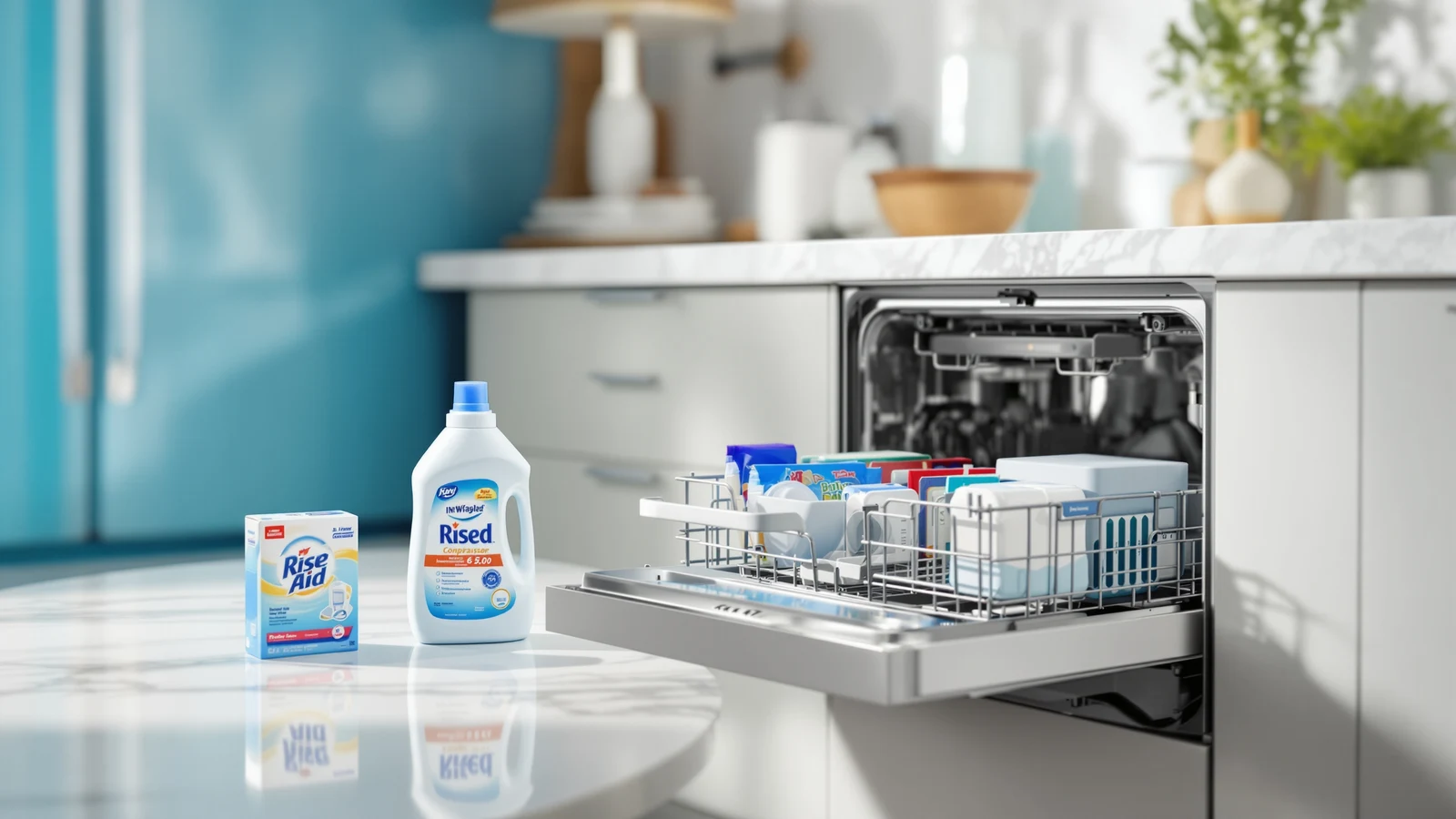
Detergent pod, powder and a rinse-aid bottle beside the small dispenser cup of a countertop dishwasher

Reader-supported: we may earn a commission when you buy through the links on this page, at no additional cost to you. Prices move constantly — confirm the live price before you order.

A full-size built-in dishwasher runs several gallons through a rack big enough to give a stubborn pod four or five minutes to dissolve. A portable countertop dishwasher does the same job with a fraction of the water and a tub small enough to fit under a wall cabinet — and on machines built around a five-litre tank, a fixed, finite amount of liquid the detergent has to work inside from the moment the cycle starts. That's the actual subject of this guide: not which brand of detergent to buy, but which form suits a small, low-volume machine, and how much of it belongs in a dispenser roughly the size of a bottle cap.

We looked at the detergent guidance published for this category against the water source, program count and dispenser design specified for four current models — two EUHOMY machines, a Hermitlux and a HAVA with an integrated water softener. If you haven't picked a machine yet, our buying guide compares the field on cabinet clearance, capacity and price; this page assumes you already own one.

How this page is built

We compare published specifications, dispenser design and manufacturer detergent guidance rather than running a testing lab of our own — we do not physically test detergent brands against each other, and we do not publish ratings we cannot verify. Amazon returns no rating or review count for these machines, so this guide relies on what is documented: capacity, water source, program count and price, plus the general mechanics of how small dishwashers dissolve and rinse detergent.

Why it matters

The dispenser on a small machine has less room for error

On a full-size built-in, the detergent dispenser is a spring-loaded flap set into a door the size of a cutting board, opening partway through a wash cycle into several gallons of actively circulating water. On a countertop portable, the entire mechanism is a cup a few inches across, opening into a tub that holds a small fraction of that water — whether it's filled from a fixed built-in tank, as on the EUHOMY 8-Program model with its 5-liter reservoir, or from the faucet directly.

Two things follow from that ratio. First, the margin between "enough detergent to cut grease" and "too much to rinse away" is much narrower — an amount that disappears into a full-size tub is a visible film in a five-litre one. Second, the spray arms covering that smaller tub have to both dissolve the detergent and rinse it off, often in a program shorter than a built-in's default cycle. Both EUHOMY machines compared here lead their own listings with a 40 dB rating alongside their program count, and a quieter, lower-pressure spray is one more reason a pod loaded whole into the dispenser can survive a cycle intact.

Program count varies more than the detail behind it: the six-program EUHOMY, the eight-program EUHOMY with its tank, and the Hermitlux — whose base listing states seven washing programs while the Black Glass Door 10 Functions variant sold under this ASIN states ten — none publish a minute-by-minute breakdown the way a full-size machine's manual usually does. Treat the default or "Normal" program as the one detergent guidance is written for, and any Quick, Fast or Eco program as the one most likely to leave a pod half-dissolved.

Pods

Pods in a short cycle: where they don't dissolve

A detergent pod is built for a specific set of conditions — a defined volume of hot water, a wash phase of a minimum length, and active circulation that pre-softens the outer film before the pod is expected to fully open. A full-size dishwasher on its Normal cycle reliably delivers all three. A portable countertop machine on a shortened or "quick" program frequently delivers none of them: less water in the tub to begin with, a briefer wash phase, and in tank-fed machines like the 5-liter EUHOMY here, a fixed volume that never gets topped up mid-cycle the way a plumbed-in machine's fill valve tops up a built-in.

The failure is specific rather than theoretical: the pod's outer film survives the cycle largely intact, or partially dissolves and leaves a slick of undiluted gel across the two or three dishes nearest where it landed instead of distributing evenly. This is a documented, general failure mode of low-volume, short-cycle dishwashers rather than a defect in any particular pod brand — it's why manufacturer guidance across compact and portable machines commonly defaults to powder or gel over pods, and why the fastest program on any of these machines is the one where a pod is least likely to fully open.

If you already own pods, the workaround manufacturers describe is mechanical rather than chemical: break the pod's film and add it as loose gel directly to the dispenser cup instead of dropping it in whole, and reserve it for the machine's longest or "Heavy" program rather than a rapid cycle. None of that helps if the rack is loaded so tightly that the spray can't reach the dispenser cup in the first place — our loading guide covers keeping the arm's path clear.

Powder & gel

Powder, and dosing for a half load

Powder and gel detergent solve the pod's dissolving problem because they're already loose or dissolve on contact, rather than needing to break through a film first. That's the reason manufacturer guidance across this category defaults to powder or gel rather than pods — and it's also why the dose has to be judged against the tub's size rather than against the scoop line printed for a full-size machine.

The practical rule manufacturers give for a small dispenser is to fill the cup to somewhere around a third to half of what a full-size machine's dispenser would hold for a comparably soiled load, and to treat any printed fill line on the cup itself as the actual limit rather than a suggestion. A tub built around six to eight programs and a handful of place settings, like the four machines in this guide, is by definition washing a half load or less by full-size standards on most days — dosing for that day's dish count matters more here than filling to the dispenser's maximum every time.

Water hardness changes the number, and it's worth checking rather than guessing: harder water needs more detergent to cut through dissolved minerals before it can start on food residue, softer water needs less, and a fixed dose used regardless of local water contributes to light loads coming out over-washed and heavy loads coming out under-washed on the same machine. None of the four listings here publish a hardness-based dosing chart, so the manufacturer's printed insert is a more reliable source than a general rule of thumb.

Rinse aid & hard water

Rinse aid, hard water and the built-in softener option

Rinse aid matters more on a portable dishwasher than on a built-in one for a specific mechanical reason: almost none of these machines dry with a heating element. They rely on residual heat and air circulation, sometimes helped by a door or lid that pops open at the end of the cycle, and rinse aid is what keeps that passive drying from leaving spots and a cloudy film instead of clear glass. Skipping it on a portable machine shows up faster than skipping it on a built-in with a heated dry cycle to fall back on.

Hard water compounds the same problem before drying even starts. Dissolved minerals leave the white film on glasses that people often mistake for a washing failure, and over time coat the heating element and interior surfaces of any dishwasher, portable or built-in. Almost none of the compact countertop machines in this category do anything about that directly — detergent and rinse aid are left to manage it dose by dose, and residue that isn't fully rinsed away tends to accumulate around the filter, which is part of why keeping it clear is a recurring line item in the monthly maintenance routine that prevents repairs.

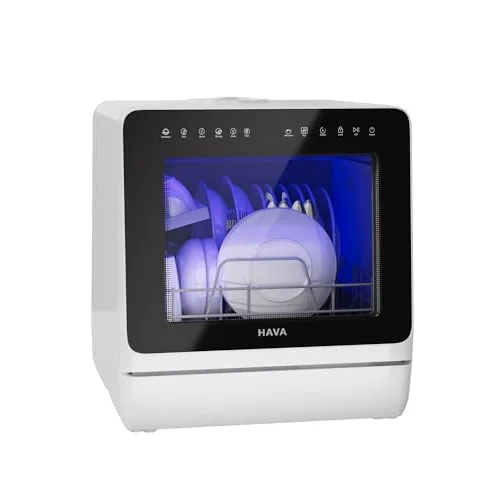
The HAVA Countertop Dishwasher with Water Softener & Enhanced Energy Efficiency is the exception among the four machines compared here: it integrates a water softener as part of the machine, rather than leaving hardness entirely to the detergent. That's a feature normally reserved for full-size, often European, built-in machines, and on a countertop model it means the softener — not the detergent dose alone — is doing some of the work of preventing limescale and glassware film. It doesn't replace rinse aid, and it does nothing useful if the local water is already soft, but where the water genuinely is hard, it changes what the detergent and rinse aid have to compensate for on their own.

At a glance

The four machines in this guide

Manufacturer specifications as listed; prices move constantly on Amazon.

MachineWater sourceProgramsDetergent-relevant notePrice
EUHOMY 6-Program, 40 dBCountertop6360° coverage claim$269.99Price
EUHOMY 8-Program, 5L Tank5 L tank8Fixed volume — dose to it$289.99Price
Hermitlux Black Glass DoorCountertop7 / 10*Program count varies by listing$299.99Price
HAVA with Water SoftenerCountertop—Built-in softener$369.00Price

* Hermitlux's base listing states seven programs; the Black Glass Door, 10 Functions variant sold under this ASIN states ten. We report both rather than resolve it.

The picks

Four machines, and what their dispenser and water source mean for detergent

01Value, tank or faucet

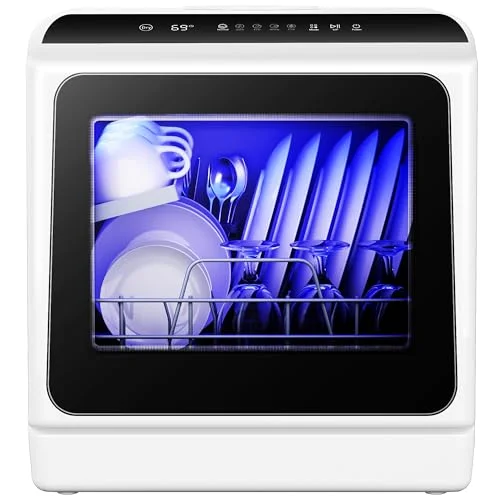
EUHOMY 6 Programs Countertop Dishwasher, 40 dB, 360° Coverage

For anyone who wants tank-or-faucet flexibility without paying for extra programs
Countertop · 6 wash programs · 40 dB rated · 360° spray coverage · Large

The listing's own name leads with the numbers that matter here: six programs, a 40 dB rating and 360-degree spray coverage. That coverage claim is the relevant one for detergent — a spray pattern described as reaching the tub from every side is one more reason to favor powder or gel over a pod that has to be struck open by whichever arm reaches it first. At $269.99 it's the least expensive of the four machines compared here.

The trade-offThe 40 dB figure and program count are the manufacturer's claims as listed; treat any quick or fast setting as the one where a pod is most likely to under-dissolve.

EUHOMY countertop dishwasher, 6 programs, 40 dB
$270
6 programsCheck price →
02Tank-fed

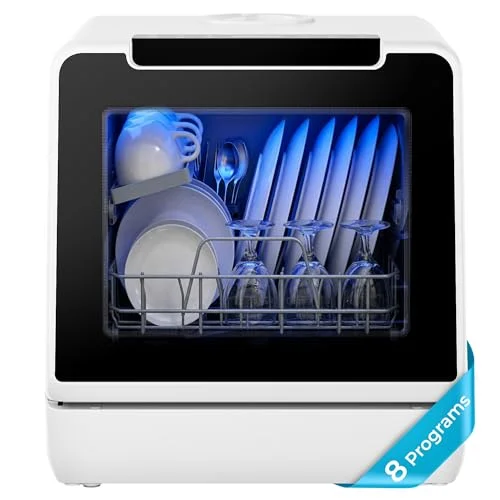
EUHOMY Countertop Dishwasher, 8 Programs with 5L Tank

For kitchens with no usable faucet, where every wash starts from a jug
Countertop · 8 wash programs · 5 L built-in tank · 40 dB rated · Black

This is the tank-fed sibling of the two EUHOMY machines here, with two more programs and a fixed 5-liter reservoir instead of a faucet connection. That fixed volume is exactly the constraint the dosing section above is about: there's no mid-cycle refill topping up what the detergent has to dissolve in, so the dose has to match a known, small amount of water every time.

The trade-off$289.99 buys two extra programs over the machine above, but the tank still needs refilling by hand before each cycle.

EUHOMY countertop dishwasher with 5 liter tank, black
$290
5L tankCheck price →
03Glass door

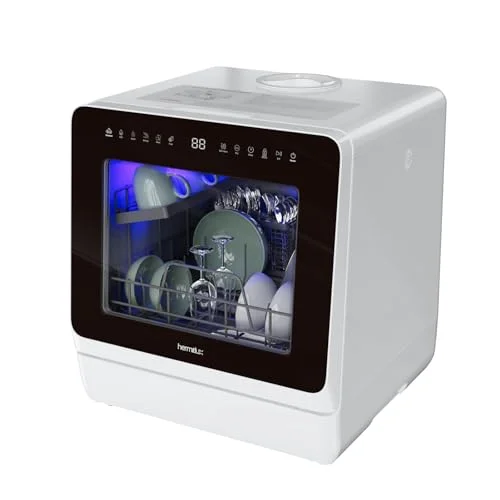
Hermitlux Countertop Dishwasher, 7 Washing Programs

Buyers who want a glass-front machine, and don't mind a listing that isn't fully consistent on program count
Countertop · 7 washing programs, base listing · Black Glass Door, 10 Functions variant

Hermitlux's base listing states seven washing programs, while the Black Glass Door, 10 Functions variant sold under this ASIN states ten — a discrepancy worth noting rather than resolving in the machine's favor. More programs generally means more of them are shortened or specialized rather than a longer default wash, which is the same reason to default to powder or gel here as on any other compact machine in this guide.

The trade-offAt $299.99 it sits between the two EUHOMY machines and the HAVA on price, with neither the tank option of the 5L EUHOMY nor the softener of the HAVA.

Hermitlux countertop dishwasher with black glass door
$300
Glass doorCheck price →
04Hard water

HAVA Countertop Dishwasher with Water Softener & Enhanced Energy Efficiency

Anyone whose glasses come out cloudy regardless of detergent brand
Countertop · Integrated water softener · Enhanced energy efficiency

The most expensive machine in this guide, and the only one built around the hard-water problem directly rather than leaving it to the detergent alone. An integrated softener means your detergent and rinse aid are no longer the only thing standing between hard water and a limescale film, which is normally the case in this category.

The trade-offAt $369.00 it costs roughly $90 more than the Hermitlux, and a softener does nothing for you if a water-hardness check shows your supply is already soft.

HAVA countertop dishwasher with built-in water softener
$369
Softener built inCheck price →
Overdosing

What too much detergent does to a small tub

Oversudsing is the single most common consequence of guessing high, and it behaves differently in a small machine than a large one. A full-size dishwasher's pump and filter are built to handle a certain amount of foam; a countertop machine's pump is smaller and its interior cavity has far less headroom, so foam that would be a minor annoyance in a full-size tub can push suds past the door seal in a portable one.

Short of an overflow, the more common result is simply a film: undiluted detergent residue left on plates and glasses because the rinse phase is sized for a lighter dose than what was used. That residue looks, to the eye, exactly like the white-to-cloudy film hard water causes on its own — which is why an overdosed cycle in a hard-water area can be mistaken for a rinse-aid or softener problem rather than a dosing one, and it's worth ruling out first. If dishes keep coming out with a film, streaks or a musty smell despite a correct dose, our troubleshooting guide covers the other common causes.

There's also a mechanical cost that's easy to miss: detergent and mineral residue that isn't fully rinsed away accumulates in the filter and spray-arm jets over repeated cycles, the same way hard-water scale does, and a partly clogged jet reduces the very spray coverage the next cycle's detergent needs to dissolve and rinse properly. Keeping the filter and spray arms clear on a monthly basis is covered step by step in our maintenance guide.

FAQ

Common questions

Can I use dishwasher pods in a portable dishwasher?

You can, but the short, low-volume cycles many compact machines run don't always dissolve a pod's outer film completely, especially on a quick or rapid program. Manufacturer guidance across this category generally defaults to powder or gel instead, or to breaking a pod open into the dispenser rather than dropping it in whole and reserving pods for the machine's longest program.

How much detergent should I use in a portable dishwasher?

Less than a full-size dishwasher's scoop line. A small dispenser cup is sized for a fraction of the water a built-in machine circulates, so guidance for this category typically calls for roughly a third to half of a comparable full-size dose, filled to the cup's own printed line where it has one, and adjusted slightly upward for genuinely hard water.

Do portable dishwashers need rinse aid?

Yes, more so than a built-in machine. Almost none of these machines dry with a heating element — they rely on residual heat and air, sometimes with a door that pops open at the end of the cycle — and rinse aid is what keeps that from leaving spots and a cloudy film rather than clear glass.

What happens if I put too much detergent in a portable dishwasher?

The most common result is a film of undiluted detergent left on dishes, because the rinse phase is sized for a lighter dose, and in some cases enough foam to push suds past the door seal, since a countertop machine's pump and cavity have far less headroom than a full-size machine's. Residue can also build up in the filter and spray-arm jets over time.

Keep reading

Next, from this site