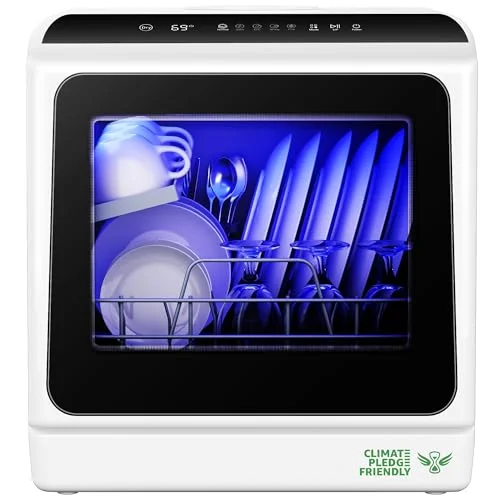
Best Portable Dishwashers
Guide · Water use

How much water does a portable dishwasher really use?

The box says a number. The machine, over a year of real cycles, says something a little different. Here is the litre-by-litre figure — per cycle, per hand-wash comparison, and per year for two people — with every assumption stated.

By Ilane TallUpdated September 6, 2026Research-based — no testing lab, no invented ratings

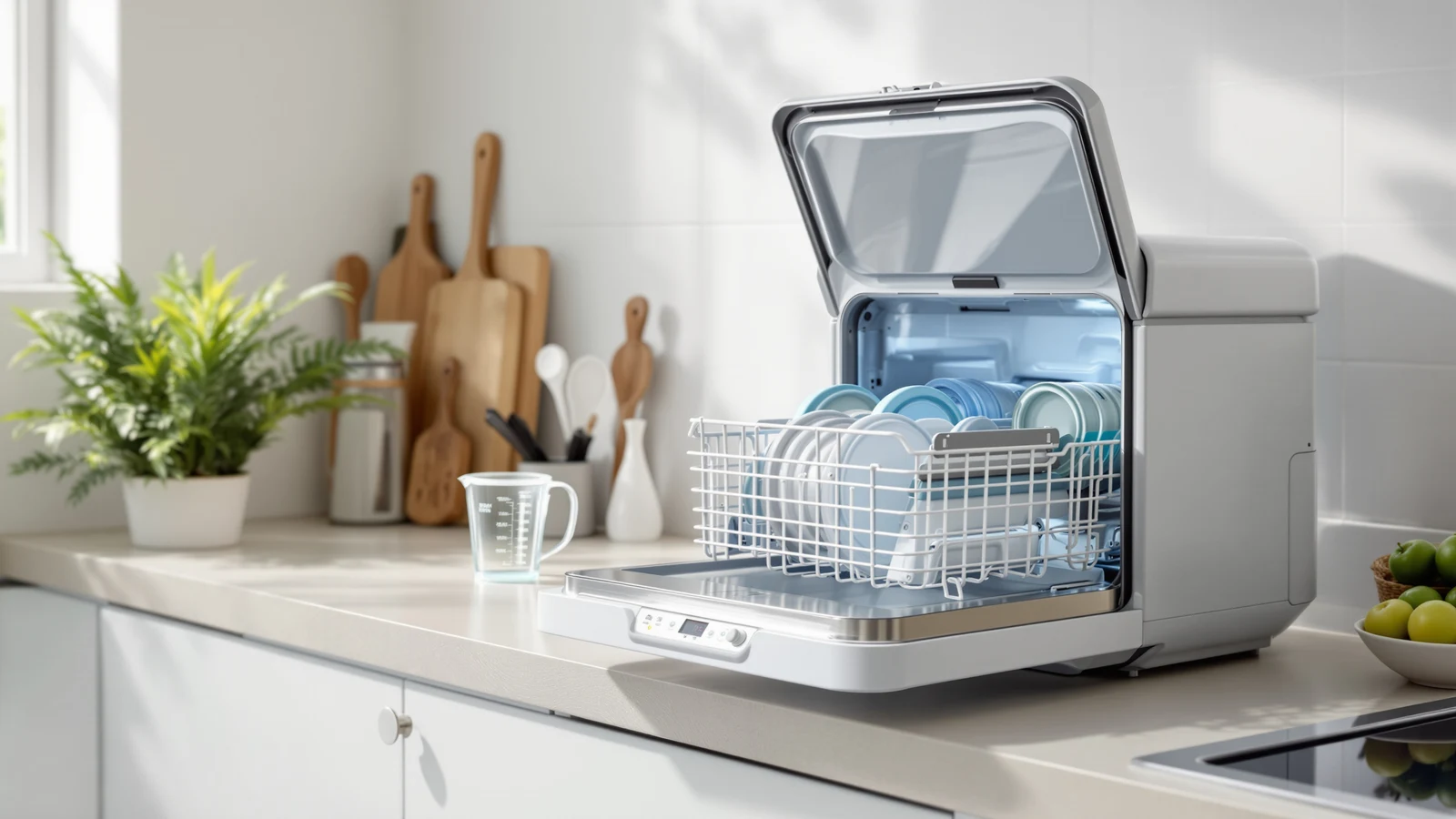
Water filling a portable countertop dishwasher's tank beside a kitchen sink

Reader-supported: we may earn a commission when you buy through the links on this page, at no additional cost to you. Prices move constantly — confirm the live price before you order.

Quick answer

A portable or countertop dishwasher typically uses somewhere between 2 and 4 gallons (roughly 7.5 to 15 litres) per normal cycle, and closer to 1 to 2 gallons on an eco or quick programme. That is less water than washing the same load by hand under a running tap, which studies of hand-washing behaviour put at 9 to 27 gallons a load depending on habits. Run once a day, a two-person household lands around 1,000 to 1,800 gallons a year on the machine — a real number, but one worth checking against your own habits rather than the figure printed on the box, which describes a lab cycle, not your kitchen.

Every dishwasher listing quotes a number nobody can act on: "low water consumption," "eco-friendly," "saves water versus hand washing." None of it says how many gallons, on which cycle, measured how. That vagueness is not an accident — manufacturers rarely publish a certified per-cycle litre figure for countertop machines the way EPA WaterSense does for full-size built-ins, so the industry default is to gesture at water-saving and leave the reader to assume the best. This guide works from what is actually published: place-setting counts, tank sizes, cycle counts and independent estimates for the appliance class, and states plainly where a figure is an estimate rather than a spec.

We compare published specifications, tank capacities and general water-use facts about the appliance category. We do not physically test these machines, we do not run a testing lab, and we do not publish star ratings or review counts we cannot verify — Amazon's product data does not include them for this category, so there are none on this site.

Per cycle

Litres per cycle, by machine class

"Portable dishwasher" covers two genuinely different plumbing setups, and the water figure follows the setup rather than the brand.

Faucet-fed countertop and 18-inch machines

These pull water on demand through an inlet hose clipped to the kitchen tap, the same way a full-size built-in does, and the machine's own pump and spray-arm design — not a fixed reservoir — decides how much passes through in a cycle. Industry estimates for this appliance class generally put a normal cycle at 2 to 4 gallons (about 7.5 to 15 litres), with the wider 18-inch machines toward the top of that range because a larger tub needs more water to reach every spray-arm level. An eco or "energy-saver" programme cuts that by using a longer, cooler wash with more recirculation of the same water rather than fresh fills — which is the mechanism behind the next section.

Tank-fed countertop machines

Tank models have a hard ceiling instead of an estimate: whatever the tank holds is the entire water budget for the cycle, because there is no faucet connection to draw more mid-cycle. A 5-litre tank — the size used across most tank-fed countertop machines on the market — is about 1.3 US gallons, which is genuinely less than the low end of the faucet-fed range above. That is not the machine being more efficient in some clever way; it is the machine physically incapable of using more, which has real consequences for what it can and cannot wash (see the tank section below).

What decides the number

Within either class, three things move the figure: cycle length (longer eco cycles recirculate rather than refill, cutting total draw even though the clock runs longer), tub size (an 18-inch freestanding machine washes more dishes per cycle than a compact countertop tub, so its per-load draw is naturally higher even if its per-plate draw is lower), and rinse settings (an extra rinse or a pre-rinse cycle adds a full draw on faucet-fed machines and simply isn't available once a tank-fed machine's water is used up). Treat every number in this section as a manufacturer-class estimate, not a metered measurement — nobody puts a flow meter on these machines and publishes the result, so the honest position is a range, not a decimal.
The comparison

The hand-wash comparison, done fairly

"A dishwasher uses less water than washing by hand" is true often enough to be a fair general claim, but the honest version needs the hand-washing side defined as carefully as the machine side, because "washing by hand" covers two habits that differ by a factor of three.

  • Running-tap hand washing. Tap left on throughout, which is how most people actually do it when they're not thinking about it. A standard kitchen faucet flows at roughly 1.5 to 2.2 gallons per minute, and a full load of dishes commonly takes 10 to 15 minutes start to finish. That works out to somewhere around 15 to 27 gallons for one load — several times the 2 to 4 gallons a faucet-fed machine uses on a normal cycle, and roughly ten times a tank-fed machine's 5-litre budget.
  • Basin hand washing. Tap off between rinses, dishes washed in a filled basin and rinsed in batches. This habit brings the figure down to something closer to 9 to 15 gallons a load — still more than a machine cycle in almost every case, but a much smaller gap than the running-tap number implies.

The fair comparison, then, is: a faucet-fed portable dishwasher on a normal cycle uses roughly a fifth to a third of what running-tap hand washing uses, and somewhat less than half of careful basin washing. A tank-fed machine's fixed 5-litre budget beats both hand-washing habits outright on water — the trade-off, covered below, is that the tank limits how much it can wash in that one fill. Where the machine loses ground is when it is run half-empty: a normal cycle uses close to the same water whether the rack is full or half full, so a machine run for two plates and a mug is not obviously the water-frugal choice that day. Full loads are where the gap holds.

None of these figures come from a lab we ran. They are general facts about faucet flow rates and appliance water classes, applied to published tank sizes and cycle counts — not a claim about any single household's tap or habits, which is why the range matters more than any single number in it.

Eco cycles

Why eco cycles use less water and more time

An eco or energy-saver programme on a countertop dishwasher almost always takes longer than the normal cycle — often by 30 to 60 minutes — and that is not a compromise so much as the entire mechanism. A normal cycle uses more, hotter water for a shorter time because heat and volume do the work of loosening soil quickly. An eco cycle substitutes time for both: cooler water, run for longer, recirculated repeatedly through the same wash rather than drained and replaced, so the spray keeps working on the soil without a fresh fill each pass.

That substitution is exactly why an eco cycle draws less water on a faucet-fed machine — the same water is doing more passes instead of being replaced — and it's also why it does very little for a tank-fed machine, which never had a second fill to save in the first place. On a 5-litre tank model, the eco programme's water saving is close to zero; what it changes is temperature and wash time, not volume. If you're choosing eco for the water saving specifically, that only pays off on a faucet-fed machine.

The honest trade-off, stated plainly: an eco cycle is a real way to cut water use on a faucet-fed machine, and a real way to add forty-five minutes to your evening for it. Whether that trade is worth it is a judgement call, not a spec — ours is that it's worth it for a load you're not in a hurry for, and not worth it for the one load you need back on the shelf before dinner. Related: cycle length in general is covered in why a portable dishwasher cycle takes two hours, and detergent behaves differently across a long, cool eco wash than a short, hot one — see which detergent for a portable dishwasher, and how much.

Tank models

Tank models: what a 5-litre fill really covers

Five litres — about 1.3 US gallons, roughly the size of a large kitchen jug — is the built-in tank capacity on most tank-fed countertop dishwashers, including the EUHOMY models covered below. It is worth being concrete about what that volume actually does across one cycle, because "5-litre tank" reads like a spec until you picture the water being split between fill, wash spray, and rinse, with nothing held in reserve.

In practice, the tank's water covers: an initial fill that submerges the pump inlet, a wash phase where the pump recirculates that same water through the spray arm repeatedly (the water isn't fresh for each pass — it's the same 5 litres, getting dirtier and doing more work each cycle), and a final rinse phase that uses what's left. There is no separate large fresh-water reserve; the tank is the entire water budget, start to finish. That is also why tank-fed machines cap out at fewer place settings than faucet-fed ones of similar external size — with a fixed volume, more dishes means less water reaching each one, and manufacturers set the practical limit before wash quality visibly drops.

The realistic reading for a household: a 5-litre tank comfortably handles a genuinely light load — a couple of plates, bowls, glasses and cutlery for one or two people — and struggles once the rack fills with anything greasy, because grease consumes the wash water's cleaning capacity faster than food residue does. Refilling the tank mid-cycle for a second load is possible on machines built for it, but it means standing at the sink with a jug, which is the daily cost tank mode trades for needing no faucet connection at all.

The picks

Machines to look at for either water profile

All three run on published specs and live pricing, not on a water figure we measured ourselves.

01Faucet-fed, quiet

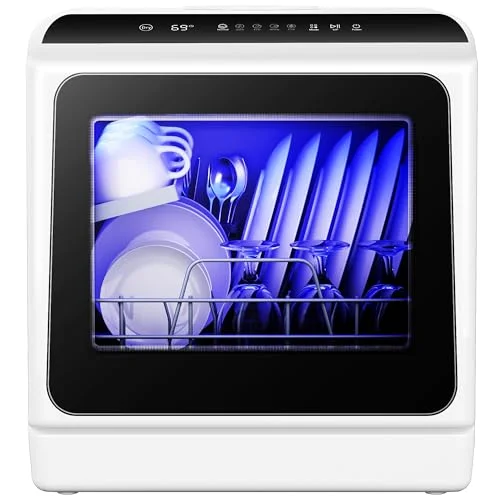
EUHOMY 6-Program Countertop Dishwasher, 360° Coverage

A kitchen with a usable faucet and a preference for the lower end of the water range
Countertop · 5 L tank or faucet · 6 programmes · 40 dB rated

This model supports both water sources: a 5-litre tank for kitchens with no usable tap, or a faucet connection for households that would rather not refill a jug between loads. Running it on faucet mode with six programmes to choose from, including a fast option, puts it toward the lower end of the faucet-fed water range described above, since a compact countertop tub needs less water to fill than an 18-inch machine does. On tank mode it's bound by the same 5-litre ceiling as any other tank model.

The trade-offThe 40 dB figure and the water-use range are both manufacturer claims for this appliance class, not numbers we measured ourselves. Treat them as an indication of where the machine sits in its category, not a guarantee for your specific tap pressure or load size.

EUHOMY countertop dishwasher, 6 programs, faucet and tank compatible
$269.99
Tank or faucetCheck price →
02Faucet-fed, larger tub

EUHOMY Countertop Dishwasher Portable, 6 Programs, No Hookup

A household that wants the larger of the two EUHOMY countertop tubs
Countertop · 6 programmes · 40 dB rated · no hookup required

The listing markets this as "no hookup," which in this category means it is built around its own water supply rather than a mandatory faucet connection — the same operating principle as the tank-based water budget described above, where the fill on hand is the entire cycle's water rather than one draw from an open tap. Six programmes give you a choice between a longer wash and a faster one, which is where the eco-versus-normal water trade-off in this guide actually plays out on a real machine.

The trade-offWe don't have a published tank-litre figure specific to this listing, so don't assume it matches the 5-litre figure quoted elsewhere in this guide for other EUHOMY models — check the listing's own capacity details before ordering if the exact fill volume matters to you.

EUHOMY portable countertop dishwasher, 6 programs, no hookup required
$249.00
No hookupCheck price →
03Tank, largest fill

SUNVIVIPRO 18" Portable Countertop Dishwasher, 152OZ Water Tank

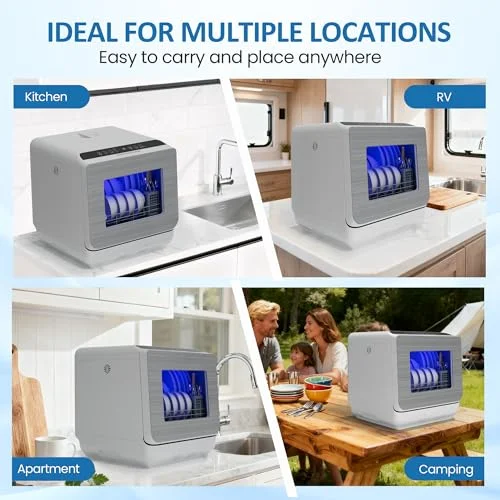
Dorms, RVs and kitchens where no faucet is available at all
Countertop · 152 oz (about 4.5 L) built-in tank · 6 preset modes · plates to 12 in · ENERGY STAR · 12-hour delay start

This one publishes its tank size in ounces rather than litres — 152 fluid ounces works out to roughly 4.5 litres, close to but slightly under the 5-litre figure quoted for most tank-fed machines above. It's ENERGY STAR certified, which for a small tank-fed machine speaks more to power draw and thermal efficiency than to a lower water figure, since the tank is already the hard ceiling on water use regardless of certification. Six preset modes and a 12-hour delay start are the practical features; the tank size is the water story.

The trade-offA 152-ounce tank is a real fill number from the listing, not a rounded marketing figure, which is worth crediting — but it's still under 5 litres, so expect the same light-load limitation described in the tank section above, more so than machines with the fuller 5-litre tank.

SUNVIVIPRO 18-inch portable countertop dishwasher with water tank
$299.99
152 oz tankCheck price →
Per year

A realistic yearly figure for a two-person household

Stated assumptions first, because this number is only as honest as what it's built on. Two people, one cycle a day (a realistic cadence for a couple rather than the "every meal" pace some marketing assumes), 365 days a year, no delay-start days skipped and no second load counted.

  • Faucet-fed machine, normal cycle at roughly 3 gallons average: 3 × 365 ≈ 1,095 gallons a year.
  • Faucet-fed machine, run on eco half the time (2 gallons average across the mix): 2 × 365 ≈ 730 gallons a year.
  • Tank-fed machine, 5-litre (1.3-gallon) fill every cycle: 1.3 × 365 ≈ 475 gallons a year.
  • For comparison, running-tap hand washing at roughly 20 gallons a load, once a day: 20 × 365 ≈ 7,300 gallons a year.

The spread between the machine figures — 475 to 1,095 gallons depending on class and cycle choice — matters less than the gap between any of them and the hand-washing figure, which runs six to fifteen times higher. That gap is the actual case for owning one of these machines on water grounds alone; the specific gallons-per-year number moves with your cycle count, your tap pressure and whether you run eco, and none of those inputs are things we can know from here. Treat 1,000 gallons a year as a reasonable planning figure for a faucet-fed machine run daily, and adjust down if you skip days or run tank mode, up if you run two loads on busy days.

What this figure doesn't capture is energy — water heating is usually the larger cost of running one of these machines, not the water itself, and that's a separate calculation with its own assumptions about your utility rates. It also doesn't settle whether a machine is "worth it" against hand washing on cost, only on water volume; a fuller answer, including detergent and electricity, belongs in a household's own math rather than a general guide. What we can say from the specs: the water case for a portable dishwasher over daily running-tap hand washing is not close, and it holds even for the smallest tank-fed machines in this category, including the ENERGY STAR-certified ones covered in our Energy Star roundup.

FAQ

Common questions about water use

Does a portable dishwasher really use less water than washing by hand?

Usually, yes, and the gap is largest against running-tap hand washing, which commonly uses 15 to 27 gallons for one load versus 2 to 4 gallons for a faucet-fed machine's normal cycle or about 1.3 gallons for a 5-litre tank fill. The gap narrows against careful basin washing with the tap off between rinses, which can run closer to 9 to 15 gallons — still more than a machine cycle in most cases, but a smaller margin than the tap-running comparison implies.

How much water does a 5-litre tank dishwasher use per cycle?

The entire cycle — fill, wash and rinse — draws from that one 5-litre fill, since there's no faucet connection to add more mid-cycle. Five litres is about 1.3 US gallons. That fixed budget is why tank-fed machines cap out at fewer place settings than faucet-fed models of similar size: more dishes in the same fixed water volume means less water reaching each one.

Does running the eco cycle actually save water?

On a faucet-fed machine, yes — the eco cycle recirculates the same water through more passes instead of draining and refilling, which is also why it takes longer. On a tank-fed machine, the water saving is close to zero, because the tank was already the entire water budget; the eco cycle there mainly changes wash temperature and time, not volume.

Is it wasteful to run a portable dishwasher half full?

Somewhat, yes. A normal cycle uses close to the same amount of water whether the rack is full or half loaded, since the machine doesn't measure dish volume and scale its fill accordingly. The water-saving case for these machines is strongest when they're run full; a half-empty load run daily narrows the advantage over hand washing considerably.

Keep reading

Next, from this site