Guide · Maintenance
Why your portable dishwasher smells (and how to stop it)
Small tubs dry slowly and hold standing water in three specific places. Find them once, clean them on a schedule, and the smell doesn't come back.
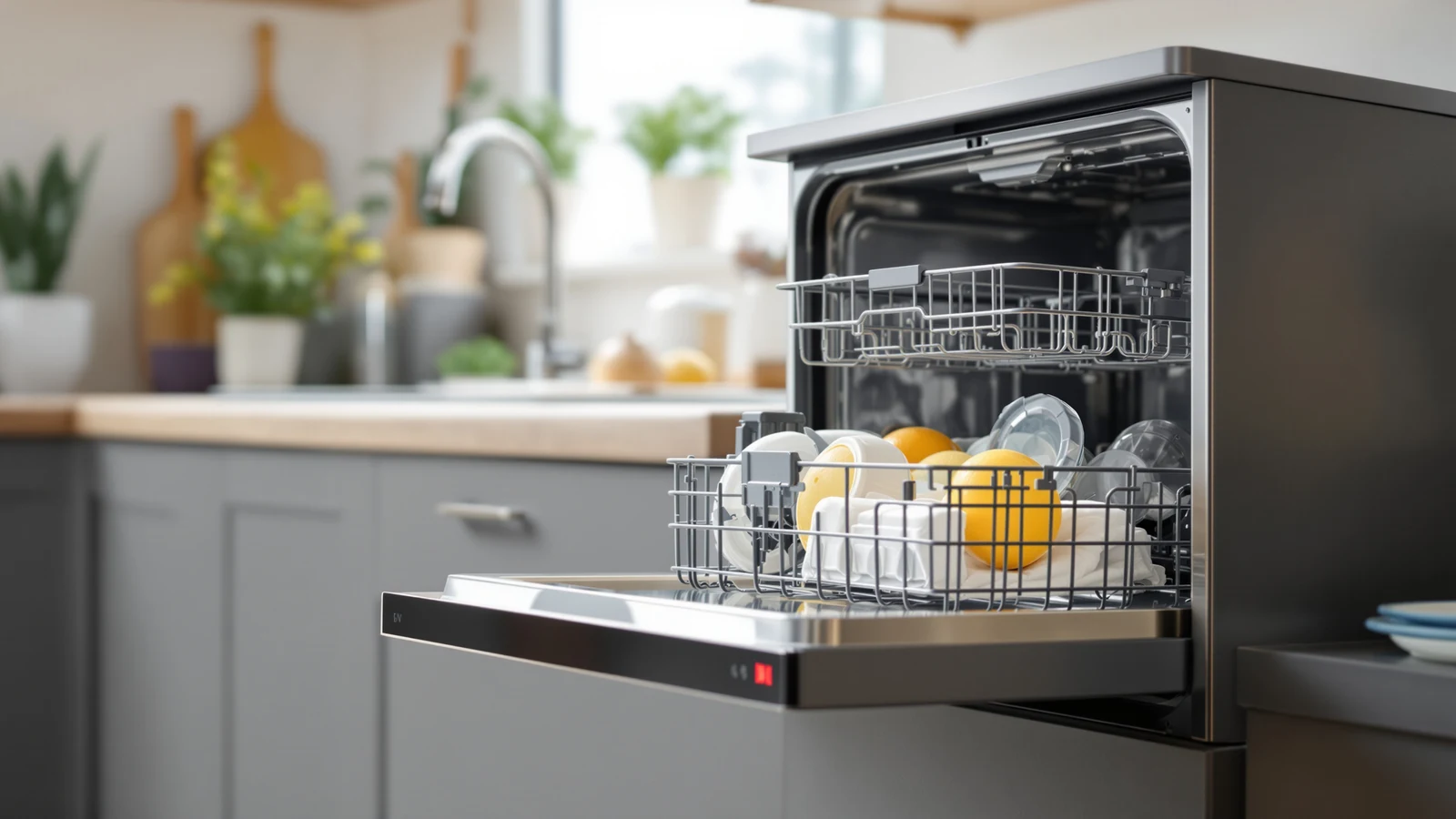
Small tubs dry slowly and hold standing water in three specific places. Find them once, clean them on a schedule, and the smell doesn't come back.
Reader-supported: we may earn a commission when you buy through the links on this page, at no additional cost to you. We compare published specifications and prices; we do not physically test these machines and we do not run a testing lab.
The smell almost always comes from standing water in three places: the base of the filter basket, the door gasket, and — on tank-fed machines — the internal tank itself. None of these drain completely on their own, because a small pump is built to move water out through a hose, not to squeeze a tub bone-dry. A ten-minute wipe-and-rinse routine once a month, plus removing and rinsing the filter after every few cycles, resolves the ordinary case. If the smell shows up mid-cycle along with slow draining or a puddle under the machine, that's usually a pump problem, not a hygiene one — see the last section.
A portable dishwasher is a sealed tub the size of a microwave, and that's exactly why it smells sooner than a full-size built-in. A 24-inch dishwasher drains through a fixed line straight into the home's plumbing and airs out through a vent path in the cabinet. A countertop or tank-fed machine pumps waste water out through a hose looped over the sink edge, dries with residual heat and a fan instead of a heating element, and then sits closed on the counter between uses with whatever moisture is left inside it. Warm, damp, and sealed is exactly the environment that grows odor-causing bacteria and mold, and it's also exactly what a small dishwasher is between Tuesday and Friday if nobody opens the door.
None of this means the machine is broken. It means three specific spots need ten minutes of attention on a schedule, because they don't clean themselves the way the spray arms clean your plates.
Food particles and grease collect in the removable filter at the bottom of the tub. It sits in a shallow well that never fully drains, so anything caught there stays wet between cycles.
The rubber seal around the door traps a thin film of water in its fold every cycle. It's out of the spray path and rarely dries before the next wash.
Machines with a built-in water reservoir hold whatever wasn't used by the last cycle. Left for a week between washes, that water goes stale on its own.
Not one of the "three," but worth naming: the ribbed interior of the drain hose holds a film of dirty water after every pump-out, and it's the first place a smell travels to the room.
The first three are the ones worth memorizing, because they're the ones a normal wash cycle does not clean. The spray arms are aimed at your dishes, not at the well under the filter or the fold in the gasket — those surfaces only get wet, never scrubbed, which is the entire mechanism behind the smell.
Every portable dishwasher has a removable filter basket or disc at the bottom of the tub, underneath the lower spray arm. It catches the food particles that come off your dishes so they don't recirculate through the pump, and it is designed to twist or lift out by hand for cleaning. Most owners never take it out, because nothing in the day-to-day use of the machine requires it — the dishes still come out clean, so the filter looks optional.
It isn't. A filter left in place for weeks accumulates a layer of grease and softened food debris that stays wet in the well beneath it long after the tub itself has air-dried. That layer is the single most common source of a portable dishwasher smell, and it's also the fastest one to fix, because the fix has nothing to do with detergent or cycle settings.
Do this after every three to five cycles for a household that runs the machine daily, or at minimum once a month for lighter use. It takes under two minutes once you know where the release is, which is most of the ten-minute routine below.
A meaningful share of the countertop category runs from a built-in water tank rather than a faucet connection — the whole appeal being that you fill it from a jug and never touch the tap. The best portable dishwashers with a built-in water tank covers which models do this and why it matters for kitchens with no usable faucet. The trade-off that guide doesn't dwell on: a tank is also a reservoir, and reservoirs hold water when the machine isn't running.
If a cycle doesn't use the full five liters, or if the machine sits idle for several days between washes, that leftover water sits in the tank at room temperature the entire time. Unlike the water in a faucet-fed machine's supply line — which drains back toward the tap when the cycle ends — a tank has nowhere for that water to go. Left long enough, it develops the same flat, stale smell as a forgotten glass of water on a nightstand, and on a machine used only occasionally that smell transfers to the tub around it.
None of this is unique to any one brand — it's a property of storing water in a sealed reservoir rather than drawing it fresh from a tap each time, so it applies to any tank-fed model regardless of size.
The three spots above share one property: none of them get worse quickly, and all of them are fixed by the same short routine done on a fixed schedule rather than only when the smell is already noticeable. Put it on a calendar reminder once a month and it stops being a chore you have to remember to do.
Total time across all five steps is genuinely close to ten minutes once the filter's release mechanism is familiar. None of it requires disassembling the machine or removing panels — everything above is accessible from inside the tub or at the visible end of the drain hose.
Standing water is the root cause of the smell, and a machine that dries its tub faster gives bacteria less time to take hold before the next wash. These are the models in our database built around active air-drying rather than a closed door and residual heat alone.
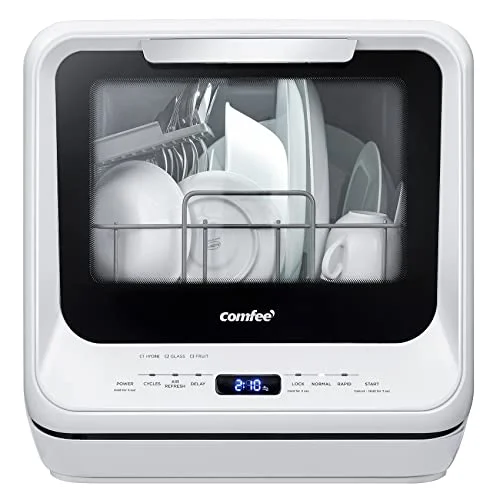
360° dual spray arms and a dedicated air-dry function, built around a 5 L tank with no hookup needed. Its Hygiene cycle runs at up to 192°F, which helps drive off moisture faster than a low-temperature wash.
$289.99 Check price →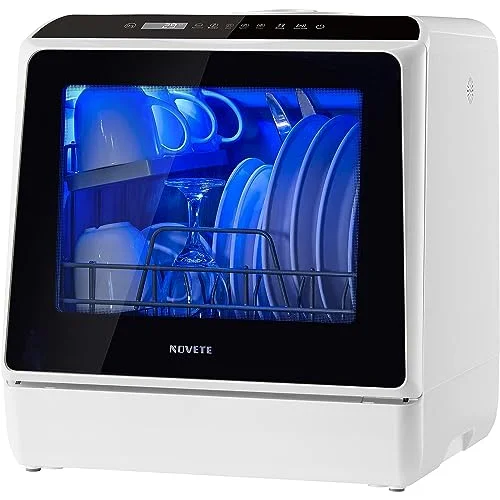
An air-dry function and an LED interior light that makes it easy to see, at a glance, whether the tub is actually dry before you close the door — a small feature that matters more than it sounds for this specific problem.
$289.99 Check price →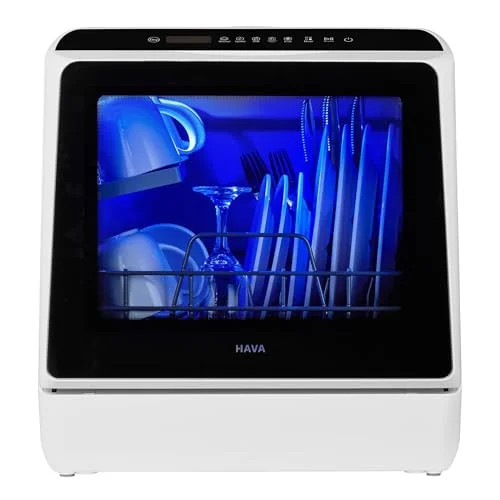
Six programs and a water-tank option for kitchens without a usable faucet, from a brand that also builds a hard-water softener variant — worth a look if limescale is compounding the standing-water problem.
$339.00 Check price →None of these three eliminate the need for the monthly routine above — no countertop dishwasher on the market has a heating element strong enough to flash-dry the tub the way a clothes dryer dries fabric. What an air-dry function and a well-placed vent buy you is a head start: less residual moisture sitting in the tub when the door closes, which means less time for the smell-causing buildup described above to take hold between cycles. Full drying behavior, including why even the best machines here still leave some water on plastics, is covered in why your portable dishwasher leaves dishes wet.
The routine above fixes the ordinary case: a musty, sour smell that builds up gradually between cleanings and clears within a cycle or two of attention to the filter and gasket. There's a different pattern worth knowing, because it isn't a cleaning problem and the fix above won't touch it.
If the smell shows up specifically during or right after a cycle — not as a lingering odor from the closed machine, but as something you notice while it's running or draining — and it comes with any of the following, treat it as a possible pump or drain issue rather than a hygiene one:
A pump that's failing or partially clogged can leave more water in the tub or hose than the design intends, and that extra standing water accelerates exactly the bacterial buildup the routine above is meant to prevent — except now it's happening faster than a monthly clean can keep up with. In that case, check the drain hose for a physical blockage or kink first, since that's the cheapest possible cause and the easiest to rule out. If the hose is clear and the problem continues, that points to the pump itself, and general information from the manufacturer's manual and support line is the right next step — this is mechanical repair territory, not a cleaning routine, and none of it should be treated as licensed appliance-repair instruction.
Every three to five cycles for daily use, or at minimum once a month for lighter use. The filter catches food particles from every wash, and the well it sits in doesn't drain on its own, so debris left there stays wet and is the most common single source of a portable dishwasher smell.
Yes, for most models — running a cup of white vinegar through an empty hot cycle once a month or two helps break down grease film in the tub, hose and pump housing. Check your specific model's manual first, since a small number of manufacturers advise against vinegar in the pump assembly.
Because the spray arms are aimed at your dishes, not at the standing water in the filter well, the door gasket fold, or a tank's reservoir. Those three spots don't get scrubbed by a normal wash cycle, so a machine can clean dishes perfectly well while still developing an odor between uses.
Some odor after several idle days is common if water is left standing in the tank, because a sealed reservoir has nowhere for that water to go. Draining and refreshing the tank before the next wash, and leaving the fill lid and door open between uses, resolves the ordinary case. A persistent or worsening smell alongside slow draining points to a mechanical issue instead.
Condensation drying, no heating element, and the four habits that fix most of it. Read →
Buying guideNo faucet, no problem — the tank models worth buying, and what a five-liter limit costs you. Read →
GuidePods, powder or gel. The dispenser on a small tub behaves nothing like the one in a built-in. Read →
Buying guideLimescale is what kills small dishwashers. The features that delay it, and the one that prevents it. Read →