Best Portable Dishwashers
Honest take · The no-ratings policy

Why you won't see a star rating anywhere in this guide.

Amazon's product data feed stopped returning a rating or a review count for nearly every machine in this category. We could paper over the gap with "owners love this" and nobody would check. Instead, here's exactly what changed, what we compare in its place, and why the four machines below are judged on specs and price alone.

By Ilane Tall · Updated November 7, 2026 · Research-based.

A blank, unlabeled star-rating row above a countertop dishwasher, representing the missing rating data behind this guide

Reader-supported: we may earn a commission when you buy through the links on this page, at no additional cost to you. Prices move constantly — confirm the live price before you order.

Every comparison page on this site carries some version of the same line in small print: no star ratings, no review counts, nothing dressed up as a buyer verdict. It's easy to read that as a cautious brand choice, a bit of legal hedging that any affiliate site might paste in. It isn't. It's a direct, literal description of what the data feed behind this site currently returns, and the honest version of that story is longer than a footer line — long enough that it deserves its own page instead of a repeated aside at the bottom of every roundup.

The short version: the API that supplies every specification and price on this site stopped returning a rating value and a review count for almost everything in the portable and countertop dishwasher category. Below, in order: what actually changed in the feed and why it touches nearly every listing here, why we won't quietly swap in paraphrased review language to fill the gap a number used to occupy, what we compare instead — specs, published cycle details, price and what ships in the box — four machines picked on that basis alone, the small number of older listings elsewhere in our wider catalogue that still carry a rating we captured before the change, and how to read any single listing's own description once you've accepted there's no review signal to lean on.

The one-sentence version

We have no verifiable rating or review count for these four machines, so we don't display one, we don't invent one, and we don't paraphrase sentiment we've never actually read — we compare the things that are still published and checkable: specifications, price and what's in the box.

What changed

A data feed stopped reporting a field, and almost nobody noticed

Every price, ASIN, image and specification on this site is pulled from Amazon's product API — the same programmatic feed every Amazon affiliate site of any size relies on rather than typing numbers in by hand. For years that feed returned, alongside a product's title and price, a rating value and a review count: the star rating and the review-count figure that used to sit under almost every listing we cited. At some point in the recent past, for the overwhelming majority of listings in this category, those two fields stopped coming back. The product still exists, the price still updates, the images still load — the rating and review-count fields simply arrive empty.

We didn't choose this. It's not a policy decision by this site, and it isn't limited to one brand or one price tier — it affects countertop machines and 18-inch freestanding ones, budget listings and premium ones, in roughly equal measure. What it means practically is that for almost every portable dishwasher we could cite, the honest answer to "what's it rated?" is "the feed doesn't tell us," not "four and a half stars." Running a review count anyway — one borrowed from a product page six months ago, or guessed at because a listing "feels" well-reviewed — would mean printing a number we can't currently stand behind. We'd rather print nothing.

This isn't the only place that gap shows up. The same feed's "in stock" signal over-flags listings as unavailable far more often than reality, which is a separate problem, but it's part of the same pattern: a programmatic feed is a convenience, not a guarantee, and the responsible move when it goes quiet on a field is to stop citing that field — not to fill it with something that sounds plausible.

The tempting shortcut

Why we won't write "owners love this" instead

There's an obvious workaround for a missing star rating, and it's the one most listicles quietly take: drop the number, keep the sentiment. Swap a specific star rating and buyer count for a vague gesture at how the crowd supposedly feels about the capacity or the noise level, and the page still reads like somebody checked. Nobody asks to see the review the sentence is supposedly standing in for.

We won't do that, for a plain reason: we have no review data to stand in for. Without the rating and review-count fields, we don't have access to a sample of verified buyer reviews for most of these listings either — and even where a handful of comments are publicly visible on a product page, treating three visible comments as a stand-in for general buyer sentiment invents a consensus that may not exist. A made-up phrase that sounds like it came from real buyers is not a softer version of a fabricated star rating. It's the same offense in different words — a confidence signal we can't actually verify, dressed up to look sourced.

So this guide, and every comparison page linked from it, sticks to claims we can trace to a specific, checkable origin: the manufacturer's own listing copy (labeled as a claim, not a fact, where it can't be independently confirmed), a published dimension or cycle name, a live price, or a general fact about how the appliance category works — the kind of thing true of place settings or cabinet heights regardless of which brand is involved. Where something is a judgment call rather than a spec, we say "the trade-off is" in our own voice, instead of attributing the opinion to a crowd of buyers who never said it.

What we use instead

Specs, published cycle details, price, and what's in the box

Dropping ratings doesn't mean dropping standards — it means being precise about what kind of fact each sentence on this site actually is. Four things remain fully available and checkable for essentially every listing, rating or no rating, and they're what this guide and its sibling pages lean on:

  • Specifications. Place settings, external dimensions, decibel figures, certification marks, water source (tank, faucet, or both) — the numbers a manufacturer publishes and stands behind on the listing itself, even if nobody outside the company has measured them independently.
  • Published cycle details. The named programs a machine actually lists — Normal, Heavy, Eco, Glass, a 90-minute cycle — rather than a vague "multiple wash modes" claim. We compared exactly this kind of detail across stated wash temperatures in how hot a portable dishwasher actually gets, where the useful comparison turned out to be the published number, read skeptically, not a star rating.
  • Price. The one figure in this whole category that's genuinely live and genuinely ours to check, because it updates on the same page we're reading from. We treat it as a snapshot, not a promise — confirm it before you buy.
  • What's in the box. Hoses, adapters, baskets, a rinse-aid reservoir — physical contents a listing either states or doesn't, independent of anyone's opinion about how well the machine performs.

Certification marks earn a special mention, because they're the one piece of this list that isn't just a manufacturer's self-reported claim. A UL or ETL mark means an independent lab tested the machine against a published electrical-safety standard — we go through exactly what that mark does and doesn't cover in UL and ETL certification on a portable dishwasher — and ENERGY STAR status is a program a manufacturer has to qualify for, not an adjective it gets to choose. Neither one tells you whether a machine washes well. Both are a layer of verification a star rating never actually provided anyway, since a rating only ever told you what other buyers felt, not what a lab confirmed.

DishwasherPriceWhat the listing confirmsWhat it doesn't
EUHOMY 6-Program Countertop$269.9940 dB claim, 6 programs, 5 L tank or faucet, Large size optionNo independent noise test; "Large" variant pricing may differ from other sizes on the same listing
Midea 6-Place Countertop$279.996 place settings claimed, ENERGY STAR certifiedNo stated external dimensions, no named cycle list, no size variant
Hamilton Beach SS/Platinum$582.40Stainless/platinum finish, current priceNo place-setting figure, water source or certification given
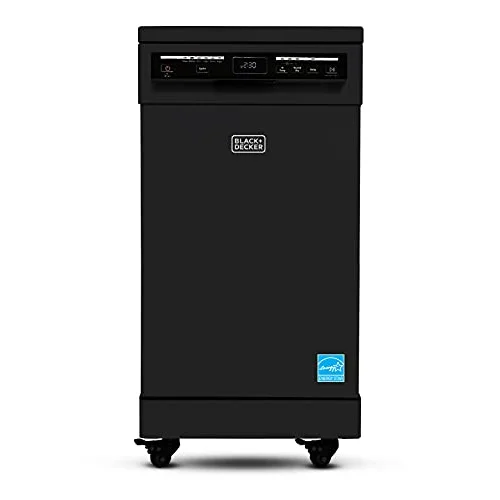
BLACK+DECKER BPD8B 18″$609.998 place settings, ENERGY STAR, 18 in wide, freestanding on castorsNo independent durability data — the full spec sheet still can't say how it ages
The picks

Four machines, judged on specs and price alone

Ordered by price. Every claim below traces to a stated spec, a published listing detail or a live price — nothing here is a paraphrase of a rating we don't have.

01Lowest price, thinnest noise claim

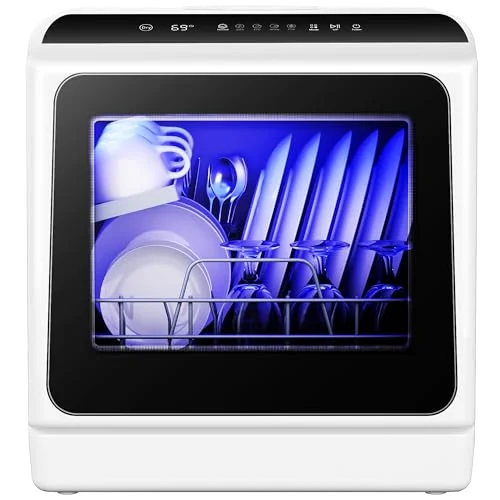
EUHOMY 6 Programs Countertop Dishwasher, 40 dB, 360° Coverage

For anyone who wants the quietest claim in the lineup and is willing to read it as a claim
Countertop · 5 L tank or faucet · 6 programs · 40 dB claimed · Large size option

This listing's own title leads with two numbers — a 40 dB noise figure and a six-program cycle count — and both are manufacturer claims rather than anything we, or any reviewer whose words we'd otherwise be borrowing, measured independently. We can tell you the figure as published and that the price above applies to the Large size option currently listed. What we can't tell you is whether a given buyer in a given kitchen found it quiet, because there's no review count behind this ASIN for us to draw on, and we're not going to invent one by paraphrasing feedback nobody has shown us.

The trade-offTreat 40 dB as a figure measured under conditions the listing doesn't disclose, not a promise. If the listing offers more than one size, confirm "Large" is still the configuration priced here before you order — sellers do change which variant a listing defaults to.

EUHOMY countertop dishwasher, Large size option
$270
40 dB claimedCheck price →
02Confirmed certification

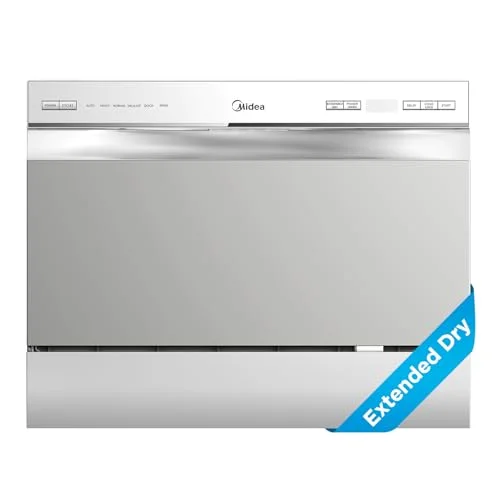
Midea Countertop Dishwasher, 6 Place Settings, Energy Star

For buyers who want one verifiable certification and won't pretend to know more than the listing says
Countertop · 6 place settings claimed · ENERGY STAR certified

Six place settings and an ENERGY STAR certification are the two facts this product's own title commits to, and they're also the two facts we're willing to compare it on. The certification is worth something specific here: unlike a star rating, ENERGY STAR status isn't a crowd's opinion, it's a qualification standard a manufacturer has to actually meet, which is a different and more durable kind of verification than anything a review count was ever giving you.

The trade-offBeyond the place-setting count and the certification, this listing gives us little else to compare against the rest of this category — no stated external dimensions, no named cycle list, no size variant called out. That's not unusual in this category, but it means the responsible comparison stops at price and those two confirmed specs. Check the current listing yourself for dimensions before assuming it matches the larger six-place machines covered elsewhere on this site.

Midea countertop dishwasher, 6 place settings, Energy Star
$280
6 place settingsCheck price →
03The thinnest spec sheet here

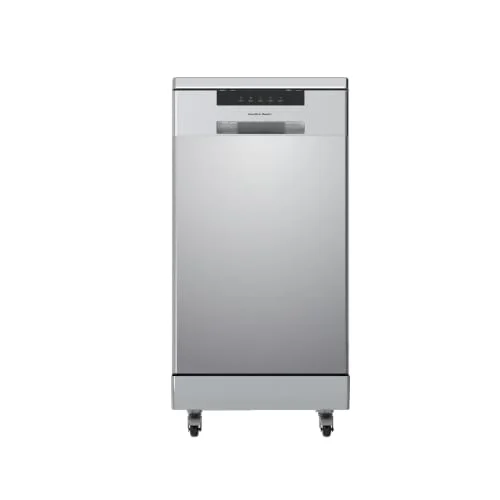
Hamilton Beach Portable Dishwasher, SS/Platinum

A case study in how little a listing sometimes gives you to go on
Stainless/Platinum finish · price confirmed in database, 2026-11

The listing data behind this one is the thinnest in this guide: a brand, a finish, a price. We don't have a stated place-setting figure for it, a certification, or a declared water source — and we're not going to borrow those details from the other Hamilton Beach portable dishwashers covered in our lineup comparison. Those are different models with different ASINs and different published specs; lending this one their numbers would be exactly the kind of invention this page exists to rule out, just dressed up as helpfulness instead of a star rating.

The trade-offAt $582.40 this sits at 18-inch-class pricing without a confirmed place-setting count to justify that comparison. If capacity matters to your decision, it's on the current Amazon listing, not on this page — read it yourself before paying full-size-class money for an unconfirmed capacity.

Hamilton Beach portable dishwasher in stainless steel and platinum
$582
SS/PlatinumCheck price →
04Fullest spec sheet, same gap

BLACK+DECKER 18-Inch Portable Dishwasher, BPD8B

Proof that a complete spec sheet doesn't close the gap a rating used to fill
Freestanding on castors · 18 in wide · 8 place settings · ENERGY STAR

Of the four machines in this guide, this one has by far the fullest public spec sheet — eight place settings, an 18-inch width, and an ENERGY STAR certification, all independently stated on the listing. It's worth including here precisely because it shows the limits of what specs alone were ever going to answer. A full spec sheet tells you what the machine is built to do on day one. It was never going to tell you how the pump sounds after two hundred cycles, which is exactly the kind of long-run fact a star rating, if we had one, still wouldn't answer reliably either — reviews skew toward the first few weeks of ownership, not the fifth year.

The trade-offFull spec sheet or not, we can tell you what's in the box and what it's rated to do; nobody without one running in their kitchen for a year can tell you how it ages, with or without a star rating attached.

BLACK+DECKER 18-inch portable dishwasher, Energy Star certified
$610
8 place settingsCheck price →
The exception, explained

The handful of older listings that still carry a rating

If you browse beyond this specific page into our wider product catalogue, you may run into a small number of listings — a handful, not a trend — that still show a star rating and a review count. Those weren't fabricated after the fact and they aren't an inconsistency in our policy. They're legacy data: a rating the API genuinely returned for that exact ASIN at some point before the field went quiet, which we recorded, dated, and have kept attached to that specific listing because we can show where it came from.

None of the four machines in this guide fall into that category. Every one of them comes back from the current feed with the rating field empty, which is the entire reason none of them is shown with a number here. We don't backfill an old figure onto a current listing just because the product looks similar to one that has one, and we don't borrow a rating from a different ASIN under the same brand — even a close relative, like the other Hamilton Beach models in our lineup comparison or the seven EUHOMY listings covered in EUHOMY's portable dishwasher lineup. If a rating isn't returned for the exact ASIN a buy button points to, it doesn't appear next to that model's name. No exceptions, no "close enough."

What you can still do

How to read a listing's own description once the rating is gone

Losing a star rating doesn't leave you with nothing — it leaves you with the listing's own words, which were always worth reading skeptically anyway. A few habits do most of the work:

  • Separate counted facts from adjectives. A listing that says "30+ dishes" is making a vaguer claim than one that itemizes four bowls, four cups, four small plates, four dinner plates and seven place settings of cutlery — the same distinction that matters when comparing published wash temperatures, where one listing's precise 162°F reads very differently from another's unqualified "sanitizing heat" in our comparison of stated wash temperatures.
  • Trust the certification mark over the marketing copy around it. "Hospital-grade clean" is a phrase; a UL or ETL mark is a standard an independent lab actually tested against. We walk through what that mark covers, and what it doesn't, in UL and ETL certification on a portable dishwasher.
  • Check whether the same brand reuses boilerplate across listings. When one manufacturer sells several near-identical machines under different model numbers — as both EUHOMY and Hamilton Beach do, covered respectively in EUHOMY's lineup and Hamilton Beach's lineup — identical phrasing across listings is a sign you're reading copy, not a description specific to that unit.
  • Read what ships in the box as literally as the drain hose question. A hose with no stated reach, or no mention of a hose at all, is the kind of gap that causes real returns; we go through exactly how far that hose needs to go in where a portable dishwasher's drain hose actually goes.
  • Assume manufacturer figures are optimistic, not false. Capacity and decibel numbers are produced by the company selling the machine, under conditions it chose and doesn't have to disclose. Treating them as claims rather than measurements — the same posture this whole site takes — gets you closer to what you'll actually experience than treating them as fact, or discarding them because there's no star rating to corroborate them.

None of this replaces a review count. It's slower, and it asks more of the reader than scanning a star icon ever did. It's also the only version of "trust the listing" that doesn't require trusting a number nobody can currently verify.

How we picked

Four machines, one constraint

We didn't choose these four because they're the best-reviewed — we have no review data to make that claim. We chose a spread across this guide's price range, from the cheapest listing with a specific, checkable claim (EUHOMY's 40 dB figure) to the one with the fullest public spec sheet (BLACK+DECKER's BPD8B), with one deliberately thin listing (Hamilton Beach) included to show what a bare-minimum spec sheet looks like next to a fuller one.

How we compared

Research, not a lab, and no invented stars

We're honest about this: we don't physically test these machines and we don't run a testing lab. We compare published specifications, what ships in the box, water source, capacity, dimensions, certification and live pricing. We show no star ratings because the data feed behind this site returns none we can verify for this category, and we never substitute a paraphrase of review sentiment for the number we don't have.

FAQ

Common questions about the no-ratings policy

Why doesn't this site show star ratings for portable dishwashers?

The product API this site pulls specifications and prices from stopped returning a rating value and a review count for almost every listing in this category. We have no way to verify a figure for most of these machines, so rather than guess, copy a stale number, or paraphrase review sentiment we've never actually read, we don't display a rating at all. We compare specs, published cycle details, price and what's in the box instead.

Does Amazon still show a star rating on the product page itself?

Often, yes. The gap is specifically in the programmatic data feed that independent sites like this one pull from, not necessarily on Amazon's own retail page for that product. If a rating matters to your decision, check the live Amazon listing directly before you buy — we simply can't verify or reproduce that figure here, and we'd rather say so than guess at it.

If a listing has no visible rating here, does that mean the product is bad?

No. A missing rating on this site reflects a gap in the data feed, not a judgment about the product. All four machines in this guide are missing a rating for the same reason — the feed doesn't return one for their ASINs — regardless of price, brand or how complete their other specifications are.

How do you decide what to recommend if you can't cite a rating?

We compare what's still fully verifiable: published place settings, dimensions, certification marks like UL, ETL and ENERGY STAR, named wash cycles, water source, what ships in the box, and live price. Where a listing simply doesn't state something — a dimension, a cycle list, a certification — we say so rather than filling the gap with a guess.

Keep reading

Next, from this site