Best Portable Dishwashers
Guide · Wash Temperatures

162°F, 167°F, 192°F. What is that number actually measuring?

Three listings in this category, three different hot-cycle numbers, and none of the listings explain what the figure is or how it was measured. Here's what a published wash temperature on a portable dishwasher is describing, why a bigger number isn't automatically a cleaner wash, and where high heat actually becomes a problem rather than a selling point.

By Ilane Tall · Updated November 5, 2026 · Research-based.

Close-up of a portable dishwasher's digital control panel showing a high-temperature wash cycle selected

Reader-supported: we may earn a commission when you buy through the links on this page, at no additional cost to you. Prices move constantly — confirm the live price before you order.

Scroll through portable dishwasher listings and a temperature figure shows up in an unusual number of titles — not a cycle name, not a place-setting count, a specific number of degrees. One machine in our database claims 192℉. Another claims 167°F. A third, from the same brand as the first, claims 162℉. Nothing on any of the three listings says what, exactly, hits that temperature, for how long, or who measured it. The number just sits in the title, doing the job titles do: making the listing sound more capable than the one next to it.

That's worth unpacking properly, because the honest answer is more useful than the marketing number. A wash temperature on a small countertop machine is a real, physically meaningful figure — water really does get that hot inside the tub — but it describes a narrow moment in the cycle, not the whole wash, and it isn't automatically the setting you want to use on every load. This guide covers what the number is measuring, why hotter doesn't mean cleaner past a certain point, where high heat turns from an asset into a hazard for plastic and baby items, and why the standard mid-100s range most machines run by default is already doing the job for the vast majority of loads.

How this page is built

We compare published listing specifications, titles and price. We do not physically test these machines, we do not run a testing lab, and we do not publish ratings we cannot verify — Amazon returns no rating and no review count for this category, so there are no stars on this site. Temperature figures below are the manufacturers' own published claims, not independently measured readings, and we say so again at the point where it matters most.
The claim

What the Published Temperature Actually Describes in the Cycle

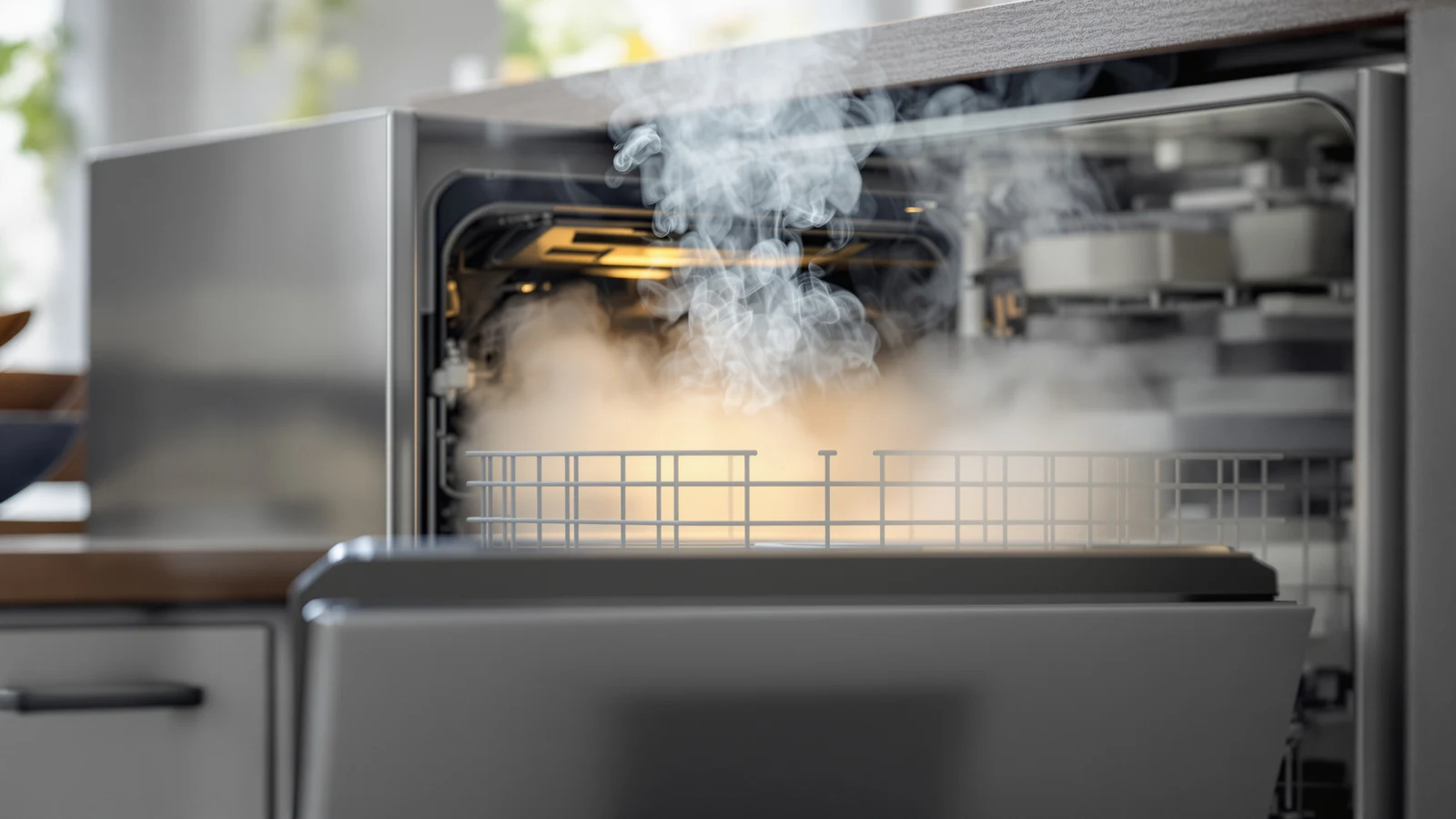
A portable dishwasher's heater is a small resistive element inside the tub or the water line, and it has one job across a cycle: bring the wash water up toward a target temperature before and during the main spray phase, then hold roughly there for as long as that phase runs. The number printed on a listing — 192℉, 167°F, 162℉ — is the ceiling the heater is built to reach during that phase on its hottest programmed cycle, not a temperature the whole machine sits at from the moment you press start.

Fill water, rinse water and the drying air afterward all run cooler. A cold-fill tank model has to heat several liters from room temperature before the main wash even begins, which is part of why a "High-Temp" cycle on a small tank machine commonly takes longer than the quick or eco program on the same unit — the extra minutes are mostly the heater working, not extra scrubbing. None of the three listings in this comparison states a heat-up duration, so treat the published figure as the peak the main wash phase is designed to hit, confirmed on the listing itself, rather than a number that applies to the whole 30-to-90-minute run.

It's also worth separating the heater from the detergent delivery. Machines that dispense detergent automatically, rather than relying on a drawer you fill by hand, time that release against the wash phase so the chemical hits the water once it's already warming — our look at automatic detergent dispensing on a portable dishwasher covers how that timing works and what it does and doesn't replace. The heater and the detergent are two separate systems doing coordinated jobs; a high published temperature says nothing about how well the second one is timed.

The myth

Why a Hotter Wash Isn't Automatically a Cleaner One

Heat does real cleaning work, up to a point. Hot water carries more kinetic energy, dissolves grease and fat faster, and helps detergent surfactants break the bond between food residue and a plate's surface — which is exactly why a dedicated high-heat cycle exists on these machines and why it's usually marketed for the greasiest loads. None of that is in dispute. What doesn't follow is that the hottest available cycle is the best choice for every load, or that a machine claiming 192℉ cleans better in practice than one claiming 162℉.

Two things cap the benefit. First, most dishwasher detergents — the pods, powders and gels sold for these machines — rely partly on enzymes to break down starches and proteins, and enzymes have a working range: push water too far past it and the enzymes denature and stop doing their job before the heat alone finishes the work. Second, heat that's genuinely useful for grease can be actively counterproductive on protein residue like egg or dairy, which can set and bond more firmly to a surface in very hot water rather than lifting away — a reason a quick rinse in cooler water before loading is still commonly recommended for egg-coated dishes, regardless of what temperature the main cycle later reaches.

This is also where automatic soil-sensing matters more than a fixed maximum. A handful of listings in this category can read how dirty a load is and choose cycle length and intensity accordingly, rather than making the shopper guess — our guide to soil-sensing wash cycles explains what that sensor is actually detecting. A machine that automatically reserves its hottest, longest program for genuinely dirty loads and runs a shorter, cooler one for lightly soiled dishes is doing something a flat "192℉ High-Temp" badge on a box can't tell you: matching heat to the job, rather than selling heat as the job.

Put simply: the published peak temperature is one input into how well a dishwasher cleans, not a scoreboard. A 162℉ machine running the right cycle for a greasy pan will outperform a 192℉ machine run on the wrong one.

The picks

The Picks, Hottest Claimed Temperature First

01Hottest claimed

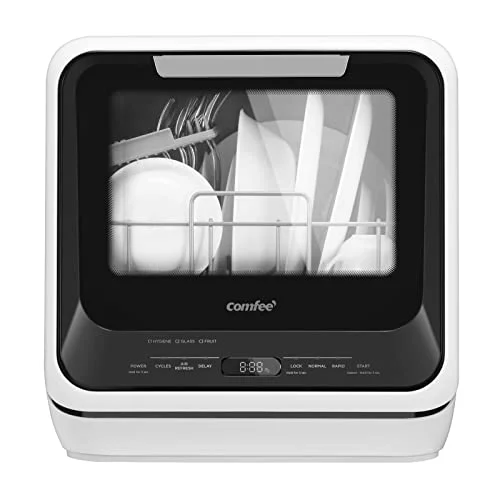
COMFEE' Portable Dishwasher Countertop, Minilite

The highest published figure in this comparison, built into a tank machine small enough for an RV
5 L built-in tank · no hookup needed · 6 programs · 360° dual spray · 192℉ High-Temp & Air-Dry

This is the listing that sets the ceiling for this whole comparison: a 192℉ High-Temp program on a machine built around its own 5-liter tank, so it runs on a power socket alone with no faucet connection. Six programs and dual spray arms above and below the rack are the other headline specs, and the listing pairs the High-Temp claim with an Air-Dry function, which matters for a sealed tub that has no heating element dedicated to drying once the wash itself is done.

The trade-offThe listing states the 192℉ figure without saying how it was measured or for how long the water holds there, and like every number in this guide it's a manufacturer claim rather than an independently measured reading — see the section on that below before assuming it translates directly into a cleaner wash.

COMFEE' Minilite portable dishwasher with built-in water tank
$289.99
192℉ claimedCheck price →
02Middle of the range

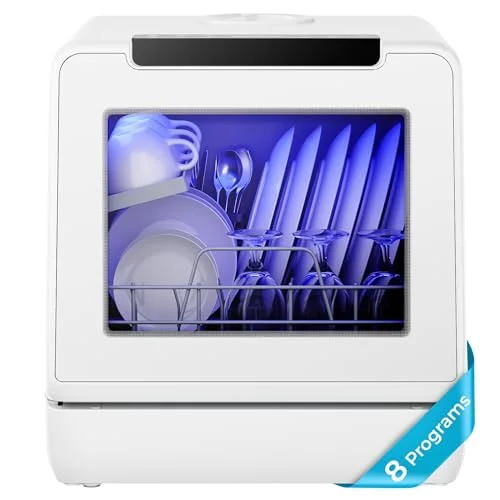
EUHOMY 8-Program Countertop Dishwasher

The widest program spread in this comparison, with a 167°F figure attached to one of its eight cycles
5 L tank · no hookup needed · 8 programs · 167°F claimed · 40 dB rated

EUHOMY sells a large number of near-identical listings in this category — enough that we gave the brand's whole lineup its own breakdown in EUHOMY's portable dishwasher lineup explained — and this one sits in the middle of the heat claims here at 167°F, with eight programs to choose between and a 5-liter tank for no-hookup use. A rated 40 dB noise figure is the other headline spec, though like the temperature claim it's a manufacturer figure rather than an independently audited one.

The trade-offEight programs is more choice than most shoppers will use regularly, and the listing doesn't say which specific program reaches 167°F or whether that's the peak for every cycle or just one of them — a gap worth checking against the manual before assuming every setting runs that hot.

EUHOMY 8-program countertop dishwasher with 5-liter tank
$265.94
167°F claimedCheck price →
03Lowest claimed, still hot

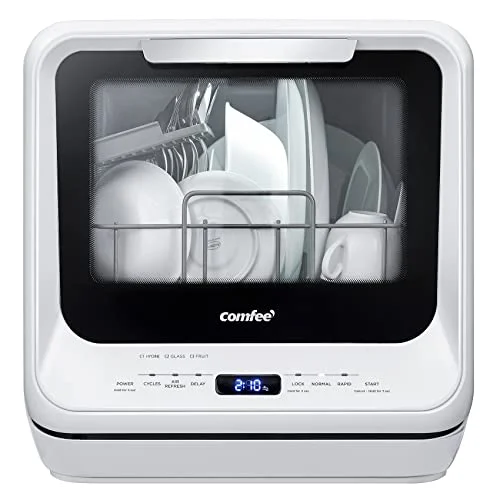
COMFEE' Portable Mini Dishwasher, Minilite

The lowest published figure here, and still well above a kettle's comfortable touch temperature
1.32 Gal built-in tank · no hookup needed · 6 programs · 360° dual spray · 162℉ High-Temp & Air-Dry

The lowest number in this comparison is still 162℉ — hot enough that nobody should be reaching into the tub mid-cycle. This is COMFEE's other Minilite-class machine, built around a 1.32-gallon tank rather than the 5-liter figure quoted on its sibling, with the same six-program spread, dual spray arms and Air-Dry function, and no faucet hookup required either way.

The trade-offIt's priced above both the 192℉ and 167°F machines in this comparison despite claiming the lowest peak temperature of the three, which is a reminder that the degree figure in a listing title isn't correlated with price — check the full spec sheet rather than assuming the hottest number is also the most expensive machine.

COMFEE' portable mini dishwasher with built-in water tank
$229.99
162℉ claimedCheck price →
The limit

Plastic, Baby Bottles and the Upper Limit of Safe Heat

A 192℉ cycle is close to the boiling point of water at sea level, and that matters the moment plastic goes into the load. Rigid dishwasher-safe plastics — the polypropylene used in most baby bottles, measuring cups and food-storage containers — are commonly rated to handle short exposure well above 200°F without deforming, which is why "dishwasher safe, top rack" labeling exists on so many of them in the first place. But that rating is a ceiling for brief exposure, not a guarantee across every cycle the plastic will ever see, and it assumes placement away from the heating element itself, which is why "top rack only" is printed on so many bottle and lid labels: the bottom rack sits closer to where the heat is generated and circulates hottest.

Softer components are the real risk at the top of this range. Silicone nipples, bottle seals and the softer seals on some BPA-free containers are frequently rated lower than the rigid plastic body they attach to, and repeated runs at a machine's hottest claimed cycle can shorten their working life faster than the bottle itself wears out — which is one reason many parents run a dedicated short cycle for just bottles and nipples rather than folding them into a full, hot load of pots and pans. That's exactly the kind of small, specific wash our guide to half-load and small-batch cycles covers — running a short program for a handful of items instead of waiting to fill the whole tub, which for baby items also means less time sitting warm and damp between the wash and the next feeding.

The practical rule that follows from all of this: a machine's single highest published temperature is a ceiling to be aware of, not a setting to default to for a mixed load. Reserve the hottest program for genuinely greasy cookware without delicate plastic in the same cycle, and use a cooler or dedicated program — where the machine offers one — for bottles, lids and anything with silicone attached.

The honest caveat

Why These Are Manufacturer Claims, Not Independently Measured Figures

None of the three temperature figures in this comparison — 192℉, 167°F, 162℉ — comes with a published test method. No listing states where in the tub the reading was taken, how long the water held at that figure, how full the machine was when it was measured, or whether the number applies at the tap end of a faucet-fed cycle versus a tank that's already heated from a cold fill. That's not unusual for this category; it's the same situation as a decibel rating or a capacity claim, both of which this site treats the same way: as a manufacturer figure worth citing, not a verified measurement worth treating as fact.

The useful comparison here is to the marks that are independently tested. A UL or ETL listing on an appliance means a third-party lab actually evaluated the product against a published electrical-safety standard and the manufacturer doesn't get to self-certify it — our explainer on UL and ETL certification covers what that process actually checks and why it's a meaningfully different kind of claim from a number printed in a product title. A "192℉ High-Temp" badge has no equivalent third-party step behind it. It's the manufacturer's own description of what the heater is designed to do, reported the way every spec in this category is reported, and worth reading the same way: as a stated design target, not a lab-verified result.

None of that means the figures are false. It means they should be read the way every other spec on this site is read — as what the manufacturer says, not what an independent party measured — and that a one-degree or ten-degree gap between two listings' claimed peaks is not a meaningful way to pick between them on its own.

The other 95% of loads

When the Standard 140–150°F Range Is Already Plenty

Most of these machines' everyday cycles — Normal, Eco, Glass, the default program rather than the badge on the box — run well below the headline high-heat figure, typically somewhere in the 140 to 150°F range. That's not a compromise setting; it's broadly the range most home dishwasher cycles have been built around for decades, long before "High-Temp" became a marketing line, because it's hot enough to dissolve grease, activate detergent and dry quickly without pushing every load to the machine's absolute ceiling.

For the dishes most people actually run day to day — plates, glasses, everyday cutlery, lightly soiled bowls — that mid-100s range does the job completely. The case for reaching for the hottest claimed cycle is narrow: a genuinely greasy roasting pan, a load that sat uncleaned for a day or two, or cookware with baked-on residue a normal cycle visibly fails to shift. Running the highest setting as a default, on the assumption that hotter always means cleaner, mostly adds cycle time and energy use without a matching improvement on lightly soiled dishes — and, as covered above, it's the setting most likely to stress any plastic that ends up in the load by mistake.

The practical takeaway across this whole guide: the degree figure in a listing title is worth knowing, not worth shopping on. A machine's Normal or Eco cycle, run at a sensible mid-100s temperature, is doing the actual daily work; the High-Temp badge is a tool for the occasional greasy load, not a reason to rank one machine above another.

At a glance

The Three Listings in This Comparison

All figures are manufacturer listing specifications; prices are approximate and move frequently.

DishwasherClaimed hot-cycle tempWater sourceProgramsPrice
COMFEE' Minilite192℉5 L tank, no hookup6$289.99Price
EUHOMY 8-Program167°F5 L tank, no hookup8$265.94Price
COMFEE' Minilite (1.32 Gal)162℉1.32 Gal tank, no hookup6$229.99Price
FAQ

Common Questions About Portable Dishwasher Wash Temperatures

What does the published temperature on a portable dishwasher listing actually measure?

It's the peak the heater is designed to reach during the main wash phase of the machine's hottest programmed cycle — not a temperature the whole machine holds for the entire run. Fill water, rinse water and the drying air afterward all run cooler, and none of these listings states how long the water holds at the published figure.

Is a hotter wash cycle always better at cleaning dishes?

No. Heat helps dissolve grease and activate detergent up to a point, but dishwasher detergent often relies on enzymes that have a working temperature range, and very hot water can set protein residue like egg onto a surface rather than lifting it off. A machine's Normal or Eco cycle in the 140–150°F range handles most everyday loads; the highest claimed temperature is a tool for occasional greasy cookware, not a default setting.

Can I run baby bottles or plastic containers through a high-temperature cycle?

Rigid dishwasher-safe plastics are commonly rated for brief exposure well above 200°F, but softer components like silicone nipples and bottle seals are often rated lower and wear out faster under repeated high-heat cycles. Many parents run a short, dedicated cycle for bottles rather than including them in a full load set to a machine's hottest program.

Are these published wash temperatures independently verified?

No. Like decibel and capacity figures in this category, the temperature claims come from the manufacturer's own listing, with no stated test method, measurement point or hold time. They're worth knowing as a stated design target, not treating as a lab-verified result — the same way we treat every unaudited spec on this site.

Keep reading

Next, from this site