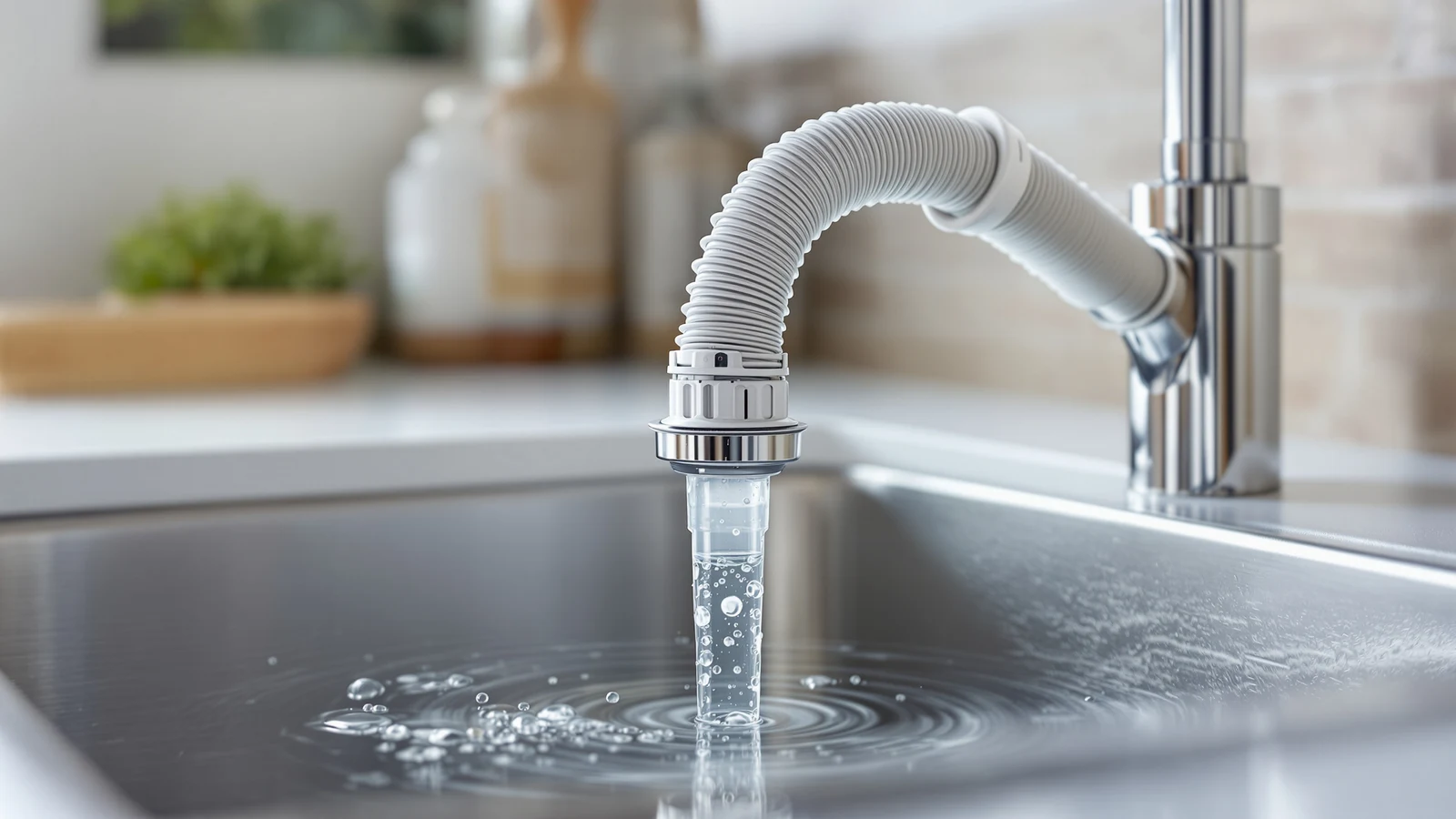
A kinked or badly routed drain hose doesn't usually announce itself as a kink — it shows up as one of a handful of familiar symptoms, and it helps to know which symptom points back to the hose rather than to the machine itself.
A full or partially full tub at the end of the cycle
This is the most direct sign of a drain problem. If the pump is running — you can usually hear it working at the point in the cycle where draining is supposed to happen — but water remains in the tub afterward, the hose is either kinked somewhere along its run, trapped under the machine's own weight where it exits the back panel, or looped in a way that creates a low point where water collects and blocks the rest of the hose from clearing.
Water running back into the tub between cycles
Covered above under hook height: if the hook-over point at the sink sits below the water level the pump pushes to, or if the hose dips after the hook point rather than staying elevated, gravity pulls wastewater back down into the tub once the pump stops pushing. This looks identical to a drain failure from the user's side, even though the pump did its job correctly the first time.
A longer-than-usual cycle, or one that seems to pause
Some machines sense when draining is taking longer than expected and extend the cycle or re-attempt the pump-out rather than simply failing silently. A consistently longer cycle time, especially on a machine that used to finish faster, is worth tracing back to the drain hose before assuming the pump itself is failing.
Water on the floor or under the machine
The most disruptive failure mode: if the hose has slipped off its hook entirely, or a kink has forced enough back-pressure that water finds a weak seam instead of continuing through the hose, wastewater ends up somewhere other than the sink or bucket. This is the scenario the hook-over instructions exist specifically to prevent, and it's the reason manufacturers are conservative about recommending any change to the stock hose length or routing.
The fix for all four symptoms is largely the same: unhook the drain hose, run your hand along its full length to find any pinch point, straighten it, and re-route it so there is no section of hose sitting higher than the hook-over point at its final destination. Avoid tight turns where the hose exits the machine cabinet — the point right at the back panel is a common place for an unnoticed kink to form against a wall or cabinet.