Best Portable Dishwashers
Honest take · Automatic detergent dispensing

One listing says automatic. Here's what that means.

A single machine in our database skips the detergent compartment you fill before every cycle for a reservoir the listing says doses itself. The bullet copy even borrows the wording from laundry appliances. We pulled apart what that promises mechanically, what it doesn't, and measured it against the two machines nearby in price that still use the ordinary system.

By Ilane Tall · Updated October 30, 2026 · Research-based.

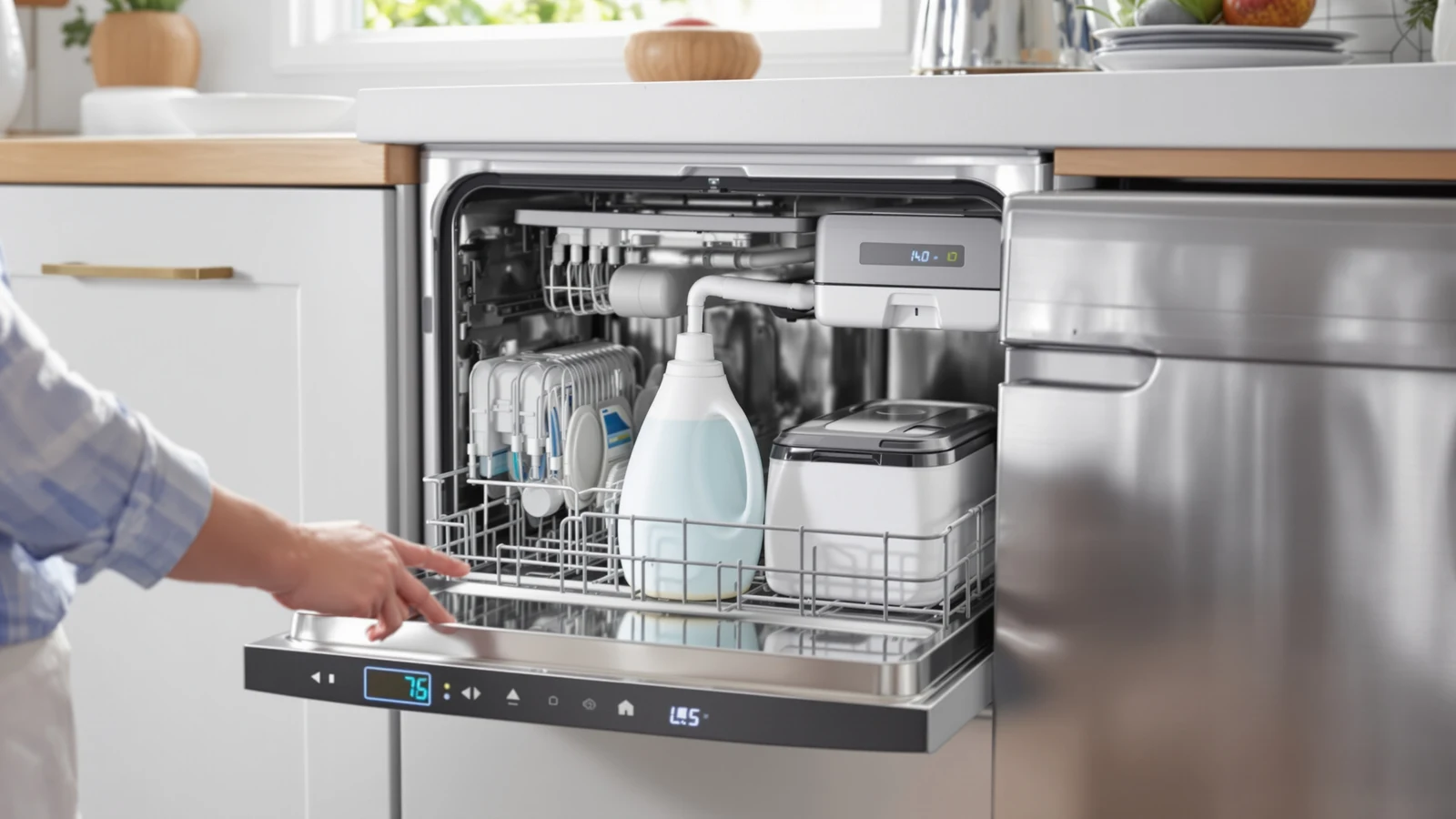
Open detergent reservoir compartment on a portable countertop dishwasher beside a single-use dish detergent pod on the counter

Reader-supported: we may earn a commission when you buy through the links on this page, at no additional cost to you. Prices move constantly — confirm the live price before you order.

Among the countertop dishwashers in our database, exactly one listing advertises something the others don't: a detergent system the manufacturer calls automatic. The bullet copy reads "Laundry detergent automatic dispensing function" — a phrase that, on its face, describes a washing machine rather than a dishwasher, and that odd wording is itself worth sitting with before taking the rest of the listing at face value. This piece is about untangling what that one feature actually does, mechanically, on the $369.99 machine that claims it, and setting it beside two cheaper countertop machines that make no such claim and rely on the drawer-and-compartment system almost every dishwasher, portable or built-in, has used for decades.

We don't own a testing lab, so this is a close read rather than a trial run: what "automatic dispensing" can and can't mean given how a reservoir-and-pump system is built, matched against the plain facts of price, water source and program count for all three machines, and a frank answer to the question most buyers actually have — does any of this save enough time to matter, or is it a convenience priced at a premium out of habit. For the fine print the listing leaves out, skip ahead to what the manufacturer claim doesn't tell you.

How this page is built

We compare what each listing's own title and bullet copy publish, against general, verifiable facts about how reservoir-dosing systems and dishwasher detergent compartments work mechanically. We do not physically test these machines and we do not run a testing lab. Amazon's product data returns no rating and no review count for any of the three ASINs below, so there are no stars on this page, and we don't paraphrase review sentiment we have no record of — that would be the same offense as inventing a score.

The mechanism

What "automatic dispensing" means on this listing, mechanically

Start with what doesn't change. On an ordinary dishwasher — a full-size built-in or a $220 countertop tank model alike — the detergent dispenser is a small, spring-loaded compartment on the door or the lid. You load a pod, a capful of gel, or a scoop of powder before the cycle starts, and a timer or a wax-motor latch pops the flap open at a programmed point partway through the wash, dropping that one dose into the water already circulating. That release is "automatic" in the sense that you don't open the door mid-cycle to add anything — every machine in this category has always worked that way, headline feature or not.

The listing that uses the phrase "Laundry detergent automatic dispensing function" — the 6.4L-tank, 5-place-setting, 8-program model with a water softener and an auto-opening door — is describing something different: a small reservoir, separate from the water tank, holding enough detergent for more than one wash. Rather than a flap releasing whatever you loaded that same cycle, a reservoir like this meters out a measured amount from its own stored supply at the start of each run, the same way an auto-dispense laundry machine doses from a jug topped up every few weeks rather than measured into a cup every load. The practical difference: you stop adding detergent before each cycle and instead refill a larger reservoir on a longer interval.

What the listing doesn't say is just as telling. It doesn't state the reservoir's own capacity — the 6.4L figure belongs to the water tank, not the detergent chamber — so there's no way to calculate how many cycles one refill actually covers. It also sits alongside two other automated claims on the same SKU, an auto-opening door and an integrated water softener: a machine built around removing manual steps generally, not one standout feature, priced accordingly against the two plainer machines below. It's the same instinct behind a listing that advertises a sensor doing the thinking for you, which we worked through in our look at automatic soil-sensing cycles — a feature name that promises more autonomy than the spec sheet confirms.

Compatibility

Pods, powder and gel: which ones still work with it

The listing doesn't specify which detergent form the reservoir is designed around, so nothing here should be read as a confirmed spec — but the mechanics of a pumped reservoir narrow the possibilities. Dosing a measured amount into the wash at the start of a cycle means moving detergent through a small channel or valve, the same basic plumbing an auto-dispense laundry machine uses for liquid detergent. That kind of system can meter a liquid or gel in small, repeatable amounts. It cannot meter a fraction of a sealed pod, built to drop whole into a compartment, not pumped in partial doses. Loose powder fits worse still: left sitting for days or weeks between refills, especially in the damp interior of a countertop appliance, it can clump rather than flow through a narrow channel.

None of that is stated by the manufacturer, and it's worth confirming in the listing's own Q&A or with customer service before ordering, especially if you already own a case of pods. The reverse case is clearer: neither other machine here claims an automatic dispensing feature, so both almost certainly use the conventional compartment-and-flap system most portable dishwashers rely on — genuinely pod-, powder- and gel-agnostic, because you choose what goes in fresh at the start of every cycle, exactly like a full-size built-in.

One general caution applies to every machine in this category regardless of dispensing method: pods often fail to dissolve fully in the short, low-volume cycles these compact dishwashers run, which is why several manufacturers specify powder or gel at a smaller dose instead. That's a fact about cycle length and water volume, not about any one listing's dispensing claim — but it matters more, not less, once detergent is being metered automatically rather than chosen fresh each time, because a reservoir system that's pre-loaded with the wrong form of detergent will keep making the same mistake on every cycle until someone empties and refills it.

The three listings

The picks, and what the standard alternative looks like

All figures are manufacturer specifications stated in each listing's own title; prices are approximate and move constantly on Amazon.

ListingDetergent systemWater sourceProgramsPrice
6.4L Softener CountertopAutomatic dispensing reservoir6.4 L built-in tank8$369.99Price
AIRMSEN CountertopCompartment-fill (no auto-dispense claim)Built-in, "no hookup needed"Not stated in title$339.99Price
Compact Tank & Faucet CountertopCompartment-fill (no auto-dispense claim)5 L manual tank or faucet6$219.99Price
01Automatic dispensing

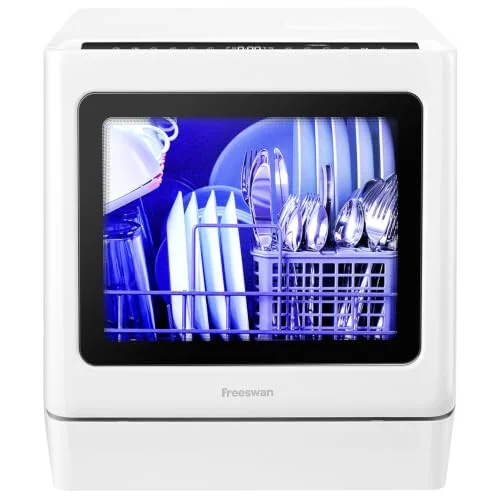
Portable Countertop Dishwasher, 6.4L Tank, Integrated Water Softener

Buyers who specifically want to stop measuring detergent before every run
Countertop · 6.4 L built-in water tank · 5 place settings · 8 programs · X-spray system · integrated water softener · auto door open · automatic detergent dispensing function

At $369.99 this is the most expensive of the three and the only one bundling several automated steps onto one machine: a softener set against local water hardness, a door that opens on its own at the end of the cycle, and the detergent reservoir this guide is about. The pitch is consistent across all three features — load it, start it, interact with it less between cycles.

The trade-offThe listing doesn't state the reservoir's own capacity, a refill interval, or which detergent forms it's built for. At $369.99 it also costs $150 more than the cheapest machine here for exactly those unconfirmed conveniences.

Portable countertop dishwasher with built-in water softener and automatic detergent dispensing
$370
Auto-dispenseCheck price →
02Standard dispenser

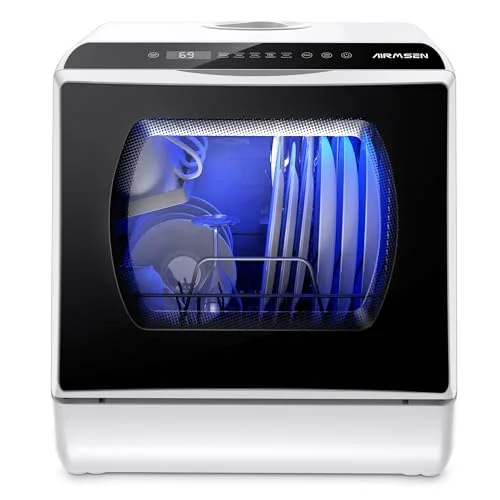
AIRMSEN Portable Countertop Dishwasher, No Hookup Needed

Kitchens that need a machine running from a tank, confirmed up front
Countertop · no hookup needed · no auto-dispense claim in the listing

AIRMSEN's listing leads with the clearest single claim of the three on water source — "No Hookup Needed" — and at $339.99 sits between the other two on price. Unlike the softener model above or the tank-and-faucet model below, it states no program count or tank volume in its headline. Since nothing in the title mentions automatic dispensing, treat it as using the conventional compartment system loaded fresh before each cycle.

The trade-offIt costs more than the tank-and-faucet model below while publishing fewer concrete numbers in its title — a premium over the cheapest option here without the program count or capacity figures to judge what it buys.

AIRMSEN portable countertop dishwasher with no hookup needed
$340
No hookupCheck price →
03Cheapest, standard dispenser

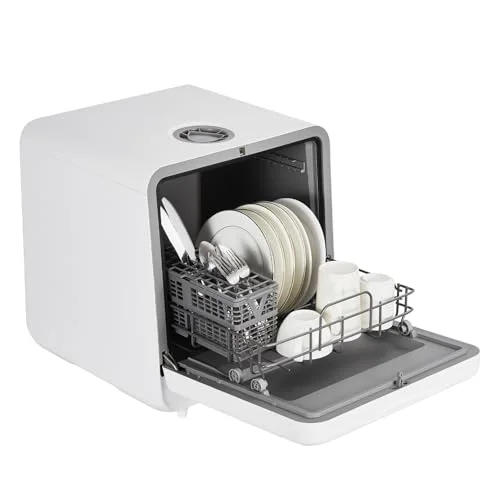
Countertop Dishwasher With Faucet & Manual Water Tank (5L)

The lowest-cost way into this group, with dual water source
Countertop, compact · 5 L manual water tank or faucet · 6 programs · marketed for RV, apartments, small kitchens

At $219.99 this is the cheapest of the three, and like several dual-mode machines on this site it runs from either its own 5-litre tank or a connected faucet. It makes no automatic dispensing claim, so detergent goes into a compartment filled before each run — the same manual step a full-size built-in asks for, and the step the pricier softener model above sells a way around.

The trade-offYou add detergent every cycle rather than every few cycles. Whether that few-second difference is worth $150 more for the auto-dispensing machine is a fair question, and we work through the honest math in the time-savings section below.

Compact portable countertop dishwasher with faucet and manual water tank
$220
Lowest priceCheck price →

Program count is the other number worth reading carefully across all three. The 6-program and 8-program figures here are both plain counts, not the "5+1" or "5+2" notation some budget listings use for a baseline cycle set plus bonus options — a distinction that matters more than it sounds, as we found when we traced what that extra number actually counts on other listings in this category. A plain number here is at least counting the same thing across all three machines, which isn't always true elsewhere.

What could go wrong

What could go wrong with a reservoir you don't load every time

A reservoir you fill once and draw from over several cycles trades one set of problems for another. None of the failure modes below are confirmed for this specific machine — we have no review data and no rating for it, and we won't paraphrase sentiment we don't have. What follows is how reservoir-and-pump dosing systems behave generally, on dishwashers and on the laundry machines this listing's wording borrows from.

  • Residue in the dosing channel. Detergent left sitting in a narrow pump line for days or weeks between refills can thicken or leave a film, which is the mechanical reason manufacturers of auto-dispense laundry machines recommend periodic cleaning cycles for the dispenser itself — a maintenance step a compartment-and-flap system simply doesn't need, because nothing sits in it between loads.
  • A damp chamber that sits unused. Any sealed reservoir inside a small, often-humid countertop appliance is a plausible place for mold or a biofilm to develop over time if it isn't emptied and dried periodically — a risk that scales with how long detergent sits rather than how often the machine runs.
  • Under- or over-dosing if the valve drifts. A compartment you fill by hand gives you a fresh, visible dose every cycle. A pump or valve metering from a shared reservoir can under-dose — leaving a film on dishes — or over-dose, which on a machine that dries with residual heat rather than a heating element can mean more rinse residue, not less.
  • No obvious empty signal. Part of what makes a compartment system reassuring is that you can see it's empty before you fill it. A sealed reservoir housed inside the machine doesn't offer that at-a-glance check unless the manufacturer adds one — the same visibility problem several tank-fed machines solve for their water supply with a visible water-level window, a feature this listing doesn't mention having for its detergent chamber.

The compounding risk is specific to a shared-supply system: a bad dose from a fresh compartment is a problem you correct next cycle. A reservoir dosing the wrong amount repeats the mistake on every wash until someone notices and refills it correctly — a real cost of convenience, not a reason to avoid it outright.

The honest math

Whether this saves meaningfully more time than a pod drawer

Filling a detergent compartment — dropping in a pod, or measuring a capful of gel or a scoop of powder — takes a matter of seconds. It happens while you're already standing at the machine loading dishes, a task that itself takes several minutes, and the wash cycle that follows typically runs an hour or more. Set against that timeline, the step an automatic dispensing reservoir removes is small in absolute terms: a few seconds, not a few minutes, per cycle.

Where it could add up is frequency rather than duration. A household running small loads often — the use case covered in our guide to half-load and small-batch cycles — repeats that few-second step more times per week than a household running one large load every few days. More cycles means more instances of the saving, even though each instance is tiny.

But the reservoir isn't free of the same task, only less frequent with it: pouring in a bottle's worth of detergent instead of a capful takes longer per instance even if it happens less often. Add it up over a month and the two approaches are plausibly close to a wash in total time spent on detergent; what differs is where that time lands. Our honest read: the real case for paying more here is not a stopwatch-measurable saving, it's not having to remember the step at all — worth something to some buyers, and worth nothing to someone who's never once forgotten to add detergent before starting a load.

The fine print

What the manufacturer claim doesn't tell you

Start with the wording itself. "Laundry detergent automatic dispensing function," on a dishwasher listing, is the kind of phrase that suggests bullet copy written for one appliance category and reused, lightly edited or not at all, for another. That's not proof of anything wrong with the machine — plenty of functional hardware ships with rough or recycled listing copy, a pattern we traced in more detail in our look at generic-brand listings — but it's a reason to read the rest of the listing a little more skeptically than one written specifically, and correctly, for a dishwasher.

Beyond the wording, four numbers are absent from the title and headline bullets: the reservoir's own capacity, how often it needs refilling under normal use, which detergent forms it's designed to accept, and whether it's removable for cleaning. None of these are confirmed one way or the other, and a buyer choosing between this $369.99 machine and either cheaper machine below is weighing a convenience claim with real unknowns against a system — the drawer you fill each time — with no unknowns left to discover, because every dishwasher in this category has used it for years.

That's the actual decision on this page, stripped of marketing language: pay more for a feature that removes a small, frequent task and adds a few unconfirmed ones, or keep the task and the certainty that comes with it. Both are reasonable choices. What isn't reasonable is assuming "automatic" means less to think about overall — on the evidence available, it mostly means thinking about detergent on a different schedule, not thinking about it less.

FAQ

Common questions about automatic detergent dispensing

Does automatic detergent dispensing mean the dishwasher never needs detergent added?

No. It means the reservoir holds enough for more than one cycle, so you refill it on some longer interval instead of adding detergent before every single run. The listing that makes this claim doesn't state how large that reservoir is or how often it needs topping up, so there's no published figure for how long one refill lasts.

Can I use a dish detergent pod in an automatic-dispensing reservoir?

Probably not, based on how these systems are built, though the listing doesn't say directly. A pumped reservoir doses a measured amount through a small channel or valve, which works for a liquid or a gel but can't meter a fraction of a sealed pod. If pods are what you already own, a machine with a conventional fill-each-time compartment is the safer match, and that's worth confirming in the listing's Q&A before you order either way.

How often do I need to refill a reservoir like this one?

We don't know, and neither does the listing say: it doesn't publish the detergent reservoir's capacity or a refill interval, only the 6.4-litre figure for the separate water tank. Refill frequency on any such system depends on the size of the reservoir and how much it doses per cycle, neither of which is stated here.

Does automatic dispensing save a meaningful amount of time compared with filling a compartment each cycle?

Not by much, on the numbers available. Filling a compartment takes a matter of seconds, done while you're already loading dishes for a cycle that runs an hour or more. A reservoir removes that small step but has to be refilled less often with a larger amount, which takes longer per instance. The honest saving is closer to a change in when you handle detergent than a reduction in how much time you spend on it.

Keep reading

Next, from this site