Best Portable Dishwashers
Guide · ADA Compliance

ADA-compliant? Here's what that word is actually doing.

Two listings in this 18-inch category specifically call themselves ADA compliant. Nothing else does. The designation sounds like it should mean a better dishwasher — it doesn't. It means something much narrower: where the buttons sit, and whether a person using the machine from a wheelchair can reach them.

By Ilane Tall · Updated November 4, 2026 · Research-based.

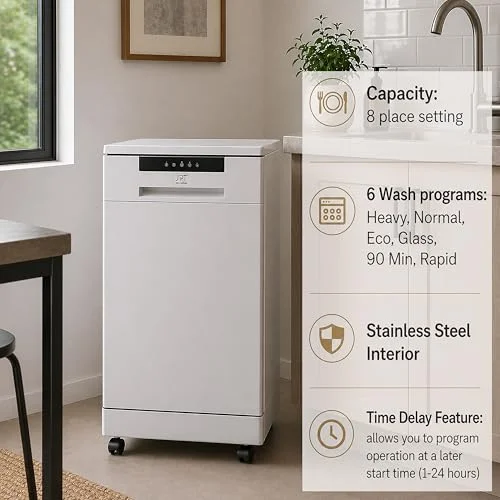
A stainless steel 18-inch portable dishwasher with its control panel mounted on the front face, standing beside a lower kitchen counter

Reader-supported: we may earn a commission when you buy through the links on this page, at no additional cost to you. Prices move constantly — confirm the live price before you order.

Out of the 18-inch portable dishwashers we track, exactly two put "ADA" in their own listing title. One more sits beside them in the same price band and size class, with no such claim anywhere on its page. That contrast is the whole subject of this guide: what the two ADA listings are actually promising, what the plain listing beside them is missing (or just not advertising), and what the designation never touches no matter which model you pick.

The short version, before the detail: ADA compliance on a dishwasher is about reach and operability — can someone using a wheelchair find the controls and work the door — not about how clean the dishes come out, how much the machine holds, or how quiet it runs. Those are separate specifications, and a model can be excellent at all of them without ever claiming ADA, or claim ADA while being an entirely ordinary dishwasher in every other respect.

How this page is built

We compare published listing titles, specifications and price. We do not physically test these machines, we do not run a testing lab, and we do not publish ratings we cannot verify — Amazon returns no rating and no review count for this category, so there are no stars on this site. Where a product's listing doesn't state a spec, we say so and don't guess at it.

The standard

What ADA Compliance Actually Regulates on a Dishwasher

The Americans with Disabilities Act doesn't test appliances the way a lab tests cleaning performance. The relevant technical guidance — the ADA Standards for Accessible Design, which lean on the same reach-range dimensions used throughout accessible building design — cares about one question: can a person using the appliance from a seated position, specifically from a wheelchair, physically reach and operate its controls. The standard sets forward and side reach zones for "operable parts" — broadly, a band running from about 15 inches to 48 inches off the floor for a straight-on forward reach, and up to 54 inches for a side reach around an obstruction. A control that sits inside that band, in a location a seated user can get close enough to touch, meets the test. A control that sits above it, behind something, or only reachable by leaning over an open door, does not.

That's the entire scope. ADA compliance says nothing about wash temperature, cycle count, drying method, decibel rating, or how many place settings fit inside. A dishwasher can be ADA compliant and mediocre at cleaning; it can fail every reach-range requirement and still clean dishes extremely well. The two aren't connected, and treating "ADA compliant" as a general quality signal — the instinct a shopper skimming titles will naturally have — is the first mistake this designation invites.

Who this actually matters to, in practice: multifamily housing built or renovated under federal accessibility requirements, assisted-living and healthcare kitchens, hotel accessible rooms, and — a smaller but real group — homeowners and renters who use a wheelchair or have a mobility-limiting condition and are shopping for themselves rather than to satisfy a building code. For a buyer in any of those situations, the ADA line in a listing title is doing real, specific work. For everyone else, it's a feature they can ignore without losing anything.

The detail that matters

Front Controls vs Top Controls — Why That's the Decision

Most full-size and portable dishwashers put their control panel in one of two places: on the top edge of the door, visible only when the door is open, or on the front face of the unit, below the door line, visible and reachable whether the door is open or shut. For a standing user this is mostly an aesthetic choice — top controls disappear for a cleaner built-in look, front controls stay visible for people who like to see the cycle running. For a seated user it stops being cosmetic.

Open a top-control dishwasher and the control panel tips away and up, out toward the counter, which puts it above the ADA forward-reach ceiling for almost anyone approaching from a wheelchair — and often out of sight entirely, since the panel now faces upward rather than toward the room. A front-mounted panel doesn't move when the door opens. It sits in the same spot, typically somewhere in the 30-to-36-inch range off the floor on an 18-inch unit, comfortably inside the reach band the standard describes, whether the door in front of it is open, closed, or halfway through a cycle.

That's why, of the three listings in this comparison, only one spells the word "front control" directly into its title, and it's not a coincidence that the same listing is the one explicitly sold as ADA. Control placement is the single detail that decides whether a machine can clear the standard at all — more than the certification badges, more than the finish, more than the price. A shopper comparing listings should look for that phrase, or for product images that show where the buttons actually sit, rather than assuming a stainless 18-inch dishwasher in this price range automatically has one layout or the other. Even within a single manufacturer's own catalog that assumption fails — our look at Hamilton Beach's three portable dishwashers turns up models at similar prices that don't share a single layout decision, and our comparison of Silonn's two countertop dishwashers makes the same point about control type generally: one spec sheet in a lineup is never a safe guess at the next one.

The two ADA listings

The Picks, and What Each One's Listing Specifically Claims

01ADA, front control

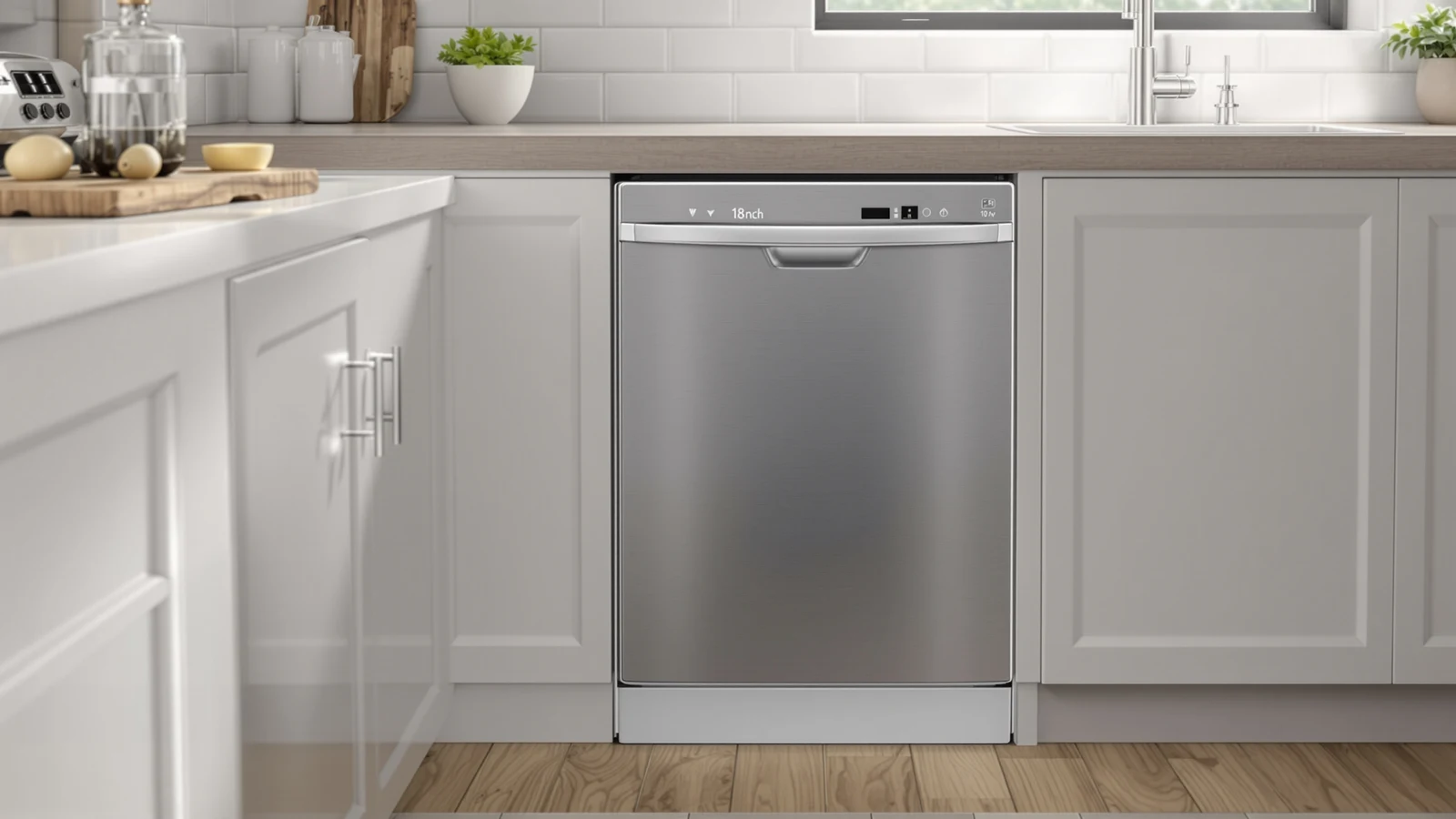
FRIGIDAIRE 18 in. ADA Compact Front Control Dishwasher

The listing that names the exact detail that decides ADA compliance
18 inches · ADA Compact Front Control · Stainless Steel · dual spray arms · 52 dBA · includes room-of-choice delivery

Of the three listings here, this is the only one that spells "Front Control" directly into its own title, which is the single clearest accessibility claim in the whole comparison — it isn't just asserting ADA compliance, it's naming the mechanism behind it. The listing also states dual spray arms and a 52 dBA noise rating, both washing-performance specs that have nothing to do with the ADA claim; a dishwasher can carry either of those without being accessible, and this one happens to carry both. It also includes room-of-choice delivery, a logistics perk worth noting for anyone whose mobility needs make carrying an appliance box from a front door to a kitchen more than an inconvenience.

The trade-offIt's the most expensive of the three at $803.00 — roughly $110 above the other ADA listing and about $210 above the plain model beside them. The listing gives no separate place-setting figure, so capacity isn't part of what you're paying the premium for.
FRIGIDAIRE 18-inch ADA front control dishwasher in stainless steel
$803.00
ADA front controlCheck price →
02ADA, panel ready

KoolMore 18 in. ADA Panel Ready Dishwasher (KM-DW1852-PR)

The ADA listing built around blending into a cabinet run
18 inches · ADA Panel Ready · 8 place settings · 52 dB · Stainless Steel · UL and Energy Star Certified

"Panel Ready" is a separate claim from "ADA" and it's worth not conflating the two: it means the front of the unit is designed to accept a custom cabinet-matching panel rather than showing its own factory finish, so the dishwasher can sit flush within a run of cabinetry instead of standing out as an obvious appliance. That matters in accessible kitchens specifically because those installs are often designed for visual continuity at wheelchair eye level. The listing also states 8 place settings — the highest capacity figure named anywhere in this comparison — plus UL and Energy Star certification, both third-party marks rather than self-declared design claims.

The trade-offThe title doesn't spell out "front control" the way the FRIGIDAIRE listing does, so a buyer relying on ADA compliance specifically for reach should still check the product images for control placement rather than assume the panel-ready detail covers it. If 8 place settings is the main draw rather than accessibility, our guide to the highest-capacity portable dishwashers covers models that push further still.

KoolMore 18-inch ADA panel ready dishwasher in stainless steel
$643.07
8 place settingsCheck price →
The comparison

The Non-ADA Model Beside Them, and What's Actually Different

The SPT SD-9263W sits in the same 18-inch, Energy Star class as the two ADA listings, at a lower price — $626.51 against $643.07 and $803.00. Its title names none of the three ADA-adjacent claims the other two carry: no "ADA," no "Front Control," no "Panel Ready." That absence is worth reading carefully, because it tells you less than it seems to.

An absent claim is not a failed test. The listing simply makes no statement about control placement, certification beyond Energy Star, or reach — which means a buyer shopping specifically for accessibility has no basis to assume this unit either meets or misses the standard. It might have front controls that happen to sit in the right reach band; it might not. Nothing in the title or the data we have resolves that question, and we won't guess at a spec the listing doesn't give. The honest instruction here is the same one that applies across this whole category: check the detailed listing photos and the installation manual yourself before assuming either way.

What the listing does establish is price and class: the same 18-inch Energy Star chassis family, roughly $100 to $210 cheaper than the two listings that do make the ADA claim. That gap tracks reasonably well with what the other two are adding — one names an explicit accessible control layout and includes delivery service, the other adds two extra place settings plus UL certification on top of Energy Star. For a buyer with no reach constraint, the SPT may wash dishes just as well as either of the others; the difference in daily use shows up specifically for the person who needs to reach the controls without bending over an open door, and that's a need this particular listing simply doesn't address one way or the other.

At a glance

The Three Listings in This Comparison

All figures are manufacturer listing specifications; prices are approximate and move frequently.

DishwasherADA claimControl detail namedOther certificationsPrice
FRIGIDAIRE 18″ ADA CompactADA CompactFront Control—$803.00Price
KoolMore 18″ ADA Panel ReadyADA Panel ReadyNot named in titleUL, Energy Star$643.07Price
SPT SD-9263W 18″None statedNot named in titleEnergy Star$626.51Price
The kitchen itself

Installation Height and Clearance for a Lower Counter

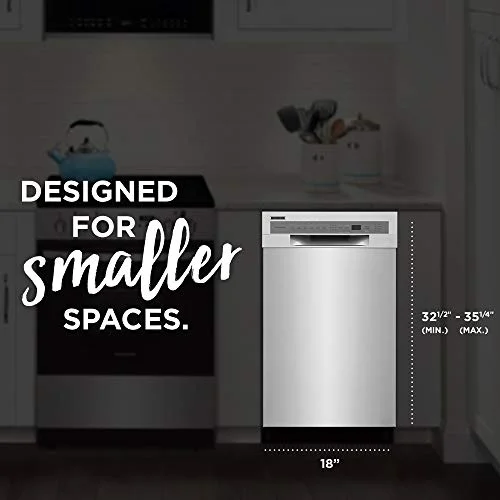
Accessible kitchens generally use a lower counter than a standard build — the ADA Standards cap an accessible work surface at 34 inches off the floor, against the roughly 36-inch counter height common in most American kitchens. For a built-in dishwasher that tucks under a counter, that two-inch difference changes the opening it has to fit into. These three are freestanding 18-inch portables, not built-in units, so they don't tuck under anything — they stand on the floor beside the counter, on their own feet or castors. That changes the clearance question rather than removing it.

What stays fixed regardless of counter height is the control panel's position on the machine itself, since that's set by the manufacturer, not by the kitchen. A front-mounted panel sitting around 30 to 36 inches off the floor — which is the usual range for this chassis size — lands inside the ADA forward-reach band whether the counter beside it is the standard 36 inches or the accessible 34. None of the three listings here states that height precisely, so if reach to the exact millimeter matters for a specific installation, the manufacturer's spec sheet or installation manual is the place to confirm it, not the marketing title.

The other half of the installation question is floor space in front of the machine. Accessible design generally calls for a clear floor area, commonly cited at 30 by 48 inches, for a wheelchair to approach and work an appliance's controls and door. On an 18-inch portable that rolls out to the sink and back, that clear-floor requirement competes directly with the footprint the machine itself needs when parked — a real constraint in any kitchen small enough to be shopping for a portable dishwasher in the first place, and one worth measuring before ordering rather than after the box arrives.

The rest of the category

Why Most Listings in This Category Never Mention ADA at All

Two listings out of the dozens we track in this category state ADA compliance. That's not a gap in how thoroughly brands document their products — it's closer to how the claim itself works. Unlike UL and ETL certification, which are third-party marks a product has to be independently tested and listed to carry, "ADA compliant" on a consumer appliance is typically a self-declared design claim: the manufacturer builds the unit to conform to the published reach-range dimensions and then states that it does. Nobody audits the claim the way a testing lab audits a UL mark, which also means there's no formal registry penalizing a brand for simply not making the claim.

The legal weight behind ADA compliance mostly lands on public accommodations, government-funded housing, and commercial or multifamily new construction — not on an individual buying an appliance for their own home. Most shoppers in this category are renters and homeowners with no legal requirement driving the purchase, so for most brands there's little marketing upside in spending the engineering and copywriting effort to earn and state the claim. Browse any single-brand lineup on this site — Hamilton Beach's three models, EUHOMY's seven listings — and accessibility language is the exception, not the rule, across the whole category.

That's also why the absence of the word "ADA" on a listing shouldn't be read as a failing grade. It usually just means the brand didn't build toward that specific use case, or didn't bother stating it if they did. The two listings that do carry the claim are worth taking at face value precisely because almost nobody else in this category has a reason to make it up.

FAQ

Common Questions About ADA-Compliant Dishwashers

What does "ADA compliant" actually mean on a portable dishwasher?

It means the controls and door are positioned so a person using the machine from a wheelchair can reach and operate them — generally within a forward-reach band running from about 15 to 48 inches off the floor. It says nothing about wash performance, drying, noise or capacity; those are separate specifications that a dishwasher can be strong or weak at regardless of its ADA status.

Why do front controls matter more than top controls for ADA compliance?

Top-mounted controls sit on the upper edge of the door and are only visible and reachable when the door swings open, which moves them up and away from a seated user's reach range. Front-mounted controls sit on the face of the unit below the door line and stay in the same position whether the door is open or closed, which is why the listing in this comparison that calls itself ADA also spells "Front Control" directly into its title.

Can I install one of these under a lower, ADA-height counter?

These three are freestanding 18-inch portables rather than built-in units, so they stand beside a counter rather than tucking underneath it, and counter height doesn't change whether they fit. What matters is the control panel's fixed height on the unit itself, typically in the 30-to-36-inch range for this chassis size, and having enough clear floor space in front of the machine — commonly cited at 30 by 48 inches — for a wheelchair to approach it.

Does ADA compliance mean a dishwasher cleans better or holds more dishes?

No. ADA compliance is exclusively about reach and operability. The highest-capacity listing in this comparison, at 8 place settings, is also one of the ADA-labeled units, but that's incidental — the other ADA listing states no separate place-setting figure at all, and the non-ADA model here is in the same price and size class as both. Capacity, noise and certification marks like UL or Energy Star are specifications you check independently of the ADA claim, not because of it.

Keep reading

Next, from this site