Best Portable Dishwashers
Guide · Auto Door Open

The dishwashers that open their own door when they're done.

A handful of countertop dishwashers end their cycle by popping the door open a few inches on their own. It sounds like a gimmick. It's actually the only drying mechanism these small machines have that doesn't rely on you remembering to do anything. Here's what it mechanically does, which machines in our database have it, and what to do instead if yours doesn't.

By Ilane TallUpdated October 16, 2026Research-based.

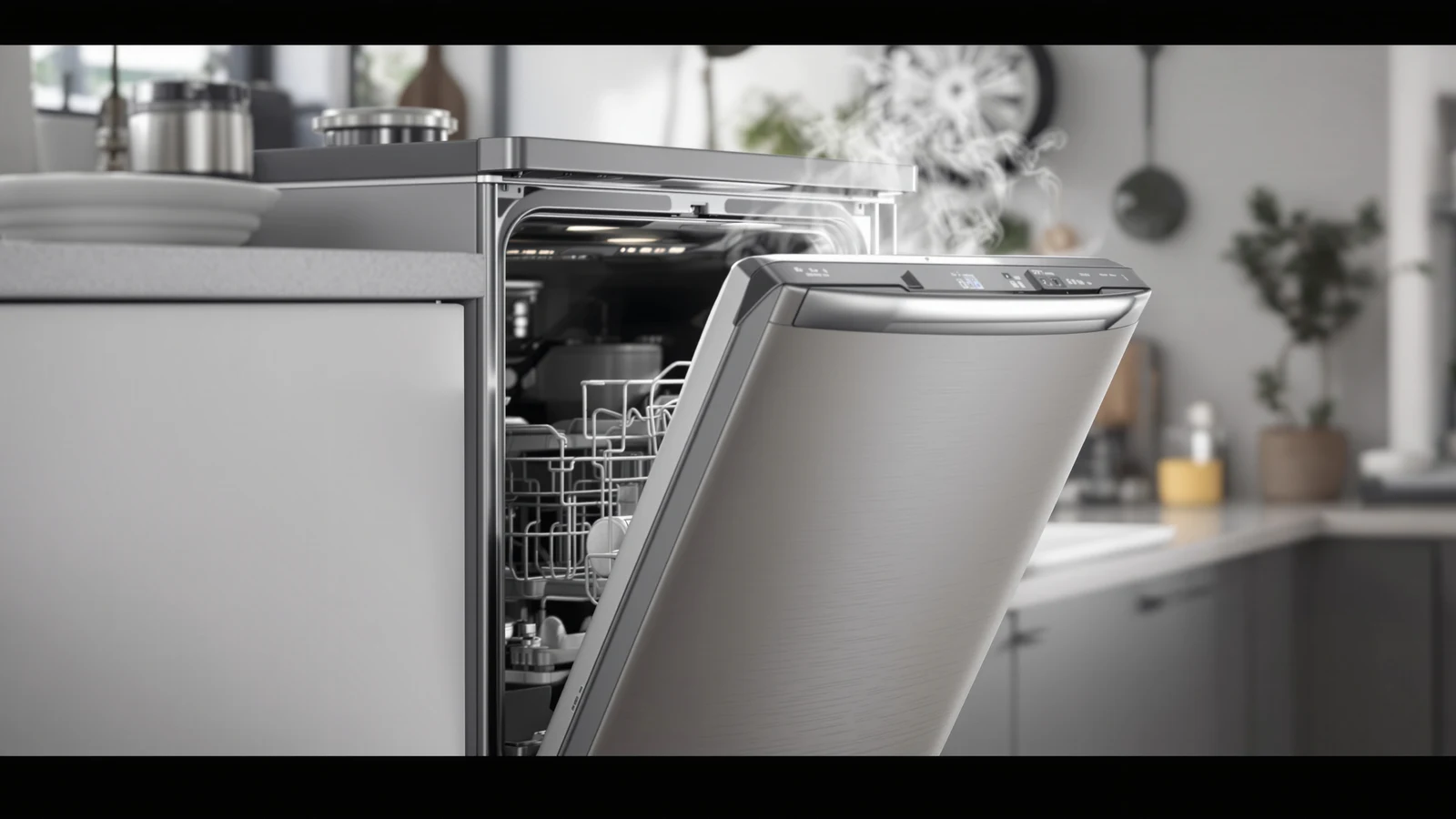
A countertop portable dishwasher with its door cracked open a few inches at the end of a cycle, releasing steam into the kitchen

Reader-supported: we may earn a commission when you buy through the links on this page, at no additional cost to you. Prices move constantly — confirm the live price before you order.

Most countertop dishwashers finish a cycle exactly the way they started it: sealed. The tub holds its heat, the glass and plastic stay wet, and nothing happens until a person walks over and lifts the lid. A smaller group of machines skip that last step. At the end of the dry phase, a latch releases and the door swings open on its own by a few inches, and stays that way. The listings call it Auto Door Open, and it shows up as a named feature or a selectable product variant rather than a separate model — which is exactly how both machines in this guide are sold.

It's a small mechanical detail with an outsized effect on a dishwasher this size, because a countertop unit has none of the tools a full dishwasher has for drying. There's no heating element cycling air through a vent, no condensation coil, often not even a fan. What's left is residual heat and whatever ventilation the design allows — and a door that opens itself is the most reliable ventilation a sealed plastic box can get.

How this page is built

We compare published specifications, listing copy and price — the three things Amazon actually gives us for this category. We do not physically test these machines, we do not run a testing lab, and we do not publish ratings we cannot verify: Amazon's product API returns no rating or review count for either machine below, so there are no stars on this page. Where we describe a mechanism, it comes from the manufacturer's own description of the cycle, not from a measurement we took ourselves.

The mechanism

What actually happens at the end of the cycle

Both machines in this guide describe the same basic sequence in their listing copy, and it maps onto how any countertop dishwasher's final phase works. The wash and rinse stages finish first, using the hottest water in the cycle — the heat is what does most of the drying work later, not a dedicated dryer. Once the rinse is done, the machine moves into a short dry phase, and on these two models that phase ends with a motorized or spring-latched release that pops the door open a controlled amount rather than leaving it sealed shut.

It isn't the door flying open — both listings describe a controlled few-inch gap, not a full swing. That detail matters mechanically: the point is to let warm, moisture-saturated air escape and be replaced by room-temperature air pulling in, which is a passive exchange that needs only a gap, not a draft. A door that swung fully open would dump more heat than it needs to and create a bigger obstruction on a countertop that's already tight on space.

This is a scheduled, cycle-end behavior, not a safety interlock. It happens whether or not anyone is standing in the kitchen, and it happens whether the load was heavily soiled or barely used — the machine doesn't sense moisture level and adjust. Treat it as a fixed step at the end of the program you selected, the same way a dry light or a buzzer is a fixed step on a machine without the feature.

Why it works

Why a cracked door beats a heater on a machine this size

Full-size built-in dishwashers often dry with a resistive heating element or, on higher-end models, a zeolite mineral that releases heat as it absorbs moisture. Countertop machines have neither. Building a heating element into a tub this small raises cost, adds a failure point, and — on a sealed plastic enclosure — raises the risk of warping nearby components with trapped heat that has nowhere to go. So the entire category leans on one resource instead: the residual heat already in the water and the dishes from the hot rinse.

That heat is only useful if the moisture it's carrying can leave. In a sealed tub, hot rinse water evaporates into the enclosed air, that air saturates almost immediately in a space this small, and condensation settles right back onto the glasses and plastic it came from — which is the flat, slightly damp result most countertop dishwasher owners eventually learn to expect without a door that opens. Cracking the door replaces that trapped, saturated air with drier room air, and it keeps doing so passively for as long as the gap stays open, which is a continuous exchange no residual heat alone can match.

Put another way: a heater adds energy to speed up evaporation inside a closed box. A cracked door removes the ceiling on how much moisture that box can hold in the first place. For a small countertop unit, removing the ceiling is the cheaper and more effective fix, which is presumably why two different brands converged on the same answer rather than adding a heating element to compete with full-size machines.

The picks

The two machines in our database with it

Both are sold under an Auto Door Open listing variant rather than as a standalone model — check the variant selector on the listing before you order.

01Auto Door Open

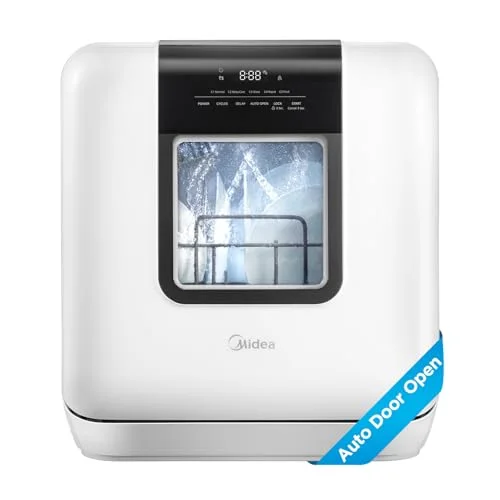
Midea Countertop Dishwasher, 1.59 Gal Built-in Water Tank

A tank-fed countertop machine with 5+2 programs, sold with an Auto Door Open option
Countertop · 1.59 gal built-in tank · 5+2 programs · Auto Door Open variant

This is a tank-fed machine first — the 1.59-gallon built-in tank means it can run without being anywhere near a faucet — and the Auto Door Open behavior is the listing's answer to the drying question every tank-fed countertop unit eventually has to face. "5+2 programs" in the listing copy reads as five main wash cycles plus two additional options, which is a fairly typical spread for this class; we don't have the individual cycle names confirmed, so we won't invent them here. Buy the Auto Door Open variant specifically — the listing offers it as a selectable option, and the plain version may not include the same end-of-cycle release.

The trade-offWe don't have external dimensions or a place-setting figure for this listing, so check both against your counter and cabinet clearance before ordering rather than assuming it matches a similarly priced machine.

Midea countertop dishwasher with built-in water tank, Auto Door Open variant
$310
Tank-fedCheck price →
02Auto Door Open + UV

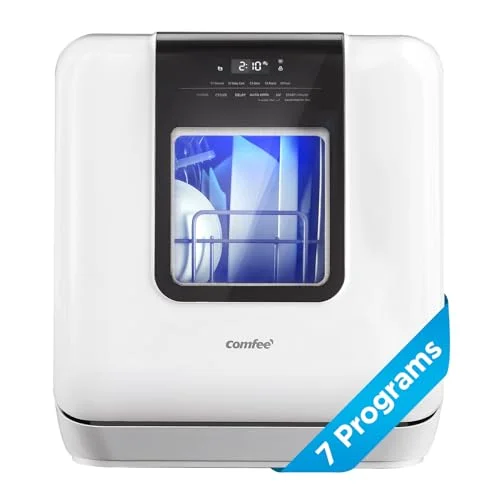
COMFEE' Countertop Dishwasher, 6L Tank, UV Hygiene & Auto Door Open

A mini dishwasher built for apartments, dorms and RVs, with both UV and a self-opening door
Mini countertop · 6 L built-in tank · 7 programs · UV Hygiene cycle · Miniplus Auto Door Open variant

COMFEE' pairs the self-opening door with a UV Hygiene cycle on the same machine, and the two features solve adjacent problems: UV targets what's living in the tub between loads, while Auto Door Open targets the moisture that would otherwise sit in there with it. The listing calls this the "Miniplus Auto Door Open" variant and markets it explicitly for apartments, dorms and RVs — small, often poorly ventilated spaces where a sealed, damp dishwasher tub sitting closed for days is the scenario the feature is built to prevent. Seven programs is on the higher end for a tank-fed mini machine, and the 6-litre tank is modestly larger than the 5-litre tank common elsewhere in this category.

The trade-off"Mini Dishwasher with More Space Inside" is the listing's own framing — we don't have a verified place-setting count or external dimensions, so don't assume it holds as much as a full six-place machine just because the tank is a bit bigger.

COMFEE' countertop dishwasher with UV Hygiene and Auto Door Open, white
$338
UV + auto-openCheck price →
In the kitchen

What it changes about steam, counter moisture and humidity

The trade a self-opening door makes is straightforward: it moves moisture out of the tub and into the room, instead of leaving it to condense back onto the dishes. That's a net improvement for the dishes and a small, localized cost for the kitchen around the machine.

In practice, that means a brief release of warm, visibly humid air right at counter height, directly over wherever the machine sits, at whatever point in the cycle the dry phase ends — typically unattended, since most people start one of these cycles and leave the room. If the machine lives under a wall cabinet or in a tight nook, that's warm moist air meeting cold cabinet undersides and painted surfaces repeatedly, load after load, which is the same condition that eventually dulls paint or encourages mildew on any surface that sees repeated damp air with no airflow to clear it. A machine on an open counter with some headroom simply lets that air disperse into the rest of the room, where normal kitchen ventilation handles it the way it handles a boiling pot.

Over a single cycle this is a trivial amount of moisture — nowhere near a kettle or a pot of pasta at a full boil. Over months of daily use in an unventilated galley kitchen or a dorm room, which is exactly the use case COMFEE' markets its Auto Door Open variant for, it's worth thinking about where the machine sits relative to a range hood, a cracked window or just open floor space, the same calculus that matters for any portable dishwasher going into a dorm room with no real ventilation to begin with.

Everything else

The models without it, and the manual habit that replaces it

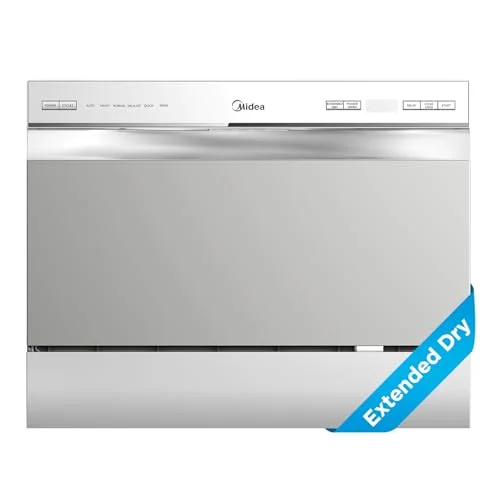
Auto Door Open is the exception in this category, not the rule. Most countertop dishwashers — including the Midea 6-place, ENERGY STAR countertop model in our database — finish their cycle sealed, with a dry or finish indicator light or chime and no automatic release. The listing for that machine doesn't mention an auto-open feature at all, so we're not going to claim it has one; treat the absence of a Size/variant line naming the feature as the listing simply not advertising it, and plan accordingly rather than assuming either way.

The fix, if your machine doesn't open itself, is the habit manufacturers were effectively building a mechanism to replace: crack the door by hand as soon as the cycle ends, rather than leaving it sealed until you're ready to unload. A few inches is enough — you're not trying to air it out like a closet, just breaking the seal so trapped humid air has somewhere to go instead of sitting against the glassware until it condenses back down. This matters most after the short, low-heat programs discussed in our guide to rinse-only and quick cycles, where there's less residual heat in the tub to begin with and condensation sets in faster.

The habit costs nothing and takes a few seconds, but it only works if you're there to do it, which is the entire case for the automated version: a machine that opens its own door does the job on a cycle that finishes at 2am or while you're at work, and a machine that doesn't will sit sealed and damp until you walk back into the kitchen. Machines advertising a larger number of wash programs, like the ones compared in our guide to portable dishwashers with the most wash programs, are no more likely to include this specific feature — program count and drying mechanism are unrelated specs, and it's worth checking both separately rather than assuming one implies the other.
Safety

A door that opens on its own, with kids and pets around

A door that moves by itself is worth a moment's thought in a household with young children or curious pets, even though the movement here is small and the risk is modest rather than acute.

  • It's a few inches, not a swing. Both listings describe a controlled partial opening, not a door falling open under gravity — there's no reason to expect it to startle a child or pet standing nearby the way a slamming cabinet might, but it is movement they didn't initiate, which is worth being aware of if you have a toddler at counter height.
  • What's inside is still hot and still wet. The dry phase ends with warm dishes and residual steam in the tub, so a door that opens on its own creates brief access to a warm, damp interior with glassware and sharp flatware in reach of small hands, sooner than if the door had stayed sealed until an adult opened it.
  • Placement does the real safety work. The same counter-height and clearance rules that apply to any countertop dishwasher apply here with slightly more urgency: keep it back from the counter edge, out of a toddler's reach, and away from where a pet jumps up looking for warmth, since a self-opening door means there's no guarantee an adult is present at the moment it opens.
  • Follow the manual's child-safety guidance as written. Both brands publish standard appliance safety instructions with their listings — detergent storage, supervision around an open door, keeping the machine out of reach of children — and an automatic door release doesn't change what that guidance asks of you, it just means the open-door window can start without anyone choosing it.
At a glance

Auto Door Open versus a sealed finish

All figures are manufacturer listing claims; prices are approximate and move constantly on Amazon.

DishwasherDoor at end of cycleWater sourceProgramsPrice
Midea 1.59 Gal, Auto Door OpenOpens itself ~a few inches1.59 gal tank5+2$309.84Price
COMFEE' 6L, UV & Auto Door OpenOpens itself ~a few inches6 L tank7$338.30Price
Midea 6 Place Settings, ENERGY STARStays sealed; not advertisedNot specified in listingNot specified$339.99Price
How we picked

Two machines, named variants

We searched our product database for countertop dishwashers whose listing explicitly names an Auto Door Open option, rather than guessing from product photos or generic "quick-dry" marketing language that doesn't describe an actual mechanism. Two machines in our database meet that bar, both sold as a selectable variant rather than a dedicated standalone model. We added the ENERGY STAR Midea model for contrast specifically because it doesn't claim the feature, to make the comparison honest rather than one-sided.

How we compared

Listing copy, not a lab

We're upfront about this: we don't physically test these machines and we don't run a testing lab. Everything here about when the door opens, how far, and what it's paired with comes from each brand's own description of its cycle. We show no star ratings because Amazon's API returns none we can verify for either model, and we never invent one.

FAQ

Common questions about Auto Door Open

Does the door open all the way, or just a crack?

Just a crack, according to both listings in this guide — a controlled partial release of a few inches, not the door swinging fully open. The goal is to let warm, moist air escape and be replaced by room air, which only needs a gap, not a wide-open door.

Does Auto Door Open replace the need for rinse aid or a dry cycle?

No. It's a ventilation step, not a heating step. The water is still only as hot as the rinse made it, and rinse aid still helps water bead and run off rather than sheet and sit — the auto-open feature just gives whatever moisture remains somewhere to go instead of trapping it against the dishes.

Can I get the same effect by opening the door myself?

Largely, yes — cracking the door by hand as soon as a cycle ends achieves the same passive air exchange. The difference is timing: an automatic release works on a cycle that finishes while you're asleep or out of the house, while a manual habit only works if you're there to do it.

Is a self-opening door dangerous with kids or pets in the kitchen?

The movement itself is small — a partial release, not a door falling open — but the interior is still warm and damp with glassware and flatware inside, and it can open without an adult choosing that moment. Normal countertop dishwasher placement rules, kept back from counter edges and out of reach, apply with a bit more reason here.

Keep reading

Next, from this site