Best Portable Dishwashers
Buying Advice · Price Per Place Setting

The sticker price lies. The per-setting price doesn't.

Five portable dishwashers, five sticker prices from $169 to $610 — and only two of the five listings actually state how many place settings you're buying. Here's the math that separates value from a cheap-looking number on a product page, with every assumption shown so you can run it yourself on any listing.

By Ilane TallUpdated October 14, 2026Research-based — no testing lab, no invented ratings

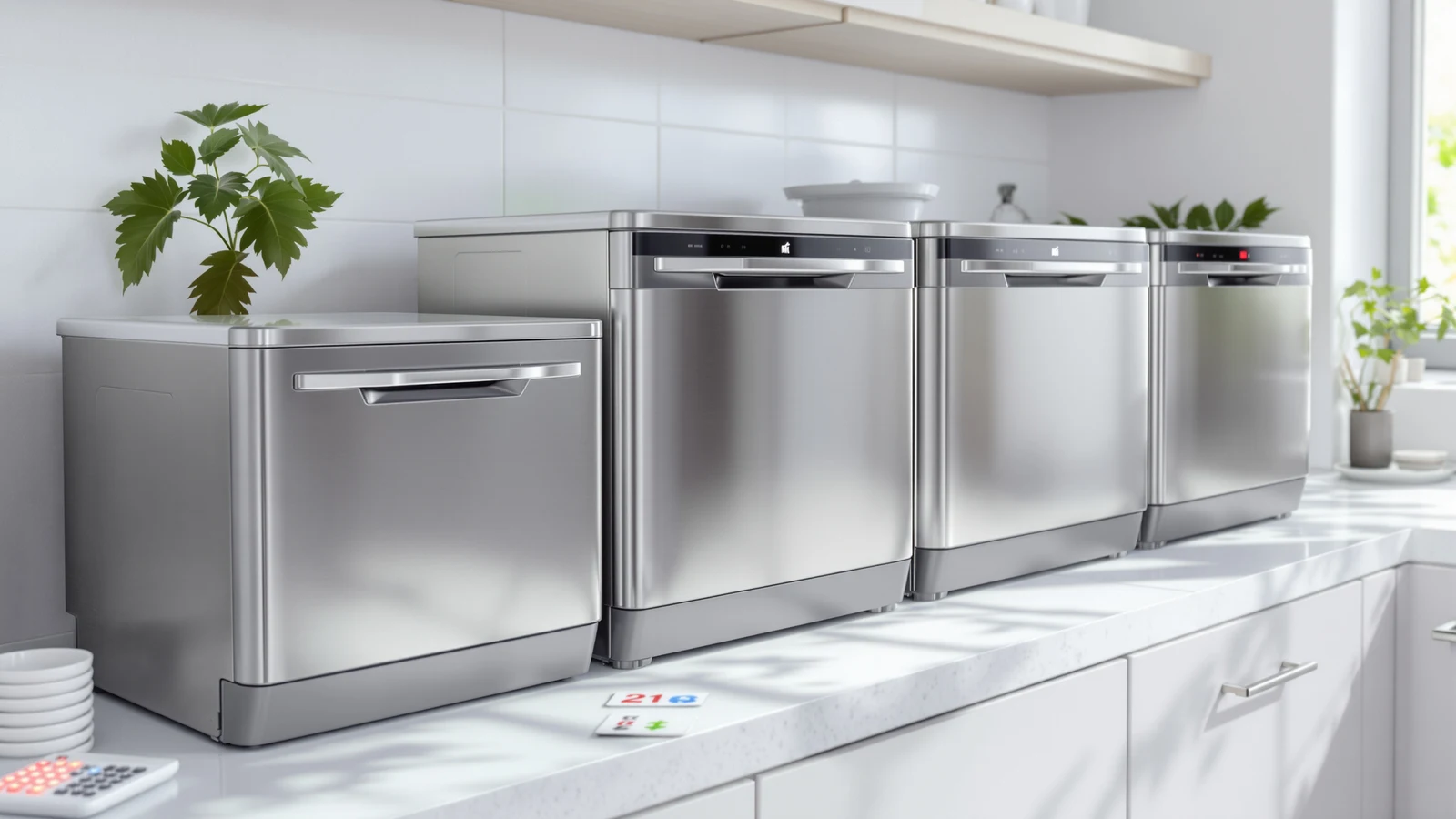
A hand holding a calculator and receipt beside a compact countertop dishwasher loaded with plates and cups

Reader-supported: we may earn a commission when you buy through the links on this page, at no additional cost to you. Prices move constantly — confirm the live price before you order.

Shop this category by sticker price and you'd rank these five machines cheapest to priciest and call it a day. But a $169 countertop dishwasher and a $610 machine on wheels aren't selling the same thing, and the number that actually tells you whether either is a good deal — price per place setting — is one most listings never print. Two of the five products in this comparison state a place-setting count. The other three don't, and that absence is itself worth paying attention to.

This isn't a roundup of which machine washes dishes best; it's a worksheet. We show the formula, the two machines we can actually run it on, why the other three resist the math, and the point at which spending more per setting stops being worth it.

How this page is built

We compare published prices and the specifications each listing actually states — place-setting counts, tank capacity, dimensions, certification. We do not physically test these machines, we do not run a testing lab, and we do not publish ratings we cannot verify: Amazon returns no rating or review count for this category, so there are no stars anywhere on this site.

Where a listing does not state a place-setting count, we say so rather than estimate one. Prices below are the snapshot our product database held on the date noted next to each machine; Amazon prices move daily, so re-run the math with the live number before you decide anything.

The problem

Why the sticker price alone is a misleading way to compare these machines

Line the five machines up by price and the order looks decisive: the BEADSTER Countertop Dishwasher at $169.00, the Collier Kitchen Portable Countertop Dishwasher at $169.99, the EUHOMY Countertop Dishwasher Portable at $249.00, the COMFEE' Countertop Dishwasher at $278.94, and the BLACK+DECKER 18-Inch Portable Dishwasher at $609.99. Read that list and the instinct is obvious: buy one of the two under $170 and save hundreds.

The instinct breaks down the moment you ask what each dollar is actually buying. A sticker price is a single number standing in for a bundle of things — wash volume per cycle, how many plates and bowls fit, what cycles are included, whether it needs a faucet or just a wall socket — and nothing forces two listings to bundle those things the same way. Some sellers even run the same physical machine under several names at several prices, which is exactly the trap we unpacked in our look at the AIRMSEN lineup: near-identical hardware, different price tags, and no honest way to compare them on sticker price alone.

Price per place setting fixes the comparison by dividing out the one variable that actually drives how much washing a machine does for you. It doesn't fix everything — water source, noise and counter space still matter — but it stops a $169 machine that holds three place settings from looking like a steal next to a $279 machine that holds six.

The method

How to calculate price per place setting, with the assumptions shown

The formula is one division:

Price ÷ Place settings = Price per place setting

Two assumptions make this honest rather than decorative. First, a "place setting" is a defined unit, not marketing copy — roughly a dinner plate, a side plate or bowl, a glass, a cup and saucer, and one person's cutlery, around ten items. Manufacturers that state a place-setting count are using that same yardstick, which is why the number is comparable across brands in a way "washes 30+ dishes" is not. Second, we're dividing the current database price, not a list price or a sale price you might catch for a day — the date is shown next to every price on this page so you know exactly when it was true.

Of the five machines here, only two state a place-setting count on their listing: the COMFEE' Countertop Dishwasher at 6 place settings and the BLACK+DECKER 18-Inch Portable Dishwasher at 8 place settings. Run the formula on those two and the gap the sticker price implies narrows sharply:

  • COMFEE' Countertop Dishwasher — $278.94 ÷ 6 place settings = $46.49 per place setting
  • BLACK+DECKER 18-Inch Portable Dishwasher — $609.99 ÷ 8 place settings = $76.25 per place setting

The sticker prices made the BLACK+DECKER look more than twice as expensive. Per place setting, it's about 64% more expensive — a real premium, but a very different number from the one the two price tags suggest. That's the entire point of running the math before you shop by price alone.

The capacity gap

Where a cheaper small-capacity machine actually costs more per load

The three cheapest machines in this comparison — the BEADSTER, the Collier and the EUHOMY — don't state a place-setting count, and that's not an accident of listing copy. All three are built around a small countertop tub with a 5-litre built-in tank (the BEADSTER's own title states the 5-litre tank; the EUHOMY's listing describes the same 5-litre tank or a faucet hose as the two fill options), and a 5-litre tank is a hard ceiling on how much water a cycle can use — which in turn caps how much the rack can hold before the spray can no longer reach everything.

That ceiling is a general fact about tank-fed countertop dishwashers as a class, not a number we're assigning to these specific machines — we don't have a stated place-setting figure for any of the three, and we won't invent one. But the mechanism explains why a $169 sticker price doesn't automatically mean a $169 cost per load. If a small-capacity machine can only clear half of what a family generates after dinner, you either run it twice — twice the water, twice the detergent, twice the electricity for a short heated cycle — or you're back at the sink hand-washing the overflow, which is the exact chore these machines exist to remove. A $279 machine that clears the sink in one run can be the cheaper option per load even though it cost more up front.

This cuts the other way too. For one or two people with a light dish load, a small tank machine's real per-load cost may never approach a bigger machine's, because the tank was never the bottleneck — the dishes were. That's a fair description of a lot of dorm-room and single-occupant setups, where sticker price and footprint matter more than theoretical capacity nobody will use. The honest answer is: know which buyer you are before the place-setting math decides anything for you.

It's also worth checking what ships in the box before you compare prices at all. A faucet adapter, a drain hose and the fittings to make either connection work aren't always included at every price point, and a machine that needs you to buy a $15 adapter separately is quietly $15 more expensive than its sticker price — see what actually comes in the box with a portable dishwasher before you assume the listed price is the whole price.

Diminishing returns

The point at which paying more per setting stops making sense

Price per setting tells you the average rate you're paying. It doesn't tell you the rate for the extra capacity above what a cheaper machine already gives you — and that marginal rate is where a lot of "just get the bigger one" advice falls apart. Here's the same two machines, this time looking only at the gap between them:

($609.99 − $278.94) ÷ (8 − 6) = $165.53 per extra place setting

Stepping up from the COMFEE's 6 settings to the BLACK+DECKER's 8 costs $331.05 for two additional place settings — $165.53 for each one, more than double the BLACK+DECKER's own overall per-setting price of $76.25, and over three times the COMFEE's $46.49. That's the number that should give you pause: you are not paying the machine's average rate for those last two settings, you're paying a steep premium for them specifically.

Whether that premium is worth it depends on what else you're buying along with the two extra settings, because the BLACK+DECKER isn't just "a bigger COMFEE'." It's a different class of appliance entirely — a full 18-inch dishwasher on castors that rolls to the sink and gives you back a finished counter surface, versus a machine that permanently occupies close to two feet of worktop. If you specifically need the floor-standing class — more floor space than counter space, a household too big for six settings, or a long-term plan to convert the unit once you own a kitchen you can modify — the $165.53 marginal rate buys real, distinct value. If what you actually want is "the same machine, slightly bigger," the marginal math says don't: buy the cheaper machine twice before you'd spend the difference once.

Spread either price over the machine's working life and the marginal gap narrows further, which is really a question about ownership cost rather than sticker price — see how long a portable dishwasher actually lasts for how to think about that amortization honestly. And if the wheeled class appeals mainly because it feels like "the real appliance," it's worth knowing a handful of 18-inch models are designed to eventually install permanently — that's a different decision than the one in front of you today, covered in our guide to convertible portable dishwashers.
At a glance

The five machines, priced per place setting where we can show it

Prices are the database snapshot dated below for each machine; confirm the live Amazon price before you buy.

DishwasherWater sourcePlace settings (stated)PricePrice per setting
COMFEE' CountertopFaucet6 settings$278.94$46.49Price
BEADSTER 5L Tank5 L tank, no hookupNot stated$169.00Not computablePrice
Collier Kitchen CountertopFaucet, with tankNot stated$169.99Not computablePrice
EUHOMY Countertop, Large5 L tank or faucetNot stated$249.00Not computablePrice
BLACK+DECKER 18-InchFaucet8 settings$609.99$76.25Price
The picks

Ranked by value, not by price

01Best computed value

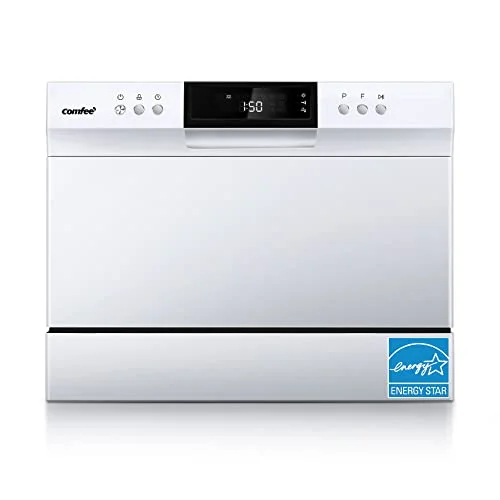
COMFEE' Countertop Dishwasher, 6 Place Settings

The only machine here that comes out ahead on both price and verified capacity
Countertop, faucet · 6 place settings, up to 70 pieces · 19.7 × 21.6 × 17.2 in · Energy Star

At $46.49 per place setting, this is the lowest per-setting price we can actually verify in this comparison, and it's verifiable precisely because the listing states a number instead of a vague dish count. It's also the only machine ranked here on hard math rather than an educated guess about capacity, which is its own kind of value: you know exactly what you're paying for.

The trade-offIt's a faucet-only machine with no tank backup, and at 21.6 inches wide it occupies more countertop than any of the smaller tank machines in this set.

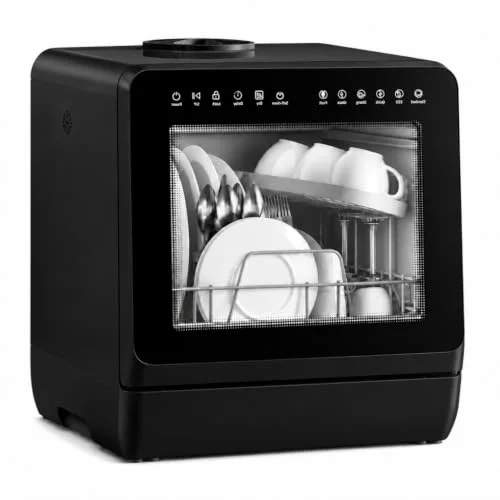
COMFEE' countertop dishwasher
$46.49
Per place settingCheck price →
02Best entry price

BEADSTER Countertop Dishwasher, 5L Tank Water Softener

The lowest sticker price in the comparison, with a feature the others skip
Countertop, 5 L tank, no hookup · built-in water softener · place settings not stated

At $169.00 this is tied for the cheapest machine here, and it adds a built-in water softener — a feature that matters a lot if your tap water is hard and does nothing at all if it isn't. We can't compute a price-per-setting figure for it because the listing doesn't state one, which means ranking it purely on value requires treating "lowest entry cost, no plumbing required" as the value proposition, rather than pretending we know its per-dish cost.

The trade-offNo place-setting count means no way to verify how much it actually holds per cycle — judge it on price and the softener, not on capacity you can't confirm.

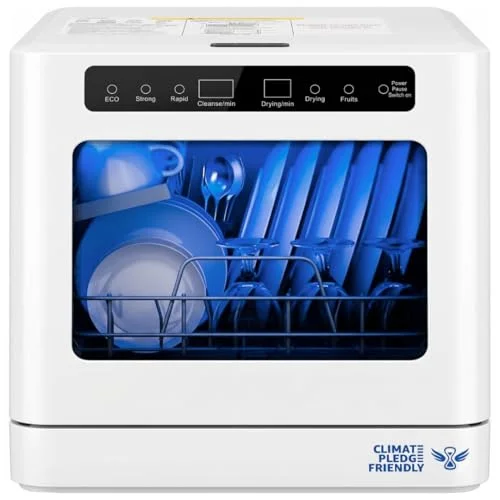
BEADSTER countertop dishwasher with 5L tank
$169
Lowest priceCheck price →
03Faucet-only budget pick

Collier Kitchen Portable Countertop Dishwasher

A straight-faucet kitchen on the smallest possible budget
Countertop · built-in water tank & faucet hose connection · place settings not stated

Within a dollar of the BEADSTER on price, this one leans on an included faucet adapter rather than a softener as its headline feature. Its listing describes both a built-in tank and a hose connection, but gives no place-setting number and no tank capacity, so there's even less to verify here than with the BEADSTER — it's a reasonable low-budget option, not a machine we can place confidently on the value ranking.

The trade-offThe thinnest published specification sheet in this comparison. If capacity matters to you, this is the machine to ask the most questions about before buying.

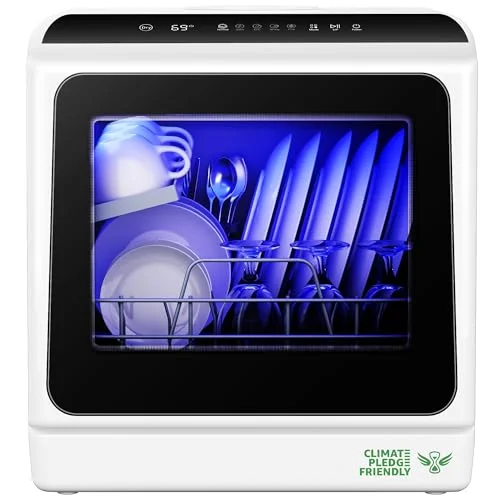
Collier Kitchen portable countertop dishwasher
$170
Budget pickCheck price →
04Quiet, dual water source

EUHOMY Countertop Dishwasher Portable, 6 Programs, 40 dB

Open-plan kitchens that want a tank backup and don't want to hear the cycle running
Countertop, Large variant · 5 L tank or faucet hose · 40 dB rated · 6 programs · place settings not stated

At $249.00 this sits between the two budget machines and the COMFEE', and its case for the money is noise and flexibility rather than capacity: a 40 dB rating (a manufacturer claim, not an independently measured one) and the choice of tank or faucet depending on what your kitchen offers that day. Like the two cheaper machines, no place-setting figure is published, so we're ranking it on stated features, not a per-dish price.

The trade-offIt costs $80 more than the cheapest machines here while giving you no more verifiable capacity information than they do — you're paying for the quiet rating and the dual water source, not for a confirmed larger wash.

EUHOMY countertop dishwasher, Large variant
$249
40 dB ratedCheck price →
05Most capacity, worst per-setting rate

BLACK+DECKER 18-Inch Portable Dishwasher, BPD8B

Only worth it if you specifically need the floor-standing class
Freestanding on castors, 18 in wide · 8 place settings · faucet only · Energy Star

This machine has the most verified capacity of anything in the comparison and the highest price per setting — $76.25, against the COMFEE's $46.49 — which is exactly why it's ranked last on value despite being the largest machine here. It earns its place on the list for buyers who need the 18-inch class specifically: a real dishwasher on wheels that gives back counter space, not a bigger version of a countertop machine.

The trade-off$331.05 more than the COMFEE' for two extra place settings — $165.53 per extra setting, well above either machine's own average rate. Buy it for the floor-standing class, not for the marginal capacity.

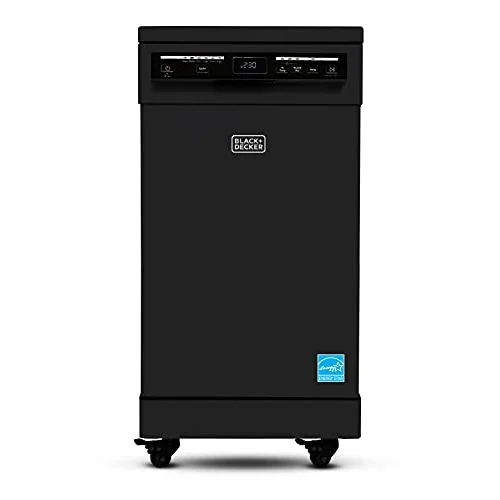
BLACK+DECKER 18-inch portable dishwasher on wheels
$76.25
Per place settingCheck price →
Do it yourself

A simple worksheet to run the math on any listing

Use this on any portable dishwasher listing, not just the five above:

  1. Find the stated place-setting count. It's usually in the title or the first bullet. If the listing only says "washes 30+ dishes" or similar, that is not a place-setting count — treat it as unstated.
  2. If no count is stated, don't estimate one. Either count the individual plates, bowls, cups and utensils the listing itself describes and divide by ten, or accept that you can't rank this listing on price per setting and judge it on price, tank capacity and dimensions instead.
  3. Divide the current price by the place-setting count. Use the live price on the page you're looking at, not a number from a review site — prices move daily.
  4. Compare the result only within the same class. Price per setting on a countertop machine versus another countertop machine is a fair fight. Comparing a countertop machine against an 18-inch floor-standing one tells you about the capacity premium, not about which is the better countertop dishwasher.
  5. Before upgrading for capacity alone, calculate the marginal rate. Subtract the cheaper machine's price from the pricier one's, subtract the cheaper machine's settings from the pricier one's, and divide. If that number is well above either machine's own per-setting price, you're paying a premium for the extra capacity specifically — make sure you need it before you pay it.

If a cycle-count comparison matters as much as capacity to you — some buyers care more about how many wash programs a machine offers than how many settings it holds — the same "state it or it doesn't count" rule applies, and our guide to wash-program counts walks through which extra cycles are worth paying for.

FAQ

Common questions about price per place setting

What's a fair price per place setting for a portable dishwasher?

In this comparison, the two machines with a stated place-setting count land at $46.49 per setting (COMFEE', 6 settings, $278.94) and $76.25 per setting (BLACK+DECKER, 8 settings, $609.99). The higher figure buys a different class of machine — an 18-inch freestanding unit on castors rather than a countertop model — not just two extra settings, so the two numbers aren't a simple "cheaper is better" comparison. The other three machines in this piece don't state a place-setting count, so no per-setting price can be verified for them.

Why don't some listings state a place-setting count?

We can't know a seller's reasoning, but the pattern across this category is that listings quoting a vague figure like "30+ dishes" rather than a specific place-setting number tend to be smaller-capacity machines where a precise count would look less impressive than the vague one. Treat the absence of a stated count as information: it means you cannot verify how much the machine actually washes per cycle, and you should shop it on price, tank size and dimensions instead of assumed capacity.

Is a cheaper tank machine ever the better value?

Yes, for the right buyer. If you're washing for one or two people with a light daily load, the capacity ceiling that makes a 5-litre tank machine a poor fit for a family of four may never come into play for you, and a lower one-time price with no faucet-compatibility requirement is a genuine advantage. Price per place setting matters most when you're actually filling the machine to capacity; it matters less if you never will.

How do I calculate price per place setting myself on a listing I'm looking at?

Divide the current price by the place-setting count stated in the listing's title or bullets. If no count is stated, count the individual plates, bowls, cups, saucers and utensils the listing describes and divide that total by roughly ten — a defined place setting is about ten items. If the listing gives you too little information to do either, treat it as a machine you can't rank on this metric and compare it on price, tank capacity and dimensions instead.

Keep reading

Next, from this site