Best Portable Dishwashers
Guide · Wash programs

The most wash programs? Fewer than you'd use.

One countertop machine in our database lists five wash programs. Another lists eight. The gap on the spec sheet looks like a gap in capability — it mostly isn't. Here's what each extra cycle actually changes, which programs owners reach for week to week, and whether paying for a bigger dial buys you anything at all.

By Ilane Tall · Updated October 11, 2026 · Research-based.

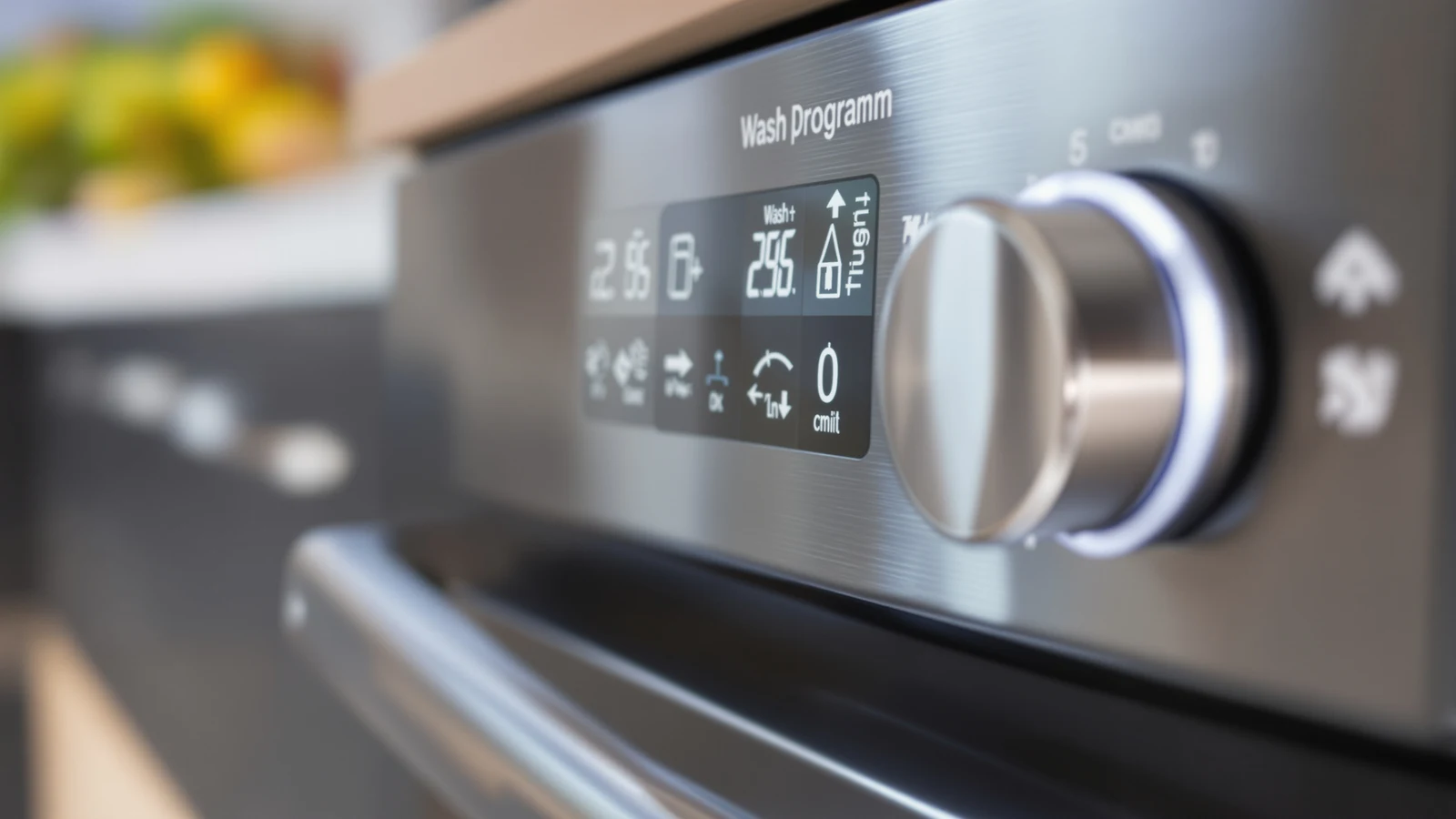
Control panel of a countertop dishwasher showing a row of wash program icons and a selector dial

Reader-supported: we may earn a commission when you buy through the links on this page, at no additional cost to you. Prices move constantly — confirm the live price before you order.

Program count has become a headline spec in this category the way megapixels once were for cameras: a number printed on the box that's easy to compare and easy to market, whether or not it reflects a meaningful difference in use. A five-program countertop dishwasher and an eight-program one both wash dishes with hot water sprayed under pressure. The question worth asking before you pay extra for the bigger number is what the additional programs actually do, and whether you'd ever turn the dial to them.

This guide works through three real countertop machines carrying published program counts of five, seven and eight, looks at what each additional cycle mechanically changes versus what it just renames, and makes the case — plainly, where the evidence supports it — that the program count on the box is one of the least informative numbers in a dishwasher listing.

How this page is built

We compare the published program names, cycle counts and stated specifications on the Amazon listings for the three machines named below, plus general, non-product-specific facts about how dishwasher cycles are engineered. We do not physically test these machines, we do not run a testing lab, and we do not publish star ratings or review counts — Amazon's product data returns neither for this category, so there are none on this site. Where a listing's own program count bundles in non-wash functions, we say so rather than let the number stand unexamined.

The gap

What a 5-program machine covers versus a 7- or 8-program one

Strip the marketing names away and nearly every countertop dishwasher program is a variation on the same four mechanical dials: water temperature, soak-and-wash duration, number of fill-and-drain passes, and whether a drying phase runs at the end. A five-program machine typically covers the two or three combinations that matter most — a long hot wash for greasy loads, a shorter one for lighter soil, and a cooler cycle for glass — and stops there.

Go to seven or eight named programs and the additional slots usually do one of two things: they split an existing combination into a narrower-use variant (a "Baby Care" cycle that's really the hot wash held at a specific temperature, or a "Fruit" program that's really the gentle glass cycle under another name), or they add a genuinely distinct function that isn't a wash cycle at all — a UV step, an auto-door-open drying mode, a delay timer, a child lock. Both are real differences on the control panel. Only the first kind changes how your dishes get cleaned.

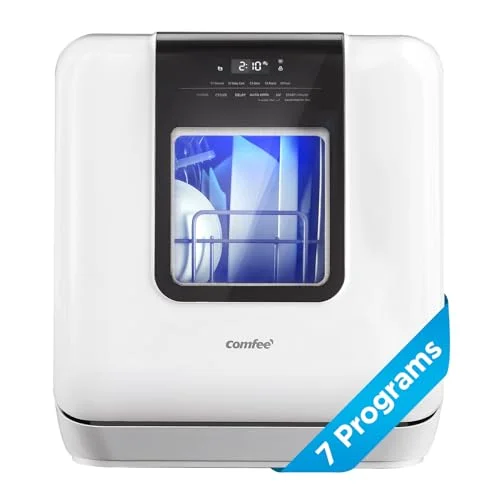
The COMFEE' Miniplus in this guide makes the split explicit in its own listing copy: it describes itself as "5+2" — five washing programs (Normal, Rapid, Hygiene, Fruit, Glass) plus two enhanced functions, Auto-Door-Open drying and a UV hygiene step, that aren't wash cycles at all. Marketed as "7 Programs," it's mechanically a five-cycle machine with two extra features bolted on. That distinction — washing programs versus bundled functions — is the one spec sheets consistently blur, and it's the reason program count alone tells you less than it appears to.

In practice

The programs owners are likely to actually use, week to week

Across the three machines here, the published program lists add up to roughly a dozen distinct names: Normal, Rapid, Standard, Quick, Strong, ECO, Fruit, Glass, Hygiene, Self-Clean, plus Delay, Child Lock and Dry as non-wash extras. Most households never reach for more than two or three of them.

  • The everyday wash — Normal, Standard or Strong, depending on the brand's naming — is the cycle most loads actually need: hot water, a soak phase, enough fill-and-drain passes to clear detergent and food residue. This is the program that justifies owning the machine at all.
  • A short cycle — Rapid or Quick — covers same-day, lightly soiled loads: a few glasses and plates rinsed within an hour or two of use, before anything has had the chance to dry on. It's genuinely useful, and it's also the second program most owners settle into using regularly, alongside Normal.
  • Glass, a cooler, gentler cycle for stemware and delicate items, earns its slot in households that actually own wine glasses or china. It's one of the more defensible "extra" programs because the lower temperature is a real, mechanical difference, not a renamed version of Normal.

Everything past that third program tends to sit unused for most buyers — not because it doesn't work, but because the situations it's built for (a hygiene cycle for baby bottles, a fruit-and-produce rinse, a self-clean maintenance cycle) come up rarely or never in a given household. If your household does run baby bottles or produce through the machine regularly, those specific programs earn their place; if it doesn't, they're dial positions you'll scroll past for the life of the machine. We cover one of those specialty cycles in more depth in our guide to portable dishwashers with a UV or hygiene cycle.

The picks

Ranked by published program count

01Most programs published

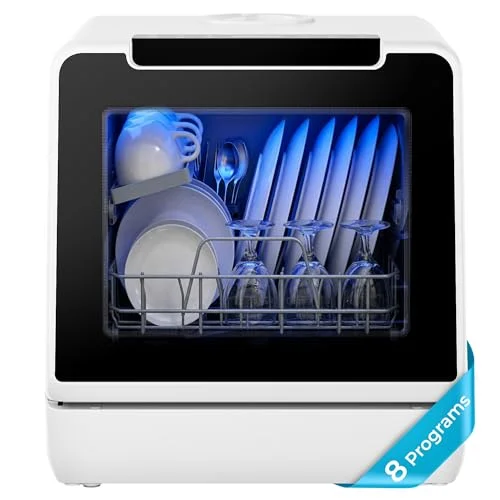
EUHOMY Countertop Dishwasher, 8 Programs

For buyers who specifically want the largest program count on the market
Countertop · 5 L tank or faucet (G3/4) · 8 programs · 30+ items, plates to 10.25 in · 40 dB rated

This is the highest program count in our database for a countertop machine, and the listing leads with that number in its own title. What the listing's bullet copy doesn't do is name all eight — it details tank-versus-faucet operation, the 15.74 × 16.14 × 18.11-inch footprint, capacity and a fruit basket and cutlery holder, but stops short of spelling out the full program list the way some rivals do. Take the headline figure as accurate but treat it as a count rather than a menu you can plan around sight-unseen; confirm the specific cycle names on the current listing before you buy if the exact eight matter to you.

The trade-offAn unusually high program count is the clearest reason to buy this one over the other two here, but it's also the pick where you have the least visibility into what distinguishes program six from program seven before the box arrives.
EUHOMY countertop dishwasher in black with an 8-program control panel
$289.99
8 programsCheck price →
02Most named wash cycles

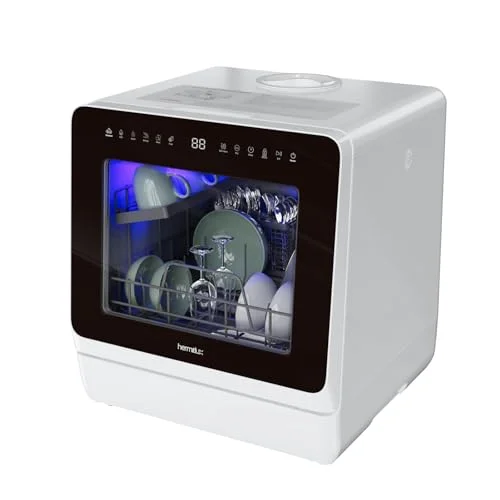
Hermitlux Countertop Dishwasher, 7 Washing Programs

For buyers who want the extra cycles to actually be wash cycles
Countertop · 5 L per cycle · 7 washing programs + 3 extra functions · 5 place settings, 30+ pieces · 16.85 × 16.73 × 18.23 in

Of the three machines here, this one draws the cleanest line between washing programs and everything else: seven named wash cycles — Standard, Quick, Strong, ECO, Fruit, Self-Clean and Glass — sold separately from three extra functions (Delay, Child Lock and Dry) that the listing itself doesn't count as programs. The variant we're linking is marketed with all ten functions together as "10 Functions," but the washing side alone, at seven, is the most of any pick in this guide that is genuinely seven distinct wash sequences rather than a wash count padded with features.

The trade-offFive place settings and a 16.85-inch footprint keep this toward the compact end of the category, so the extra cycle variety doesn't come with extra capacity. And more dial positions mean more labels to learn — Strong versus Standard versus ECO isn't self-explanatory from the control panel alone.

Hermitlux countertop dishwasher with black glass door
$299.99
7 washing programsCheck price →
03Marketed highest, washes fewest ways

COMFEE' Countertop Dishwasher, Miniplus Auto Door Open

The clearest example of why program count alone is a weak comparison point
Countertop, mini · 6 L tank or faucet · 5 washing programs + 2 enhanced functions · plates to 10.5 in

The listing title advertises "7 Programs," and by its own "5+2" breakdown, that figure is accurate — but only two of the seven are washing programs in name only once you separate them out: Auto-Door-Open is a drying mode, and the UV Hygiene step is a sanitizing add-on, not a sixth or seventh way to wash a plate. The actual wash menu is Normal, Rapid, Hygiene, Fruit and Glass — five cycles, the same count as the smallest-dial machine in our database. What you're paying the "7 Programs" premium for is the auto-open drying and the UV step, not additional wash versatility.

The trade-offIf UV sanitizing and auto-open drying are features you want, this machine delivers them at a real cost in control-panel complexity for a program count that reads bigger than its washing capability actually is. If you don't care about those two features specifically, a plainer 5-program machine gets you the same washing range for less money and one less set of labels to learn.

COMFEE' Miniplus countertop dishwasher with auto door open drying
$342.05
5 wash + 2 functionsCheck price →
The dial

Where more programs means more dial complexity, not more cleaning power

All three of these machines share the same wash mechanism underneath the program list: a pump, one or two spray arms, a heater, and a tub that holds somewhere around five to six liters of water per cycle. No program on any of them adds a physical cleaning capability the others lack — there's no program that sprays harder, reaches corners the others can't, or uses a different detergent chemistry. What changes between programs is duration, temperature and how many times the machine fills and drains.

That means the ceiling on cleaning power is set by the machine's water temperature and soak time on its longest, hottest cycle — not by how many additional named programs sit below it on the dial. The Hermitlux's seven washing programs and the COMFEE' Miniplus's five both top out at whatever their respective hottest, longest cycle can do; adding a Fruit program or a Self-Clean program doesn't raise that ceiling, it just adds another way to run a shorter or cooler version of the same underlying wash.

What more programs does add, reliably, is more to learn on the control panel: more icons to memorize, more labels that sound similar (Standard versus Strong, Quick versus Rapid), and a higher chance that an unfamiliar guest or a second household member picks the wrong one by accident. A five-program dial with Normal, Quick, Glass, ECO and Dry is close to self-explanatory the first time you look at it. An eight-program dial on an unfamiliar brand, with no printed program list in the Amazon bullets, asks you to either guess or dig out the manual before the first load — which is a cost, even if it's a small one.

Time, not just programs

The cycle-time trade-off that comes with extra programs

Program count and cycle length are two separate specs, and a machine with more programs isn't necessarily faster or slower on any given one — but splitting a wash menu into more, narrower options does tend to push the total menu toward both extremes at once. A five-program machine that only offers one fast option and one slow one gives you a coarse choice: quick or thorough. A seven- or eight-program machine that adds Strong, Self-Clean or a dedicated Hygiene cycle on top of Quick and Standard is, in effect, adding options at both ends — a shorter shortcut and a longer, hotter extreme — while the middle-ground Normal cycle most loads actually need stays roughly the same length across all three machines in this guide.

None of the three listings here publish a specific minute figure for every program; that detail simply isn't in the bullet copy for any of these models, so we're not going to invent one. What is safe to say, mechanically: a hygiene or self-clean program that holds water at a higher temperature for longer will run longer than the Normal cycle on the same machine, and a Quick or Rapid cycle will run shorter by cutting the soak phase — the same trade-off we detail machine-by-machine in our guide to rinse-only and quick cycles on a portable dishwasher. The practical upshot for a buyer comparing program counts: more programs generally means a wider spread between your fastest and slowest options, not a faster version of the cycle you'll use most.

The decision

Is a simpler machine with fewer programs the smarter buy?

Buy the higher program count if

One of these applies to you

You specifically want a UV or hygiene step for baby bottles or allergy-sensitive dishes, you run fruit and produce through the machine often enough that a dedicated cycle matters, or you simply want the most granular control over temperature and duration and don't mind learning a longer label list. For those buyers, the extra programs aren't padding — they're the reason to choose that model.

Buy the simpler machine if

This describes your household

You expect to use two or three programs regularly — an everyday wash, a quick cycle, maybe Glass — and the rest would sit unused. In that case, a 5-program machine gives you the washing range that matters at a lower price and a shorter learning curve, with no cleaning capability actually sacrificed, since the ceiling is set by temperature and soak time, not by how many extra names share the dial.

Fewer programs is not a compromise worth apologizing for. Mechanically, a well-specified five-cycle machine washes exactly as well as a well-specified eight-cycle one on the loads both would actually run most weeks, because the hot-soak-rinse sequence underneath Normal is the same on either. The honest test before buying up the program ladder: name the specific extra cycle you expect to use and how often. If you can't, the bigger number on the box is costing you money and control-panel complexity for programs that will sit untouched — the same math that applies to picking a machine by price point rather than feature count, which we work through in our guide to the best portable dishwashers under $200.

At a glance

The three machines, by program count

Washing programs counted separately from non-wash functions where the listing makes that distinction. Prices move constantly on Amazon — confirm the live price before you buy.

DishwasherWashing programsExtra functionsWater sourcePrice
EUHOMY, 8 Programs8 (names not fully listed)—5 L tank or faucet$289.99Price
Hermitlux, 7 Washing Programs7: Standard, Quick, Strong, ECO, Fruit, Self-Clean, GlassDelay, Child Lock, Dry5 L per cycle$299.99Price
COMFEE' Miniplus, "7 Programs"5: Normal, Rapid, Hygiene, Fruit, GlassAuto-Door-Open, UV Hygiene6 L tank or faucet$342.05Price
Go deeper

Related reading

FAQ

Common questions

Does more wash programs mean a dishwasher cleans better?

Not directly. All the countertop machines in this guide wash with the same mechanism — hot water sprayed under pressure from a pump through one or two spray arms. Extra programs change duration, temperature and the number of fill-and-drain passes; they don't add a cleaning capability the base cycle lacks. A machine's cleaning ceiling is set by its hottest, longest wash cycle, not by how many additional named programs sit on the dial below it.

How many wash programs do I actually need?

Most households settle into using two or three: an everyday Normal or Standard wash, a Quick or Rapid cycle for lightly soiled same-day loads, and sometimes a Glass cycle for stemware. Specialty programs like Hygiene, Fruit or Self-Clean only earn their place if you have a recurring use for them — baby bottles, produce washing, or routine maintenance cleaning of the tub itself.

Why do two machines both advertised as "7 programs" list different things?

Because "programs" isn't a standardized term across brands. Some manufacturers count only distinct wash cycles; others fold in non-wash functions like auto-open drying, UV sanitizing, a delay timer or a child lock into the same headline number. The COMFEE' Miniplus in this guide markets "7 Programs" as "5+2" — five actual washing cycles plus two added functions — while a machine with seven genuinely distinct wash cycles is a mechanically different product despite the matching number on the box.

Do shorter programs use less water than Normal?

None of the listings in this guide publish a specific per-cycle water figure for every program, so we won't invent one. Mechanically, a shorter program that skips fill-and-drain passes and cuts the soak phase is, by necessity, using fewer of those passes than a long Normal or Heavy cycle — every pass skipped is water the machine didn't pump, heat or drain. Treat that as a reasonable inference from how the cycles are engineered, not a measured figure.