Best Portable Dishwashers
Buying Guide · Built-in water softeners

The dishwashers that soften water. Not just rinse it away.

Rinse aid breaks surface tension so water sheets off glass instead of spotting it. A softener does something earlier and more useful: it strips the calcium and magnesium out of the water before it ever hits a dish. A handful of countertop dishwashers now build that function in. Here's what it actually does, what it costs to keep running, and which machines have it.

By Ilane TallUpdated October 15, 2026 · Research-based.

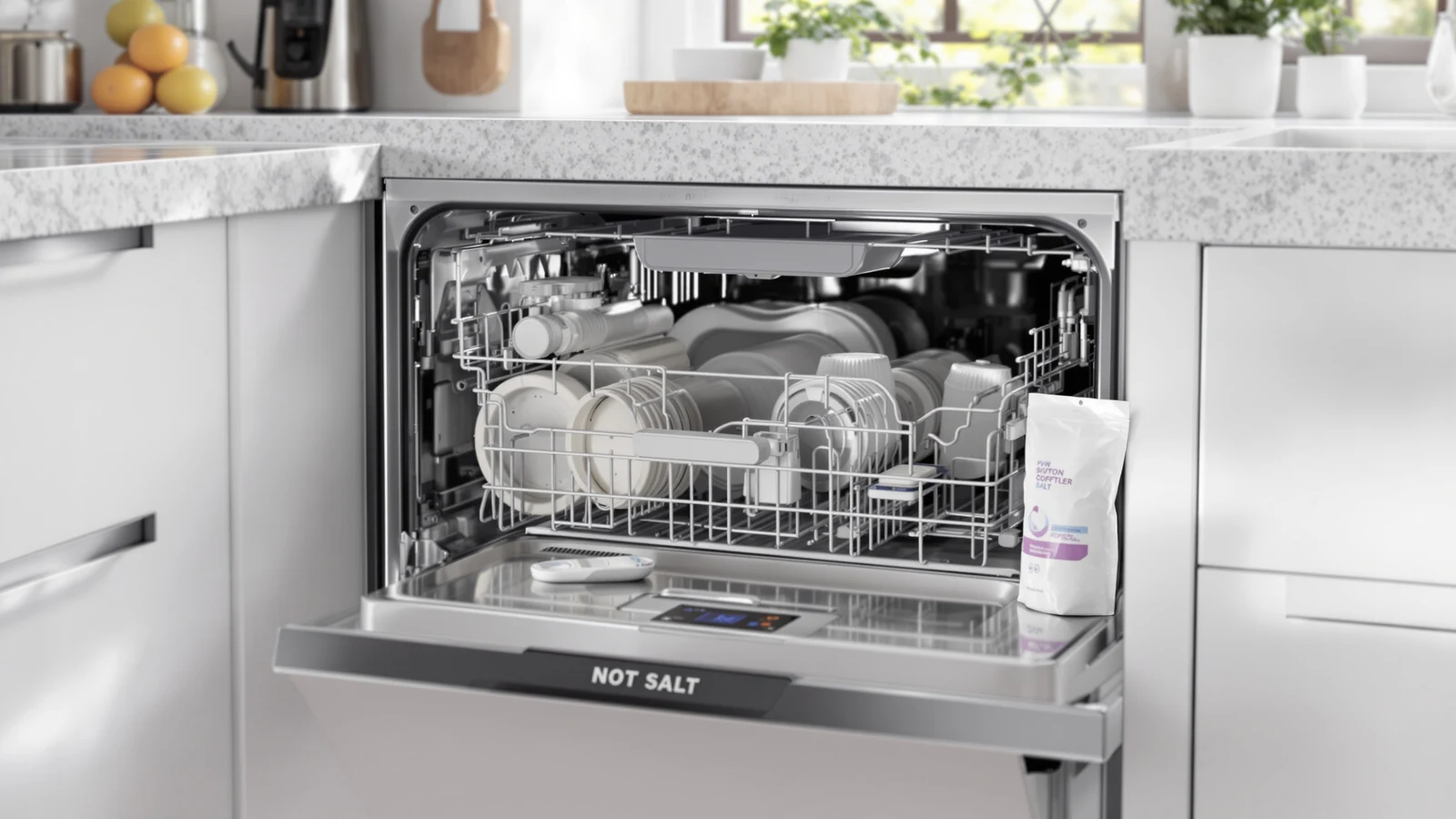
Compact countertop dishwasher with a water softener compartment open on a kitchen counter, showing a salt or cartridge access point

Reader-supported: we may earn a commission when you buy through the links on this page, at no additional cost to you. Prices move constantly — confirm the live price before you order.

Almost every countertop dishwasher ships with a rinse-aid dispenser, and almost every manufacturer treats that as the hard-water answer. It isn't, not fully. Rinse aid is a surfactant: it changes how water behaves on a glass surface in the last thirty seconds of a cycle. It does nothing to the minerals dissolved in the water itself, which means a rinse-aid-only machine in a hard-water house is still pumping calcium and magnesium through its heating element, its pump and its spray arms, load after load, for the life of the machine.

A small number of listings in this category now build in an actual softener — a unit that treats the water supply before the wash starts, the way a full-size European dishwasher has for decades. We compared the four portable and countertop models in our database that advertise one, what each listing actually discloses about how the softener works, and what owning one adds to your routine that a plain rinse-aid machine doesn't ask of you.

How this page is built

We compare published specifications, what ships in the box, and live price. We do not physically test these machines, we do not run a testing lab, and we do not publish ratings we cannot verify — Amazon returns no rating and no review count for any of the four machines below, so there are no stars on this site. Where a listing is specific about how its softener works, we say so; where it isn't, we say that too, rather than filling the gap with a guess.

The mechanism

What a built-in softener changes that rinse aid alone can't

Rinse aid treats the dish. A softener treats the water.

Hard water carries dissolved calcium and magnesium. Run it through a dishwasher's heating element and those minerals come out of solution as heat is applied, the same way a kettle grows a white crust — that's limescale, and it builds on the heater, the spray-arm jets and the inside of the tub whether or not your glasses look spotted. Rinse aid doesn't touch any of that; it only changes the surface tension of the water in the final rinse, which is why it helps with spotting and streaking but does nothing for the buildup happening inside the machine.

A softener works earlier in the chain. It passes incoming water through a resin bed, a salt-based exchange unit, or an electronic conditioner before the wash cycle starts, swapping out the hardness-causing minerals or disrupting how they crystallize. Less scale reaches the heater and the jets, which is the part of the machine a rinse-aid-only model has no defense for. On a portable or countertop dishwasher — a 5-litre tank and a heating element a fraction the size of a full-size machine's — that protection matters more, not less, because there's less thermal mass to tolerate a coating of scale before performance drops.

The two aren't competing — they're sequential

Buying a softener model doesn't mean skipping rinse aid. The softener's job ends when the wash water is cleaner going in; rinse aid's job is still the final sheeting action on glass and flatware. Every machine in this guide still has a rinse-aid dispenser, and the honest framing is that the softener is solving a problem rinse aid was never built to solve in the first place — not an upgraded version of the same feature.

Ownership

Salt, cartridges, and the upkeep a softener actually adds

A softener is not a feature you set once and forget — that's the trade on the other side of the limescale protection, and it's worth knowing before you add $40 to $150 to the price of a countertop machine. Full-size dishwasher softeners, the kind this category borrows the idea from, typically run on dishwasher-grade salt topped up into a dedicated compartment every few weeks depending on water hardness and how often the machine runs. Some countertop implementations use a sealed cartridge or resin unit instead, which is replaced rather than refilled. The two systems ask different things of you — one is a recurring small purchase and a five-minute top-up, the other is a periodic part swap — and not every listing in this category says which one it is.

Of the machines below, the AIRMSEN explicitly names its medium: the listing states the softener supports dishwasher salt, which means you're buying and topping up salt the same way you would for a full-size European machine — a known, inexpensive routine, but one more thing on the shopping list. The BEADSTER listings describe "a built-in water softener" that reduces limescale and water spots without naming whether it runs on salt, a cartridge, or a passive conditioning unit; if that detail matters to you, confirm it on the current listing before ordering; we won't guess at a mechanism the manufacturer hasn't published. The HAVA softener is described as a dial you set to match your local water hardness — closer to a conditioning setting than a consumable you replenish, though HAVA's own listing doesn't spell out the servicing interval either.

The practical upshot: a softener model is not maintenance-free, it just moves some of the maintenance from "wipe down the tub" to "keep a specific consumable in stock." If you're the kind of owner who lets rinse aid run dry for a month before noticing, factor that in — an empty softener reservoir doesn't make dishes dirty, but a de-scaled, unprotected heater is exactly the long-term problem a softener was bought to avoid in the first place. For the broader picture of what wears a small dishwasher out over years of use — pumps, heaters, door seals — see how long a portable dishwasher actually lasts.
The picks

The four machines, and how each handles the softener

01Established hard-water pick

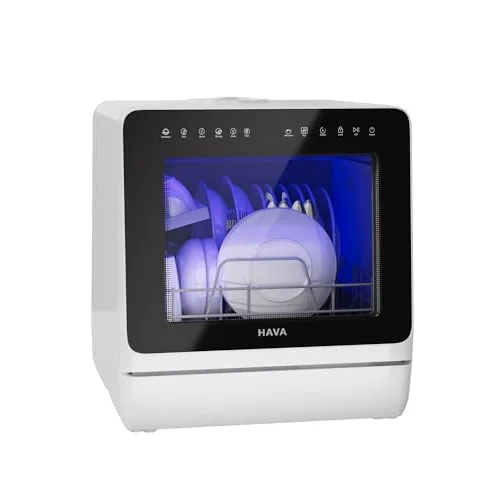
HAVA Countertop Dishwasher with Water Softener & Enhanced Energy Efficiency

For buyers who want the softener dialed to their own water, not left on one default setting
Countertop · tank or faucet · integrated water softener · optimized ECO mode · adjustable tableware basket

This is the most expensive machine in the comparison, and the extra money goes almost entirely into the softener rather than into capacity figures the listing doesn't quote. You choose a softener setting that matches your water's hardness rather than running one fixed level, which is closer to how a full-size dishwasher's softener works than the simpler on/off units on cheaper countertop machines. The ECO mode is described as "optimized" specifically around the softener's water and energy use, and the adjustable basket is pitched at households that need the rack reconfigured rather than a fixed four-setting layout.

The trade-offThe listing doesn't publish a place-setting count, a plate-size limit, or the softener's servicing medium, so you're trusting the brand's description of "integrated softener" without the specifics a buyer gets from AIRMSEN's listing. Confirm the current listing's capacity claims before you order if settings count matters to you.

HAVA countertop dishwasher with integrated water softener in black
$369
Softener built inCheck price →
02Most disclosed softener

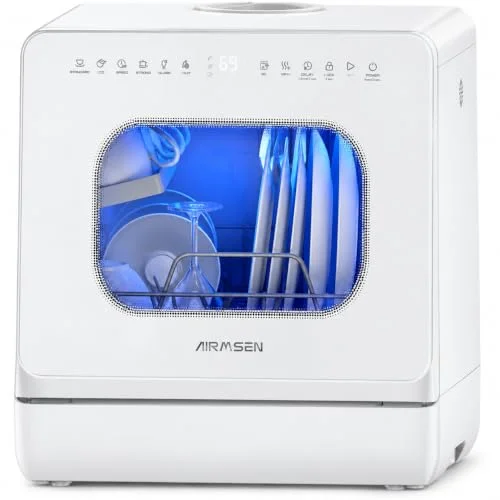
AIRMSEN Countertop Dishwasher with Built-in Water Tank & Softener

Buyers who want to know exactly what the softener runs on before they buy
Countertop · 5 L (1.3 gal) tank or faucet · softener supports dishwasher salt · 8 programs · wash up to 167°F

Of the four machines here, this is the only listing that names the softener's consumable outright: it supports dishwasher salt, the same medium a full-size European machine uses, rather than leaving the mechanism to guesswork. It runs from either its own 5-litre tank or a faucet connection, which gives it the no-hookup flexibility the BEADSTER twins have and the HAVA and most 18-inch machines don't. Eight programs cover Standard, ECO, a 29-minute Speed cycle, Strong, Glass, Fruit, Self-Clean and a Dry+ mode, and every cycle except Fruit washes at up to 167°F before a hot-air dry — a genuinely hot wash for a machine this size. A 1-to-18-hour delay start and a child lock round out the controls. This brand's broader lineup is picked apart in why so many AIRMSEN listings look identical, which is worth reading before you buy if you see a near-twin listing at a different price.

The trade-offSalt is cheap but it's a recurring purchase you have to remember, and the listing doesn't publish a place-setting count or a maximum plate diameter — it's sold on program count and wash temperature, not capacity. If your household's dish volume is the deciding factor, that's a gap you'll need to confirm on the current listing.

AIRMSEN countertop dishwasher with built-in water tank and softener in white
$214
Salt-based softenerCheck price →
03Cheapest softener model

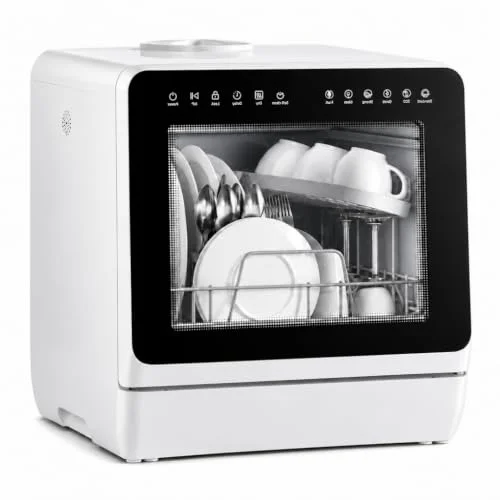
BEADSTER Countertop Dishwasher 5L Tank Water Softener No Hookup

Buyers who want the limescale protection at the lowest entry price in this comparison
Countertop, mini · 5 L built-in tank, no hookup · built-in water softener · 8 programs · plates to 10.24 in

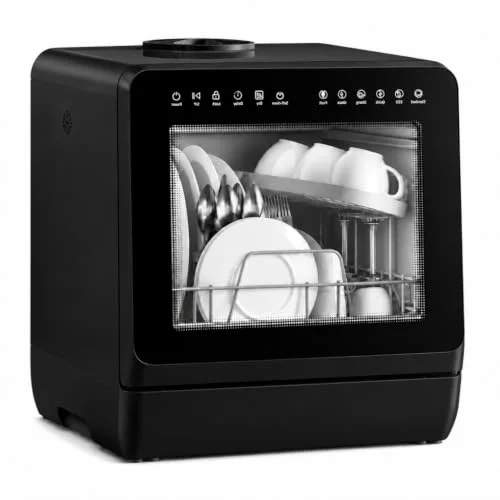
At roughly $169, this is less than half the price of the HAVA and about $45 under the AIRMSEN, and it's still built around a tank rather than needing a faucet at all — fill the 5-litre reservoir and plug it in. Eight programs cover Normal, ECO, Strong, Rapid, Glass, Baby Care, Self-Clean and Dry, with a child lock and an 18-hour delay start. The double-layer metal rack takes plates up to 10.24 inches, and the 360° spray is described the same way across the brand's listings. It's sold in two color options at the same price and spec: this Black Door version (ASIN B0HKWCF3TC) and an all-black all-black twin (ASIN B0HKWFMG63) — same machine, pick on looks.

The trade-offThe listing says "built-in water softener" without naming whether it runs on salt, a cartridge, or a passive conditioning element, which is the one disclosure the AIRMSEN above gives you and this one doesn't. At this price point you're also not getting the tank-or-faucet flexibility the AIRMSEN offers — it's tank only.

BEADSTER countertop dishwasher with 5-liter water tank and built-in softener, black door
$169
Lowest priceCheck price →
The cheaper alternative

Softener versus simply descaling more often

Every countertop dishwasher, softener or not, can run a descale cycle — typically a citric-acid or dedicated descaler product run through an empty machine on a hot cycle every month or so in hard-water areas. It's the maintenance step most owners skip, and skipping it is the single biggest reason a cheap countertop machine's heater or pump fails early. So the honest comparison isn't "softener versus nothing," it's "softener versus a disciplined descaling habit," and the two solve the problem from opposite ends.

Descaling is reactive: scale forms, then you dissolve it, on a schedule you have to remember and maintain for the life of the machine. A softener is preventive: it keeps the minerals from depositing in the first place, so there's less to dissolve later — though manufacturers of softener models still recommend occasional descaling, because a softener reduces scale formation, it doesn't claim to eliminate it outright. Neither of these are claims we can verify independently; they're the manufacturer's own framing, and we pass them on as such rather than as a lab result.

Cost-wise, descaler product runs a few dollars a bottle and a once-a-month routine; dishwasher salt for a softener runs a similar small cost but needs topping up more frequently once the reservoir is in regular use. Neither is expensive in isolation. The real difference is what happens when you forget: skip descaling for six months in hard water and you're dissolving six months of buildup in one go, which is harder on an old gasket than six smaller doses would have been; let a softener's salt or cartridge run empty and the machine keeps working exactly like a non-softener model until you refill it — no sudden damage, just a return to the baseline. If remembering a monthly chore isn't realistic for your household, that asymmetry is the case for paying for the softener up front.

Going without

What a hard-water buyer gives up by skipping the softener

None of this makes a non-softener machine a bad purchase — most countertop dishwashers sold in the US don't have one, and most owners never run a softener model at all. What you give up by buying a plain machine in a genuinely hard-water area is specific, not vague:

  • Faster visible scale on glassware and the tub interior. Rinse aid masks spotting for a while; it doesn't stop the mineral deposit building on the tub walls and door seal that eventually dulls the interior and can affect how well the door seals.
  • A heating element working against a coating. Scale is an insulator. A heater coated in limescale has to work harder, for longer, to reach the same water temperature — which on a wash cycle that's supposed to hit 167°F on the AIRMSEN or a comparable figure on other machines, is the difference between a cycle that actually gets dishes that hot and one that falls short while the heater strains.
  • More frequent descaling to stay ahead of it. Without a softener doing some of the work, the descaling schedule above shifts from "every month or so" toward "more often," in genuinely hard water — which is more maintenance, not less, for the owner who skips the softener and also skips the discipline.
  • No protection if you forget the routine. A non-softener machine has no fallback between scheduled descales; a softener model, even an imperfect one, is doing some mineral reduction on every single cycle regardless of whether you remembered the descaler bottle.

If your water is soft or only mildly hard — check your local utility's water-hardness report, which is public information in most US municipalities — none of this applies, and a softener is a feature you'd be paying for and never using. The decision genuinely starts with a number from your water supplier, not with the shelf price of the machine.

The decision

When the extra cost is worth paying

Pay for the softener if

Any one of these is true for you

Your water utility's hardness report comes back "hard" or "very hard," not just "moderate." Or you've already seen scale buildup on an older kettle, coffee maker or dishwasher in the same kitchen. Or you know you won't keep up a monthly descaling habit, so the always-on protection is worth the extra $40 to $150 up front. Or you're buying a machine you intend to keep for years and want to protect the heating element for the long run rather than replace a scaled-up unit sooner.

Skip it and buy plain if

All of these are true for you

Your water is soft to moderately hard by the utility's own numbers. You're comfortable running a descaler bottle through the machine on a monthly schedule and will actually do it. Budget is the deciding factor and every dollar matters more than the maintenance trade. And you don't already own appliances in the same kitchen showing visible scale — the strongest practical sign hard water is a problem for you specifically, not just in theory.

There's a middle case worth naming: a buyer in moderately hard water who can't be bothered to descale but also doesn't want to spend $369 on the HAVA. The AIRMSEN at roughly $214 is the practical answer — a disclosed, salt-based softener plus tank-or-faucet flexibility at a price much closer to the budget-conscious machines we cover in our guide to dorm-room picks than to the premium end of this category. Program count matters here too; if cycle variety is your actual priority rather than the softener itself, our guide to wash-program counts covers whether extra cycles are worth paying for on their own. And if you'd rather solve spotting without the softener's ongoing upkeep at all, our guide to rinse-only and quick cycles explains where a shorter cycle with rinse aid alone is genuinely enough.

At a glance

The four machines compared

All figures are manufacturer specifications; prices are approximate and move constantly on Amazon.

DishwasherWater sourceSoftener disclosed asProgramsPrice
HAVA with Water SoftenerTank or faucetAdjustable setting by hardnessECO + others (not fully listed)$369.00Price
AIRMSEN with Tank & Softener5 L tank or faucetDishwasher salt8 (Standard, ECO, Speed, Strong, Glass, Fruit, Self-Clean, Dry+)$214.36Price
BEADSTER, Black Door5 L tank, no hookupNot specified by listing8 (Normal, ECO, Strong, Rapid, Glass, Baby Care, Self-Clean, Dry)$169.00Price
BEADSTER, All-Black5 L tank, no hookupNot specified by listing8 (same as above)$169.00Price
How we picked

Four machines, one real spec

We searched our product database for every portable or countertop dishwasher whose listing specifically claims a built-in water softener, rather than relying on rinse aid alone. That returned four machines across three brands. We did not include machines whose listings merely mention "soft water compatible" or "works with any water type," since that language describes tolerance, not a built-in treatment component — a distinction worth watching for in listing copy generally.

How we compared

Research, not a lab

We compared published specifications, what each listing discloses about the softener's mechanism, water source, program count, and live price. We don't physically test these machines and we don't run a testing lab. Where a listing doesn't name the softener's consumable or a capacity figure, we said so rather than filling the gap, and we show no star ratings because Amazon returns no verifiable rating data for any of these four products.

FAQ

Common questions about built-in softeners

Is a built-in water softener the same thing as rinse aid?

No. Rinse aid is a surfactant added to the final rinse that changes how water sheets off a dish, which reduces spotting and streaking but does nothing to the minerals dissolved in the water. A built-in softener treats the water supply before the wash starts, reducing the calcium and magnesium that would otherwise deposit as limescale on the heater, spray arms and tub. The two work at different points in the cycle and neither replaces the other.

Do all of these softeners run on salt?

Only one listing in this comparison says so explicitly: the AIRMSEN names dishwasher salt as the softener's medium. The BEADSTER listings describe "a built-in water softener" without naming whether it uses salt, a cartridge, or a passive conditioning unit, and the HAVA describes an adjustable setting based on water hardness rather than naming a consumable. Confirm the current listing before buying if the servicing medium is a deciding factor for you.

Can I just descale more often instead of buying a softener model?

For many owners, yes — regular descaling with a citric-acid or dedicated descaler product addresses the same scale buildup a softener prevents, and it costs less up front. The difference is that descaling is reactive and depends on you remembering a monthly routine, while a softener works preventively on every cycle regardless of whether you kept up the schedule. If your water is only moderately hard and you're disciplined about maintenance, descaling alone is a reasonable substitute.

Does a softener mean I can stop using rinse aid?

No. The softener and rinse aid solve different problems — the softener reduces the minerals reaching the machine's internals, while rinse aid affects how water behaves on the dish surface in the final rinse. Every machine in this guide still includes a rinse-aid dispenser, and manufacturers continue to recommend using it alongside the softener rather than as a substitute for it.

Keep reading

Next, from this site