Best Portable Dishwashers
Comparison · Countertop vs 18-inch portable

Countertop or 18-inch on wheels? Two different appliances.

Both are sold as "portable dishwashers" and share a category page, a set of search terms and almost nothing else. One lives on your worktop and can wash from a jug of water. The other is a real dishwasher on castors. Your cabinets, your faucet and your floor make the choice for you.

By Ilane Tall · Updated August 13, 2026 · Research-based.

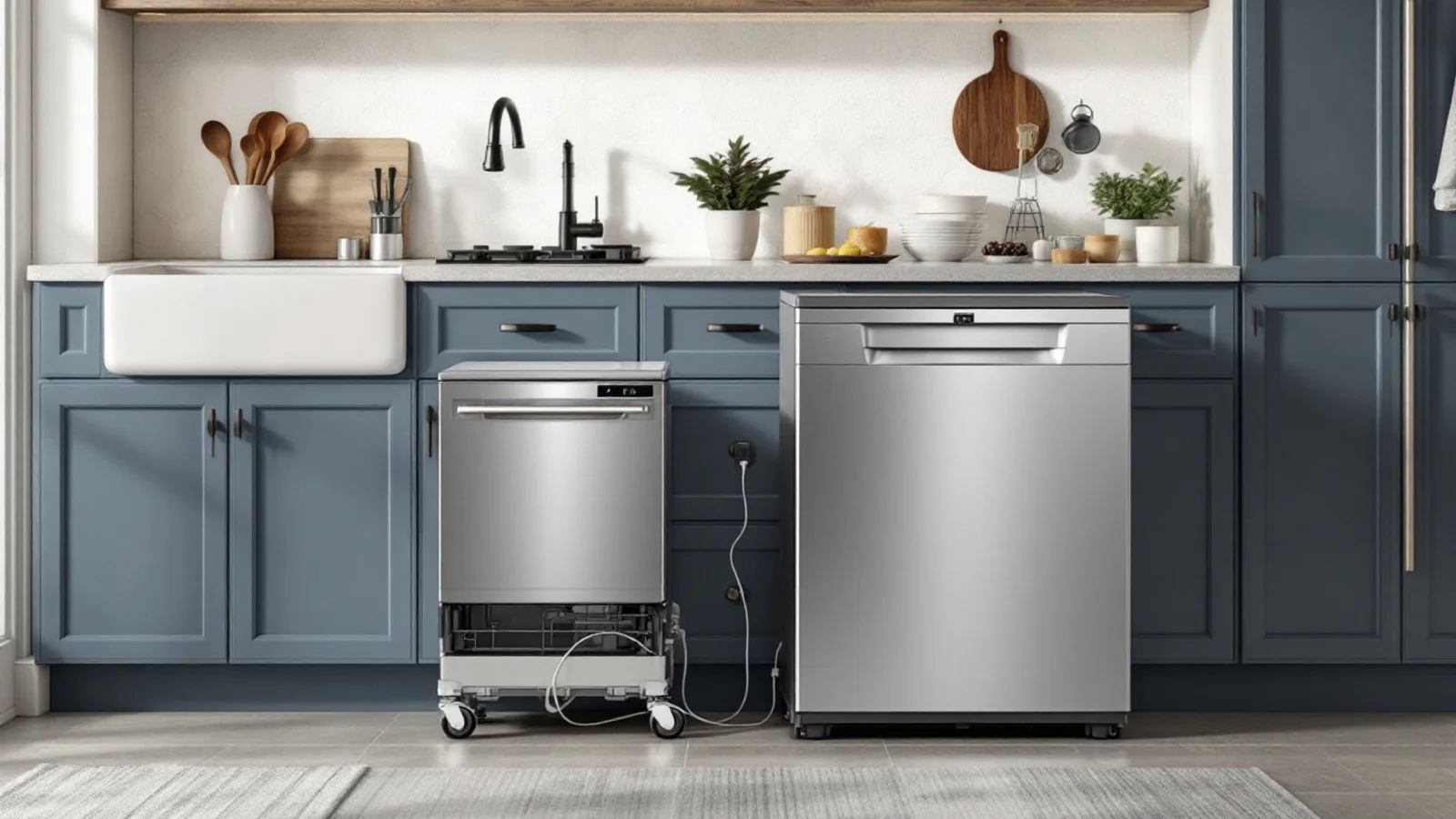
A compact countertop dishwasher beside a full-height 18-inch portable dishwasher on castors in a small kitchen

Reader-supported: we may earn a commission when you buy through the links on this page, at no additional cost to you. Prices move constantly — confirm the live price before you order.

Type "portable dishwasher" into Amazon and you get two machines that behave like different appliances. The first is about the size of a microwave — roughly 17 inches wide, 17 deep, 18 tall — sits on the counter next to the kettle, and on most models fills from a five-litre tank you top up with a jug, so it needs only a power socket. The second is a genuine 18-inch dishwasher on castors with a finished top: roll it to the sink, clip it onto the faucet, run it, roll it back.

They cost different money, hold different amounts, and fail for different reasons. The buyer who orders the wrong one finds out with the box open — the countertop machine an inch taller than the gap under the wall cabinets, or the rolling machine needing eighteen inches of floor the kitchen doesn't have. Capacity, price, clearance, water source, drain reach, noise and moving house below, then a plain buy this one if… section.

How this page is built

We compare published specifications, what ships in the box, dimensions, water source, capacity and price. We do not physically test these machines, we do not run a testing lab, and we do not publish ratings we cannot verify — Amazon returns no rating and no review count for this category, so there are no stars on this site. Where a judgement is ours rather than a specification, we say so, and we treat manufacturer capacity and decibel figures as claims, not measurements.

The split

What the two machines actually are

Class one: the countertop machine

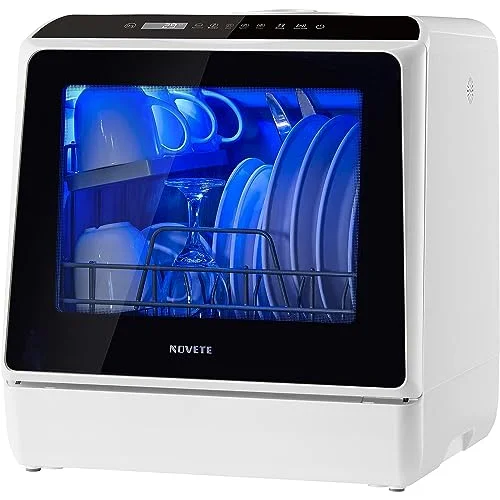
A countertop dishwasher is a sealed tub with one or two spray arms, a small pump and a heater, in a cabinet 16 to 22 inches wide. The NOVETE model is typical of the compact end: 16.9 × 16.8 × 18.1 inches externally, with a stated four full place settings the listing actually enumerates — four serving bowls, four cups, four small plates, four dinner plates and seven each of spoons, forks and knives. That is 34 items, and spelling them out is more honest than the "30+ dishes" most rivals quote.

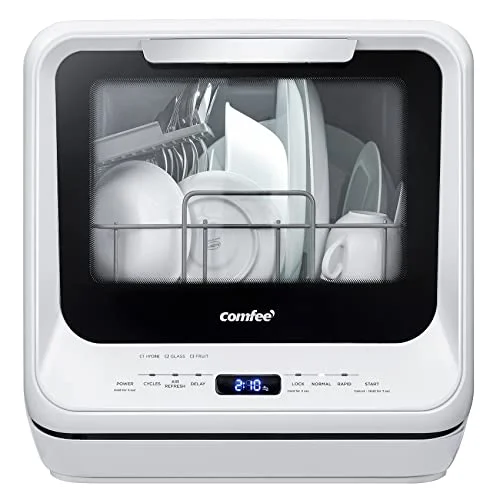
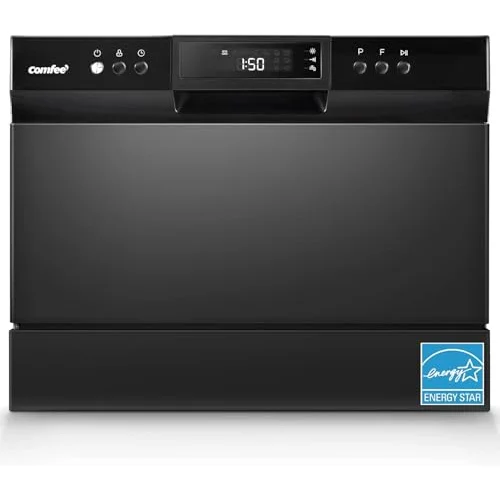
At the top of the class, COMFEE's six-place machine is a much bigger box: H17.2 × W21.7 × D19.7 inches, claimed at up to 70 pieces with plates to 10 inches. Still a countertop machine, but at nearly 22 inches wide it eats a serious run of worktop, and it has no tank — faucet only. At the small end sits the COMFEE' Minilite, built around a 5 L tank, with six programmes and dual spray arms above and below. Its listing quotes no place-setting figure at all, which tells you something.

Class two: the 18-inch freestanding machine on castors

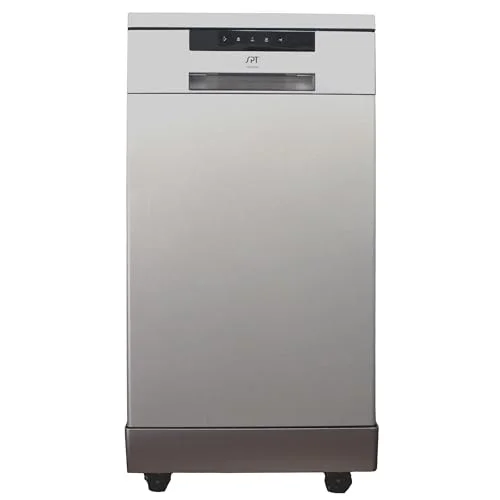
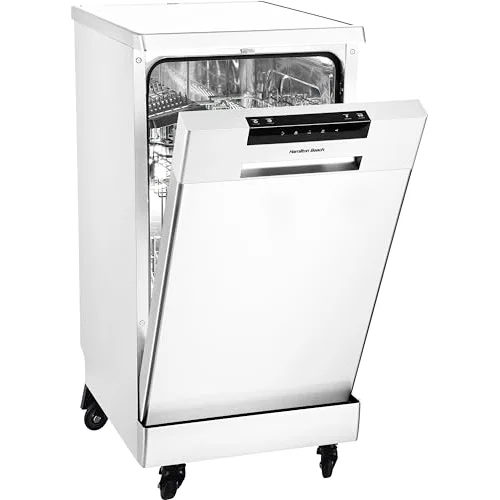
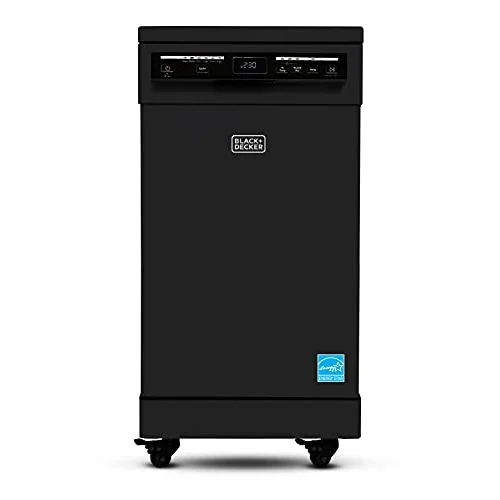
The rolling machines are a different product line. The SPT SD-9263SSC lists eight place settings and six programmes — Heavy, Normal, Eco, Glass, 90 Min and Rapid — plus a rinse-aid refill indicator and ENERGY STAR certification. The BLACK+DECKER BPD8B lists eight settings and the same six cycles, and tellingly its first bullet is not about washing: it advertises the countertop surface on top, because the design premise is that the machine gives back the worktop it stands beside. Hamilton Beach's wheeled model lists eight settings at 19 inches wide, with a silverware basket and a tap connection.

None of the three has a water tank. All of them go to the sink. That single fact decides this comparison for a large share of buyers.
Capacity

What a "place setting" means, and how big the gap really is

A place setting is a defined unit, not marketing language: one dinner plate, one side plate or bowl, one glass, one cup and saucer, one person's cutlery — roughly ten items. It is how dishwasher capacity has been quoted for decades, which is why a four-place and an eight-place machine are genuinely comparable across brands.

The arithmetic is unforgiving. Four settings is one dinner for a family of four with no room for the pan. Six — the COMFEE' countertop model's claimed 70 pieces — is roughly a full day of dishes for two or three people, the point at which you stop planning around the machine. Eight, the figure SPT, Hamilton Beach and BLACK+DECKER all quote, is close to what a standard 24-inch built-in holds.

Two warnings. These are manufacturer claims, produced with standardised crockery rather than your mismatched bowls, so assume real capacity lands under the number. And plate diameter matters as much as the count: the six-place COMFEE' caps out at 10-inch plates, while plenty of American dinner plates are 11 or 12 inches, and a plate that won't lie flat doesn't get washed. If one evening's dishes don't fit in one cycle you'll keep hand-washing — which is why capacity is the first filter in our guide to countertop machines under $300.

Money

The price gap, and what the extra $300 buys

Countertop machines in our database run about $170 to $330. The 18-inch machines on castors run about $585 to $690: the SPT SD-9263W in white at the bottom, its stainless twin and the Hamilton Beach model around $600, the BLACK+DECKER BPD8B near $690. Per unit of capacity the gap narrows — the six-place COMFEE' at about $310 works out near $52 a place setting, an eight-place rolling machine at about $600 near $75. A premium of roughly 45 percent per setting, not the doubling the shelf price implies.

What the premium buys, going by the listings:

  • Two to four more place settings — the difference that decides whether the machine changes your evenings.
  • Your counter back. An 18-inch machine stands on the floor and has a usable top; a countertop machine takes 16 to 22 inches of worktop and never gives it back.
  • A grown-up cycle set. Both 18-inch machines list Heavy, Normal, Eco, Glass, 90 Min and Rapid. Countertop cycle lists run longer on paper — Fruit and baby-care modes — and shorter on what matters for a greasy roasting tin.
  • ENERGY STAR certification, stated for the SPT and BLACK+DECKER machines and the six-place COMFEE'. Plenty of listings here carry none.
  • Small courtesies like SPT's rinse-aid refill indicator — trivial until you remember these machines dry with residual heat, not a heating element, so rinse aid is the difference between dry plates and spotted ones.

What it does not buy is a tank. No 18-inch portable here can wash without a faucet, so if your kitchen can't supply one, $690 buys nothing that $250 doesn't. Whether either class earns its price against washing by hand is worked through in our honest cost and water math.

Physical fit

Where each machine lives: the cabinet versus the floor

Each class has an enemy, and they are different enemies.

The countertop machine's enemy is the wall cabinet

Standard American kitchens hang wall cabinets about 18 inches above the countertop. Compact countertop dishwashers are typically 18 to 18.2 inches tall — the NOVETE is listed at 18.1. You can see the collision coming, and it worsens once the door has to open, since most swing down and forward or lift at the lid. Manufacturers know it: one COMFEE' listing asks in the small print for more than 19.6 inches between counter and wall cupboard, and a competitor's asks for 20.08 inches. That is more than a standard kitchen gives you.

So countertop dishwashers often end up on an island, a dining table or a shelving unit rather than the counter beside the sink — which creates the drain problem below. Measure that gap first; it disqualifies more kitchens than price does. The full measuring routine, including RV and dorm cases, is in choosing a machine for an apartment, dorm or RV.

The rolling machine's enemy is floor area

An 18-inch portable needs an 18-inch strip of floor — 19 for the Hamilton Beach — plus depth, plus door swing, plus a clear path from its parking spot to the sink. In a galley kitchen that path is often the only standing space in the room, and the machine occupies its footprint permanently, not just while washing.

The compensation is a work surface. In a small kitchen the top of an 18-inch portable is often the only flat surface anyone has added in decades, and BLACK+DECKER is right to lead with it. Our judgement: if the footprint is floor you were walking on, that's a loss; if it was holding a recycling bin, the trade is close to free. And castors roll well on tile and vinyl, badly on thick rugs and thresholds: "portable" here means movable within one room, not carryable.

Water source

The tank is a countertop-only superpower

This specification ends the argument for a large share of buyers, and it splits perfectly along the class line: tank mode exists on countertop machines and does not exist on 18-inch portables.

The NOVETE supports two supply modes — a 5 L built-in tank filled by hand, with an automatic water-level indicator, or an inlet hose to the faucet. The COMFEE' Minilite is designed around the tank: no hookup needed, fill it, run it. The six-place COMFEE' is faucet-only, and so is every 18-inch machine here.

Why that matters: faucet connection needs a tap with a removable aerator and standard threads. Pull-down and pull-out sprayer faucets — now the default in a large share of American kitchens and close to universal in recent rentals — generally cannot take the adapter, because the spray head unscrews from a hose rather than a fixed spout. Nor can many designer taps with concealed aerators. If that is your kitchen, the entire 18-inch class is unavailable at any price, and a tank-equipped countertop machine isn't a compromise, it's the only version of this appliance that works. Hence our separate step-by-step hookup guide on adapter threads and the taps that simply refuse.

Tank mode has real costs. Five litres is one cycle's water, so you fill by hand before every wash — a jug, twice, for most people — and it caps what the machine can spend on rinsing, part of why tank models stop at four settings. Faucet mode has neither problem, which is why machines supporting both are worth a small premium over tank-only ones: tap at home, tank in the RV.

Drainage

Drain-hose reach: the second reason a machine goes back

Neither class plumbs into a waste pipe. Both pump dirty water out through a hose hooked over the edge of the sink, and that hose has a finite length.

For a countertop machine this quietly overrides the freedom the tank just gave you. Tank mode means you can put the machine anywhere; the drain hose means anywhere within a hose length of a sink, roughly level with or above the drain point, because a small pump does not enjoy pushing water uphill. A machine exiled to the dining table because the wall cabinets were too low is a machine whose waste water has nowhere to go — at which point you either live with a hose across the counter, or drain into a bucket, which works and is exactly as tedious as it sounds.

The 18-inch machines solve it more elegantly, with a single quick-connect coupler at the tap carrying supply in and waste out through the same connection — what Hamilton Beach's "easy to connect to any kitchen tap" bullet describes. No hose over the edge, no reach question, but the machine stands at the sink for the whole cycle, blocking it, which in a one-sink kitchen running a two-hour Normal programme is not nothing. Either way the drain hose is where smells start, since ribbed hose holds water between cycles — see how to clean and descale a portable dishwasher.

Noise

Which one is louder, honestly

None of the seven machines here publishes a decibel figure in its listing bullets, so anyone quoting a precise number for them is guessing. What the category advertises: compact countertop models are commonly marketed around 40 dB, and the larger machines that do quote a figure — one 18-inch portable and one premium countertop model — quote around 52 dB. Those are manufacturer claims, measured in undisclosed conditions and not independently audited, so treat the spread as an indication of class, not a promise. Every 10 dB is roughly a doubling of perceived loudness.

Placement matters more than the number, in our judgement. A countertop machine runs at counter height, three feet from your ears, out in the open air of the room. An 18-inch machine runs at floor level, partly shielded by the counter overhang and surrounding cabinets, so a nominally louder floor machine can be less intrusive in the same open-plan room. Two things make noise in both classes: the drain pump at the end of the cycle, and water hitting a half-empty tub.

The long view

Moving house with each of them

Most people shopping this category are renting and will move again within a few years, so "portable" deserves checking.

A countertop machine moves the way a microwave moves: unplug, unclip the inlet hose, drain, put it in the car. One person, no van, and — if it's a tank model — complete indifference to the next kitchen's faucet.

An 18-inch portable moves the way an appliance moves: it rolls on flat floors and stops at every threshold, stair and van ramp, so you'll want two people and a strap. It is still far more mobile than the built-in it replaces, which is the point of the class — a near-full-size dishwasher in a property you aren't allowed to modify, nothing cut, drilled or plumbed, no deposit conversation at the end of the lease.

At a glance

The seven machines in this comparison

All figures are manufacturer specifications; prices are approximate and keep moving.

MachineClassCapacity (claimed)Water sourceLivesPrice
COMFEE' 6-Place CountertopCountertop6 settings, ~70 piecesFaucet onlyCounter$309.99Price
NOVETE CountertopCountertop4 settings, 34 items listed5 L tank or faucetCounter$289.99Price
COMFEE' MiniliteCountertop, miniNot quoted in settings5 L tank, no hookupCounter$249.94Price
SPT SD-9263W 18″Freestanding, castors8 settingsFaucet onlyFloor$585.25Price
SPT SD-9263SSC 18″Freestanding, castors8 settingsFaucet onlyFloor$599.99Price
Hamilton Beach on WheelsFreestanding, castors8 settings, 19 in wideFaucet onlyFloor$599.99Price
BLACK+DECKER BPD8B 18″Freestanding, castors8 settingsFaucet onlyFloor$689.27Price
The shortlist

Four machines that define the two classes

01Countertop, max size

COMFEE' 6-Place Countertop Dishwasher

The countertop machine that behaves like a real dishwasher
Countertop · 6 place settings claimed, ~70 pieces · plates to 10 in · 17.2 × 21.7 × 19.7 in · ENERGY STAR

If your objection to the countertop class is capacity, this machine answers it. Six settings is where one evening's dishes fit in one cycle for two or three people, and the eight cycles cover Heavy, Normal, Baby-Care, ECO, Glass, Speed, Mini-party and Rinse with extra drying on most. It can also be fitted into a cupboard rather than left out on the worktop.

The trade-offNearly 22 inches wide and 20 deep is a lot of countertop, and there is no tank — faucet-only, so a sprayer tap rules it out.

COMFEE' six-place countertop dishwasher in black
$310
6 place settingsCheck price →
02Countertop, no plumbing

COMFEE' Minilite Countertop Dishwasher

Kitchens whose faucet will not accept an adapter, and RVs
Mini countertop · 5 L tank, no hookup · 6 programmes · 360° dual spray arms · Hygiene cycle to 162°F

The Minilite exists for the situation the 18-inch class cannot serve at any price: no usable tap. Fill the tank, plug it in, run it. Dual spray arms above and below matter more than programme count in a tub this small, and Air Refresh circulates air afterwards to keep a sealed tub from going stale between uses.

The trade-offThe listing quotes no place-setting figure, which in our reading means capacity is not something the maker wants compared against a four-place machine. Expect to hand-fill before every wash.

COMFEE' Minilite countertop dishwasher with built-in water tank
$250
Tank, no hookupCheck price →
0318-inch, value

SPT SD-9263SSC 18-Inch Portable Dishwasher

The cheapest sensible way into eight place settings
Freestanding on castors · 8 place settings · 6 programmes: Heavy, Normal, Eco, Glass, 90 Min, Rapid · rinse-aid indicator · ENERGY STAR

SPT has built this 18-inch platform for years, and the specification is what the class is for: eight settings, a proper cycle spread with Eco and a 90-minute programme, and a rinse-aid warning light that matters because these machines lean on rinse aid to dry. Take the stainless version unless white suits the room better — the SD-9263W in white is the same platform for about $15 less.

The trade-offFaucet-only, like everything in its class, and it needs 18 inches of floor plus door swing plus a path to the sink. Confirm your tap's aerator threads before ordering.

SPT 18-inch portable dishwasher in stainless steel
$600
8 place settingsCheck price →
0418-inch, counter back

BLACK+DECKER BPD8B 18-Inch Portable Dishwasher

Small kitchens that need the work surface as much as the dishwasher
Freestanding on castors · 8 place settings · usable countertop on top · 6 cycles: Normal, Heavy, Rapid, Glass, Eco, 90-min · ENERGY STAR

The most expensive machine here, with the clearest design argument: a dishwasher that adds counter space instead of consuming it, which in a kitchen with four feet of worktop is close to structural. Eight settings and six cycles put it level with the SPT on washing; the extra money goes on the finished top and the brand's parts availability.

The trade-offAbout $90 more than the SPT for a comparable specification, with the same floor and faucet constraints. If the top surface isn't solving a real problem, buy the cheaper machine.

BLACK+DECKER 18-inch portable dishwasher on wheels
$689
Counter on topCheck price →

Two more from the table deserve a line each. The NOVETE countertop model has the most transparent listing here — it enumerates the 34 items its four settings consist of, supports tank and faucet both, and takes 12-inch plates at an angle, which the six-place COMFEE' cannot. The Hamilton Beach machine on wheels matches the SPT on capacity and price but is 19 inches wide, so check that extra inch before assuming the rolling machines are interchangeable.

The decision

Buy this one if…

Buy a countertop machine if

Any one of these is true

Your faucet is a pull-down or pull-out sprayer, or has no removable aerator — a tank model is then the only version of this appliance that works for you. Or you have no spare floor. Or you're washing for one or two. Or you move often, or live in an RV. Or your budget stops below $350. Any one of these settles it, and the tank models are where to start.

Buy an 18-inch on castors if

All of these are true

A straight kitchen faucet with a standard aerator; an 18-to-19-inch strip of floor with a clear path to the sink and room for the door to swing; three or more people to cook for; around $600 to spend. Miss any one — particularly the faucet — and the machine cannot do its job.

The awkward middle, and the case for neither

There is a real middle case: a straight faucet, a family of three, no floor space. That buyer should look hard at the six-place countertop machine — the only countertop model here that approaches the rolling machines on capacity — and accept nearly two feet of worktop gone. If the wall cabinets above sit at the standard 18 inches, it won't fit there either, and the answer is an island, a cart, or the 18-inch machine after all.

And if you have a dishwasher cabinet, plumbing and permission, buy a built-in: both portable classes exist to solve the absence of those three things. That comparison and the running costs are on the portable dishwasher buyer's guide and in our cost and water math.

FAQ

Common questions about the two classes

Is an 18-inch portable dishwasher just a countertop model with wheels?

No. They are different machines on different platforms. An 18-inch portable is a full-height dishwasher on castors that stands on the floor, claims eight place settings, and can only be filled from a kitchen faucet. A countertop model is a small sealed tub that sits on the worktop, claims four to six place settings, and on many models runs from its own five-litre tank with no plumbing at all. Roughly double the capacity, roughly $300 more.

How much bigger is 8 place settings than 4?

A place setting is a defined unit of about ten items: a dinner plate, a side plate or bowl, a glass, a cup and saucer and one person's cutlery. Four settings is a single family dinner with no room for the pan; eight is close to what a standard built-in holds. These are manufacturer claims measured with standardised crockery, and plate diameter matters too: a machine rated for 10-inch plates will not take a 12-inch dinner plate however many settings it claims.

Can an 18-inch portable dishwasher run without connecting to a faucet?

No. Every 18-inch portable in this comparison is faucet-only; tank mode does not exist in that class. If your kitchen has a pull-down or pull-out sprayer faucet, or a tap with no removable aerator, the adapter will not fit and the machine cannot be filled. That is what tank-equipped countertop models are built for, and the most common reason a buyer ends up in the countertop class.

Which one fits under a standard kitchen wall cabinet?

Often neither, without measuring first. American wall cabinets typically hang about 18 inches above the countertop, and compact countertop dishwashers are typically 18 to 18.2 inches tall before you account for opening the door or lid — several listings ask for 19.6 to 20 inches of clearance for that reason. An 18-inch machine on castors sidesteps the problem because it stands on the floor; its constraint is floor width and door swing.

Keep reading

Next, from this site