Best Portable Dishwashers
Buying Advice · Camping & Boats

No shore water. No dock hookup.

Sometimes you have a generator instead of a full circuit, and a jerry can instead of a kitchen faucet. The portable dishwashers that actually work off-grid aren't the fanciest ones in the category — they're the ones built around a water tank, light enough to brace down, and honest about what still needs real plumbing.

By Ilane Tall · Updated October 2, 2026 · Research-based.

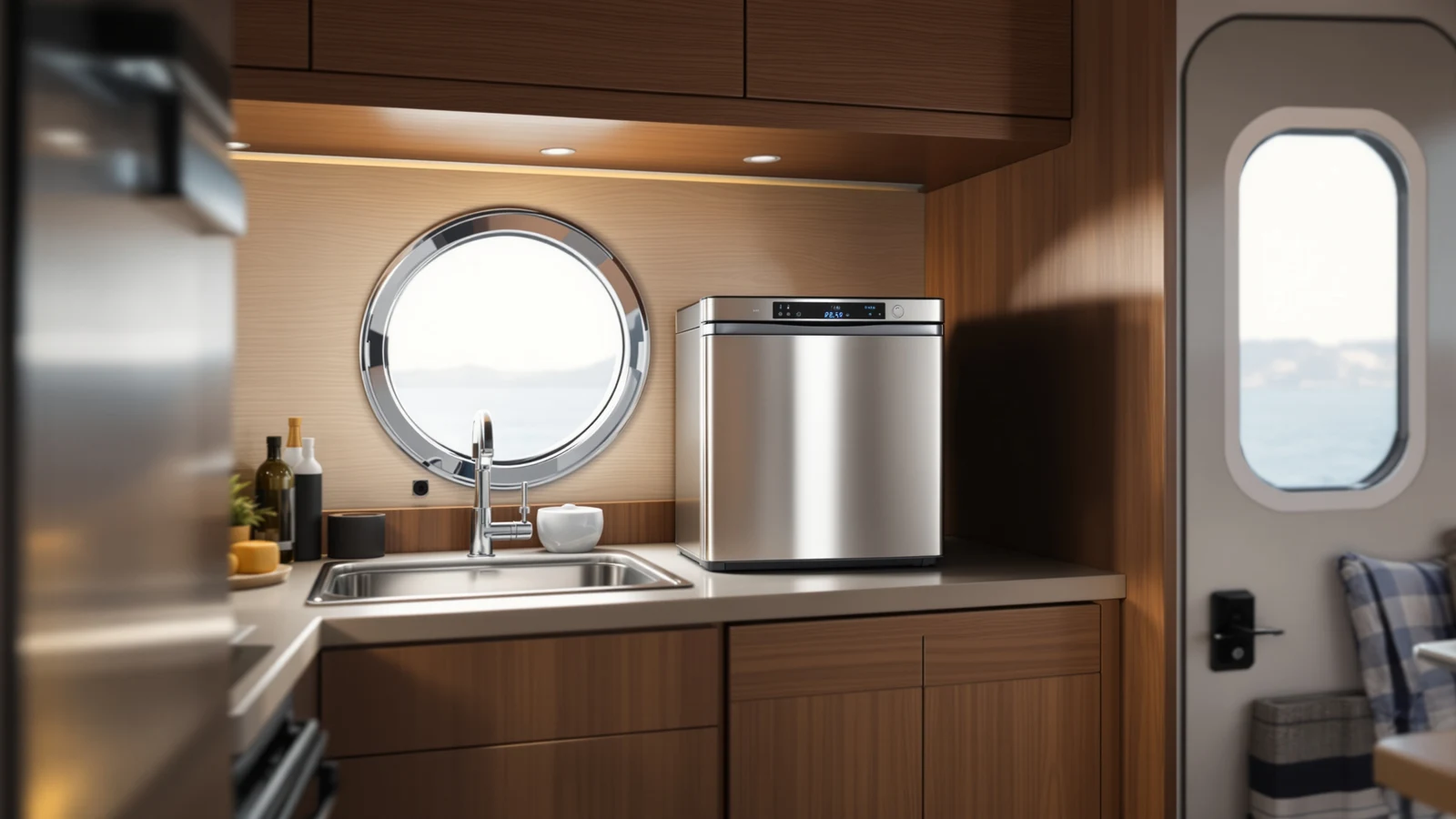
A compact countertop dishwasher braced on a galley counter aboard a boat, with a water jug and coiled hose nearby

Reader-supported: we may earn a commission when you buy through the links on this page, at no additional cost to you. Prices move constantly — confirm the live price before you order.

A portable dishwasher sold for an apartment or a rental kitchen is designed around one assumption: somewhere nearby there's a faucet with standard threads, and somewhere nearby there's a wall outlet on the house circuit. Take the same machine to a campsite or a boat and both assumptions can disappear at once. The faucet might be a pump-fed trickle with no removable aerator, or there might be no faucet in reach of the counter at all. The outlet might be a generator you run for two hours a night, or a battery bank behind an inverter, not a breaker panel.

None of that rules out a countertop dishwasher. It changes which four matter and how you use them. A machine with a built-in water tank sidesteps the faucet problem entirely; a machine without one needs a workable tap or it's dead weight. This guide covers the two things that decide whether a countertop dishwasher earns its space on a boat or in an RV — water source and power draw — plus the three things nobody mentions in the listing copy: bracing it so it doesn't become a projectile underway, where the waste water actually goes when there's no drain nearby, and which parts of the job still need something close to a real hookup even when you're off-grid.

How this page is built

We compare published specifications, what ships in the box, price and stated water-supply modes for four dual-purpose countertop dishwashers. We do not physically test these machines on a boat or in an RV, we do not run a testing lab, and we do not publish star ratings or review counts — Amazon's listings carry none for this category, and inventing one would be the same offence as inventing a spec. Where a dimension or capacity figure isn't published for a specific model, we say so instead of guessing, and we flag manufacturer wattage, capacity and footprint claims as claims, not measurements.

Water source

Why tank mode matters more here than at home

In a house, a built-in water tank on a countertop dishwasher is a nice-to-have — a backup for the one morning the kids are hogging the sink. Off-grid, it's frequently the only mode that works at all. A boat galley faucet is usually fed by a small freshwater pump rather than municipal pressure, and it's rarely threaded the way a dishwasher adapter expects; plenty of RV kitchen faucets have the same pull-out-sprayer design that defeats the adapter in a regular apartment. If the tap can't take the hose, faucet mode isn't an inconvenient option — it's not an option.

Fresh water is also a budget, not a utility, on a boat or in an RV. Tanks commonly run anywhere from under twenty gallons in a small camper to over a hundred in a larger rig, and every gallon that goes into the dishwasher is a gallon that isn't available for drinking, cooking or the next shower. Filling a machine's built-in tank from a jug by hand means you decide exactly how much of that budget a wash costs, instead of an automatic faucet connection pulling water at its own pace for the length of a cycle.

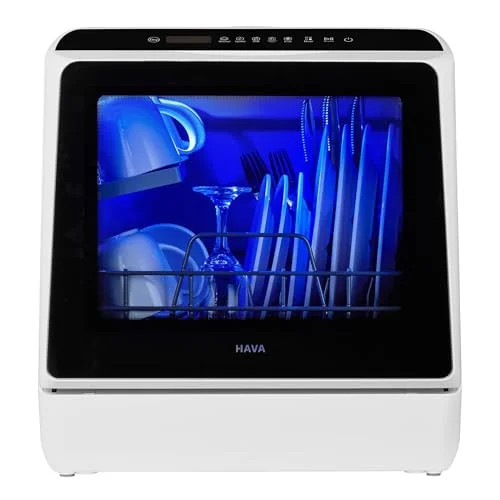
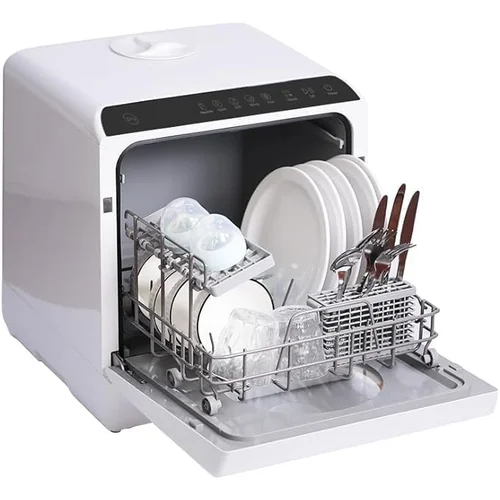
Of the four machines here, three are built around the choice rather than forced into one. The HAVA Countertop Dishwasher explicitly supports two water-supply modes — fill its 5-liter built-in tank by hand, or connect the included hose to a faucet — and switching between them is a listed feature, not a workaround. The Sunvivi 18-Inch Countertop Dishwasher does the same with a removable 152-ounce (roughly 1.2-gallon) tank that has a buzzer alert for when it's full or empty, plus a direct faucet-fill option. The Collier Portable Countertop Dishwasher is built the same way: a built-in tank alongside a faucet hose connection and adapter, so you pick whichever the galley allows that day.

The Canbo Countertop Dishwasher is the outlier, and it's arguably the more honest listing for this use case: its published bullets describe only the built-in tank, with no faucet-hose connection mentioned at all. For a boat where you already know the faucet is never going to cooperate, that's not a missing feature — it's one less adapter to pack and one less connection to troubleshoot at anchor.
Power

Power draw against a generator or shore power limit

A countertop dishwasher's power draw isn't steady — it spikes when the heating element is running the wash or dry phase, the same way a kettle or a hair dryer spikes against a circuit. None of the four listings in our database states a wattage figure on its spec sheet, so treat any number you see elsewhere as an estimate, not a guarantee, and check the rating plate on the unit itself — usually printed on the back or underside — before you decide it will run on what you have.

What's worth knowing in general terms, without pinning a number to a specific model: small resistive-heating appliances in this size class commonly draw in the high hundreds to low-thousands of watts during the heated part of a cycle. That matters two ways off-grid. On shore power, RV parks and marinas typically wire a 30-amp pedestal at 120 volts, which caps the whole circuit around 3,600 watts — plenty for a dishwasher running alone, tight if the air conditioner, water heater and a hair dryer are competing for the same 30 amps at once. On a small inverter generator, commonly rated in the 2,000- to 3,500-watt range, a dishwasher's heating element can be a meaningful share of total output, especially if it's starting at the same time as a compressor fridge.

Two practical habits follow from that. First, don't run the dishwasher at the same moment you're running the microwave, a space heater or the water heater element — stagger them, the way boat owners already stagger the air conditioner and the toaster. Second, if your generator only runs on a schedule — morning and evening, say, to keep the noise down at anchor or in a campground — a model with a delayed-start function lets you load the machine whenever it's convenient and have it finish exactly when the generator is already on; see how delay start actually works for what it does and doesn't do. None of the four machines here advertise WiFi or app control, which off-grid is a feature rather than an absence — there's no signal at anchor for an app to use anyway, a point covered in more detail in what smart features on a portable dishwasher actually buy you.

The picks

Smallest footprint first

Ordered by published external footprint, smallest to largest. Counter and galley space is usually the tighter constraint than price in this category.

01Smallest footprint

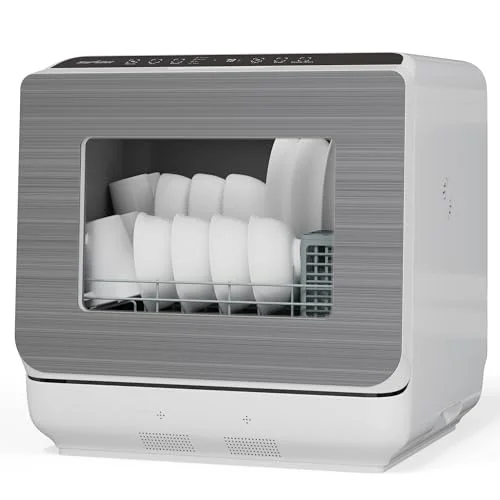
Canbo Countertop Dishwasher with Built-in Water Tank

The tightest galley counter or dinette table, where every extra inch is a problem
16.54 × 16.54 × 18.03 in (W×L×H) · built-in tank, no faucet hose listed · 5 programs · 1–3 settings, plates to 10.5 in · 29-min Quick cycle

At roughly 16.5 inches square, this is the smallest footprint of the four by the published numbers, and it's built entirely around its tank — no faucet hose is mentioned in the listing, which on a boat is one less connection that can fail. Upper and lower spray arms give 360-degree coverage in a tub this small, the Quick program finishes in 29 minutes, and the listing specifically calls out apartments, small homes, RVs, camping and boats as its intended use, not an afterthought.

The trade-offOne to three place settings is a single meal, not a day's dishes, and there's no stated faucet mode if you ever dock somewhere with a usable tap — you're filling the tank by hand every time.

Canbo countertop dishwasher with built-in water tank
$189.99
Smallest footprintCheck price →
02Dual-mode, compact

HAVA Countertop Dishwasher, 6 Programs

Anyone who wants the tank at anchor and the faucet at the dock, in the same machine
16.9 × 16.8 × 18.1 in (L×W×H) · 5 L built-in tank or faucet hose · 6 programs · 4 place settings, 30+ pieces, plates to 11 in at an angle

A few tenths of an inch larger than the Canbo, and in exchange you get the flexibility of two real water-supply modes rather than one. Fill the 5-liter built-in tank when there's no usable faucet, or connect the included hose when there is — the listing frames it as a genuine either/or, not tank-only with a faucet bolted on as an afterthought. Four place settings and plates up to 11 inches loaded at an angle is enough for a couple's full day of dishes, and the Fruit program and dedicated fruit basket are a reasonable extra for anyone provisioning fresh produce before a passage or a trip with no store nearby.

The trade-offFour place settings is still a small load by household standards, and the 5-liter tank caps how much rinsing the machine can do per fill — expect to refill between back-to-back loads rather than running one big batch.

HAVA countertop dishwasher with 6 wash programs
$289.00
Tank or faucetCheck price →
03Removable tank

Sunvivi Portable Dishwasher, 152oz Water Tank

Whoever has to lug the tank to a tap or a jerry can to refill it
17.7 × 17.3 in footprint (W×D) · 152 oz (~1.2 gal) removable tank with fill buzzer, or faucet · 6 programs · plates to 12 in · 29-min Quick cycle, 167°F dry

The product title calls this an "18-inch" model, but the published footprint is 17.7 inches wide by 17.3 deep — a countertop machine, not the full-height freestanding class that actually runs 18 inches wide on castors, so don't confuse the two when you're measuring a galley counter. What sets it apart here is a removable tank rather than a sealed one: you can carry the tank itself to a dock tap or a water jug instead of hauling water to the machine, and a buzzer tells you when it's full on fill or empty on drain. It also takes the largest plates of the four, up to 12 inches, and the 167°F drying cycle is a genuine high-temperature option rather than just a fan.

The trade-offAt roughly 1.2 gallons the tank is bigger to carry than the HAVA's but still small relative to a full cycle's needs, and the listing doesn't state an overall height, so confirm clearance under a cabinet or hatch before ordering.

Sunvivi portable countertop dishwasher with removable water tank
$299.99
Removable tankCheck price →
04Lowest price

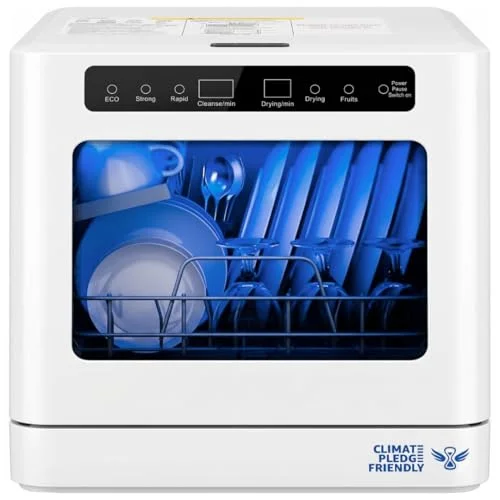
Collier Portable Countertop Dishwasher

A low-cost way to find out whether a dual-mode machine earns its space before you spend more
Footprint not stated — check the listing · built-in tank & faucet hose connection · 5 wash programs · marketed for apartments, RVs & small kitchens

The cheapest of the four, and the one with the least published detail: the listing confirms a built-in tank plus a faucet hose connection and adapter for when a tap is available, and five wash programs, but it does not state external dimensions or place-setting capacity the way the other three do. We're not going to invent a footprint or a capacity figure it doesn't publish — if counter space is tight, confirm the exact measurements on the current listing before you buy, not from this page.

The trade-offWithout published dimensions or a stated place-setting count, this is the hardest of the four to plan a tight galley installation around in advance. Treat the lower price as reflecting less documentation, not necessarily less machine.

Collier portable countertop dishwasher with built-in water tank and hose connection
$149.99
Lowest priceCheck price →
At a glance

The four compared

All figures are manufacturer specifications; prices are approximate and move constantly on Amazon.

DishwasherFootprintWater sourceProgramsPrice
Canbo Countertop16.54 × 16.54 in5 L tank (no faucet hose listed)5$189.99Price
HAVA Countertop16.9 × 16.8 in5 L tank or faucet6$289.00Price
Sunvivi 18-Inch Countertop17.7 × 17.3 in152 oz removable tank or faucet6$299.99Price
Collier CountertopNot statedTank or faucet hose5$149.99Price
On the move

Bracing a machine for movement on a boat

None of these four machines are marketed as marine appliances, and none of their listings mention impact resistance, a locking lid or anything designed for a hull moving under chop or wake — treat that as an absence of information, not a claim either way, and plan your own bracing rather than assuming the machine will stay put on its own. At rest in a slip or at a quiet anchorage this barely matters; underway, or anywhere a wake can roll through, a loose appliance on a galley counter is a hazard before it's an inconvenience.

A non-slip rubber mat under the unit is the cheapest first step and stops the everyday sliding that comes from a boat's normal motion at anchor. For anything rougher, cargo straps or ratchet tie-downs run to a secured point — a cleat, a rail, an eye bolt mounted for the purpose — do the real work, the same way you'd secure a cooler or a propane tank that can't be bolted down permanently. Running the strap low, around the base rather than the lid, keeps the door or top from being pulled open if the machine shifts. If the galley has a sink large enough to set the unit inside, that's a lower center of gravity and a built-in barrier on four sides for free, at the cost of not being able to use the sink while the cycle runs.

The hoses matter as much as the machine. A fill hose or drain hose left loose across a walkway is a trip hazard on a pitching deck in a way it never is in a kitchen, so route and secure both before you leave the dock, not after the first roll. If the machine includes a loose cutlery basket rather than a dedicated holder, that's worth checking before you buy — loose cutlery in a basket that isn't secured is exactly the kind of small, sharp problem that gets worse with motion; see whether a dedicated cutlery basket actually matters for what to look for. Only run the machine underway if you've confirmed the bracing holds under the conditions you're actually sailing in — a mat that's enough at a calm mooring is not a plan for open water.

Waste water

Grey water: where it actually goes when you're not near a drain

Every countertop dishwasher, these four included, pumps its waste water out through a drain hose at the end of the cycle — none of them have a holding tank of their own. At home that hose hangs over the edge of a sink and the water goes straight into the house drain. Off-grid, that drain often doesn't exist where the machine is sitting, and the waste water has to go somewhere specific, not just "away."

On a boat, the honest answer depends on the vessel and the water you're in. Larger boats with a galley sink typically route grey water either overboard through a seacock or into a grey-water holding tank, depending on how the boat was built and where it's used; smaller boats and most dinghies have neither, and the drain hose needs to run into a bucket, a jerry can, or a portable waste container you empty properly later. A growing number of inland lakes, rivers and some coastal areas are designated no-discharge zones, where releasing any wastewater — grey or black, with or without detergent — directly into the water is restricted or banned outright. Rules vary by state and by waterway, so check local regulations for where you're actually anchoring rather than assuming your home port's rules travel with you.

At a campsite or on an RV, the same hose needs a destination too: a dump station if the campground has one, a portable waste tote carried to a dump point, or a basin you empty on departure if you're boondocking with no services at all. Detergent residue in dishwasher waste water means it shouldn't be poured directly onto bare ground near a tent, a fresh-water source or a shared campsite — treat it the same way you'd treat grey water from a camp sink. If you're putting the machine into storage over the off-season rather than using it through winter, the drain system is also the part most likely to hold stagnant water and freeze; winterizing a portable dishwasher for an RV or seasonal home covers draining it properly before you park the rig for the season.

The honest limit

What still needs a real hookup, even off-grid

A tank-fed dishwasher solves the water-supply half of the off-grid problem, but it doesn't make the machine fully self-contained, and it's worth being clear about what's left.

  • Stable AC power. All four of these run on standard household-style AC, not 12-volt DC, so you need shore power, a generator, or an inverter running off a battery bank sized for the load. Many appliance manufacturers recommend a pure sine wave inverter rather than a cheaper modified sine wave unit for anything with an electronic control board or a motor — check your specific model's manual, since none of these listings state a preference either way.
  • Somewhere for the drain hose to go. Tank mode removes the need for an incoming water line, but every one of these machines still pumps dirty water out through a hose at the end of the cycle. That water needs a destination — a sink, a bucket, a holding tank — every single time, which is the grey-water question above, not a one-time setup.
  • A genuinely usable faucet, if you want faucet mode at all. Three of the four machines here support a faucet connection as an alternative to the tank, and that mode still requires an actual tap with a removable aerator and standard threads — the exact requirement this whole guide is built around avoiding. Faucet mode is a convenience for the days you're at a dock or a full-hookup site, not a feature to plan the trip around.

None of this makes a portable dishwasher impractical off-grid — it just means "no hookup needed" describes the water connection, not the entire appliance. Plan for power, a waste-water destination and an honest read of your faucet, and a tank-mode machine does the one job it's actually built for: washing a sink of dishes without a kitchen's worth of plumbing behind it.

FAQ

Common questions

Can a portable dishwasher run off a small generator?

Usually, but size the generator to the appliance's heating element, which is the biggest load it draws — the same category of draw as a kettle or hair dryer. Small inverter generators commonly run 2,000 to 3,500 watts, which typically covers a countertop dishwasher on its own; the risk is running it at the same moment as another high-draw appliance like a microwave or the water heater. None of the four machines in this guide publish a wattage figure, so check the rating plate on your specific unit before relying on a generator's rated output.

Will a battery bank and inverter work instead of shore power or a generator?

It can, if the inverter is sized for the heating element's draw and ideally produces pure sine wave output rather than modified sine wave, which some manufacturers recommend for appliances with electronic controls or motors. A heating element running for the length of a wash and dry cycle pulls meaningfully from a battery bank, so check your inverter's rating and your bank's capacity before assuming it will finish a full cycle unattended.

Where does the dirty water go if I'm anchored out or boondocking with no drain nearby?

Into whatever you've set up to catch it — a bucket, a jerry can, a grey-water holding tank if the boat or rig has one, or a portable waste container you empty at a proper dump point or disposal location afterward. None of these dishwashers include their own holding tank; the drain hose simply needs a destination every time it runs. Many lakes, rivers and some coastal areas restrict discharging wastewater directly, so check local rules for where you actually are.

Do I need a faucet-compatible machine, or is tank mode enough?

Tank mode is enough if you're comfortable refilling by hand before each wash — three of the four machines here, the HAVA, the Sunvivi and the Collier, support both tank and faucet modes, while the Canbo is tank-only. If your boat or RV faucet has no removable aerator or standard threads, which is common on pull-out sprayer taps, faucet mode won't work regardless of which machine you buy, and a tank-equipped model is the only version of this appliance that functions for you.

Keep reading

Next, from this site