Best Portable Dishwashers
Guide · Water-level indicators

Water-level windows. What they actually show.

A handful of tank-fed listings mention a water-level indicator, and the word "window" makes it sound like a porthole you watch while the machine runs. On the machines that actually carry this feature, it isn't that. Here's what it signals, when it signals it, and whether it beats just remembering to fill the tank yourself.

By Ilane Tall · Updated October 25, 2026 · Research-based.

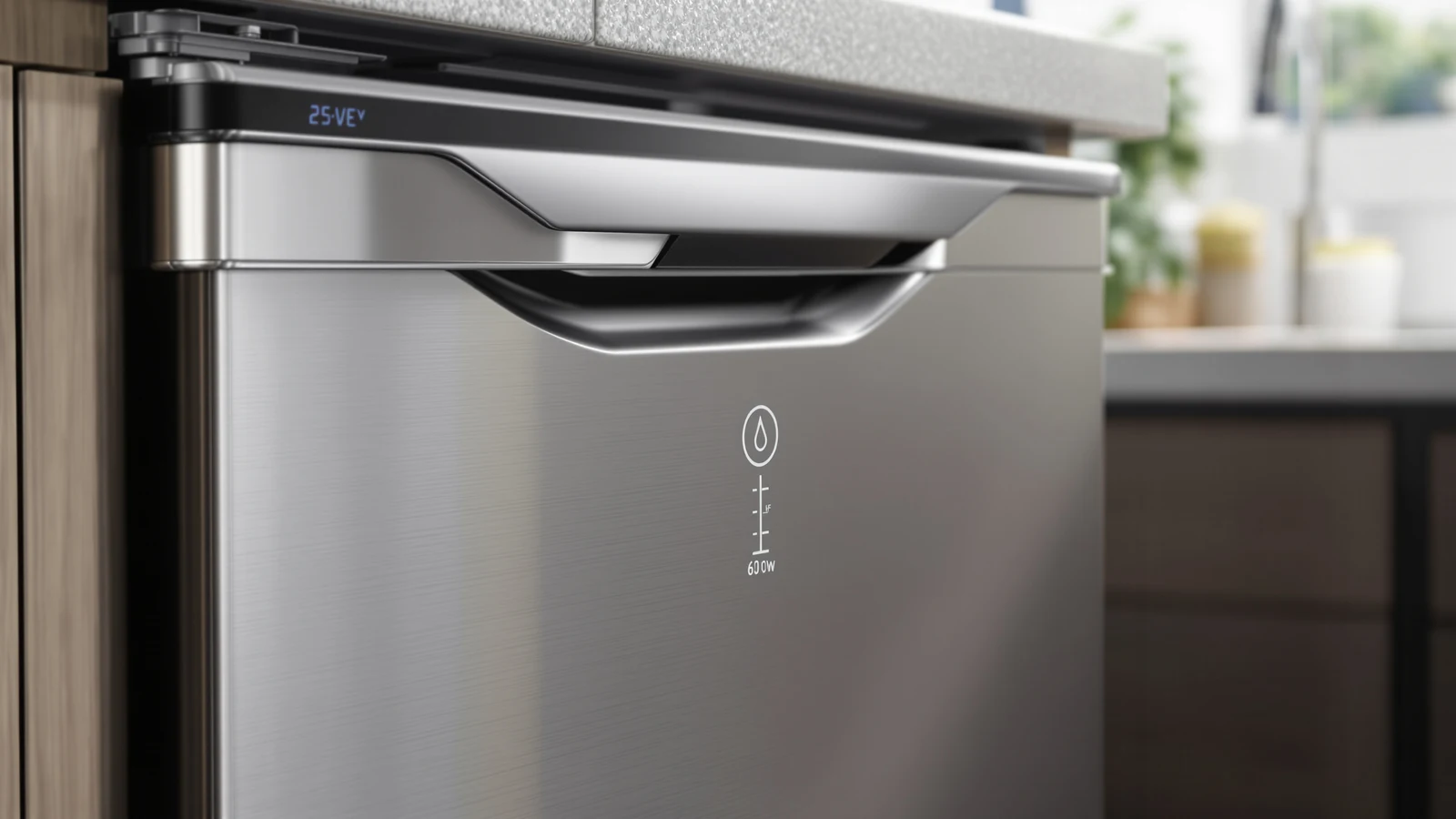
Close-up of a stainless steel countertop dishwasher door showing a water-drop level icon and fill markings above the handle

Reader-supported: we may earn a commission when you buy through the links on this page, at no additional cost to you. Prices move constantly — confirm the live price before you order.

Tank-fed countertop dishwashers run from a built-in reservoir you fill by hand, usually five litres, before you press start. Because that reservoir is the entire water supply for the cycle, getting the fill right matters more on these machines than it does on a faucet-connected one that draws continuously from the tap. A few listings address that with what they call a water-level indicator, and it's worth being precise about what that word is doing, because "window" and "indicator" imply two different designs: a window is something you look through; an indicator is something that tells you a state has been reached, which could be a light, an icon, or a line of printed text on the control panel.

This guide covers three EUHOMY countertop dishwashers that all carry some version of an automatic water-level indicator, what each one actually does, what happens if you run a cycle without enough water in the tank, why faucet-only machines never bother with this feature at all, whether you can realistically top the tank up mid-cycle, and whether the indicator is worth factoring into a purchase over just learning your own fill routine. It's the same kind of listing detail this site tends to dig into — small, easy to misread, and worth a plain explanation, the way we've done for a child lock that doesn't lock what buyers assume it does.

How this page is built

We compare published specifications, what ships in the box, listing copy and price. We do not physically test these machines, we do not run a testing lab, and we do not publish ratings we cannot verify — Amazon returns no rating and no review count for this category, so there are no stars on this site. Where a judgement is ours rather than a specification, we say so.
The feature, precisely

What a water-level indicator actually shows

On all three machines in this guide, the indicator belongs to one moment only: filling the tank before a cycle starts. The listings describe it consistently — pour water into the built-in reservoir, and "the automatic water-level indicator will notify you when the ideal level is reached," or in the plainer phrasing on another of the three, "the water-level indicator lets you know when the tank is full." That's a fill-point signal, not a running gauge. None of the three listings describes a clear strip or porthole molded into the tank wall that you could glance at mid-wash to see how much water is left — the kind of literal "window" the phrase might bring to mind. What they describe is closer to a fill line with a sensor behind it: useful for knowing when to stop pouring, silent for the rest of the cycle.

That distinction matters because it sets expectations correctly. If you're picturing a sight-glass you can check partway through a wash the way you'd check a coffee maker's water reservoir, none of these three machines offers that. What they offer is a way to avoid guessing during the one moment guessing actually causes a problem — the pour. Once the lid is closed and the program is running, the indicator has already done its job for that cycle. A genuine transparent viewing window is a different feature entirely, found on a different part of some machines — see our guide to glass-door portable dishwashers for what that one actually changes.

It's also worth noting the indicator is specific to tank mode. All three machines support a second water source — an inlet hose that connects to a kitchen faucet with a standard G3/4-inch thread — and the indicator plays no role when the machine is running that way, for reasons covered further down.

Under-filling

Running a cycle with too little water in the tank

The built-in reservoir on each of these three machines holds roughly five litres, and that fixed volume is the entire water budget for a tank-mode cycle — there's no plumbing behind it topping things up as the program runs. A wash program is written assuming the tank started full, spreading that five litres across a wash phase and a rinse phase through a recirculating pump and dual spray arms. Start the same program with less water in the tank than the indicator calls for, and the pump is working with a smaller budget than the program expects it to have.

In a small, closed-loop system like this, the practical risk of under-filling is the pump running low or drawing air partway through — the same general mechanism that makes any recirculating pump struggle once its reservoir runs short, in any compact appliance built this way. One of the three machines here, the EUHOMY 8-program model, even lists a dedicated Self-clean program specifically to flush residue and limescale out of that same small pump-and-tank loop — a tacit acknowledgment from the manufacturer that a five-litre closed system needs more active upkeep than a dishwasher plumbed into the house's water line. Starving that same loop of water mid-wash isn't a documented failure mode we can point to a spec sheet for, but it runs against the entire design logic of the indicator, whose stated purpose is to get the fill right before you start rather than let you find out partway through.

The straightforward takeaway: treat the indicator's signal as the minimum, not a suggestion. Fill to the mark it gives you, every time, rather than eyeballing a jug and guessing you're close enough.

The picks

The picks, and where the indicator sits on each

All three support tank mode with an automatic water-level indicator and faucet mode via an inlet hose. Prices move constantly on Amazon — confirm the live price before you buy.

016 programs

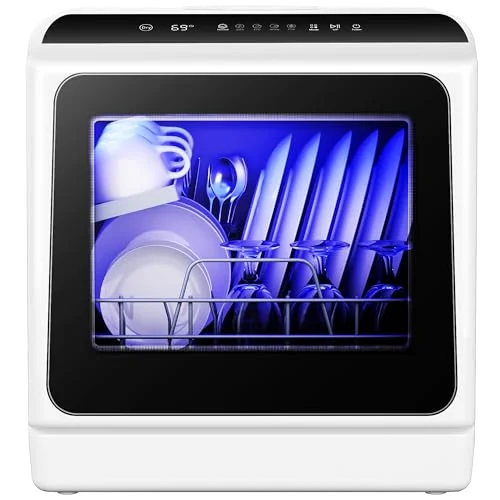
EUHOMY Countertop Dishwasher, 6 Programs, Dual Spray Arms for 30+ Items

A straightforward six-program machine for a household of two or three
Countertop, tank or faucet · 5 L tank · 30+ items, plates to 10.25 in · 6 programs · Large size

In tank mode, you fill the built-in 5-litre reservoir and the water-level indicator signals when it's full before you select a program. Its listing describes six cycles — Normal, Quick, ECO, Baby Care/Heavy, Fruit and Dry — with the Quick cycle finishing in 29 minutes and Baby Care/Heavy running hot enough, at 167°F, for greasy pans and baby items. The dual spray arm system is the same layout EUHOMY uses across this trio, aimed at 360-degree coverage inside a single-rack tub.

The trade-offThe listing doesn't break the indicator down beyond "notifies you when the tank is full" — there's no published detail on whether that's a light, an icon or a tone, so don't assume a visible sight-glass. Fill it with the recommended clearance of 19 inches between counter and cabinet in mind before you buy.

EUHOMY countertop dishwasher with dual spray arms
$252
6 programsCheck price →
02Quietest of the three

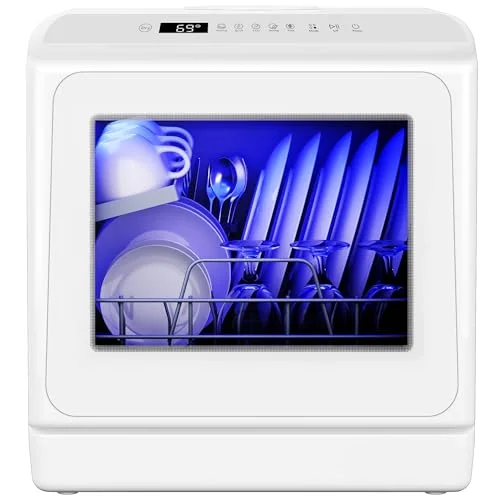
EUHOMY 6 Programs Countertop Dishwasher Portable, 40dB, 360° Coverage

Studios and open kitchens where a quieter tank-fed machine matters more than a wide cycle list
Countertop, tank or faucet · 5 L tank · 40 dB rated · 30+ dishes, plates to 10.25 in · Large size

This one carries the same fill-point logic — pour into the 5-litre tank and the automatic indicator confirms the ideal level is reached — paired with a 40 dB rating, the quietest figure claimed across the three. Its listed program set is slightly shorter than its sibling above: Normal, Fast, Glass, Baby Care/Heavy Duty and Fruit, with the Fast cycle also finishing in 29 minutes and the same 167°F Baby Care/Heavy mode.

The trade-offManufacturer decibel figures are measured in undisclosed conditions and aren't independently audited, so treat 40 dB as an indication of class rather than a guarantee. Its program list is one shorter than the other two — no dedicated self-clean or dry-only cycle listed.

EUHOMY 40dB countertop dishwasher with 360-degree coverage
$270
40 dB ratedCheck price →
03Most programs, incl. Self-clean

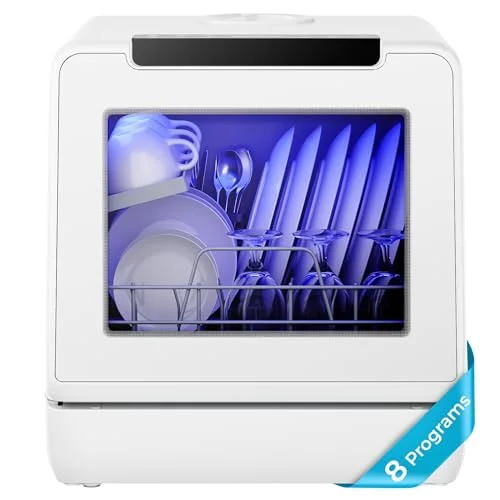
EUHOMY 8-Program Countertop Dishwasher with 5L Tank, 167°F, 40dB, No Hookup

Buyers who want the indicator paired with a dedicated maintenance cycle for the tank itself
Countertop, tank or faucet · 5 L tank · 40 dB rated · 30+ items, plates to 10.25 in · 8 programs incl. Self-clean

The listing calls this one "No Hookup" in the title to emphasize that it runs fully from its own tank, though the same bullet that describes the auto water-level indicator confirms it also accepts a direct G3/4-inch faucet connection like its two siblings here — the tank is the default, not the only option. Its eight listed programs are the widest of the three: Normal, ECO, Quick (29 minutes), Baby Care/Strong at 167°F, Glass, Fruit, Self-clean and Dry. The Self-clean cycle is the one worth pairing mentally with the water-level feature — it's a maintenance pass for the tank-and-pump loop the indicator is there to help you fill correctly in the first place.

The trade-offAt $265.94 it's the most expensive of the three for roughly the same 30+ item capacity and 10.25-inch plate limit as its siblings — the extra cost buys two more listed programs, not more tank volume or a different indicator design.

EUHOMY 8-program countertop dishwasher with 5-liter tank
$266
8 programsCheck price →
At a glance

The three, side by side

All figures are manufacturer specifications; prices are approximate and keep moving.

DishwasherWater sourceIndicatorProgramsPrice
EUHOMY 6-Program, Dual Spray5 L tank or faucetFill-point indicator6$251.99Price
EUHOMY 40 dB, 360° Coverage5 L tank or faucetFill-point indicator5$269.99Price
EUHOMY 8-Program, Self-clean5 L tank or faucetFill-point indicator8$265.94Price
Faucet mode

Why most faucet-only models skip this feature entirely

A water-level indicator exists to answer one question: has the finite reservoir been filled to the point the program needs? That question only makes sense when there is a finite reservoir. A faucet-connected dishwasher draws continuously through an inlet hose for as long as the program calls for water, the same way a kitchen tap doesn't run dry mid-use — there's nothing to measure before the cycle starts, because the supply isn't a fixed volume you poured in by hand.

That's also why all three machines in this guide carry the indicator only in connection with their tank mode, never their faucet mode — switch the same unit over to the inlet hose and the feature is simply irrelevant for that run, not disabled or hidden, just not applicable. It's the same logic that separates this site's two broad machine classes: faucet-only 18-inch portables on castors never mention a water-level indicator in any listing we've reviewed, because the entire category skips the built-in tank that would make one necessary. If you're weighing a tank model against a faucet-only one for other reasons — available floor space, your faucet's thread type, how much counter you can give up — that comparison is worth working through on its own terms in our look at Midea's countertop tank models versus its built-in-style line, since the water-source question tends to decide more of the purchase than any single convenience feature does.

Mid-cycle

Refilling mid-cycle: what's actually possible

None of the three listings here describes a way to top up the tank once a wash program has started — the water-level indicator is documented strictly as a before-you-start signal, not a running gauge paired with a refill routine. That's consistent with how tank-fed countertop dishwashers are designed generally: the fill step happens once, at the beginning, and the program then runs on whatever volume was in the reservoir at that point.

Physically, opening the lid partway through a cycle on a dishwasher — compact or full-size — is treated as a safety event in general appliance design, since spray arms running under an open lid risk splashing water out of the tub; most dishwashers interrupt or pause active spraying when the lid or door is opened for exactly that reason. None of the three product listings in this guide documents a specific "pause and resume" refill feature, so the safest assumption for any of them is that opening the lid to add water mid-wash interrupts whatever the program was doing rather than cleanly pausing and resuming it. Practically, that makes mid-cycle refilling something to plan around rather than rely on: if you're unsure a program will need more than one tank's worth of water, the dependable move is filling generously to the indicator's mark before you start, not planning to top up halfway through.

The real comparison

Whether an indicator beats just timing your own refills

Strip away the marketing language and the indicator is solving a narrow, specific problem: telling you when to stop pouring. Anyone who fills a five-litre tank to a line marked on the inside wall, or simply fills a known jug size a fixed number of times, is solving that same problem manually and about as reliably — a measuring jug doesn't get confused by lighting or an awkward viewing angle the way a light-based indicator theoretically could, though none of the three listings here gives us grounds to flag that as an actual complaint rather than a hypothetical one.

The trade-off is really about attention, not accuracy. An indicator removes a small mental task — remembering roughly how much water a five-litre tank needs, or counting jug-fulls — and replaces it with a glance at the machine before you press start. That's a modest convenience, not a safeguard against a materially different outcome, since a careful manual fill and an indicator-confirmed fill both land you in the same place: a tank filled to the level the program expects. Where the indicator earns more credit is for a household member who didn't set up the machine and doesn't know its fill routine — a flatmate, a houseguest, a renter who inherited the appliance — where a clear "full" signal replaces guesswork that would otherwise require reading the manual first.

Our view: worth having when it's already on a machine you're buying for other reasons — capacity, program count, size — but not worth paying a premium for on its own, and not a reason to rule out a tank model that lacks it. Program counts and the notation some budget listings use to describe them are a similar story: worth understanding so you're comparing the right things, as covered in our guide to what '5+1' or '5+2' wash programs actually means, but rarely the single feature that should decide a purchase on its own.

FAQ

Common questions about water-level indicators

Is a water-level indicator a visible window you can watch during the wash?

Not on the machines covered in this guide. All three describe an automatic water-level indicator that signals when the tank reaches the right fill level while you're pouring water in before the cycle starts — not a transparent window you'd check mid-wash. Treat it as a fill-point signal, not a running gauge.

What happens if I start a cycle without enough water in the tank?

The listed programs are built around a full five-litre tank, and the pump recirculates that fixed volume through the wash and rinse phases. Starting with less than the indicator calls for gives the pump a smaller budget than the program expects, which runs against the entire point of filling to the indicator's mark in the first place. None of the three manufacturers documents the exact failure behavior, so the safe move is simply filling to the signaled level every time.

Why don't faucet-connected or 18-inch portable dishwashers have a water-level indicator?

Because they don't have a finite reservoir to measure. A faucet-connected machine draws continuously from the tap through an inlet hose for as long as a given cycle phase needs water, so there's nothing to fill by hand and nothing to signal "full." The feature only exists on machines with a built-in tank you fill manually before starting.

Can I top off the tank partway through a wash cycle?

None of the listings in this guide documents a way to do that. The water-level indicator is designed around a single fill before the program starts, not a pause-and-refill routine mid-cycle, and opening the lid on a running dishwasher is generally treated as a safety interruption rather than a clean pause. Fill generously to the indicator's mark up front instead of planning to top up later.

Keep reading

Next, from this site