Best Portable Dishwashers
Honest take · Generic-brand listings

No name on the box. What that costs you.

Collier, Canbo and JOJTETTY aren't names you've seen on a showroom floor. They're three of the cheapest portable dishwasher listings we track, and none of them belongs to a company most Americans could place. That doesn't automatically make them bad buys — but it does change what you're able to know before you order, and what happens after the box is opened.

By Ilane TallUpdated October 26, 2026Research-based — no testing lab, no invented ratings

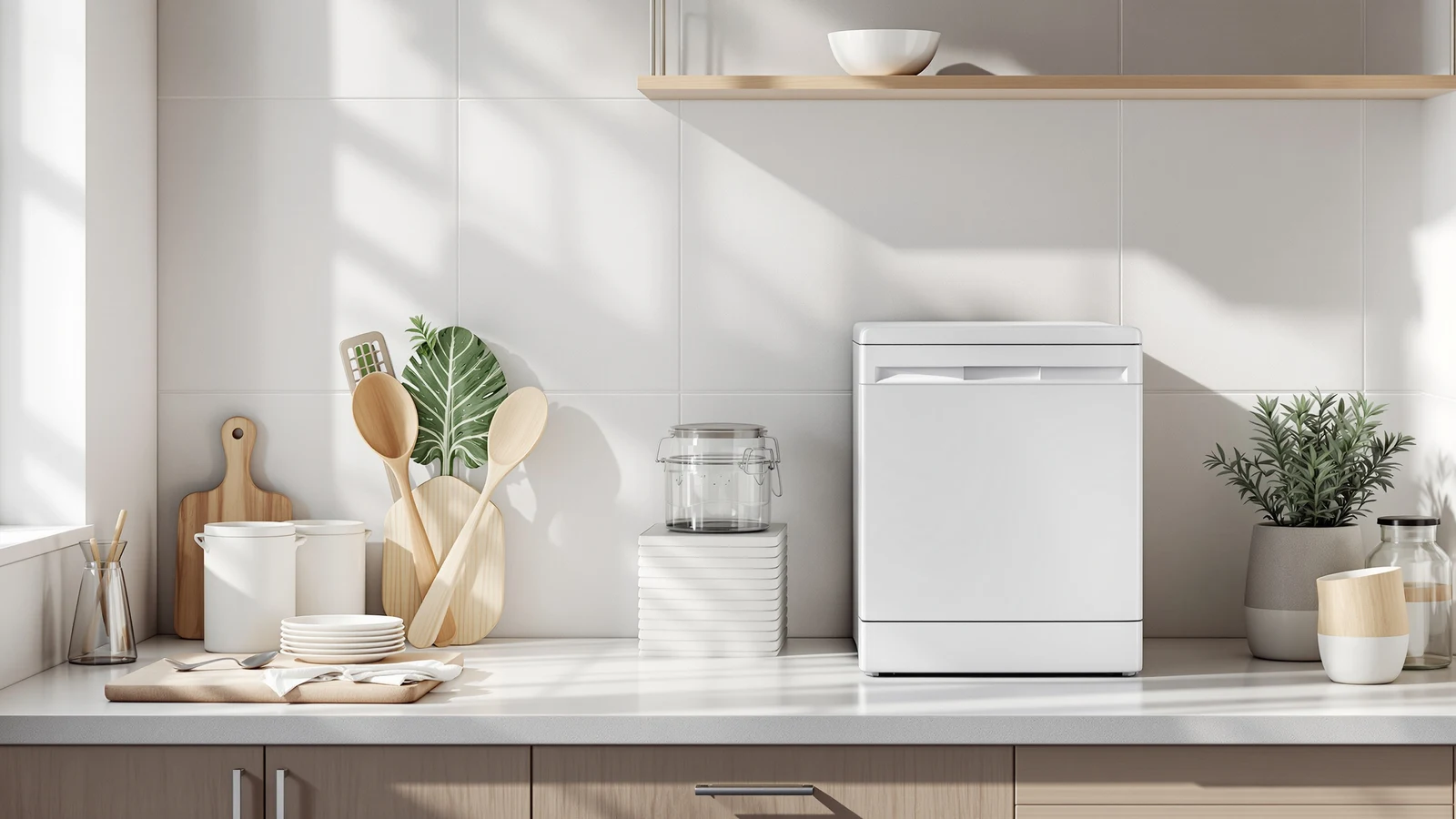
Three unbranded countertop portable dishwasher boxes on a kitchen counter, no recognizable logo visible

Reader-supported: we may earn a commission when you buy through the links on this page, at no additional cost to you. Prices move constantly — confirm the live price before you order.

Search "portable dishwasher under $200" on Amazon and a good share of the results carry names that sound invented, because in the sense that matters — a company with a history, a warranty line and a support number — they often are. Collier, Canbo and JOJTETTY are three such listings in our own database: a $169.99 compact countertop unit, a $189.99 tabletop model built around its own water tank, and a $200.00 fully automatic tabletop machine that can run from either a faucet or a hand-filled tank. None of the three is a brand you'd recognize from a big-box aisle, and none of their listings reads like one either.

This guide is about what that actually means for a buyer, separated from what it doesn't. A storefront name you've never heard of is not, by itself, evidence of a bad product — plenty of established appliance brands started as exactly that. But it does predict something real about how much the listing tells you before you buy, and how much backup exists after you own it. We go through what each of these three listings promises, what it leaves out, and where a no-name machine is genuinely the right call at this price.

How this page is built

We compare what's published in each listing's own title and bullet copy against the live price, and against general, verifiable facts about how the portable dishwasher category and Amazon's marketplace work. We don't physically test these machines and we don't run a testing lab. Amazon's product data returns no rating and no review count for any of the three ASINs below, so there are no stars on this page — and we don't paraphrase review sentiment we have no record of, which would be the same offense as inventing a score.

Where they come from

Why some of the cheapest listings carry no name you recognize

Almost every portable dishwasher on Amazon, branded or not, comes off a small number of contract factories that build the same basic chassis — a sealed tub, a small pump, a heating element, one or two spray arms — and sell it to whoever registers a storefront. An established name like the ones that show up elsewhere on this site typically buys that hardware, puts real engineering and testing behind the finished product, and backs it with a company that answers a phone line and sells spare parts for years afterward. A storefront brand buys close to the same hardware, writes the listing copy, and registers a name through Amazon's Brand Registry mainly so it can run its own product pages rather than compete on someone else's — which is a real and legitimate program, but it sets a very low bar for what counts as a "brand."

That's the pattern behind names like Collier, Canbo and JOJTETTY: each is the registered brand on its own listing, each sells a dishwasher-shaped appliance at a price well under the established-name machines in this category, and none of them is a company with a public history, a retail presence, or — as far as we can find — any product outside this one appliance category. It's the same structural story we found when we traced why one established brand's lineup carries seven nearly identical listings under one model number: Amazon's marketplace rewards having your own listing to control, and a new registered name is often the cheapest way to get one, whether the seller behind it builds anything distinctive or not.

None of this tells you the machine inside the box is worse. It tells you that the name on the listing isn't doing the work a recognizable brand name usually does — vouching, in effect, for a baseline of consistency and support — and that you'll need to get that reassurance somewhere else, because the name itself won't give it to you.

The spec sheet

What the title promises, and what it quietly skips

The fastest way to see the gap is to read what each listing's own title chooses to say — and, just as tellingly, what it doesn't. Collier's listing title promises "5 Wash Programs, Built-in Water Tank & Hose Connection," and markets itself as "Space-Saving for Apartments, RVs & Small Kitchens." Canbo's title leads with "Built-in Water Tank" and calls itself a "Bottle Washer ... With Drying Function." JOJTETTY's title promises "4 Washing Modes and Drying Function" and that it "Can be connected to the faucet and manually filled with water" — in other words, it covers both water sources the way several tank-and-faucet dual-mode machines on this site do, a trade-off explained in more detail in our comparison of a major brand's own tank-fed and faucet-fed lines.

What none of the three titles states is a place-setting count, an external dimension, a plate-diameter limit or a decibel figure — the handful of numbers that let you compare one countertop dishwasher against another without guessing. An established brand's listing usually leads with exactly that: a stated "6 place settings" or "8 place settings," a height-by-width-by-depth figure to the tenth of an inch, and often a certification mark like ENERGY STAR or NSF, the kind our guide to NSF certification covers for machines that carry it. Numbers like that cost the seller something to publish, because they can be checked against a tape measure and a stack of plates when the box arrives. A bare program count costs nothing to claim and nothing to verify before you've bought it.

There's a smaller tell worth flagging too. Collier's "5 Wash Programs" is stated as a flat number, not the "5+1" or "5+2" notation some budget listings use for a baseline cycle set plus bonus options — which matters because, as we found when we traced what that extra number actually counts, the plain figure and the "+" figure aren't always counting the same thing, and a listing that states one or the other without explanation is asking you to take the count on faith either way.

ListingWhat the title statesWater connectionPrice
Collier Compact Countertop5 wash programs, no place-setting or dimension figure givenBuilt-in tank or faucet via hose$169.99Price
Canbo TabletopDrying function, "bottle washer" use case, no program count stated in titleBuilt-in tank$189.99Price
JOJTETTY Fully Automatic4 washing modes, drying function, no place-setting figure givenFaucet or manual tank fill$200.00Price
The three listings

Our take on each one, and what it's missing next to a branded machine

01Cheapest

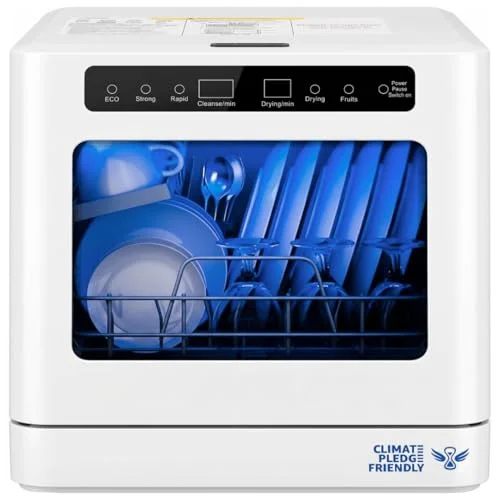
Collier Kitchen Portable Countertop Dishwasher

The lowest entry price in our database for a tank-and-faucet dual-mode machine
Countertop, compact · 5 wash programs · built-in water tank + hose connection · white

At $169.99, this is the cheapest way into a countertop dishwasher that can run from either its own tank or a faucet, which on its own is a genuinely useful combination — it's the same flexibility that makes a dual-mode machine worth a premium elsewhere in this category. The listing calls out "easy faucet hookup" with an included adapter and markets the unit specifically for apartments, RVs and small kitchens.

What it's missingNo place-setting count, no external dimensions and no plate-size limit anywhere in the title or headline bullets — the three numbers a branded listing almost always leads with. You're ordering a size and a capacity you can't check against a tape measure until the box is already in your kitchen.

Collier compact countertop portable dishwasher in white
$170
Lowest priceCheck price →
02Middle price

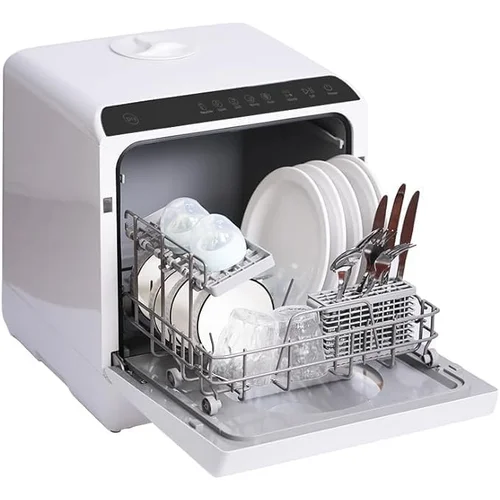
Canbo Countertop Dishwasher With Built-in Water Tank

A bottle-washer-first machine for a single person or a couple
Tabletop, mini · built-in water tank · drying function · marketed as a bottle washer

Canbo's listing is the most honest about scale of the three: it calls itself a "mini" tabletop machine and pitches itself directly as a bottle washer with a drying function, rather than implying it's a stand-in for a full dish load. That's a narrower promise, and narrower promises are easier to actually keep.

What it's missingA stated program count and a capacity figure. "Mini" and "bottle washer" tell you the rough size category, but not how many plates, bowls or glasses fit in a cycle — information a branded machine in the same tank-fed class typically states as a place-setting number, not a scale adjective.

Canbo tabletop portable dishwasher with built-in water tank
$190
Tank-only, miniCheck price →
03Most expensive of the three

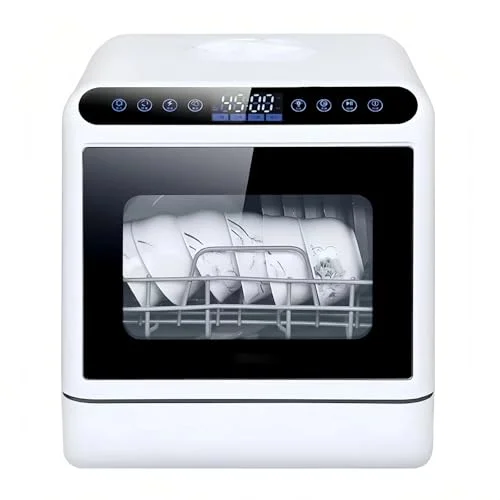
JOJTETTY Fully Automatic Tabletop Dishwasher

Buyers who specifically want both a faucet option and a tank fallback
Tabletop · 4 washing modes · drying function · faucet or manual tank fill · black

At $200.00 this is priced closer to the budget end of the branded countertop class, and it's the only one of the three whose title explicitly covers both connection methods — faucet when you have one, a hand-filled tank when you don't. "Fully automatic" in the title is standard language for "you select a program and walk away," which is true of essentially every machine in this category and isn't a differentiator on its own.

What it's missingLike the other two, no place-setting count or external dimensions in the listing's own copy. At this price point, several branded alternatives on this site do publish both — which is the actual premium you're paying for when you spend more on a recognizable name.

JOJTETTY fully automatic tabletop portable dishwasher in black
$200
Dual water sourceCheck price →
If something breaks

Parts, support and what happens when it stops working

This is the question a storefront brand's listing never answers, because it's not in the seller's interest to raise it. An established appliance brand — the kind behind, say, the multi-finish lineup covered in our look at a single brand sold under three finishes — maintains a parts catalog, a published warranty term and a support line that still exists in two years, because the company's name is attached to products beyond this one listing and a bad outcome follows it. A storefront brand registered around a single appliance category has none of that structure to fall back on by default.

In practice, that changes what "it broke" means for each class. For a machine from an established brand, a failed pump or heating element is often a part number you can order and a problem you can fix. For a machine sold under a name like Collier, Canbo or JOJTETTY, the realistic path is Amazon's own return and replacement window — typically 30 days, sometimes extended during a promotional period — and after that window closes, the honest expectation is that a failure means buying a new unit, not repairing the old one. None of this is unique to these three listings; it's the standard trade-off of buying through a marketplace seller with no independent service network, and it's worth pricing in before you order, not after the warranty period has quietly ended.

The practical move, whichever of the three you're considering: register the purchase with Amazon's order history (which it does automatically), note the return deadline on a calendar the day it arrives, and run the machine through at least one full cycle well inside that window rather than letting it sit in a box. A problem caught on day 12 is a replacement; the same problem caught on day 45 is usually a sunk cost.

The honest case for them

Where a generic listing is genuinely the right buy

None of this means skip the category entirely and always pay more. There's a real buyer for whom one of these three is the correct choice, not just the cheapest one.

  • You're testing whether you'll use a portable dishwasher at all. At $169.99 to $200.00, any of the three costs less than the gap between the cheapest and most expensive branded machines in this category. If the honest question is "will I actually run this, or is it going to sit unused," the lower stakes of a storefront-brand price make that a cheaper experiment.
  • You need a dedicated bottle or small-item washer, not a full dish-load machine. Canbo's listing is explicit about this use case, and a narrow, honestly-scoped job is exactly where an unfamiliar name's lack of a long track record matters least — there's less that can go wrong when the machine isn't being asked to do much.
  • You have a tank-only kitchen and need the lowest-cost way into tank-fed washing. Collier's combination of a built-in tank and a faucet hose option, at the lowest price in our database for that combination, is a legitimate reason to pick it over a pricier dual-mode machine — provided you've accepted the unknowns around exact capacity.
  • You're equipping a rental, RV or short-term setup you don't plan to keep for years. The repair-versus-replace math changes completely when you expect to own the appliance for one season rather than five years; a machine with no parts network is a much smaller downside on a short horizon.

What ties all four cases together is that the buyer isn't expecting the brand name to do any work. They're pricing the machine as what it actually is — a disposable-if-it-fails appliance at a disposable-adjacent price — rather than hoping an unfamiliar name will behave like a familiar one.

The pattern

The one corner that's cut almost every time

Add it up across all three listings and the missing feature isn't a spray arm, a cycle or a tank size — it's disclosure itself. Not one of the three states a place-setting count, an external dimension or a plate-diameter limit in its own title or headline copy. That's not a coincidence repeated three times; it's the one corner that's consistently cheapest to cut, because it costs the seller nothing to omit a number that a reviewer or a returning customer could otherwise hold them to.

Why this is the tell, not the price

A low price by itself doesn't predict quality — plenty of genuinely competent machines in this category are inexpensive. What predicts how much you can verify before buying is whether the listing commits to checkable numbers. Established brands publish dimensions, place settings and sometimes a certification mark because those figures get compared, screenshotted and quoted back at them if they're wrong. A storefront listing that skips straight from "5 wash programs" to lifestyle photography is skipping the part that would let you hold it accountable later — which is a cheaper decision for the seller than it is for you.

The workaround is simple, if not glamorous: before you order a dishwasher-shaped appliance from a name you don't recognize, check the listing's Q&A section and the written reviews specifically for a measurement or an item count someone else has already supplied — not a star rating, which these listings mostly don't have anyway, but a concrete number a previous buyer bothered to post. If nobody has, assume the gap in the spec sheet is real and plan your counter space and your dish count with margin, not precision.

FAQ

Common questions about buying a no-name portable dishwasher

Does a no-name brand mean the dishwasher is badly made?

Not by itself. Most portable dishwashers, branded or not, come off a small number of shared contract factories, and a storefront name like Collier, Canbo or JOJTETTY can be selling perfectly functional hardware. What it doesn't come with is a company history, a parts catalog or a long-standing warranty structure — the things that back up a known brand's name. The name tells you less about the product and more about what support looks like afterward.

Why doesn't the listing say how many place settings it holds?

Because a place-setting count, like an exact dimension, is a specific claim a buyer can check and complain about if it's wrong — and it costs the seller nothing to leave it out. Established brands tend to publish it because comparison shopping and returning customers hold them to it. None of the three listings here state one in their own title or headline copy, which is the single most consistent gap we found across all three.

What happens if a generic portable dishwasher breaks after the return window?

Realistically, you replace it rather than repair it. An established brand typically sells spare parts and runs a support line for years after purchase; a storefront brand built around one appliance listing usually doesn't have that infrastructure. Amazon's own return and replacement window — commonly 30 days — is the main protection you have, so it's worth running the machine through a full cycle well before that window closes.

Is a generic brand ever the smarter buy than an established one?

Yes, in specific situations: testing whether you'll use a portable dishwasher at all, a narrowly-scoped job like washing bottles rather than full dish loads, the lowest-cost way into tank-fed washing, or equipping a rental, RV or short-term setup you won't own for years. In each case the buyer isn't counting on the brand name for anything — they're pricing the appliance as what it is, at a price that matches the risk.

Keep reading

Next, from this site