Best Portable Dishwashers
Guide · Reading the program count

'5+1' Programs. What's the plus-one?

Plenty of budget tank dishwashers don't list a plain number of wash programs. They list a split one — "5+1" or "5+2" — as if the extra cycle is a bonus the listing is excited about. It usually isn't a wash cycle at all, and knowing what it actually is tells you more about the machine than the headline number does.

By Ilane Tall · Updated October 24, 2026 · Research-based.

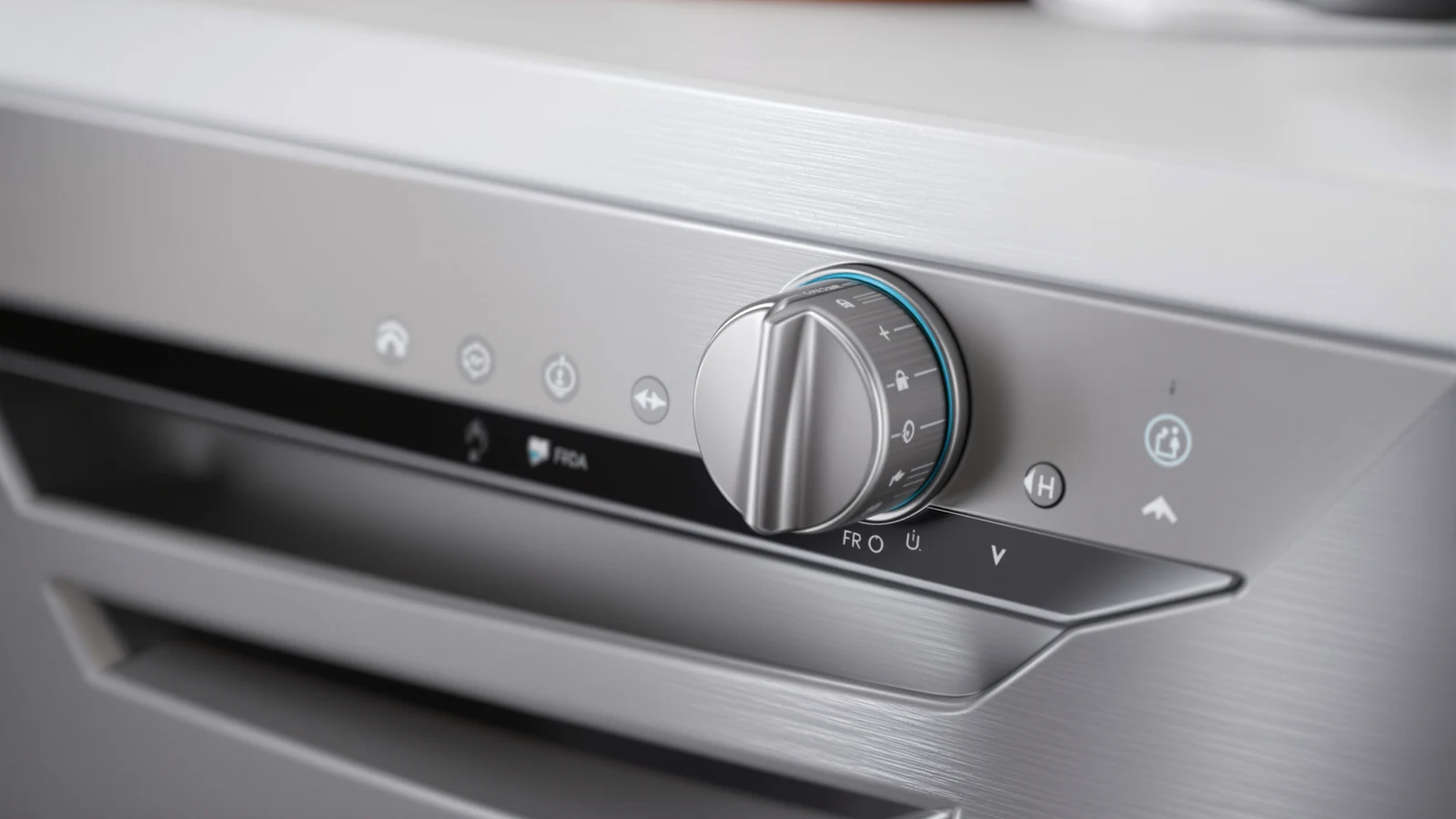
Control panel of a compact countertop dishwasher showing a row of program icons with a separate highlighted self-clean icon

Reader-supported: we may earn a commission when you buy through the links on this page, at no additional cost to you. Prices move constantly — confirm the live price before you order.

If you've spent any time scrolling budget dishwasher listings, you've seen the notation: "5+1 Wash Programs," "5+2 Programs," sometimes "6+1." It reads like a typo the first time, then like a sales trick the second time, and it's neither. It's a specific accounting choice a manufacturer makes when writing the bullet points, and it shows up almost exclusively on the cheapest tier of countertop and portable dishwashers — the tank-fed machines that compete on price before anything else.

This guide explains what the base number and the plus number are each counting, why the extra program is almost never a wash cycle in the sense you'd expect, why the notation clusters on budget tank models specifically, and how to compare a "5+1" listing fairly against a competitor that just says "6 Programs." We'll use three real tank-fed countertop dishwashers that carry this exact notation to make the comparison concrete, and we'll link out to the sibling guides on this site that cover adjacent questions — brand sourcing, auto door venting, child locks and NSF certification — where they're relevant to the same shopping decision.

How this page is built

We compare published specifications, what ships in the box, listing copy and price. We do not physically test these machines, we do not run a testing lab, and we do not publish ratings we cannot verify — Amazon returns no rating and no review count for this category, so there are no stars on this site. Where a judgement is ours rather than a specification, we say so.

The notation

Why some listings count programs as a base number plus extra

A dishwasher's "programs" are its preset wash cycles — the buttons or dial positions that set water temperature, cycle length and spray intensity for a given job: a Normal wash, a Heavy wash for greasy pans, a Glass cycle for stemware, a fast Quick wash, and so on. For decades the industry has simply added them up and printed the total: "6 Programs," "8 Cycles." A single clean number is easy to compare across listings, which is exactly why it's the default on mid-range and premium machines.

Budget tank models broke that convention for a reason that has nothing to do with washing dishes and everything to do with how a listing gets read. A dishwasher built to compete on price has a short feature list — it's a small sealed tub with a pump, a heater and a handful of programs, not much else to brag about. Splitting the count into "5+1" turns one number into two mentions of a number in the same bullet point, and it draws a reader's eye to the "+1" as if it were a bonus feature rather than a footnote. It's a presentation choice, not a technical standard, which is why you won't find "5+1" on a mid-range or premium machine that already has eight or ten programs worth listing plainly.

It also solves an honesty problem for the manufacturer. The "+1" item usually isn't a wash program in the sense a shopper means the word — it doesn't clean a sink full of dishes on its own. Counting it plainly in the headline total ("6 Programs") would be defensible but slightly misleading; leaving it out entirely would undersell a real, useful function. Splitting the number is the middle path: the function gets credit, but it's visually set apart from the five or six programs that actually wash a full load.

The plus-one

What the '+1' or '+2' program usually turns out to be

Across the budget tank-fed category, the extra program listed after the plus sign is, with remarkable consistency, one of three things — and it's worth naming them plainly because none of them is "an extra way to wash a full load of dishes":

  • A self-clean or tank-rinse cycle. Runs with no dishes loaded, circulating hot water (sometimes with a descaling tablet or a splash of vinegar per the manual) through the tub, pump and spray arms to clear limescale and food residue the regular wash cycles leave behind in a small, sealed system. Genuinely useful on a tank-fed machine, because a five-litre tank and a compact pump accumulate buildup faster than a full-size, plumbed-in dishwasher does — but it doesn't wash a plate.
  • A rinse-only or pre-rinse cycle. A short, no-detergent rinse meant for dishes that will sit in the machine for a few hours before a full wash, or for giving lightly soiled items a quick water-only pass. It uses less water and no heat cycle worth mentioning, and it's not a substitute for an actual wash program.
  • A delay-start or timer function. Some listings count the ability to delay the start of a cycle — useful for running the machine on off-peak power or finishing a wash right when you walk in the door — as if it were its own program, when it's really a scheduling feature layered on top of whichever wash program you actually pick.

What the "+1" is not, on the machines in this guide and the category generally, is a sixth or seventh distinct wash intensity — there's no hidden "Pots and Pans Extra Heavy" program hiding behind the plus sign. If a listing doesn't spell out what the extra function does, the honest assumption is one of the three above, and the honest move as a shopper is to check the product listing's own program list (most spell it out further down the page, even when the headline bullet doesn't) before assuming you're getting a functional sixth wash.

The picks

The picks, and what each extra program actually does

All three carry the "5+1" or "5+2" notation in their own listings. Prices move constantly on Amazon — confirm the live price before you buy.

015+1, delay start

Countertop Dishwasher with Delay Start, 5+1 Wash Programs

Buyers who want to schedule a wash around off-peak hours or a specific finish time
Countertop, tank-fed · 5+1 programs · delay-start timer

The name of this one gives away its own "+1": the listing pairs "Delay Start" directly with "5+1 Wash Programs" in the same breath, which is a reasonably transparent way to write the bullet. Read plainly, that means five regular wash programs plus a delay-start function counted as the sixth item — not a sixth wash intensity. If you want to load it in the morning and have it finish right before dinner, or run it overnight on a cheaper electricity rate where that applies, the delay timer is the feature doing the work, and it's worth having regardless of how the listing counts it.

The trade-offWe don't have a published spec sheet breaking out exactly which five programs are included or the unit's place-setting capacity, drain method or external dimensions beyond what's in the listing title — check the current Amazon listing for those details before you buy, since we don't assert specs we can't verify here.
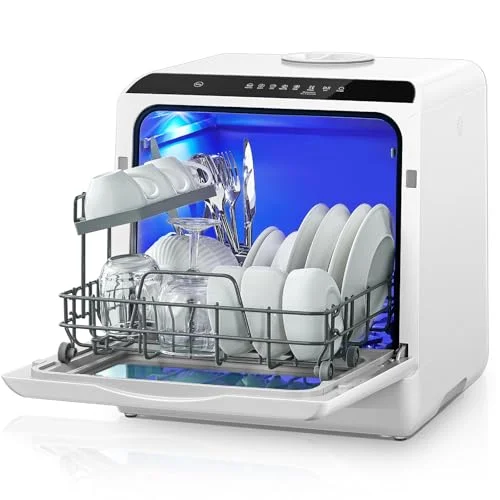
Countertop dishwasher with delay start and 5+1 wash programs
$229
5+1 programsCheck price →
025+1, mini footprint

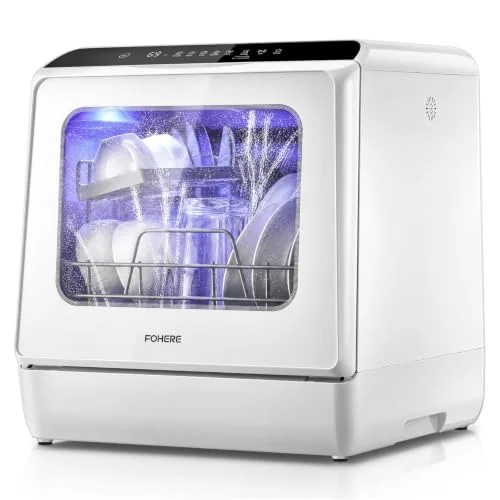
Portable Countertop Dishwasher 5+1 Programs, Mini

Tiny counters, dorms and anyone who just needs the basics
Mini countertop · 5+1 programs

This one markets its small size first and its "5+1" program count second, which is typical of the mini-countertop tier: the footprint is the selling point, and the program count exists mainly to confirm the machine isn't a one-trick box. Without a published breakdown of what the sixth item is, the safest read — consistent with the rest of this category — is a self-clean or rinse-only function rather than a genuine sixth wash intensity. Treat the "5" as the real program count for planning purposes, and treat the "+1" as a nice-to-have utility function on top.

The trade-offWe don't have a published spec sheet for this unit's capacity, water source details beyond "portable countertop," or exact external dimensions — the listing's own detail page is the authority on those, not this guide.

Portable countertop mini dishwasher with 5+1 wash programs
$238
5+1 programsCheck price →
035+2, auto door open

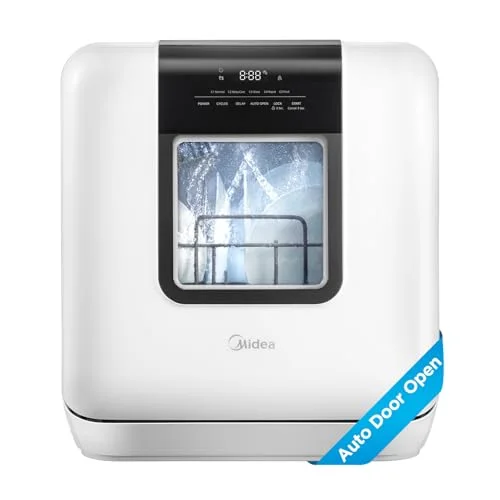
Midea Countertop Dishwasher with 1.59Gal Built-in Water Tank, 5+2 Programs

Buyers who want a known brand and self-venting drying on top of the basics
Countertop, tank-fed · 1.59 gal built-in water tank · 5+2 programs · Auto Door Open

Midea's listing goes further than the other two by splitting the extra count into two: "5+2" rather than "5+1." That second-tier split is consistent with our read above — a self-clean or rinse-only utility plus a separately counted function, which on this model is plausibly tied to its stated Auto Door Open feature, since the door popping open at the end of a cycle to vent steam is sometimes counted as its own listed "program" even though it's really a drying behavior layered onto whichever wash cycle you ran. We cover what Auto Door Open changes in practice, on this and other Midea machines, in our guide to portable dishwashers that vent themselves after a cycle. Midea also sells a separate line of 18-inch built-in-style machines under the same brand, which is a different product entirely from this tank-fed countertop unit — see Midea's countertop vs. built-in portable dishwashers if you're comparing across Midea's whole range.

The trade-offThe 1.59-gallon tank is on the smaller side for a tank-fed machine, which caps how much you can run in one cycle before refilling — and we don't have a published place-setting count or external dimensions for this unit beyond the tank size and the Auto Door Open spec, so confirm capacity on the live listing before assuming it matches a larger countertop model.

Midea countertop dishwasher with built-in water tank and auto door open, 5+2 programs
$272
5+2 programsCheck price →
Why budget tank models

Why this notation shows up mostly on budget tank models

You will rarely see "5+1" on a mid-range or premium dishwasher, and that's not a coincidence of marketing taste — it's a function of what each tier has to say about itself. A machine with eight or ten genuinely distinct wash programs, a WiFi connection and an ENERGY STAR certification has plenty of headline-worthy bullets; splitting one of its ten programs out for emphasis would bury a stronger feature. A $170–$290 tank-fed countertop machine has far fewer bullets to work with — a tank, a handful of programs, maybe a basket configuration — so the program count carries more weight in the listing's first line, and splitting it is a cheap way to make that line do more work.

There's a second, more structural reason too. Tank-fed machines genuinely need a self-clean or rinse-maintenance function more than faucet-connected machines do. A five-litre (or smaller) built-in tank and a compact pump recirculate the same small volume of water repeatedly during a cycle, and food residue and limescale build up in that closed loop faster than in a full-size machine drawing from a home's plumbing on each fill. So the "+1" earns its place functionally, even if it's being used rhetorically — it's not purely a marketing invention, it's a real maintenance feature that happens to also be convenient to count separately when the rest of the spec sheet is thin.

Brand and manufacturing patterns play a role too. A number of these budget tank machines share chassis and control boards across several nameplates — the kind of pattern we document in our guide to who actually makes portable dishwashers and in our look at the SPT SD-9263's seven nearly identical listings. When several brands are selling close variants of the same underlying hardware, the program count — and how it's split — tends to get copied across listings along with everything else, which is part of why "5+1" shows up again and again across unrelated brand names rather than being one manufacturer's quirk.

Comparing fairly

Comparing a plain '6 Programs' listing against a '5+1' one fairly

The instinct when you see "6 Programs" next to "5+1 Wash Programs" is to read them as the same number written two different ways — six versus six. That's the comparison the "5+1" format is designed to invite, and it's the wrong one to make without checking what each number is actually counting.

The fairer method is to separate wash programs from utility functions before comparing anything:

  • Count actual wash cycles only. If a competitor lists "6 Programs" and all six are wash intensities — Normal, Heavy, Glass, Quick, Eco, Baby Care, say — and the "5+1" machine's five are a similar spread with a self-clean cycle as the "+1," the honest comparison is 6 wash programs versus 5. The plain-number listing has one more real way to wash a load.
  • Credit the utility function on its own terms. A self-clean or rinse-maintenance cycle is a genuine convenience, worth having, and arguably more necessary on a tank-fed machine than on a plumbed-in one for the reasons above. It just isn't equivalent to a wash program, so weigh it as "does this machine have an easy built-in way to flush the tank" rather than folding it into the headline count.
  • Check whether the plain-number listing has its own hidden utility functions. Some "6 Programs" listings also have a self-clean or delay-start function — they just didn't choose to count it in the headline. The only way to know is to read the full program list on the product page, not the title.
  • Weight by what you'll actually use. If you'll never run a self-clean cycle on purpose, a "+1" that's a self-clean function is worth close to nothing to you personally, however it's counted. If you specifically want delay-start scheduling, a "+1" that is a delay timer might matter more to you than an eighth wash intensity would.

None of this means the "5+1" machine is worse — plenty of them are priced, sized and specced appropriately for what they are, which is an entry-level tank-fed dishwasher. It means the headline number on its own isn't the number to compare. Read past the plus sign before deciding one listing beats another on program count alone.

What actually matters

The programs worth having regardless of how they're counted

Strip away the notation question and a short list of programs does most of the real work on any budget tank dishwasher, split or not:

  • A Normal or Standard cycle for everyday mixed loads — this is the one you'll use most often, and the one worth checking the stated cycle time and temperature on if the listing provides them.
  • A Heavy or Pots & Pans cycle with a longer run time and hotter wash for baked-on food, since a short, low-volume cycle on a small tank-fed machine struggles with heavy soil the same way it struggles with detergent pods not fully dissolving.
  • A Quick or Fast cycle for lightly soiled dishes or glassware when you don't want to wait out a full Normal program.
  • A Glass or delicate cycle that runs gentler spray pressure and lower heat, if you wash stemware or anything you don't want to risk chipping on a high-pressure jet.
  • Whatever the "+1" or "+2" turns out to be on the specific machine you're buying — a self-clean cycle is genuinely worth using every few weeks on a tank-fed machine to keep limescale and residue from building up in the pump and spray arms; a delay-start timer is worth having if your schedule or your electricity rates benefit from it.

If a listing's program count — split or plain — covers that list, the exact notation it uses to advertise itself matters a lot less than whether the five or six programs it has map onto the kinds of loads you'll actually run. A machine with a clean plain "5 Programs" that covers Normal, Heavy, Quick, Glass and Eco is arguably better specified for daily use than a "5+2" machine whose extra two are both administrative functions and whose base five skip a dedicated Glass cycle. Read the full program list, not just the headline number, and the plus sign stops being confusing.

FAQ

Common questions about '5+1' program counts

Is the '+1' program on a '5+1' dishwasher a real wash cycle?

Usually not in the sense of washing a full load of dishes. Across the budget tank-fed category it's most often a self-clean or tank-rinse cycle that runs with no dishes loaded to flush limescale and residue from the pump and spray arms, a short rinse-only cycle with no detergent, or a delay-start timer function counted as if it were its own program. It's a real, often useful feature — it just isn't a sixth distinct wash intensity.

Why don't mid-range or premium dishwashers use the '5+1' notation?

Because they usually have enough genuinely distinct wash programs — eight, ten, sometimes more — that splitting one out for emphasis wouldn't help their listing. The split notation is most common on entry-level tank-fed machines with a short feature list overall, where drawing extra attention to the program count, and to a genuine utility feature like self-clean, does more work for the listing.

Should I count the '+1' when comparing program totals between two dishwashers?

Count it separately rather than folding it into the total. Compare actual wash programs against actual wash programs first — a plain "6 Programs" listing where all six are wash cycles has one more real way to wash a load than a "5+1" listing whose fifth-plus-one is a self-clean function. Then weigh the utility function on its own merits: useful to have, but not equivalent to an extra wash cycle.

Does a '5+2' dishwasher have more wash programs than a '5+1' one?

Not necessarily. The number after the plus sign counts how many utility or administrative functions the listing chooses to call out separately, not additional wash intensities. A "5+2" and a "5+1" machine may well have the identical five wash programs, with the "5+2" listing simply splitting two non-wash functions — say, a self-clean cycle and a separately counted drying or venting behavior — into two bullet items instead of one.

Keep reading

Next, from this site