Best Portable Dishwashers
Guide · Leak Detection

Leak detection on a portable dishwasher. Which models actually have it.

A hose clamp slipping off its fitting is the single most common way one of these machines floods a kitchen floor. Almost none of the listings in our database mention a sensor built to catch that before it happens — only a couple name one at all, and they sit at opposite ends of the price range. Here's what the feature mechanically watches for, why it's rare, and what actually happens on a machine that doesn't have it.

By Ilane Tall · Updated November 21, 2026 · Research-based.

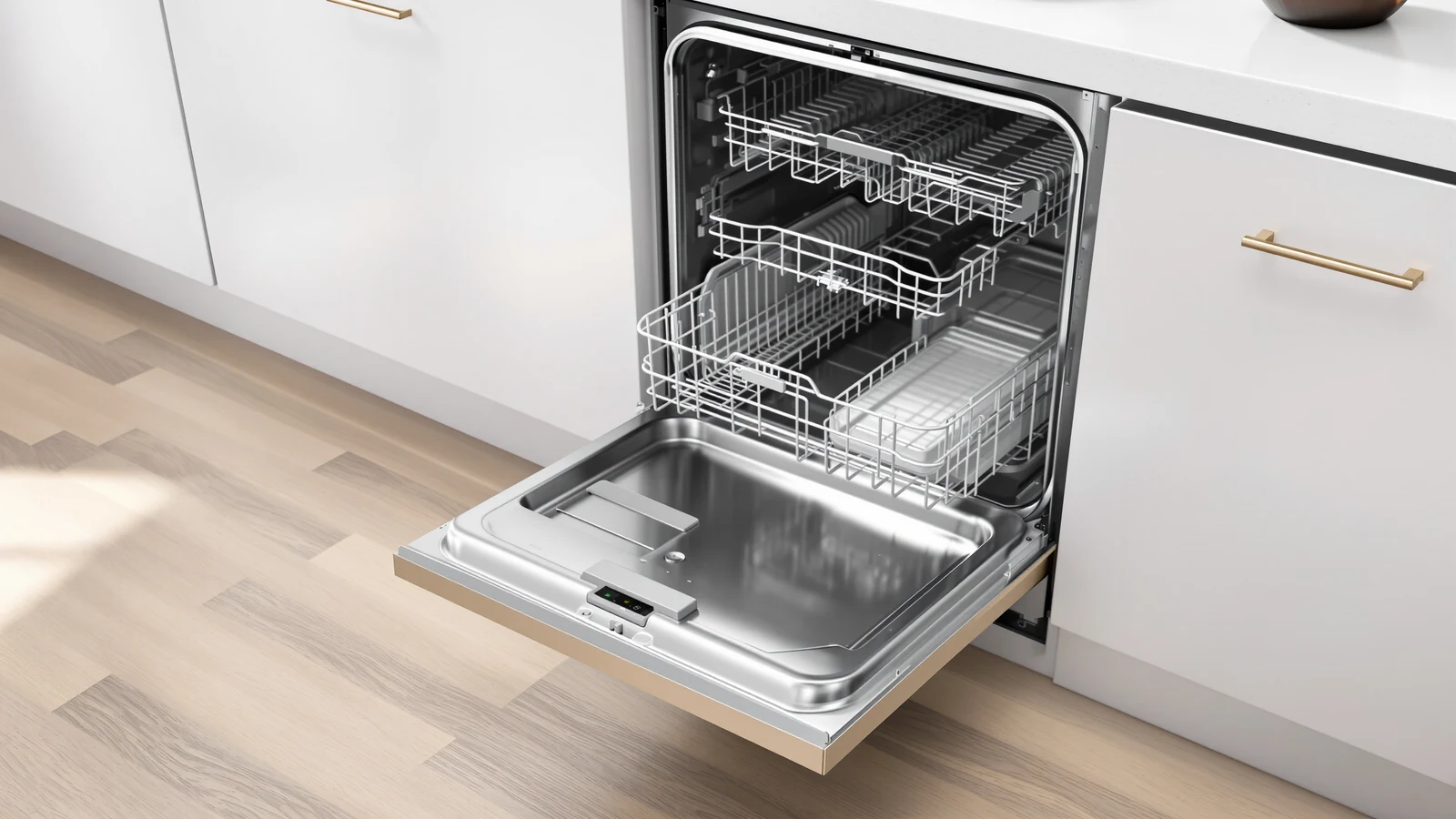
An open built-in dishwasher pulled out from its cabinet, showing the stainless base pan beneath the racks where a leak-detection float sensor sits

Reader-supported: we may earn a commission when you buy through the links on this page, at no additional cost to you. Prices move constantly — confirm the live price before you order.

Search a listing title for "leak detection" or "leakage sensor" in this category and you'll come back with almost nothing. Of the products in our database, only two name the feature outright: a $336 countertop machine from EdgeStar and an $849.99 Kenmore built-in. A third machine we cover regularly — COMFEE's six-place countertop dishwasher — names no such feature, and we treat that absence as a real spec gap, not an oversight in how the title was written.

We compare published specifications, what ships in the box, and live pricing — we do not run a testing lab and we do not verify how any of these sensors behave inside a real cabinet over a thousand cycles. What we can do honestly is explain what a leak sensor is built to watch for, why it shows up on so few listings here, and what a reader without one should do instead.

How this page is built

We work from manufacturer listing titles and bullets, not from a rating or review count — Amazon returns neither for this category, so there are no stars anywhere on this site. Where a listing states a feature, we report it; where a listing is silent on a feature, we say so and don't assume it's there anyway, even for two machines from the same brand family.

The mechanism

What a leak-detection sensor mechanically watches for

Strip the marketing language off "leak detection" and the engineering underneath is simple and has been standard on full-size built-in dishwashers for years: a float switch or a pair of electrical contacts sits in the base pan, underneath the tub, at the lowest point water in the cabinet would reach. During a normal cycle, that pan stays dry — any water that gets there came from somewhere it shouldn't have, whether that's a worn door seal, a cracked spray arm, or the hose connection at the back of the machine working loose.

When water reaches the sensor, the float rises, or the contacts complete a circuit, and the control board either halts the cycle and trips an error code on the display, or runs the drain pump continuously until the water is gone, regardless of what step the wash cycle was on. Either behavior serves the same purpose — stop adding water to a tub that's already leaking, rather than run the cycle to completion while the floor underneath gets wetter.

It's worth being precise about what this is not. A base-pan float sensor does not detect a slow drip from a worn hose gasket before it pools, it does not alert your phone, and it does not stop water that leaks from a connection point outside the machine's own cabinet — a supply line fitting at the faucet adapter, for instance, is upstream of where the sensor sits. The feature is a last line of defense against water accumulating inside the appliance's own footprint, not a whole-kitchen monitoring system. That distinction matters more on a portable or countertop machine than on a plumbed-in one, which we get to below.

Why it's rare

Why this feature appears on so few listings in this category

Full-size built-in dishwashers have carried some form of leak protection for well over a decade, because the failure case is expensive: a built-in sits inside a cabinet, under a counter, often over a wood or laminate floor, and a flood there can mean replaced subfloor and swollen cabinetry before anyone notices. A countertop machine fails differently. It sits in the open, on a worktop, where a spill is visible within minutes and the floor below is usually tile or vinyl rather than a sealed cabinet base. The cost of a leak going unnoticed is lower, so the incentive to engineer a sensor into a $260 appliance is lower too.

There's a second, blunter reason: a float sensor and the control-board logic behind it are a real line item on a bill of materials, and countertop machines here are built down to a price. Most listings we track spend their feature budget on cycle count, a water softener, or an ENERGY STAR badge instead, because those sell better than a safety feature a buyer hopes never activates. The two exceptions in our database make the trade-off visible rather than disprove it: a $336 countertop unit that names the sensor as a headline bullet, and an $849.99 24-inch built-in, the product class leak detection was designed for in the first place.

None of this means an unlisted machine definitely lacks the feature — it means the listing doesn't claim it, and an unclaimed feature is treated as absent here. If a leak sensor specifically matters to your decision, a stated "leakage sensor" or "leak detection" bullet is the only reliable signal; a brand name or a higher price is not.

The picks

The picks, and what each one's sensor actually triggers

01Countertop, has it

EdgeStar Countertop Dishwasher, Leakage Sensor + Child Lock

A countertop buyer who specifically wants the safety net, not just the wash cycles
Countertop · 6 place settings · 21-5/8 in wide · 7 wash cycles · Leakage sensor · Child lock · ENERGY STAR Rated

This is the title bullet that started this page: a $336 countertop machine that states a leakage sensor outright, alongside a child lock and a 7-cycle programme list. Mechanically, a sealed countertop tub this size has less base-pan depth than a built-in, so the sensor here is most plausibly reading a shallow catch tray under the wash compartment rather than a full cabinet floor — the listing doesn't specify the exact placement, and we don't invent one. What the bullet tells a buyer is that EdgeStar engineered a response to water in the wrong place into a sub-$350 appliance, which is uncommon enough in this price band to be the headline reason to pick this listing over its own siblings.

The trade-offEdgeStar sells near-identical countertop listings under the same family name that do not claim a leakage sensor — see our comparison of all three EdgeStar countertop listings before assuming any EdgeStar box has it.
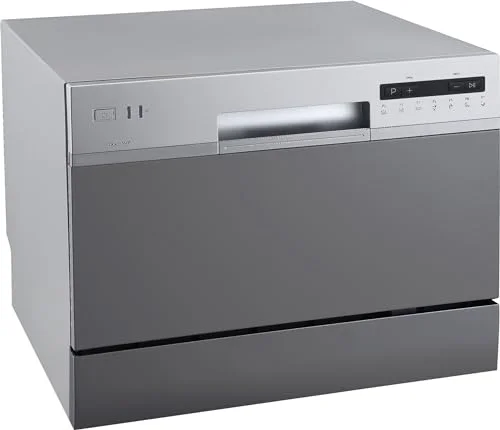
EdgeStar countertop dishwasher in silver with a leakage sensor and child lock
$336
Leakage sensorCheck price →
02Built-in, has it

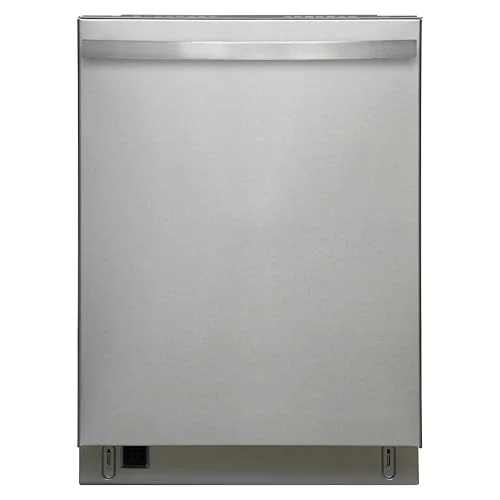
Kenmore 24" Built-In Dishwasher with Leak Detection

Someone installing a permanent built-in and wanting the standard safeguard for that product class
24.61 × 23.55 × 33.88 in · 49 dBA · 15 place settings · TurboDry · SmartWash · Leak Detection · ENERGY STAR Certified

At $849.99 this is the most expensive machine in this comparison and the one where leak detection is least surprising to find: a 24-inch built-in sits inside a fitted cabinet over a finished floor, exactly the installation a base-pan sensor was designed to protect. The listing pairs Leak Detection with TurboDry and SmartWash and states 15 place settings and a 49 dBA rating — a genuinely large-capacity machine built for a kitchen with a real dishwasher opening, not a counter or a cart.

The trade-offThis is a permanent installation, not a plug-in appliance — it needs the cabinet opening, water line and drain a built-in requires, and at $849.99 it costs roughly 2.5 times the EdgeStar countertop listing above. If you're comparing Kenmore's other built-in and freestanding listings, see our breakdown of Kenmore's three very different "portable" dishwashers — this unit's dimensions and price don't match any of those three, which is exactly the kind of mix-up a shared brand name invites.

Kenmore 24-inch built-in dishwasher in fingerprint-resistant stainless steel with leak detection
$850
Leak DetectionCheck price →
03Doesn't have it

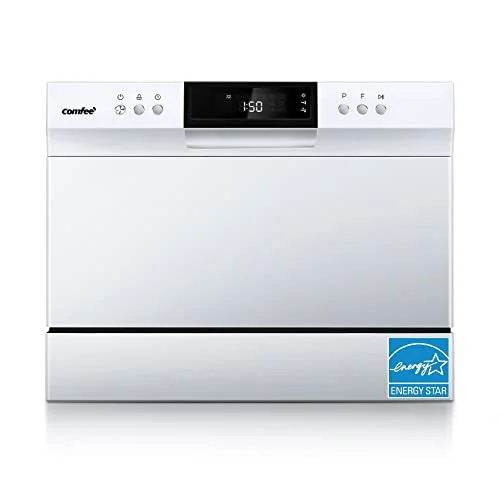
COMFEE' Countertop Dishwasher, 6 Place Settings

The baseline for comparison: a well-specified countertop machine with no stated leak sensor
Countertop · 19.7 × 21.6 × 17.2 in · 6 place settings · ENERGY STAR

We're including this one specifically because its listing is silent on leak detection, and that silence is the point of this page. At $259.99 it's the cheapest of the three and a machine we recommend elsewhere on this site for its capacity and its ENERGY STAR certification — but nothing in its title or bullets claims a leakage sensor, so we don't credit it with one. Anyone choosing between this and the EdgeStar listing above on safety grounds alone is choosing a stated feature over an unstated one, not a cheap machine over an expensive one.

The trade-offWithout a base-pan sensor, this machine's leak protection is whatever the door seal and hose fittings provide passively — solid engineering, but nothing that actively stops a cycle if a connection works loose. See the habits below for how to cover that gap yourself.

COMFEE' countertop dishwasher, 6 place settings
$260
No stated sensorCheck price →
Price isn't the tell

An $850 built-in and a $336 countertop both have it — price isn't the signal

It would be convenient if leak detection tracked price in a straight line — pay more, get the sensor. The three listings above don't support that. The Kenmore built-in at $849.99 states Leak Detection, and so does the EdgeStar countertop machine at $336.00, a little over a third of the price and in an entirely different product class. Meanwhile the COMFEE' countertop machine at $259.99 states none, despite sitting only $76 below the EdgeStar listing that has it.

What actually predicts the feature, as far as a published title can tell you, is whether the individual manufacturer chose to build it in and say so — not the machine's size, its install type, or its price tier. That's an uncomfortable conclusion for a shopper who wants a simple rule, but it's the honest one: "spend more" is not a reliable way to buy leak protection in this category, and the EdgeStar listing is the clearest proof of it we have in our database. Check the title and bullets for the words "leak" or "leakage," not the price tag.

This mirrors a pattern we've documented elsewhere — stated features clustering unevenly across a brand's own lineup rather than scaling with price. Our comparison of 24-inch built-in capacity against 18-inch portables found the same thing with place settings: read the actual bullets rather than assume the bigger number sits on the bigger price tag.

Without the feature

What happens on a machine without the feature if a hose connection fails

None of the water-handling mechanics change on a machine without a stated leak sensor — hoses still clamp onto fittings, pumps still push water in and out, door seals still compress against a gasket. What changes is who notices first when something goes wrong, and how long a failure runs before it's caught.

On a countertop machine like the COMFEE' above, the supply line connects at the faucet with an adapter and the drain hose hooks over the sink edge; a loose faucet adapter or a drain hose that's slipped off the sink lip is the two most common failure points, and both are visible, not hidden inside a cabinet. Without a sensor, nothing inside the machine stops the cycle if water starts escaping at either connection point — the wash and drain programme runs to completion regardless, and the first sign of trouble is water on the counter or the floor, found whenever someone next walks into the kitchen. Because the machine sits in the open rather than behind a cabinet door, that discovery is typically faster than it would be for a built-in, which is some of the reason countertop makers can justify skipping the sensor.

On a built-in without the feature — not a concern for the Kenmore listing above, which states Leak Detection, but relevant to other built-ins on the market that don't — the same failure happens behind a cabinet door, over a floor that may be wood, and the water can run for a full cycle, sometimes 90 minutes to two hours, before anyone opens the cabinet and finds it. That's the scenario a base-pan sensor exists to shorten, and why we treat an unstated leak-detection bullet on any built-in listing as a real gap, not a minor omission. If a sudden flood from a failed connection concerns you more than a slow drip, our guide to portable dishwashers for low water pressure or well water covers the related supply-line checks worth doing on any model, sensor or no sensor.

What actually catches it

Simple habits that catch a leak before any sensor would

01

Check the hose clamp before every load, not just at setup

A faucet adapter or drain-hose clamp that was snug on day one can work loose after repeated connect-and-disconnect cycles, especially on countertop machines moved between a jug fill and a tap. A five-second squeeze check before starting a cycle catches this before a sensor would even see water.

02

Run the first few cycles with the kitchen in earshot

A new connection is most likely to fail in its first several uses, while fittings seat and seals compress. Running early cycles while you're in or near the kitchen, rather than starting it and leaving, means a problem gets caught in minutes rather than discovered hours later — effectively doing a sensor's job with attention instead of electronics.

03

Keep a dry towel or tray under the machine's base

For a countertop machine without a stated leak sensor, a folded towel or a shallow tray underneath the unit turns an invisible drip into a visible, immediate sign — the same function a base-pan float performs mechanically, done with a $5 object instead of a control board.

04

Confirm the drain hose sits above the trap, not just over the edge

A drain hose that slips below the sink's drain level can siphon dirty water back in, which looks like a leak and sometimes causes one as the hose works loose fighting the backflow. Securing the hose with a clip rated for the sink lip, rather than just resting it in place, removes a common cause of the exact failure a sensor is built to catch.

At a glance

The three machines in this comparison

All figures are manufacturer specifications; prices are approximate and move constantly on Amazon.

MachineClassLeak detection stated?CapacityPrice
EdgeStar CountertopCountertopYes — leakage sensor6 settings$336.00Price
Kenmore 24" Built-InBuilt-inYes — Leak Detection15 settings$849.99Price
COMFEE' CountertopCountertopNot stated6 settings$259.99Price
FAQ

Common questions about leak detection

What does a dishwasher's leak-detection sensor actually sense?

Water pooling in the base pan underneath the tub, usually read by a float switch or a pair of electrical contacts at the lowest point of the appliance's own cabinet. It responds to water that's already accumulated inside the machine's footprint — a worn seal, a cracked internal part, or a connection fitting working loose — not to a leak at an external fitting like a faucet adapter upstream of the machine.

Does a higher price mean a dishwasher is more likely to have leak detection?

No. In our database, a $336.00 countertop dishwasher from EdgeStar states a leakage sensor while a $259.99 countertop model from COMFEE' does not, and an $849.99 built-in from Kenmore states Leak Detection as a headline feature. Price tier doesn't predict it; whether the specific listing's title or bullets name the feature is the only reliable signal.

If my portable dishwasher doesn't have leak detection, how would I know a hose has failed?

Nothing inside the machine stops the cycle automatically — the wash and drain programme runs to completion regardless of a loose fitting. You'd typically notice water on the counter or floor near the machine once the cycle finishes or someone walks past it mid-cycle. Checking the hose clamp and faucet adapter before starting a load, and running new installations within earshot for the first few cycles, catches most failures faster than waiting to discover a puddle.

Do all EdgeStar countertop dishwashers have a leakage sensor?

No. EdgeStar sells at least three countertop listings under its brand, and only the Silver listing at $336.00 states a leakage sensor and child lock in its title; its own differently priced siblings do not make the same claim. See our full comparison of EdgeStar's three countertop listings before assuming a feature carries across the brand's lineup.

Keep reading

Next, from this site