Best Portable Dishwashers
Buying advice · Water pressure & well water

When the faucet can't keep up. Fill it by hand instead.

A faucet-fed countertop dishwasher fills the way a washing machine does — using your home's own water pressure to push water through a hose. A tank-fed model skips that step entirely: you pour the water in. On a well, or behind old galvanized pipe, that single design difference decides whether the machine runs a full cycle or gives up halfway through one.

By Ilane Tall · Updated November 16, 2026 · Research-based.

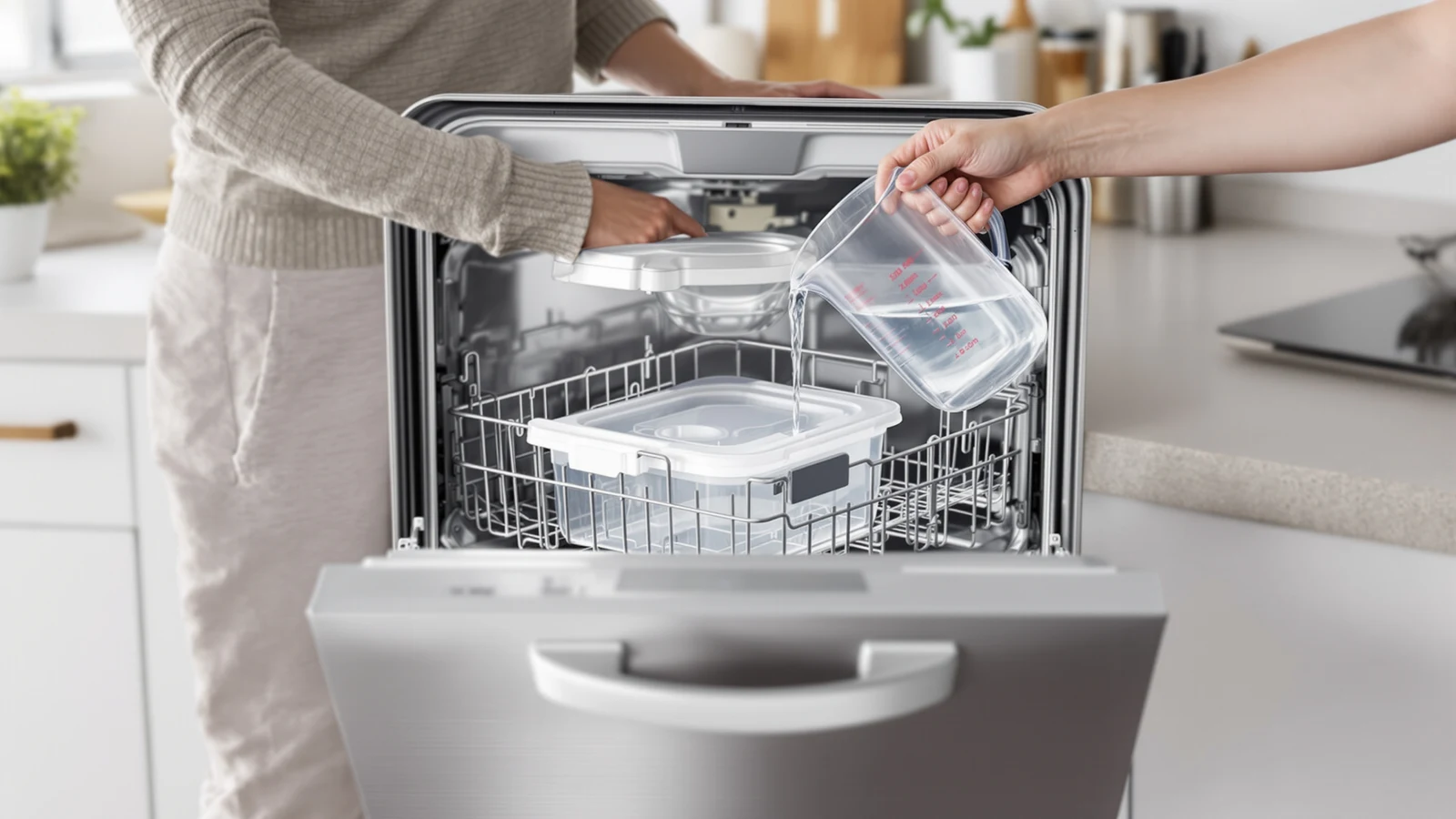
A countertop dishwasher being filled by hand from a water jug next to a kitchen sink, illustrating a tank-fed fill that skips household water pressure

Reader-supported: we may earn a commission when you buy through the links on this page, at no additional cost to you. Prices move constantly — confirm the live price before you order.

Most countertop dishwasher listings assume a kitchen with a normal city water connection: a straight faucet, a removable aerator, and enough pressure behind the tap to fill a small tub in a minute or two. That assumption breaks down in a specific, common set of homes — a well with a pump that cycles between a low and high pressure setting, a farmhouse or older build on galvanized pipe that has narrowed with age, a low-pressure municipal connection at the end of a long street main, or an upstairs kitchen far from the water meter. None of those homes are rare, and none of them are a reason to give up on a portable dishwasher. They're a reason to pay attention to which of the two filling designs you're buying.

This guide covers why faucet-fed filling depends on minimum household pressure, how well water and older plumbing create the kind of inconsistent pressure that trips it up, why a tank-fed model sidesteps the entire problem by filling from a jug instead of a pipe, what that trade-off actually costs you in convenience, what water hardness does to either design once you're past the pressure question, and how to check your own home's pressure before you order anything.

How this page is built

We compare published specifications, what ships in the box, water source, price and general plumbing facts — we do not physically test these machines, we do not run a testing lab, and we do not publish ratings we cannot verify. Amazon's listings for this category return no rating and no review count, so there are no stars on this site. Where a conclusion is our judgment rather than a spec, we say so.
Why it matters

Why a faucet-fed countertop dishwasher depends on your home's PSI

A faucet-fed countertop dishwasher doesn't have its own pump to pull water in. It connects to the kitchen tap with an adapter and a short inlet hose — the EUHOMY 8-Program model ships with a hose for a standard G3/4-inch faucet thread — and when the fill valve opens, it relies entirely on the pressure already sitting in your home's pipes to push water through that hose and into the tub. There's no booster, no second pump stage, nothing in the machine itself that compensates if the pressure behind the tap is weak. It either arrives fast enough, or it doesn't.

That's the same arrangement a washing machine or a built-in dishwasher uses, and it's why appliance fill valves are generally engineered around a minimum working pressure rather than an average one. Most residential plumbing runs somewhere between about 40 and 80 PSI at the fixture, which is comfortably above what any small appliance needs. Appliances built to rely on line pressure typically expect at least something in the neighborhood of 20 PSI to fill in a reasonable window — below that, a fill that should take a minute or two can stretch out, and on some machines a prolonged fill will trip a timeout or a water-level error rather than simply running slow.

The practical result is that a faucet-fed countertop machine is quietly inheriting whatever your plumbing gives it. It has no idea whether your water comes from a municipal main at 60 PSI or a well pump that's currently at the bottom of its cycle, and it has no way to ask for more. If your kitchen has good, stable pressure, the faucet connection is simply the more convenient of the two filling methods — no hand-filling, no jug, no refilling mid-week. If it doesn't, the hose connection stops being a convenience and starts being a liability, which is the problem the next two sections cover.

The source

How well water and older plumbing create inconsistent pressure

Well systems don't hold one steady number

A municipal water connection is backed by a utility that maintains pressure across the whole system; a private well is backed by a pump and a pressure tank that cycle between two set points — typically a low "cut-in" pressure that restarts the pump and a higher "cut-out" pressure that shuts it off again. In practice that means the pressure at your kitchen tap is never one fixed figure. It drifts downward through the cycle until the pump kicks back in, and it can drop further and faster than a municipal connection would when something else in the house — an irrigation line, a second bathroom, a washing machine — is drawing water from the same tank at the same time. A faucet-fed dishwasher that fills fine at 9 a.m., when the tank just topped off, can fill noticeably slower at 6 p.m. during the dinner-and-shower overlap, from the same tap, with nothing in the kitchen having changed.

Older pipe narrows from the inside

Separately from the source, the pipe itself can be the bottleneck. Galvanized steel supply lines — common in homes built before the 1960s and still present in plenty of older farmhouses and rural properties on well systems — corrode and scale from the inside over decades, and the effective diameter of the pipe shrinks even though the pressure entering the house hasn't changed. The result reads exactly like a low-pressure well: a weak trickle at the tap, a dishwasher or washing machine that fills slowly, a shower that loses force when a toilet flushes elsewhere in the house. It's worth knowing the two causes are different, because the fix is different — a well's pressure tank and switch can be serviced or adjusted by a well contractor, where narrowed galvanized pipe generally means replacing the affected run, a job for a licensed plumber rather than something to diagnose from a dishwasher's behavior alone.

Either way, the symptom a faucet-fed countertop machine shows you is the same: a fill that takes far longer than the listing implies, or a short-cycle machine that can't complete its programmed fill window and throws an error instead of simply running late. If that sounds familiar from your own kitchen, it's worth reading what to expect running a new portable dishwasher empty for its first wash before assuming a slow first fill means something is broken — on a well or older line, it may just mean the machine is telling you the truth about your pressure.

The workaround

Tank-fed models: filling by hand sidesteps the problem entirely

A tank-fed dishwasher removes the pressure question by removing the pipe. Instead of a hose pulling water from the faucet under line pressure, you fill a built-in tank by hand — a jug, a pitcher, the sink — and the machine's own internal pump draws from that tank to run the wash and rinse stages. Household water pressure never enters the equation, because nothing in the cycle depends on it.

This is the design behind the EUHOMY 8-Program model with a 5-liter tank, which its own listing markets as "No Hookup" — there's no faucet adapter to fight with and no hose to connect at all, just the tank, filled by hand, and a power outlet. The first EUHOMY model takes the middle path: the same 5-liter built-in tank for plug-and-play washing, or the included hose to a faucet for continuous supply, so the same unit can run tank-only on a well with weak pressure and switch to faucet mode later if the plumbing gets fixed. Either way, a tank-fed cycle starts from water you already know is there, measured out by you rather than negotiated with a pipe.

That also makes a tank-fed machine a reasonable answer for any kitchen where the faucet is the obstacle rather than the pressure — a pull-down or pull-out sprayer tap with no removable aerator, for instance, which can't accept the hose adapter at all regardless of how strong the line pressure is. See our guide to clearance and installation for the other physical constraints worth checking before you order either type.

The honest cost

The trade-off: manual refilling versus never thinking about pressure

Nothing here is free. A tank-fed machine buys independence from your plumbing by asking you to do the plumbing's job yourself, one jug at a time.

  • You fill it, every time. A 5-liter tank — the size on both EUHOMY models in this guide — holds roughly one cycle's worth of water. There's no walking away and coming back to a filled machine; you pour the water in before you start it, and on a model with no faucet hookup at all, that's the only way it ever fills.
  • Capacity is capped by what you're willing to carry. A faucet connection can supply as much water as a cycle needs without anyone measuring it out. A tank can't exceed what you poured in, which is part of why tank-fed countertop machines tend to run smaller loads than faucet-fed ones of a similar size.
  • In exchange, the cycle always starts. A tank-fed machine doesn't care whether the well pump is mid-cycle, whether someone just ran the washing machine, or whether the supply line is forty years old. The water is already sitting in the tank when the cycle begins, so there's nothing for inconsistent pressure to interrupt.
  • A dual-mode unit lets you choose per situation. The first EUHOMY model's faucet hose means you're not locked into hand-filling forever — on the days pressure is fine, connect the hose and skip the jug; on the days it isn't, or if you're using the machine somewhere with no faucet access at all, fall back to the tank.

Put plainly: faucet-fed is less work when your plumbing can support it, and tank-fed is more work in exchange for working every single time. On a well with a pump that cycles, or a line that's never going to be re-piped this year, that trade is usually worth making. On stable city pressure, it generally isn't — the hassle of hand-filling a tank for no reason is its own cost. Our broader comparison of capacity across portable dishwasher classes covers how much that tank limit actually costs you in dishes per load.

One layer up

Water hardness and softening, on top of a tank-fed design

Pressure and hardness are separate problems that happen to show up in the same well-water households a lot. Low or inconsistent pressure is about how much water arrives and how fast; hardness is about what's dissolved in it once it does — dissolved calcium and magnesium that leave scale on heating elements, a white film on glassware, and a gritty residue that builds up inside any machine that heats water repeatedly. Wells are more likely than municipal supplies to run hard, because municipal utilities frequently treat for it and private wells generally don't, so a household already dealing with pressure swings is often dealing with hardness too.

Most countertop dishwashers, tank-fed or not, do nothing about hardness — they just heat whatever water arrives. The HAVA Countertop Dishwasher is the exception in this lineup: it integrates a water softener with a setting you choose to match your local water hardness, built specifically to prevent limescale from building up inside the machine and to stop the watermarks hard water leaves on glassware. HAVA also supports both tank and faucet supply, so on a well with hard, low-pressure water it can be filled by hand like the two EUHOMY models while still addressing what's dissolved in that water once it's inside the tub. Its listing also highlights an optimized ECO mode for energy efficiency and an adjustable tableware basket for a "larger capacity," though HAVA doesn't publish an exact place-setting count — check the current listing if a specific capacity number matters for your household.

Softening inside the dishwasher is a convenience fix for the machine, not a substitute for treating the water at the source. A whole-house softener or filtration system addresses hardness for every tap in the home; a built-in softener like HAVA's only protects the one appliance it's installed in. For a kitchen where a whole-house system isn't in the budget yet, that's still a meaningfully better starting point than a tank-fed machine with no softening at all.

Before you buy

How to check your own home's water pressure first

You don't need to guess which category you're in. A few low-effort checks, as general information rather than a licensed trade inspection, will tell you most of what matters before you order either type of machine:

  • Use a hose-bib pressure gauge. An inexpensive gauge that threads onto an outdoor spigot or a washing-machine hookup gives a direct PSI reading in under a minute, and it's the most reliable check available to a homeowner without calling anyone in.
  • Watch for the everyday symptoms. A shower that weakens when another fixture runs, a toilet tank that refills slowly, or a washing machine that regularly takes longer than its printed cycle time to fill are all signs of marginal pressure, with or without a gauge.
  • If you're on a well, check the pressure tank gauge and the pump's cut-in and cut-out settings — most residential well systems are set to cycle within a specific range, and if yours is set low or the range is wide, expect the same swings at the kitchen tap that a faucet-fed dishwasher would be fighting.
  • On municipal water, your utility can usually tell you the typical main pressure for your street, which won't account for in-house pipe condition but rules the supply side in or out.
  • When in doubt, bring in a licensed plumber for an actual pressure test and an opinion on whether old pipe is the bottleneck — this is a quick, low-cost visit, and cheaper than returning an appliance that never fills properly.

If that check comes back comfortably above the appliance-friendly range and stays steady through the day, a faucet-fed machine like the dual-mode EUHOMY will generally fill the way its listing describes. If it's low, inconsistent, or you're not able to test it easily, start with a tank-fed model and treat the faucet hose — on units that include one — as a bonus for later rather than the plan.

At a glance

The three machines in this guide

All figures are manufacturer specifications; prices are approximate and move constantly on Amazon.

DishwasherBest forWater sourceNotablePrice
EUHOMY 8-Program CountertopPressure flexibility5 L tank or faucet hose40 dB rated, 8 programs$269.03Price
EUHOMY 8-Program, No HookupNo usable faucet or weak pressure5 L tank only167°F wash, 40 dB rated$265.94Price
HAVA with Water SoftenerHard well water, tank or faucetTank or faucetIntegrated softener, ECO mode$312.55Price
The picks

Three machines, three pressure situations

01No hookup at all

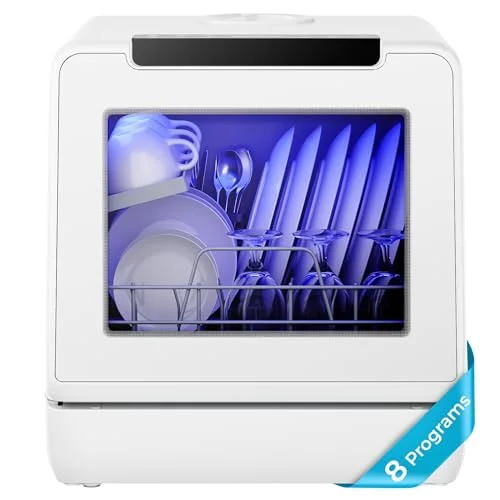
EUHOMY 8-Program Countertop Dishwasher, 5L Tank, 167°F, No Hookup

Weak well pressure, a sprayer faucet, or no usable tap near the sink
Tank-fed only · 5 L built-in tank · 167°F wash temperature · 40 dB rated · 8 programs

This model's own listing leads with "No Hookup" rather than treating it as a fallback mode, which makes it the straightforward choice when the honest answer is that your faucet or your pressure can't be trusted. Fill the 5-liter tank by hand, start the cycle, and the machine never asks your plumbing for anything. The 167°F wash temperature is a manufacturer-stated figure worth treating as a claim rather than a measurement, same as the 40 dB noise rating, but both describe a machine built around hand-filling from the ground up rather than a faucet connection with a tank bolted on as an afterthought.

The trade-offThere's no faucet mode to fall back on if you'd rather not fill it by hand on a good-pressure day — this unit is tank-only, by design.

EUHOMY countertop dishwasher with 5-liter built-in water tank and no faucet hookup
$265.94
Tank onlyCheck price →
02Flexible either way

EUHOMY Countertop Dishwasher, 8 Programs with 5L Tank

Pressure that's inconsistent rather than consistently bad
Tank or faucet · 5 L built-in tank · G3/4-inch faucet hose included · 40 dB rated · 8 programs

This is the same brand's dual-mode version: the 5-liter tank for plug-and-play washing on a day the well pump is cycling low, or the included hose to a standard G3/4-inch faucet when pressure is behaving. That flexibility matters most for a household whose pressure swings through the day rather than one that's permanently weak — you're not locked into hand-filling every single wash, but you're not stranded on the days the tap can't deliver, either.

The trade-offFaucet mode still depends on the same household pressure as any other faucet-fed machine; if your line is permanently weak, the tank is the mode you'll be using most of the time anyway, and the hose adapter is paying for a convenience you may rarely use.

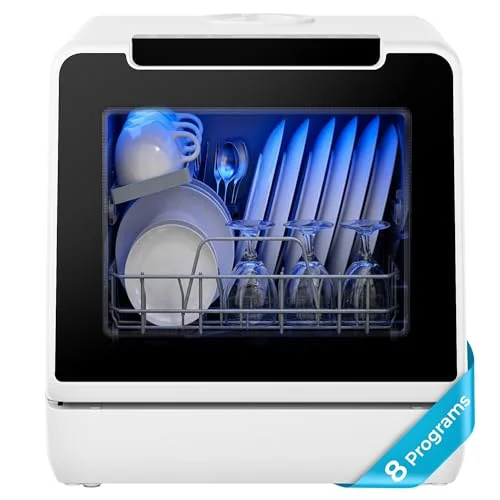
EUHOMY countertop dishwasher with 5-liter tank and included faucet hose adapter
$269.03
Tank or faucetCheck price →
03Hard well water

HAVA Countertop Dishwasher with Water Softener

Low pressure and hard water showing up in the same kitchen
Tank or faucet · integrated water softener · softener setting by water hardness · optimized ECO mode · adjustable tableware basket

Pressure and hardness are different problems, and this is the one machine here built to address both at once: tank or faucet filling covers the pressure question the same way the EUHOMY models do, and the integrated softener — set to match your local water hardness — tackles the limescale and watermark problem that hard well water adds on top. If a water-hardness report from your utility or a home test kit shows genuinely hard water, that single feature is worth more than any other spec on this page.

The trade-offIt costs roughly $90 to $110 more than either EUHOMY model, and the softener setting does nothing if your water is already soft — confirm your hardness before paying extra for it. HAVA's listing also doesn't quote an exact place-setting count, so check the current listing rather than assuming a specific capacity.

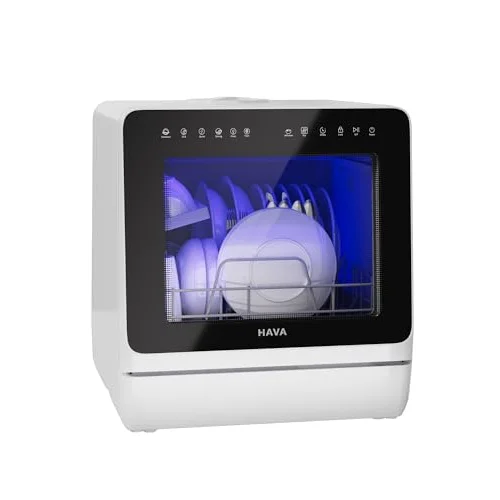
HAVA countertop dishwasher with integrated water softener
$312.55
Softener built inCheck price →
The decision

Buy this one if…

Choose a tank-fed model if

Any one of these is true

You're on a well and the pump cycles noticeably through the day, your kitchen faucet is a pull-down or pull-out sprayer with no removable aerator, you've measured your pressure and it's low or unsteady, or you simply don't want to think about plumbing when you press start. A tank-only model like the "No Hookup" EUHOMY removes the question entirely; a dual-mode model keeps the faucet option open for later.

A faucet-fed connection is fine if

All of these are true

You're on stable municipal water, your pressure has tested at a healthy, steady PSI, your faucet has a standard removable aerator, and you'd rather not hand-fill a tank before every wash. In that kitchen, the convenience of a faucet connection outweighs the independence a tank buys you — and a dual-mode unit still gives you the tank as a backup if anything changes.

If hardness is part of the picture too

Low pressure and hard water often arrive together on a well, but they're solved separately. Fix the filling method first — tank or faucet — based on your pressure check, then decide whether the softener is worth the premium based on an actual hardness reading rather than an assumption. HAVA is the only machine here that handles both; the two EUHOMY models solve pressure alone and leave hardness to a separate filter or whole-house system if you need one.

FAQ

Common questions about pressure and well water

Will a faucet-fed countertop dishwasher work with low water pressure?

It depends on how low. Faucet-fed machines fill using your home's own line pressure through a hose, with no pump of their own to compensate, so they generally need pressure in the range appliance fill valves are built around — well above a trickle. Below that, fills get slow, and on some models a prolonged fill can trigger a timeout or error instead of just taking longer. If your pressure tests low or swings through the day, a tank-fed model sidesteps the issue entirely.

Does well water affect how a portable dishwasher fills?

Yes, indirectly. It's not the water itself but the way a well's pump and pressure tank work — cycling between a lower and higher pressure rather than holding one steady number — that creates the inconsistency a faucet-fed machine notices. The same symptom shows up with narrowed older pipe, which is a separate cause with a different fix, but the two often coexist in older rural homes on well systems.

Does a tank-fed dishwasher still need good water pressure?

No. A tank-fed model fills from water you pour in by hand, and its own internal pump handles the wash and rinse cycle from there — household water pressure never enters the process. That's true whether the tank is the only fill method, as on the "No Hookup" EUHOMY model, or one of two options on a dual-mode unit.

Can a tank-fed dishwasher also soften hard well water?

Only if it's built with a softener, which most tank-fed countertop dishwashers are not. The HAVA Countertop Dishwasher in this guide integrates a softener you set to match your local water hardness, on top of supporting both tank and faucet filling, which is why it's the pick here for a well with both low pressure and hard water. A built-in softener protects that one appliance only, not every tap in the house.

Keep reading

Next, from this site