Best Portable Dishwashers
How-to · First use

The first wash: run it empty first.

The box says six programs and a drying cycle, and it's tempting to load it with the dishes sitting in the sink and go. Almost every manual in this category, and nearly every listing, asks for one empty run first. Here's what that cycle is actually doing, and why it isn't a suggestion you can skip.

By Ilane Tall · Updated November 9, 2026 · Research-based.

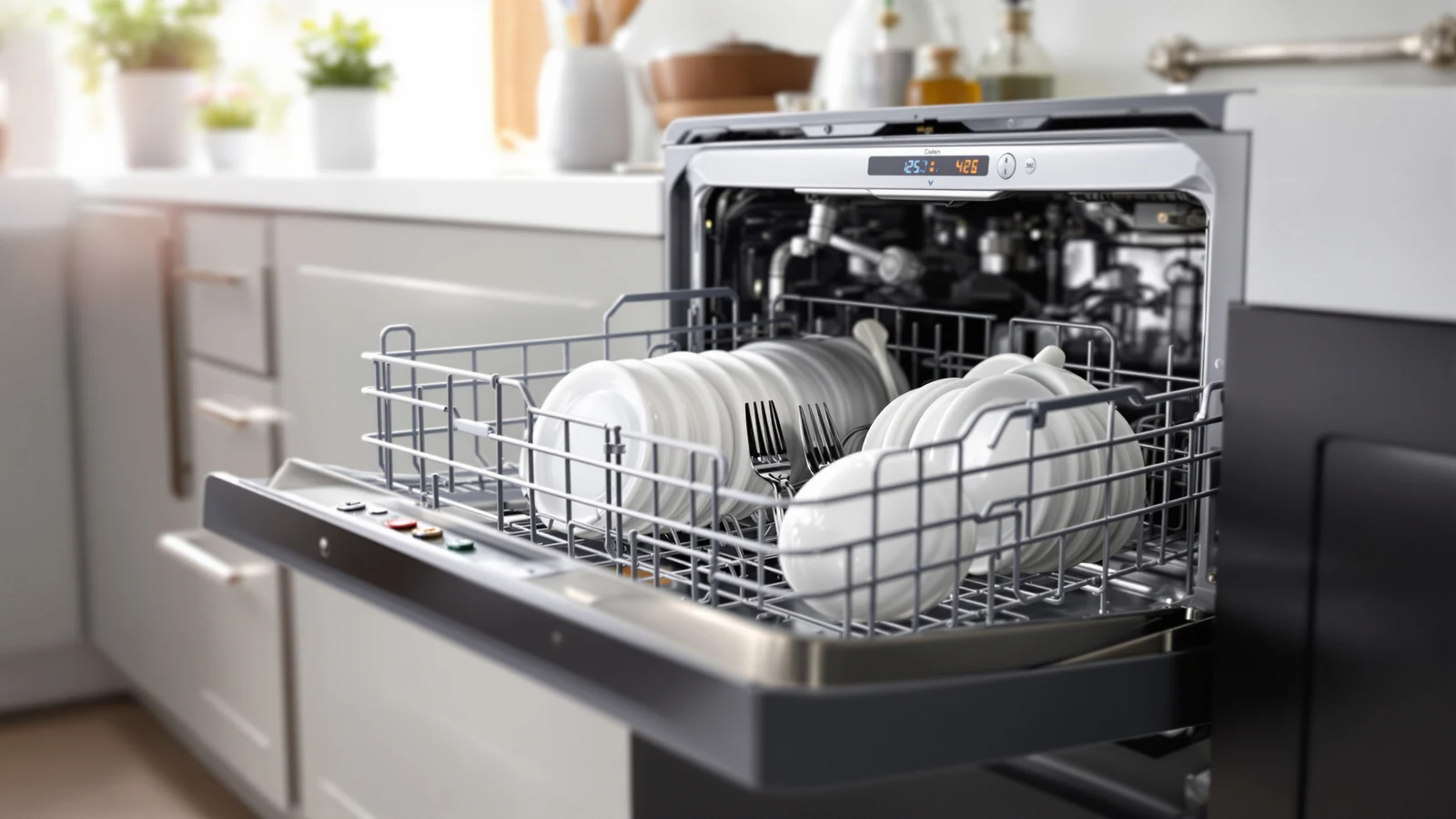
A new portable dishwasher running an empty first cycle with the door open, no dishes inside

Reader-supported: we may earn a commission when you buy through the links on this page, at no additional cost to you. Prices move constantly — confirm the live price before you order.

Unbox a new portable dishwasher and the instinct is to find the dirtiest dishes in the house and put the machine to work immediately. Resist it for forty-five minutes. The instruction manuals for most machines in this category — tank-fed countertop units and 18-inch units on wheels alike — specify a single empty cycle before the first real load, usually a sentence or two buried between the unboxing diagram and the control-panel key. It's easy to miss, and skipping it doesn't break the machine. It just means your first real load of dishes does a job an empty cycle would have done for free.

This guide covers what that first cycle flushes out, how the step differs between a countertop machine and an 18-inch unit on wheels, why it's also the best moment to check for leaks, detergent or no detergent on the first run, and the one dial — water hardness or softener setting — manuals ask you to set before the second load, not the first.

How this page is built

We compare published specifications, manufacturer setup instructions and what ships in the box. We do not physically test these machines, we do not run a testing lab, and we do not publish ratings we cannot verify — Amazon returns no rating and no review count for this category, so there are no stars on this site. Where a judgement is ours rather than a specification, we say so.

Why it matters

Why manufacturers ask for an empty cycle first

The reasoning has nothing to do with washing dishes and everything to do with washing the machine itself. A dishwasher — countertop or full-size — is a sealed tub with a pump, a heating element, a spray arm or two, and a network of hoses assembled, tested at the factory, boxed, palletized, shipped and handled by several people before it reached your kitchen. None of that happens in a clean room. An empty cycle runs the same pump, spray arms and drain path the machine will use for every load after it, with nothing in the tub to get in the way of flushing out whatever accumulated during manufacturing and transit.

It also functions as a function check you get for free. The cycle runs the fill valve, heater, wash pump and drain pump through a full sequence while you can watch every connection point — the faucet adapter, the inlet hose, the drain hose over the sink's edge — without risking a load of plates if something leaks or the machine doesn't drain. If something is going to go wrong with a brand-new unit, it tends to show up in the first cycle, and an empty cycle keeps the stakes of that first cycle close to zero.

The upside is one-time only. Once the empty cycle has run, the tub, spray arm and drain path are in the same state they'll be in for every ordinary wash afterward — there is no month-two version of this step. It belongs entirely to the first time the machine runs, which is also why manuals mention it once and never bring it up again.

What's inside

What's actually being flushed out: residue, not dirt

It helps to be precise about what an empty cycle removes, because it isn't grime and it isn't food soil — the machine has never seen either. It's manufacturing residue: light machine oils used on the pump and motor assembly during production, metal or plastic fines left over from molding and machining the tub and spray arm, dust that settled in during the weeks between the factory floor and the shipping container, and the faint plastic-and-packaging smell of a sealed unit sitting in a warehouse. None of it is hazardous in the quantities involved, and none of it will survive contact with your dishes in any meaningful way — but it's also not something you want introduced into a wash cycle alongside plates you're about to eat off.

The stainless tub on the SPT SD-9263SS is less prone to a lingering smell than a plastic tub, simply because stainless doesn't off-gas the way molded plastics can fresh from the factory. That doesn't exempt it from the empty-cycle recommendation — the pump and hose residue is independent of what the tub itself is made from.

Hard water deposits are a related but separate concern, and they don't apply here — a brand-new machine has run zero cycles, so there's no scale buildup yet to flush. That's a maintenance-cycle problem for months two and beyond, not a first-wash problem. The empty cycle is strictly about what the factory and the supply chain left behind.

By machine class

How the first wash differs: countertop versus 18-inch

The empty-cycle instruction is the same sentence in both kinds of manual, but what you're actually doing to get there is different, because the two classes of machine in this category set up differently.

Countertop, tank-fed: fill, don't connect

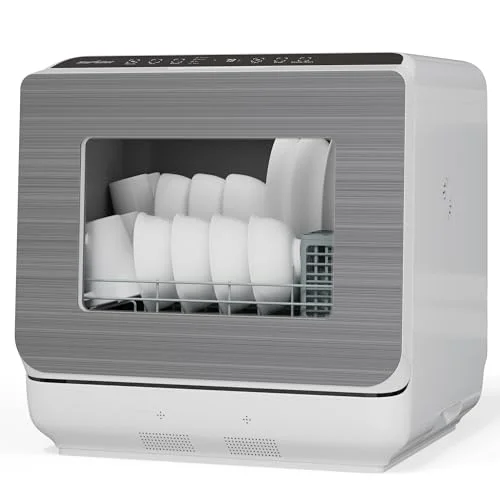
The EUHOMY Countertop Dishwasher is built to run with no hookup at all, filling from its own built-in tank. For the first wash, that means the entire setup is: unbox it, set it somewhere stable and level, fill the tank with clean tap water, plug it in, and select a cycle with the tub empty. There's no faucet adapter to attach and no aerator thread to match, which is exactly the point of a tank-fed design — it's also why this class of machine is the one to buy if your kitchen faucet has a pull-out sprayer head that won't accept a dishwasher adapter at all, a problem covered in more detail in our drain hose guide.

Because there's no faucet connection to test, the leak-check portion of the first cycle on a tank-fed machine is narrower: you're watching the tank seal, the door seal and the drain hose, not an inlet connection. Run the empty cycle with the unit pulled slightly away from the wall or cabinet it's sitting against, so you can see behind it.

18-inch on wheels: two hose connections before you press start

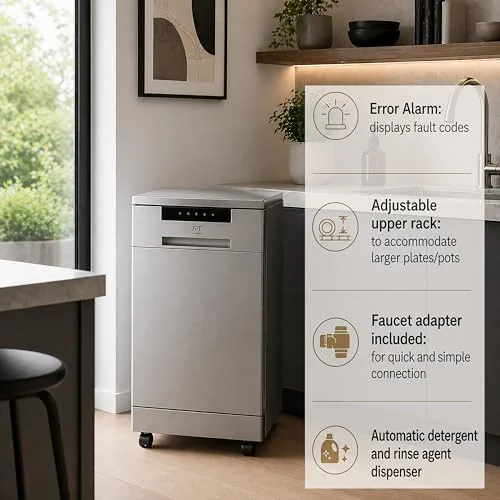
The SPT SD-9263SS, an 18-inch wide freestanding unit, is a different setup altogether. Before any cycle — empty or otherwise — the machine has to be rolled to the sink and connected on two hoses: an inlet line to the faucet, usually via an adapter over a standard aerator thread, and a drain hose hooked over the sink's edge or into a standpipe. Both connections are new and both were handled in transit, which makes them exactly the kind of connection an empty cycle is meant to pressure-test before dishes are involved. A bad connection also carries higher stakes on a machine this size — more water volume, more weight, and a unit that's harder to move out of the way mid-cycle.

The Sunvivi 18'' Countertop with 152OZ Water Tank sits in between: countertop-format, but shipping with a 152-ounce tank as an alternative to a faucet connection. Your first-wash checklist follows whichever mode you set it up in — the EUHOMY's (fill the tank, no hose) or the SPT's (connect both hoses) — so check the setup instructions for the mode you intend to use before the first cycle.

Safety check

Checking for leaks while nothing's at stake

An empty cycle is the lowest-consequence moment this machine will ever have. There are no dishes to ruin if the drain backs up, no cutlery to lose down a gap if the tub tilts, and no detergent residue to clean off a kitchen floor if a hose connection weeps instead of holding. That makes it the right time — arguably the only genuinely low-stakes time — to watch the machine's full cycle from fill to drain with your attention on it rather than on dinner.

What to actually watch for, in order:

  • The inlet connection (faucet-fed machines only). Watch the adapter and hose joint during the fill portion of the cycle. A slow drip at a threaded connection usually means the adapter wasn't seated fully or the washer inside it is misaligned — both fixable by disconnecting and reseating, not a defect.
  • The door or lid seal. Run a hand along the gasket line partway through the wash portion of the cycle. Any dampness on the outside of the door means the seal isn't compressing evenly, which is worth checking against the manual's loading instructions — on some models an unlatched or improperly closed door is the actual cause, not the gasket itself.
  • The drain hose and its hook-over-the-sink point, both during the wash (standing water shouldn't be visibly backing up the hose) and during the drain phase at the end, when you should hear and see the pump actually clear the tub rather than leaving water standing in the bottom.
  • The floor or countertop underneath, checked after the cycle completes rather than during it — residual dampness that wasn't there before the cycle started is the tell for a slow leak you didn't catch in real time.

If you do spot a leak during this cycle, you've lost nothing but found a problem before it was wedged between $60 of groceries and a dishwasher full of your actual plates. A unit that leaks on an empty first cycle is also the cleanest case for a return or exchange — there's no ambiguity about whether it was something you did wrong with a real load.

Detergent or not

Detergent on the first run — what the manuals actually say

This is the detail that varies most between manufacturers, and it's worth checking your specific manual rather than assuming. Some manuals ask for the first cycle to run completely empty — no detergent, no rinse aid — purely as a water-and-mechanism flush. Others ask for a small amount of regular dishwasher detergent in that first cycle specifically because detergent helps lift manufacturing residue and any faint chemical smell more thoroughly than plain water alone.

What's consistent across the manuals in this category: none ask for a full normal dose of detergent on the first cycle, and none suggest skipping straight to a loaded, detergent-dosed real wash as the machine's first run. Detergent-or-not is a secondary detail layered onto the same basic idea — run the mechanism through its paces before dishes are involved.

Pods deserve a mention regardless of which instruction your manual gives: a pod is designed to dissolve across a longer, higher-volume cycle than most machines here run, and pods frequently fail to dissolve fully in a short or low-volume program. If your manual calls for detergent on the first cycle, loose powder or gel in a small dose is the safer choice — save pods for once you've confirmed your machine's cycles give them enough time and water to dissolve.

Before load two

Setting the water hardness dial before the second load

Here's the step that belongs to the second wash, not the first, and manuals are specific about the order: set the water hardness or softener dial after the empty first cycle, before you run your first load of actual dishes. The empty cycle's job is to flush the machine, not establish a long-term setting, and a hardness setting only matters once real loads start running back to back.

Water hardness varies enormously by location — some municipal supplies are soft enough that no adjustment is needed, while well water and many harder-water regions will leave a cloudy film on glassware and chalky buildup inside the tub if the machine sits on a default or softest setting. The Sunvivi 18'' Countertop and machines like it typically ask you to check a hardness number from your local utility — most publish one in grains per gallon in their annual water quality report — and dial the machine to match before the second cycle. Skipping this step doesn't damage anything immediately, but it's the most common reason a new machine's dishes come out cloudy or spotted in the first week.

If your specific unit's manual doesn't mention a hardness dial at all, it likely doesn't have one — not every machine in this category includes a softener setting, and that's a spec worth checking before you buy if you already know your water is hard. Where that's the case, rinse aid and a lower detergent dose do more of the work instead.

The machines

The three machines referenced in this guide

01Tank-fed countertop

EUHOMY Countertop Dishwasher Portable

No faucet hookup required — the simplest possible first-wash setup
Countertop · 6 programs · 40 dB rated · no hookup needed · Large

Because this machine fills from its own tank rather than a faucet connection, the first-wash checklist is the shortest in this guide: fill the tank, plug it in, run a cycle empty. There's no inlet adapter to pressure-test, which also means it's the pick for a kitchen where the faucet itself was never going to accept a dishwasher connection in the first place.

The trade-offTank mode means refilling by hand before every load, not just the first one — there's no faucet connection to fall back on if you'd rather not.

$249
No hookupCheck price →
02Tank or faucet

Sunvivi Portable Dishwasher 18'' Countertop

Flexible setup, but check which supply mode you're using before the first cycle
Countertop, 18'' · 152 OZ water tank · faucet-connect alternative

This model ships with both a water tank and a faucet-connect option, which means the first-wash setup depends on which mode you intend to use day to day. Set it up and run the empty cycle in whichever mode you plan to actually use — testing the faucet connection once with an empty cycle is worthwhile even if you expect to fall back to the tank most of the time.

The trade-offHaving two supply modes means two sets of setup instructions to read instead of one — check the manual for both before the first cycle rather than guessing.

$300
152 OZ tankCheck price →
0318-inch, faucet-only

SPT SD-9263SS 18″ Portable Dishwasher

The full two-hose setup — the first cycle is also your pressure test
Freestanding, 18″ · stainless steel tub · 8 place settings · 6 wash programs · ENERGY STAR

With both an inlet hose and a drain hose to connect before the machine can run at all, this is the unit where the empty first cycle is doing the most work as a function check — watch both hose connections through a full empty cycle before trusting it with a sink full of dishes. The stainless tub also means less of the factory-smell residue that plastic tubs can carry.

The trade-offTwo hose connections means two more places for a slow leak to hide than a tank-fed countertop unit has — budget the extra few minutes to watch both during the first run.

$623
8 place settingsCheck price →
FAQ

Common questions about the first wash

Do I really need to run a new portable dishwasher empty before using it?

Manufacturers recommend it, and skipping it won't break the machine, but it means your first real load of dishes absorbs whatever manufacturing residue and factory smell an empty cycle would otherwise have flushed for free. It also doubles as a leak check on the faucet, drain and door connections while there's nothing in the tub to ruin if something goes wrong.

What is the empty first cycle actually removing?

Manufacturing residue, not dirt: light machine oils from the pump and motor assembly, fine plastic or metal particles left from molding the tub and spray arm, dust picked up during storage and shipping, and the faint plastic smell of a sealed new unit. It is not food soil or hard-water scale — the machine hasn't run any cycles yet, so there's nothing from your own water supply to flush out at this stage.

Should I use detergent on the first empty cycle?

Check your specific manual — instructions vary. Some ask for a completely empty cycle with no detergent at all; others ask for a small amount of regular detergent to help lift residue more thoroughly. None of the manuals for machines in this category ask for a full normal dose, and none suggest skipping straight to a detergent-dosed load of real dishes as the first thing the machine does.

When should I set the water hardness or softener dial?

After the empty first cycle and before your first real load of dishes. The empty cycle's job is flushing the machine, not establishing an ongoing setting, so manuals place the hardness-dial step at the start of normal use rather than during setup. Skipping it is the most common reason new owners see cloudy glassware or chalky buildup in the first week on hard water.

Keep reading

Next, from this site