Best Portable Dishwashers
Honest take · The sub-$220 tier

The cheapest portable dishwashers we found. Here's what's missing.

Three machines in our database sit $50 to $100 below the rest of the category: $159.99, $214.36 and $219.99. That gap isn't a discount — it's a different bill of materials. A plastic body instead of stainless or coated steel, a tank you fill by hand, and a wash cycle built around a lower price point rather than a bigger load. None of that makes them bad. It makes them a specific trade, and this is what you're actually trading.

By Ilane Tall · Updated November 14, 2026 · Research-based.

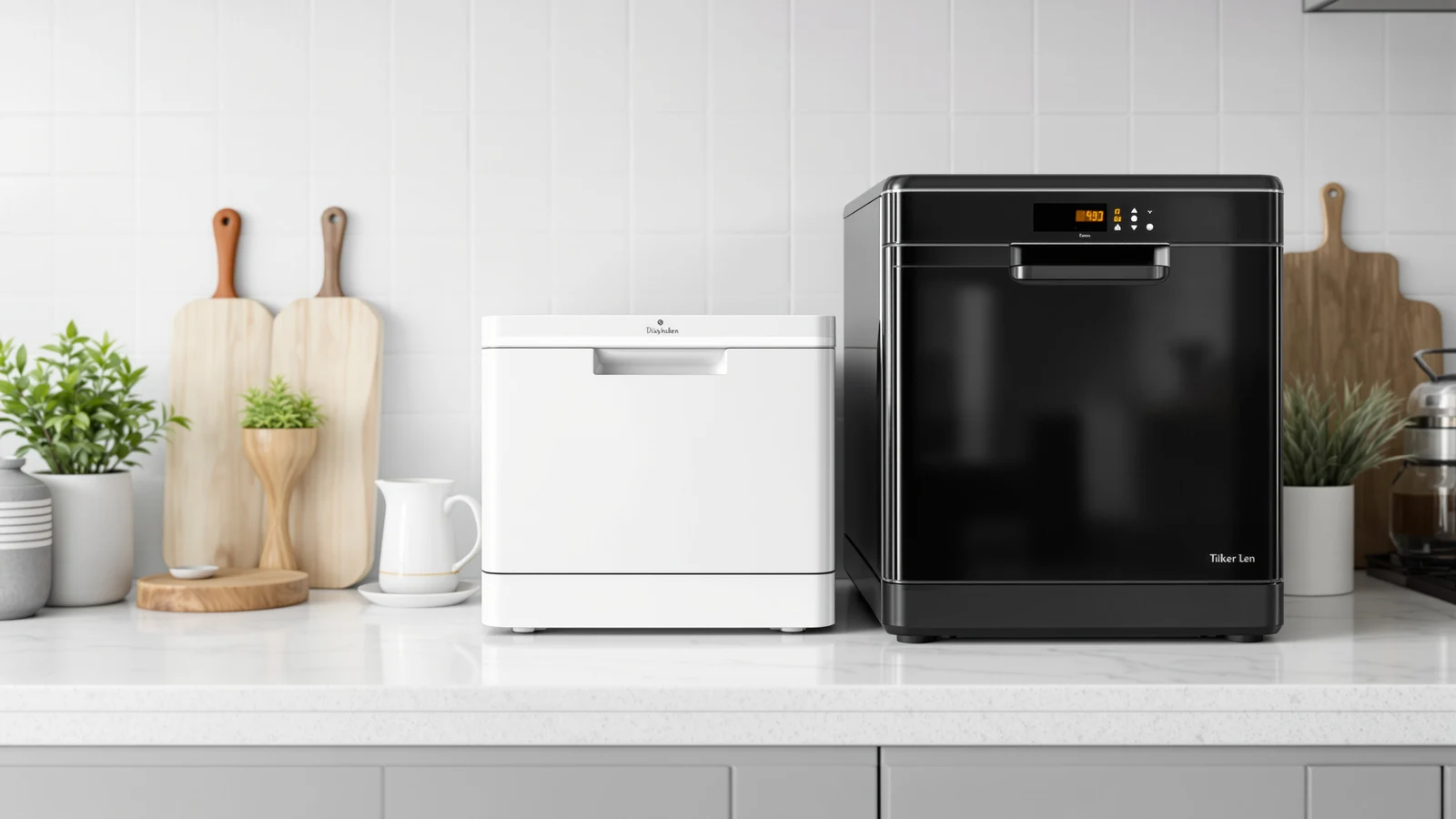
A small plastic-bodied countertop dishwasher next to its manual fill tank and water jug on a kitchen counter

Reader-supported: we may earn a commission when you buy through the links on this page, at no additional cost to you. Prices move constantly on Amazon — confirm the live price before you order.

Every portable dishwasher in this category is already a budget appliance next to a built-in. But even inside that budget category there's a lower tier, and these three machines sit in it: a countertop model at $159.99 with 4 programmes and a 167°F wash claim, the AIRMSEN at $214.36 with a built-in water tank and softener, and a 6-programme compact at $219.99 with a 5-litre manual tank and faucet. All three undercut the $250-$370 machines we cover elsewhere on this site by $50 to $100, and the gap has to come from somewhere.

It mostly comes from the tub. We go through what a plastic body actually means next to stainless or coated steel, why a manual-fill tank is as much a cost decision as a convenience one, how a water softener ends up on a $214 machine at all, and what wash temperature and program count tell you at this price. We close with when the cheapest option is genuinely the right call, and when it isn't.

How this page is built

We compare published specifications, listing copy and live pricing for these three products. We do not physically test dishwashers, we do not run a testing lab, and we do not publish star ratings or review counts — Amazon's product data does not include rating or review figures for this category, so there are none on this site. Where we draw a conclusion about durability or trade-offs, it's reasoning from the stated materials and mechanism, not from a lab result or an owner survey we don't have. Read more on why this guide has no star ratings.

The trade

What $50-100 cheaper actually removes

A portable dishwasher has a short list of expensive parts: the tub and door material, the heating element and its control board, the pump, the spray arm assembly, and whatever makes the water supply work — a faucet adapter, a tank, or both. On a $300-plus machine like the ones in our main buyer's guide, the money mostly goes into a bigger tub, more programs, a certification like ENERGY STAR, and sometimes a feature like WiFi or a built-in softener that doesn't need to compromise on anything else to exist.

On a sub-$220 machine, the same dollar has to cover the same basic mechanism — heater, pump, spray arm, control board — in a smaller package, so the savings get taken from whatever isn't load-bearing to "the dishes come out clean." That's almost always the tub shell material, the fill method, and the program count. None of those three actually stop the machine from washing a dish. They change how long it lasts, how it sounds, how often you touch it mid-cycle, and how flexible the wash is.

The three machines here are a clean illustration of where that money goes instead. The $159.99 model is the furthest into the trade: four programs, no stated water softener, and a tank/fill setup the listing describes only in passing. The AIRMSEN at $214.36 spends part of its budget on a built-in water softener rather than more programs. The $219.99 unit spends it on a sixth program and a 5-litre manual tank with a defined capacity. Three different allocations of the same shortfall.

The tub

ABS and PP plastic bodies vs stainless or coated-steel tubs

The interior tub of a dishwasher sits in near-boiling water, detergent and food residue for an hour or more, several times a week, for years. What it's made of is not a cosmetic detail — it's the single material choice with the longest-run consequences in the whole machine.

Full-size dishwashers and the pricier countertop models in this category build the tub from stainless steel or a steel shell with a baked-on coating, because steel tolerates sustained heat and chemical exposure without degrading and doesn't hold odor the way plastic does. It's also the heavier, more expensive material to stamp and finish, which is exactly why it shows up on the machines that cost more.

Budget countertop dishwashers, including machines in this price tier, commonly use an ABS (acrylonitrile butadiene styrene) or PP (polypropylene) plastic tub instead. Both are legitimate, widely used appliance plastics — PP in particular is rated for hot water and is the same family of plastic used in microwave-safe containers and dishwasher-safe tubs themselves. They're not a safety problem. The trade-off is slower and less dramatic: plastic doesn't dissipate heat the way steel does, so it runs hotter against the wall of the tub for longer; it can take on staining and faint odor from grease and detergent residue over repeated cycles in a way steel resists; and it's more prone to fine scratching from pans and racks, which creates more surface for residue to cling to over time. None of that is a one-wash problem — it's a multi-year-ownership problem, and it's also why a plastic-bodied unit is lighter, cheaper to ship, and cheaper to make at this price point in the first place.

None of the three products listed in our database have a published tub-material spec we can quote directly, so we aren't going to assign ABS or PP to one specific unit here — that would be inventing a spec sheet doesn't give us. What we can say generally, and what's true across the budget tier this category sits in: a sub-$220 countertop dishwasher is far more likely to use a plastic tub than a sub-$220 machine isn't, because steel at this volume and size would push the price well past $220 on its own. If tub material matters enough to you that you want it confirmed, check the listing's own material spec or the manufacturer page before you order — it's the one line in the fine print worth reading twice.

Water supply

Manual-fill tanks as a cost-cutting measure, not just a convenience feature

Elsewhere on this site we've written about tank-fed countertop dishwashers as a feature — the thing that lets you run a dishwasher with no faucet connection at all, which matters a lot in a rental with a sprayer tap or an RV with no plumbing to speak of. That's still true. But a manual-fill tank is also, separately, a way to build a cheaper machine, and the two reasons overlap on exactly the products in this tier.

A faucet-fed dishwasher needs an inlet hose, a coupler that fits standard aerator threads, and a water-level or flow sensor to know when the tub has enough water for the cycle. A tank-fed machine replaces all of that with a plastic reservoir you fill from a jug and a simple fill-level float — mechanically simpler and cheaper to manufacture, which is part of why tank-only designs cluster at the bottom of the price range rather than the top. The $219.99 unit in this group is explicit about this: a 5-litre manual water tank, specified by the listing itself, with a faucet connection also available. That 5-litre figure is a hard ceiling — it's one cycle's water, no more, so you refill by hand before every wash rather than running the tap continuously.

The $159.99 model's listing doesn't give a tank-capacity figure the way the $219.99 one does — only that it needs "no hookup," which strongly implies tank-based operation without specifying how much water that tank holds. We're not going to guess a liter figure the listing doesn't state; if that number matters to your decision, check the current Amazon listing before buying.

The honest version of this trade-off: a manual tank is not a downgrade if you were never going to use a faucet connection anyway — RVs, dorms, and kitchens with pull-out sprayer taps that can't accept an adapter all land here regardless of price tier. It is a downgrade if you have a usable faucet and would have preferred to walk away and let the machine fill and drain on its own, because at this price tier that convenience usually isn't on the table even as an option.

Hard water

How a water softener ends up on a sub-$220 unit, and what's traded for it

A built-in water softener is usually the kind of feature that shows up on a $350-plus machine, because softening hardware — a resin compartment and a dial to set it against your local water hardness — is one more part to engineer and build around a tub that's already a tight fit. The AIRMSEN at $214.36 has one anyway, built into a water-tank design, at a price well below where that feature normally shows up.

The way that math works, based on what the listing specifies and doesn't: the AIRMSEN spends its budget on the softener and the tank, and that spending has to come from somewhere else in the design. The listing we have doesn't give AIRMSEN's program count the prominence the other two machines' listings give theirs, and it doesn't carry a wash-temperature figure the way the $159.99 model's "167°F" claim does. That's consistent with a machine that picked one standout spec — the softener — and built a simpler machine around it everywhere else, rather than trying to be well-specified on every axis at once.

Whether that's the right allocation for you depends entirely on your water. A softener built for a specific hardness setting does real, visible work if your local water is hard — it's the difference between glasses that come out clear and glasses that come out with a chalky film, because limescale also coats the heating element over time and can shorten the life of exactly the component this whole machine depends on. If your water is already soft, the AIRMSEN's defining feature does nothing for you, and you're better served looking at the $219.99 or $159.99 machines instead, or at the machines in our running-costs guide that spend their budget on capacity instead. Check your water utility's annual hardness report — most publish one — before paying extra for a softener you might not need.

What it washes

Wash temperature, program count and drying at this price tier

The three specs that most directly describe how a cycle actually goes are wash temperature, how many programs you get to choose from, and how the machine dries. Here's what's published for each of the three machines, and what it's reasonable to infer.

Wash temperature

The $159.99 model's listing is the most specific of the three on this point, stating "167°F high-temperature washing." That figure, if accurate, is a genuinely hot wash — hot enough to help break down grease without scrubbing and to matter for sanitizing baby bottles or cutting boards, and it's in the same range quoted by higher-priced machines in this category that advertise a baby-care or heavy cycle. We have no comparable temperature figure published for the AIRMSEN or the $219.99 unit, so we can't compare the three on this spec directly — only note that one of them states a number and the other two don't.

Program count

The $159.99 model lists 4 programs; the $219.99 model lists 6. More programs mainly buys you the ability to match the cycle to the load — a short glass-only cycle instead of running delicate items through a full heavy wash, for instance — rather than a difference in how clean any single cycle gets dishes. Four programs at this price is on the low end for the category but not unusual; six is a reasonable spread for a $220 machine and is closer to what mid-tier countertop machines offer.

Drying

The $159.99 listing specifies "hot air drying & 72-hour air circulation," which describes a fan-assisted dry followed by an extended air-circulation mode meant to keep the tub from smelling stale between uses — a genuine problem with small sealed dishwashers that sit unused for a day or two. Neither the AIRMSEN nor the $219.99 listing states a drying method as specifically. In general, none of the machines in this category — budget or otherwise — use a heating element purely for drying the way some full-size built-ins do; expect residual heat, a fan, or an auto-open door to do the work, and expect some water left on plastic items regardless of price, which is true across this whole category and not specific to the cheap tier.

Treat every figure in this section as a manufacturer claim rather than a measurement we've verified — that's true of specs on every machine we cover, cheap or expensive, and it's worth repeating here because a hot number like "167°F" is exactly the kind of spec that's easy to take as gospel.
At a glance

The three machines side by side

All figures are manufacturer specifications pulled from current Amazon listings; prices move constantly.

DishwasherProgramsWater supplyStandout specPrice
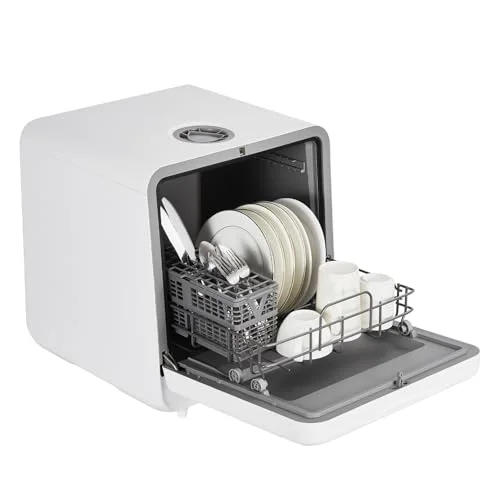
4-Program Countertop (360° Coverage)4No hookup needed (tank-based)167°F wash, 72-hr air circulation$159.99Price
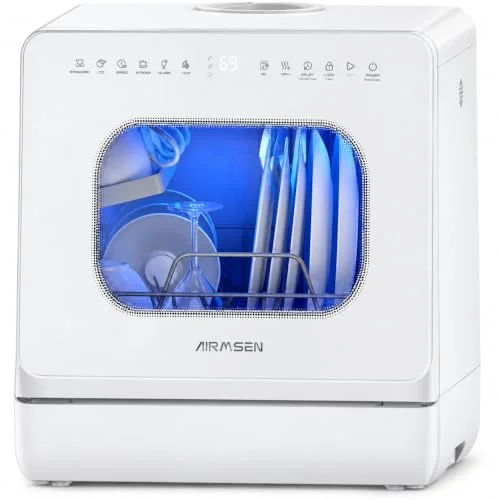
AIRMSEN with Built-in Water Tank & SoftenerNot statedBuilt-in tankIntegrated water softener$214.36Price
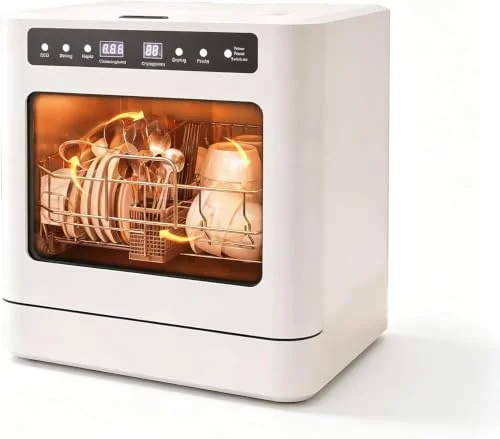
Compact with Faucet & 5L Manual Tank65 L manual tank or faucetMost programs of the three$219.99Price
The three

Each machine, and what it's actually for

01Lowest price

Countertop Dishwasher, 4 Programs — 360° Coverage, No Hookup Needed

RVs and no-faucet kitchens where a hot wash matters more than program choice
Countertop · 4 programs · 167°F high-temperature wash · hot air drying + 72-hr air circulation · no hookup needed

At $159.99 this is the lowest price in our database for a portable dishwasher, and the listing leans into the one spec that costs nothing extra to state clearly: a 167°F wash temperature, hot enough to matter for grease and for sanitizing baby bottles if that figure holds up in practice. The 72-hour air circulation claim is a genuine answer to the smell problem small sealed dishwashers develop when they sit unused — a fan keeps air moving through the tub well after the cycle ends. "No hookup needed" tells you this is a tank design, though the listing doesn't give a liter figure for that tank the way the $219.99 model does.

The trade-offFour programs is the lowest count among the three, and the listing is silent on tub material and exact tank capacity. If either of those matters to you, confirm them on the current listing before ordering.

Compact countertop dishwasher with 4 programs and no hookup needed
$159.99
Lowest priceCheck price →
02Hard water on a budget

AIRMSEN Countertop Dishwasher with Built-in Water Tank & Softener

Hard-water households who want softening without paying $350+ for it
Countertop · built-in water tank · integrated water softener · $214.36

Water softeners normally show up on machines well above this price point, which makes the AIRMSEN's single standout spec worth noting on its own: a built-in softener paired with a built-in tank, at $214.36. If your water is genuinely hard, that one feature does visible work — clearer glasses, less limescale buildup on the heating element over time — in a way that no amount of extra programs or higher wash temperature would replace.

The trade-offThe listing doesn't publish a program count or wash-temperature figure with the specificity the other two machines offer, which reads as a design that spent its budget on the softener rather than spreading it evenly. And the softener itself does nothing if your water is already soft — check your utility's hardness report first.

AIRMSEN countertop dishwasher with built-in water tank and softener
$214.36
Softener built inCheck price →
03Most flexible at this price

Countertop Compact Dishwasher with Faucet & Manual Water Tank (5L), 6 Programs

Small kitchens, apartments and RVs that want either water option and the most program choice under $220
Countertop, compact · 5 L manual water tank or faucet · 6 programs · $219.99

This is the best-specified of the three on paper: 6 programs — the most in this group — plus the flexibility of either a faucet connection or a 5-litre manual tank, so it isn't locked into one water source the way a tank-only machine is. The 5-litre figure is stated outright rather than implied, which is more transparent than the $159.99 model's unspecified tank. For small kitchens, apartments and RVs, having both options covers more scenarios than either alone.

The trade-offIt's still the most expensive of the three, and a 5-litre tank is one cycle's water — refill by hand before every wash if you're not on the faucet. The listing's size/variant line is the only authority on bowl shape or fit, so check it against your plates before assuming it matches a pricier model's capacity.

Compact countertop dishwasher with faucet connection and 5-liter manual water tank
$219.99
6 programsCheck price →
The decision

When the cheapest option is genuinely fine, and when it isn't

The cheap tier is fine if

Any one of these matches you

You're washing for one or two people and a load rarely exceeds what a small tub holds. You want to find out whether you'll use a countertop dishwasher at all before committing $300-plus. It's for a secondary space — an RV, a dorm, a guest suite — that won't see years of daily heavy use. Or your water is already soft, so a softener would be wasted money regardless of price. In any of these cases, the lighter plastic body and simpler tank design aren't costing you anything you'd actually use.

Spend more if

All of these are true for you

You're running the machine daily for a full household, which is exactly the use pattern that exposes a plastic tub's weaker heat and stain resistance over years, not weeks. Your water is hard enough that a softener is doing real, continuous work. You want a faucet connection with no manual refilling. Or you want a published, specific spec sheet — tub material, exact tank capacity, wash temperature — rather than a listing that states one standout feature and stays quiet on the rest. If most of those apply, the machines in our main buyer's guide or our running-costs comparison are the better starting point.

The honest middle case is the one worth naming: a renter or first-time buyer who isn't sure a countertop dishwasher will actually earn its counter space. For that buyer, the $159.99 or $219.99 machine is a reasonable, low-risk way to find out, in the same way the cheapest machine in our flagship roundup is positioned as "the lowest-risk way to find out whether you'll use one." If the answer is yes after a few months, the upgrade path to a steel-tubbed, faucet-only, higher-capacity machine is still open — you'll just know by then exactly which spec you were missing.

FAQ

Common questions about sub-$220 portable dishwashers

Is a plastic-bodied dishwasher unsafe or just lower quality?

Not unsafe. ABS and PP, the two plastics most commonly used in budget dishwasher tubs, are standard appliance-grade materials rated for repeated hot-water exposure — the same plastic family used in dishwasher-safe containers. The difference against stainless or coated steel is longevity under sustained heat and chemical exposure, and resistance to staining and fine scratching over years of use, not a safety issue with any single wash.

Does a manual-fill tank mean the dishwasher washes worse?

No — a tank affects how you supply water, not how the wash cycle itself works once the tub is full. The trade-off is capacity (a 5-litre tank is one cycle's water, so you refill by hand before each wash) and convenience, not cleaning performance. A tank is also the only way to run one of these machines with no faucet connection at all, which matters in RVs and kitchens with sprayer taps.

Is a built-in water softener worth paying extra for on a budget machine?

Only if your water is actually hard. A softener built for a specific hardness setting prevents limescale from coating glasses and the heating element, which is a real, visible benefit in hard-water areas. If your local water is already soft, the feature does nothing, and you're better off spending that budget on a model with more programs or a stated tub material instead. Check your water utility's published hardness report before deciding.

How do I know if a cheap portable dishwasher will fit my dishes?

Check the listing's size or variant line, which is the only reliable source for plate diameter and bowl shape on any given model — not the product title or category description. If a listing doesn't publish that line, treat capacity as unconfirmed rather than assuming it matches a similarly priced machine, since the three products in this price tier differ from each other in program count and stated capacity.

Keep reading

Next, from this site